Mirror Check Roadmap Teacher Roadmap • 7th & 8th Grade • 30 Minutes
Mirror Check
Exploring Personal Identity, Self-Concept & Trustworthiness
Learning Objective
Students will articulate at least two aspects of their personal identity and explain how self-perception influences choices at school .
Key Concepts
Identity
Self-concept
Trustworthiness begins within
Lesson Kit:
Seeing the Real You Slides Identity Ice-Breaker Script Name Emoji Match Identity Snapshot Sheet
30-Minute Instructional Arc
Time
Phase
Teacher & Student Moves
Material
0:00–5:00
(5 min)
1. Hook & Quick Poll
Students create an emoji code for their name and match with 2 peers. Close with a quick stand-up/hand-raise poll on identity words.
Name Emoji Match, Script, Slide 2
5:00–13:00
(8 min)
2. Mini-Lesson
Define identity and self-concept . Contrast internal cues (values, strengths) with external cues (grades, social media, labels).
Seeing the Real You Slides (3–4)
13:00–20:00
(7 min)
3. Guided Reflection
Students independently complete Part 1 & Part 2 of the worksheet, naming two identity facets and linking one to a recent school choice.
Identity Snapshot Sheet, Slide 5
20:00–25:00
(5 min)
4. Pair-Share
In pairs, students share one identity facet and explain how their self-perception shaped a recent choice in class, hallways, or with friends.
Identity Snapshot Sheet, Slide 6
25:00–30:00
(5 min)
5. Group Debrief
Facilitate whole-group synthesis: Trustworthiness begins within . Students complete the brief exit reflection on self-honesty.
Script, Slide 7, Snapshot Sheet
Before Class: Print one Name Emoji Match and one Identity Snapshot Sheet per student. Cue Seeing the Real You Slides and set a 5-minute timer for the warm-up so transitions stay crisp.
Mirror Check • Page 2
Facilitation & Differentiation Guide
7th & 8th Grade
Why "Trustworthiness Begins Within" Matters for Middle Schoolers
Seventh and eighth graders are navigating intense external pressures—peer approval, social media, and academic labels. When students only define themselves by external cues, their choices swing to please whoever is watching. Helping them name internal identity cues builds self-honesty, which is the foundation of being someone others can count on.
Differentiation & Classroom Supports
Multilingual & Emerging Writers
Encourage students to use the emoji bank as visual anchors before writing. Offer sentence stems on the board: "One part of my identity is ___ because ___." and "Seeing myself as ___ led me to ___."
Quiet or Hesitant Sharers
Remind students they have "choice over voice": they only share what feels comfortable in Pair-Share. Allow them to share their emoji code meaning instead of a personal story if they prefer.
Need Deeper Challenge
Ask early finishers to examine a moment when an external cue (like peer pressure) clashed with an internal cue (like honesty or loyalty), and how they handled the tension.
Common Misconception Watch
Students often confuse identity with only hobbies or appearance. Prompt them to include values, roles (e.g., older sibling, reliable teammate), and inner strengths.
Quick Assessment Look-Fors (Identity Snapshot Sheet)
1
Two Distinct Identity Facets: Student names two clear aspects of who they are (not just two versions of the same hobby) and identifies whether each is driven by internal or external cues.
2
Cause-and-Effect Link to School Choices: Student connects how they see themselves to a concrete school behavior (e.g., speaking up in group work, helping a classmate, staying focused).
3
Self-Honesty & Trustworthiness: In the exit reflection, student articulates how being honest with themselves makes their actions more consistent and trustworthy to others.
Lesson: Mirror Check (7th & 8th Grade) Key Anchor: Identity • Self-Concept • Trustworthiness Begins Within
Seeing the Real You Slides 7th & 8th Grade • 30-Minute Session Mirror Check
Seeing the Real You
How your personal identity and self-concept shape the choices you make every day at school.
Today's Goal: Name two parts of your identity and explain how your self-perception guides your choices.
Part 1 • 5 Minutes Warm-Up & Quick Poll
Name Emoji Match
1. Pick
Choose 2–3 emojis that match your vibe or strengths.
2. Code
Write your first name + emoji code on your card.
3. Match
Meet 2 classmates and guess why they chose theirs!
Quick Poll:
Which word feels most like the real you today? Creator • Helper • Thinker • Explorer
Part 2 • Mini-Lesson Key Concept 1
What Is Identity?
Your identity is the combination of traits, values, roles, and experiences that make you you .
It is bigger than just your favorite hobby or outfit—it includes what you care about and how you show up for others.
Identity Facets
🧭 Core Values (honesty, loyalty)
🤝 Roles (sibling, friend, teammate)
💡 Strengths (listener, problem-solver)
🎨 Passions (music, art, coding, sports)
Part 2 • Mini-Lesson Key Concept 2
Self-Concept: Who Shapes the Mirror?
Self-concept is the mental picture you hold of yourself—built from two kinds of cues:
Internal Cues (Inside Out)
• Your personal values and beliefs
• What makes you feel proud or energized
• Your honest view of your strengths
• Goals you choose for yourself
External Cues (Outside In)
• Grades, scores, or teacher feedback
• Likes, comments, or social media trends
• Friend group labels or rumors
• Pressure to fit in or look cool
When external cues take over, our choices chase approval instead of who we really are.
Part 3 • 7 Minutes Independent Reflection
Your Identity Snapshot
On your Identity Snapshot Sheet , complete Parts 1 and 2 silently:
Step 1: Two Facets
Name two real aspects of your identity. Circle whether each comes mostly from internal or external cues.
Step 2: School Choices
Think of one recent choice at school. How did the way you see yourself shape what you decided to do?
Voice Level 0: Silent thinking time
Be honest with yourself—this is for you.
Part 4 • 5 Minutes Partner Conversation
Pair-Share: Identity in Action
Turn to a partner. Each person gets 2 minutes to share:
1. One facet of your identity you wrote down (and why it matters to you).
2. One recent school choice—how did your self-concept influence that choice?
Listening Goal: Listen without interrupting, then jot one takeaway on your sheet.
Part 5 • 5 Minutes Group Debrief
Key Takeaway
Trustworthiness Begins Within
When you are honest with yourself about who you are and what you value, your words and actions match . People can trust you because you know and trust yourself.
Final Step: Complete Part 3 (Exit Reflection) at the bottom of your Identity Snapshot Sheet.
Mirror Check • Seeing the Real You
Identity Ice-Breaker Script Facilitator Script • Part 1 (0:00–5:00)
Identity Ice-Breaker & Quick Poll
5 Minutes Total
Setup & Room Cue
Display Slide 2 (Name Emoji Match) . Hand each student a Name Emoji Match sheet as they enter, and set a visible 4-minute timer before starting.
0:00–1:00
1. Launch the Emoji-Name Warm-Up
Say This:
"Before we dive into today's session, take a quick look in the mirror—not at your hair, but at your vibe. On your Name Emoji Match sheet, pick 2 or 3 emojis that represent who you are or what you bring to a room. Write your first name and your emoji code in the badge box. You have 60 seconds—go!"
1:00–3:30
2. Classmate Match Mingle
Say This:
"Stand up and find two people you don't usually sit next to. Show them your emoji code, and let them guess what your emojis say about you before you reveal the real meaning. Jot down their name and code on your log!"
Teacher Move: Circulate and listen for creative guesses. Give a 30-second warning before calling everyone back to their seats.
3:30–5:00
3. Quick Poll on Identity Words
Say This:
"Back in your seats! Let's do a fast pulse check. Look at the four words on the screen: Creator, Helper, Thinker, Explorer . Raise your hand when you hear the word that feels most like the real you today... Creator? Helper? Thinker? Explorer?"
"Notice how our room has all four. Those emojis and words are clues to your identity —and that's what we're unpacking today."
Mirror Check • Facilitator Script Next: Advance to Slide 3 (What Is Identity?)
Facilitator Script • Part 2 (20:00–30:00)
Pair-Share & Trustworthiness Debrief
Page 2 of 2
20:00–25:00
Launching Pair-Share (Slide 6)
Say This:
"Turn to a partner. Partner A, you have two minutes to share one identity facet from your sheet and one recent school choice it shaped. Partner B, listen without interrupting, then switch. Remember: you always have choice over what you share."
25:00–28:30
Whole-Group Debrief: Honesty & Trustworthiness (Slide 7)
Opening Synthesis:
"Let's bring it together. We talked about internal cues—who you really are—and external cues—what others expect. Here is the big question: What happens when you are honest with yourself about who you are, versus pretending to be someone you're not?"
Follow-Up Prompts (Pick 1–2 based on time):
"Why is it easier to trust a friend whose words and actions match who they really are?"
"How can knowing your own values help you make a tough choice in the hallway or online?"
"What does 'trustworthiness begins within' look like on a regular Tuesday at school?"
28:30–30:00 • Closing Anchor & Exit Reflection
"Trustworthiness doesn't start when someone else watches you—it begins within, when you're honest with yourself about your identity and let that guide your choices. Take the last 90 seconds to write your Exit Reflection at the bottom of your Identity Snapshot Sheet."
Collect Identity Snapshot Sheets at the door to check for two articulated identity facets and a clear school-choice connection.
Mirror Check • Facilitator Script Key Anchor: Trustworthiness Begins Within
Identity Snapshot Sheet Mirror Check • Student Worksheet
Identity Snapshot Sheet
Name: _________________________________________
Date: ___________________
Warm-Up Quick Poll: Circle the word that feels most like the real you today.
Creator
Helper
Thinker
Explorer
Part 1: Two Facets of My Identity
Guided Reflection
Think beyond just hobbies or clothes. List two real aspects of your identity (values, strengths, roles, or passions) and explain why each matters to you.
Identity Facet #1 (What it is & why it matters):
Cue source: ☐ Internal ☐ External ☐ Both
Identity Facet #2 (What it is & why it matters):
Cue source: ☐ Internal ☐ External ☐ Both
Mirror Check • Page 1 of 2 Continue to Part 2 on the back →
Identity Snapshot Sheet (Continued)
Choices & Debrief
Part 2: How Self-Perception Shapes My Choices
Think about a choice you made at school recently (in class, in the hallway, at lunch, or online). How did the way you see yourself influence what you decided to do?
Describe the school situation, your choice, and how your self-concept played a role:
Part 3: Pair-Share Connection
With a Partner
After listening to your partner, write one connection or insight you noticed between their identity and their choices:
Part 4: Exit Reflection — Trustworthiness Begins Within
In 2–3 sentences, explain how being honest with yourself about who you are helps make you someone others can trust at school.
Mirror Check • Page 2 of 2 Turn in at the end of the session
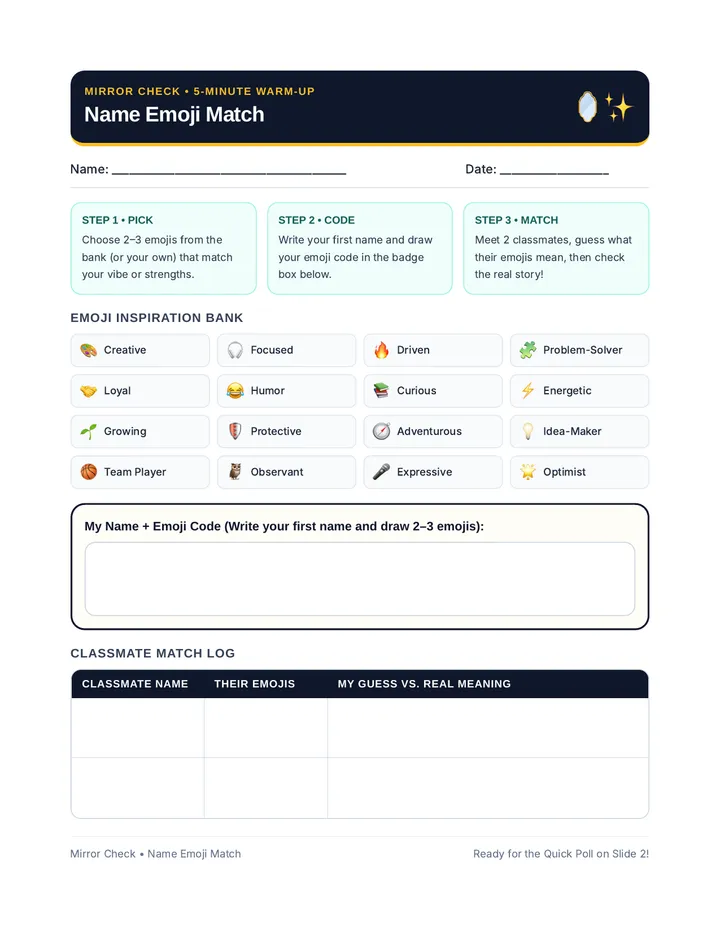
Name Emoji Match Activity Mirror Check • 5-Minute Warm-Up
Name Emoji Match
🪞✨
Name: _________________________________________
Date: ___________________
Step 1 • Pick
Choose 2–3 emojis from the bank (or your own) that match your vibe or strengths.
Step 2 • Code
Write your first name and draw your emoji code in the badge box below.
Step 3 • Match
Meet 2 classmates, guess what their emojis mean, then check the real story!
Emoji Inspiration Bank
🎨Creative
🎧Focused
🔥Driven
🧩Problem-Solver
🤝Loyal
😂Humor
📚Curious
⚡Energetic
🌱Growing
🛡️Protective
🧭Adventurous
💡Idea-Maker
🏀Team Player
🦉Observant
🎤Expressive
🌟Optimist
My Name + Emoji Code (Write your first name and draw 2–3 emojis):
Classmate Match Log
Classmate Name
Their Emojis
My Guess vs. Real Meaning
Mirror Check • Name Emoji Match Ready for the Quick Poll on Slide 2!