Power of No Lesson Plan THE POWER OF NO
Mastering Peer Pressure Lesson Plan
30 MIN SESSION
Objective
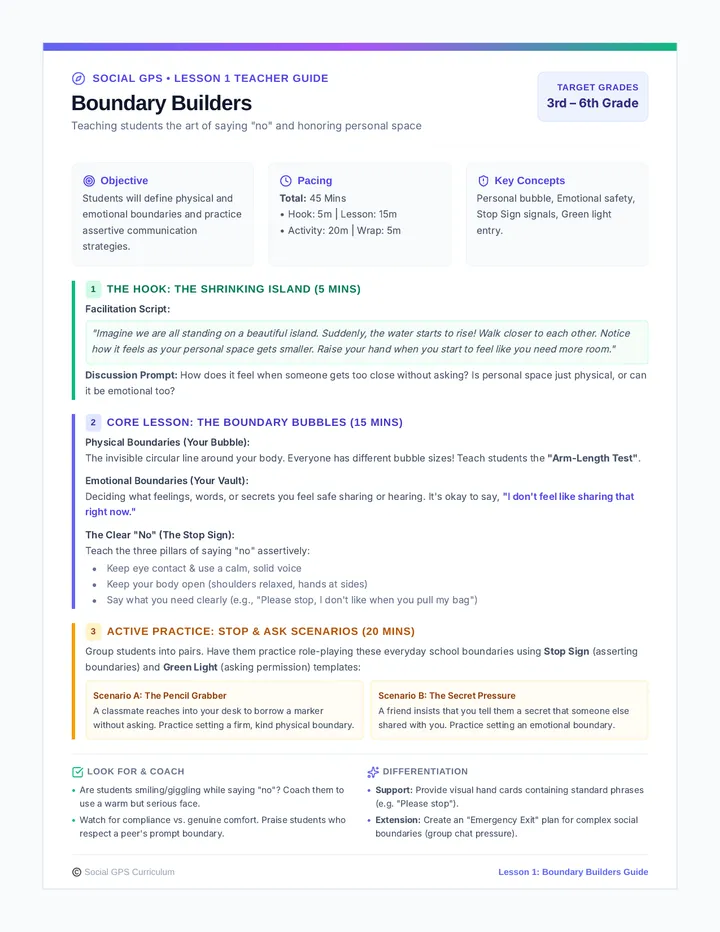
Empower 6th-8th grade students to confidently say 'no' to peer pressure and set healthy boundaries during social interactions.
Audience
Middle School Students (6th-8th Grade)
Preparation
• Review lesson plan and materials in advance.
• Print copies of the Peer Pressure Worksheet and Reading.
• Set up the video: Managing Peer Pressure.
• Arrange the room for small group role-play activities.
• Prep quiz and test copies for final assessment.
Pacing Guide
5 MIN
Warm-Up & Introduction
Define "peer pressure" and ask for voluntary experiences. Introduce the session goals and the "Power of No."
10 MIN
Main Activity: Role Play
Students divide into small groups to practice assertive refusal strategies using the Role Play Scenarios and Peer Pressure Worksheet.
8 MIN
Video & Guided Discussion
View the video on managing pressure. Facilitate a discussion relating video strategies to the role plays just performed.
7 MIN
Wrap-Up & Assessment
Complete the Reinforcement Quiz. Review answers interactively to solidify learning and reaffirm boundaries.
Lesson Materials
• Peer Pressure Presentation Slides
• Reinforcement Quiz
• Peer Pressure Worksheet
• Mock Test on Assertiveness
• Informative Reading Guide
• Teacher Answer Key
• Guided Discussion Outline
• Video: Managing Peer Pressure
Peer Pressure Worksheet Peer Pressure Worksheet
Practicing Assertiveness & Boundary Setting
Name:
Date:
This worksheet is designed to help you practice saying 'no' and reflect on your experiences with peer pressure. Work with your group to role-play the scenarios and answer the questions that follow. Write your responses in the spaces provided.
Part 1: Role-Play Scenarios
1
Scenario: Group Invitation
Imagine you are at school and a group of peers invite you to join in an activity that you know is against your values (for example, skipping homework to hang out). Role-play how you would say 'no' assertively.
What did you say to the group?
Why did you choose those specific words?
2
Scenario: Unwanted Challenge
A friend challenges you to do something you're not comfortable with, like trying a risky game or dare. Practice saying 'no' clearly and respectfully in your group.
What strategy did you use to refuse?
What was your body language like (eye contact, posture)?
Part 2: Reflection Questions
1. What feelings did you experience when saying 'no' during the role-play?
2. Looking back, what did you learn about standing up for yourself in these scenarios?
3. How can the strategies practiced today help you in real-life situations involving peer pressure?
Take your time to reflect and discuss your answers with your group before sharing them with the class if comfortable.
Peer Pressure Basics Reading Student Reading Guide
Understanding Peer Pressure
Peer pressure is when others try to influence your decisions or actions. It can come in many forms, like suggesting activities, opinions, or behaviors that might not match your own values. Sometimes, the pressure comes from friends or classmates, and it may seem like you have to agree with them even if you feel uncomfortable.
Positive Pressure
Happens when friends encourage each other to do things that help them, such as studying for a test, trying out for a team, or practicing a new skill.
Negative Pressure
May lead you to take risks or do things that go against your belief system. It's important to recognize this difference to make the best choice.
Effects of Peer Pressure
Stress & Anxiety
You might worry about fitting in or being accepted by others if you don't conform.
Losing Confidence
Constant pressure may cause you to doubt your own abilities, values, or ideas.
Regrettable Choices
Acting under pressure can lead to decisions that don't reflect who you truly are.
Strategies for Handling Pressure
1
Be Assertive
Practice saying "no" clearly and confidently. It's okay to explain your reasons without feeling guilty or making excuses.
2
Build Self-Confidence
Know your strengths and what you stand for. The more confident you are, the easier it is to resist unwanted pressure.
3
Choose Your Friends Wisely
Surround yourself with people who support your decisions and respect your boundaries.
4
Think Before You Act
Take a moment to consider the consequences. This pause gives you the clarity needed to make the right choice.
"Being true to yourself and your values is one of the most important decisions you can make. It's completely okay to say 'no' when something doesn't feel right."
Guided Discussion Outline Guided Discussion Guide
Navigating Choices & Peer Influence
Name: __________________________
Date: ___________________________
This discussion is an opportunity to share your thoughts after the role-play and video. Use the spaces below to jot down your ideas or notes from the class conversation.
1. Reflect on Your Role-Play
What was one effective strategy you or your group used to say 'no'?
How did you feel during and after the role-play?
2. Video Reflections
What key strategies from the video stood out to you? (Ref: Managing Peer Pressure Video)
In what ways can these strategies help you in real-life situations?
3. Decision Making & Confidence
How can practicing saying 'no' strengthen your self-confidence over time?
What advice would you give to someone who struggles with saying 'no'?
Key Class Takeaways:
"The goal is to learn from each other's experiences and build confidence in our ability to make choices that reflect our true selves."
Role Play Scenarios Activity Practicing Assertiveness
Role Play Scenarios Activity
Activity Guidelines
Form Groups: Divide into 3-4 people.
Read Scenario: Carefully review your prompt.
Plan: Decide on words and body language.
Role Play: Act out the refusal. Switch roles.
Reflect: Discuss what worked well.
Share: Briefly summarize for the class.
Plan Your Approach
Verbal Strategy (Your Words)
Example: "No thanks, I'm heading home to finish my project."
Non-Verbal Strategy (Body Language)
Think about: Eye contact, standing tall, calm tone.
Group Reflection
What strategy was most effective in saying 'no'? Why?
How did body language help?
What would you change next time?
Remember: Respectful but firm. You have the right to choose your actions.
Reinforcement Quiz on Peer Pressure Reinforcement Quiz
Mastering Peer Pressure
Name:
Date:
Complete the questions below to review what you've learned about handling peer pressure and being assertive.
1
Which of the following best describes a key strategy for handling negative peer pressure?
Avoiding the situation and ignoring your feelings
Saying 'yes' to all requests to fit in
Saying 'no' assertively while explaining your reasons
Aggressively confronting the peer without listening
2
Reflect on a time when you felt pressured by peers. What strategy did you use or could you have used to handle the situation? Explain your reasoning in a few sentences.
3
On a scale from 1 to 5, rate the following statement:
1 Strongly
2 Disagree
3 Neutral
4 Agree
5 Strongly
4
What is one effect of negative peer pressure mentioned in the lesson?
Increased self-confidence
Enhanced decision-making skills
Feeling stressed or anxious
Improved communication
"Trust yourself and stand your ground."
Mock Test on Assertiveness Mock Test: Assertiveness
Applying Peer Pressure Resistance Skills
Name:
Date:
Instructions: Read each question carefully. For multiple-choice questions, select the best answer. For open-response questions, provide a thoughtful and detailed explanation.
1
Which of the following best defines assertiveness in the context of peer pressure?
Aggressively confronting others to force compliance
Avoiding conflict by giving in to peer demands
Clearly and confidently expressing your own needs while respecting others
Ignoring your feelings to keep the peace
2
When faced with a situation where peers are pressuring you to do something you’re uncomfortable with, which approach is most appropriate?
Saying 'yes' to avoid standing out
Saying 'no' assertively with a clear explanation
Staying silent and letting the situation escalate
Teasing the peer to diffuse the pressure
3
Imagine you are in a situation where your friends are encouraging you to skip an important class activity. Describe how you would respond assertively. Include both your words and non-verbal communication strategies in your answer.
4
Reflect on a past incident (real or hypothetical) where you faced peer pressure. What did you learn about your own ability to use assertiveness effectively? How might you handle a similar situation differently in the future?
End of Mock Test on Assertiveness Skills.
Answer Key for Quiz and Test Teacher Answer Key
The Power of No: Mastering Peer Pressure
Reinforcement Quiz Answers
Question 1 (Multiple Choice)
Prompt: Best strategy for handling negative peer pressure.
Saying 'no' assertively while explaining your reasons.
Explanation: This approach balances personal boundaries with respectful communication, providing a rationale that helps peers understand the decision.
Question 2 (Open Response)
Prompt: Personal experience and strategy used.
Expected Response:
Students should mention using assertive communication, setting boundaries, or calmly explaining why they were uncomfortable. Look for awareness of personal values.
Question 3 (Likert Scale)
Grading Note:
Self-assessment. Use this to gauge students' self-perception regarding assertiveness and to spark reflective discussion.
Question 4 (Multiple Choice)
Prompt: Effect of negative peer pressure mentioned in lesson.
Feeling stressed or anxious.
Explanation: Stress and anxiety are primary emotional responses to negative social pressure, often impacting confidence and decision-making.
Mock Test Answers
Question 1 (Multiple Choice)
Prompt: Definition of assertiveness.
Clearly and confidently expressing your own needs while respecting others.
Question 2 (Multiple Choice)
Prompt: Appropriate approach when pressured.
Saying 'no' assertively with a clear explanation.
Question 3 (Open Response)
Grading Guidance:
Verbal: Clear "No," and an "I" statement (e.g., "I don't want to skip").
Non-Verbal: Eye contact, standing tall, calm and steady voice.
Question 4 (Open Response)
Expected Response:
Reflection on a past incident. Must include: (1) details of the situation, (2) what was learned, and (3) a concrete change for the future (e.g., specific phrase or body language adjustment).
This key supports teachers in evaluating understanding and facilitating class discussions on peer pressure management.