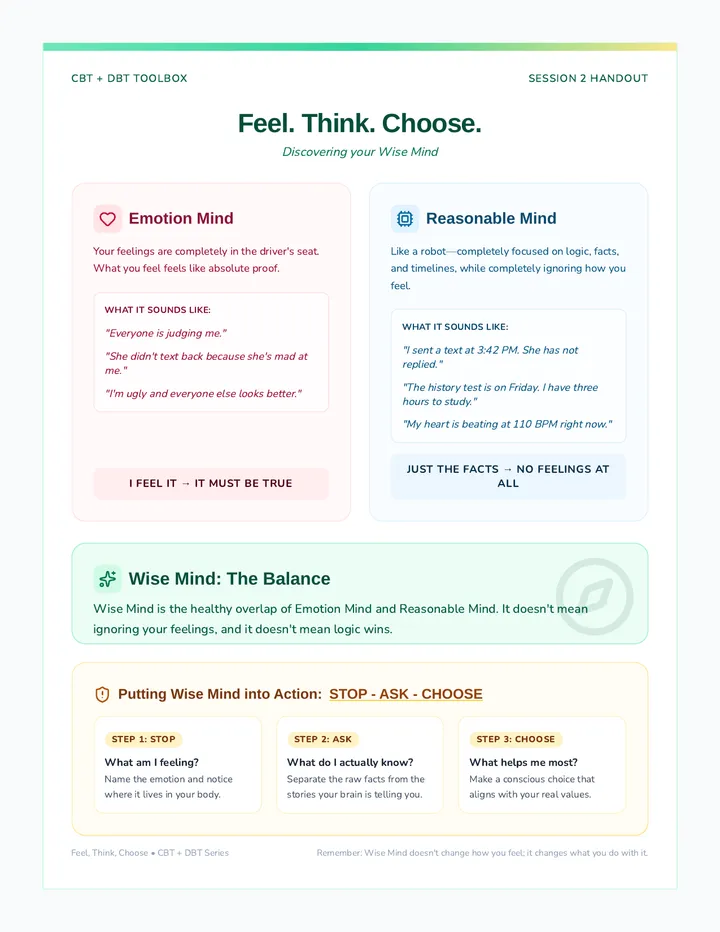
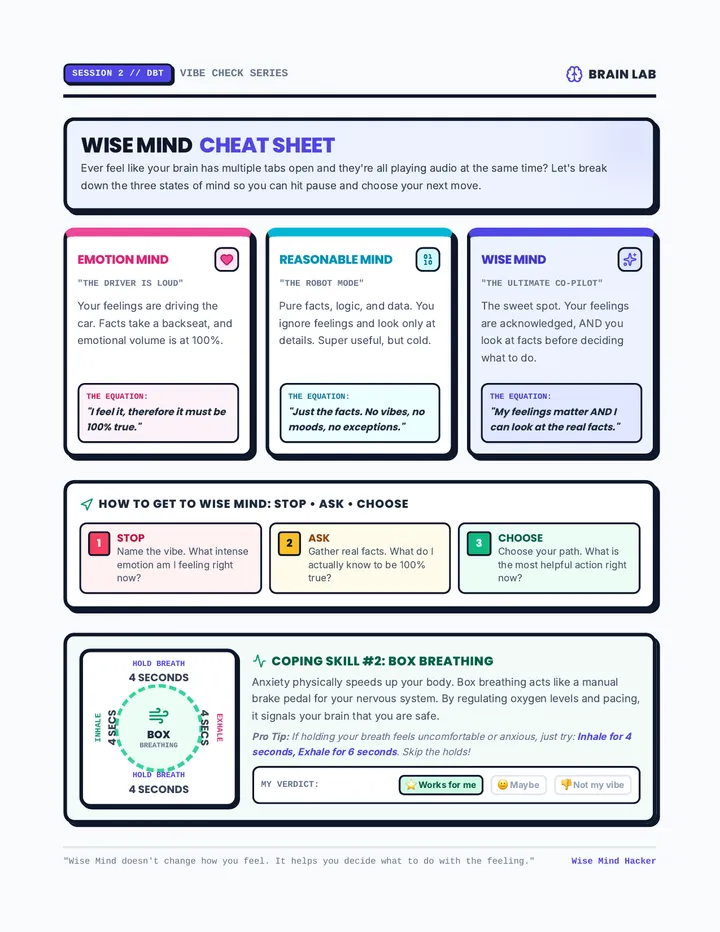
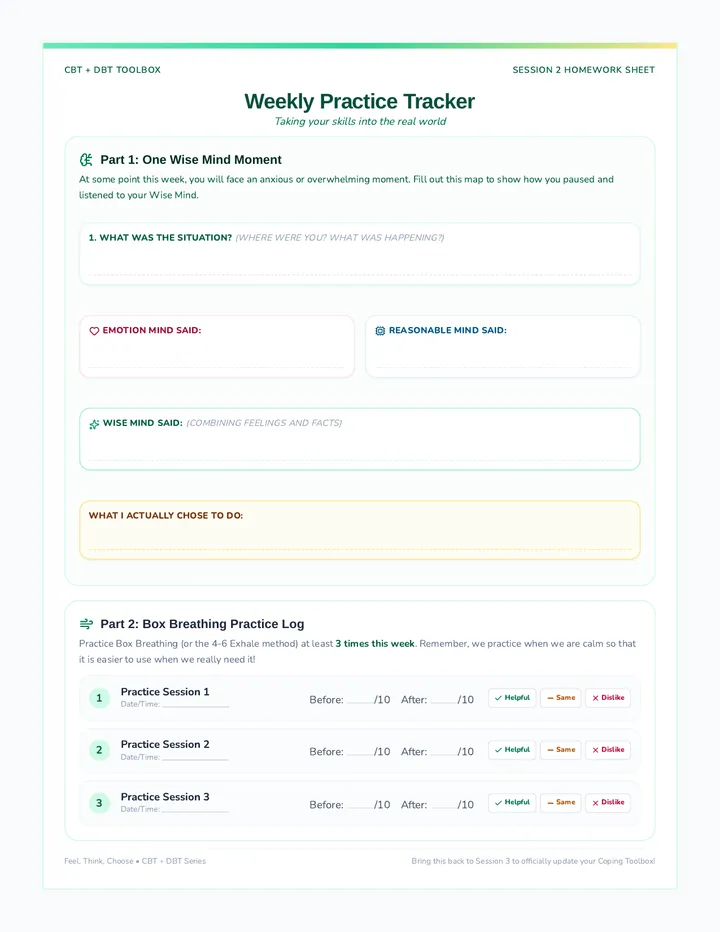
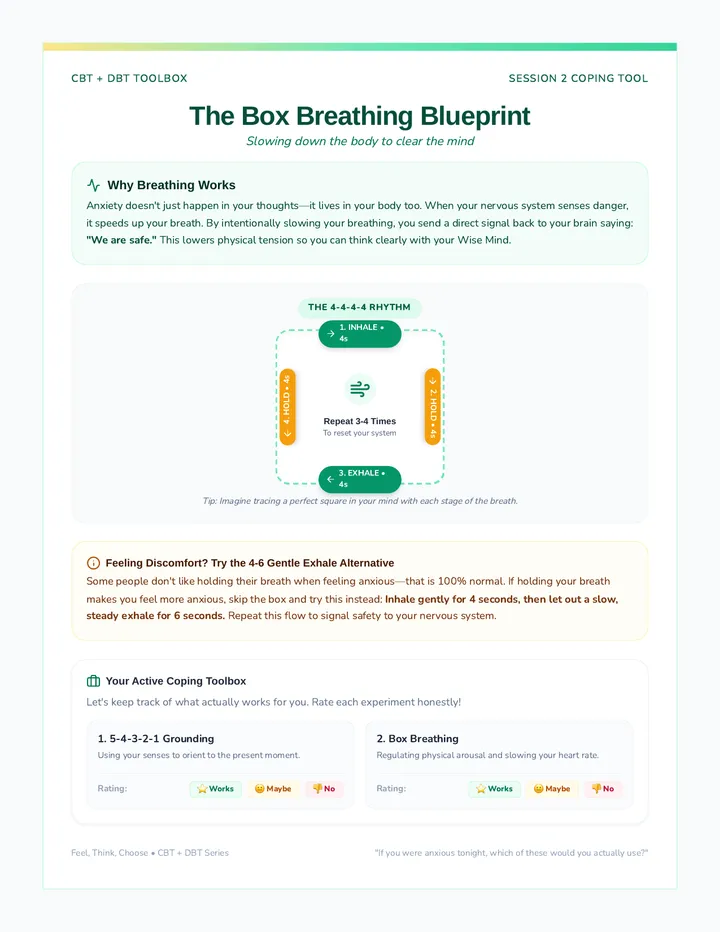
create a homework assignment and coping skill strategy from this session: Absolutely. Session 2 can build directly from Session 1. Since she practiced grounding last week, I’d begin by reviewing whether it actually helped her, then move into **Emotion Mind, Reasonable Mind, and Wise Mind**, with **box breathing** as this week’s coping-skill experiment. # Session 2 — Wise Mind: Feel It, Think It, Choose It **CBT + DBT | Anxiety & Low Self-Esteem | 45–50 minutes** **Primary goals:** Increase awareness of how emotions influence thoughts and behavior, introduce the DBT concept of Wise Mind, practice applying Wise Mind to real-life anxiety/self-esteem situations, and add a second coping strategy to her toolbox. --- ## 1. Check-In — 5 minutes Start conversationally: > “Before we get into anything from last week, how have things been?” Possible prompts: * “What was the best part of your week?” * “What was the hardest part?” * “Where was anxiety this week from 0–10?” * “Any situations where you felt especially nervous or overwhelmed?” * “How was your confidence this week?” * “Was there a time you were particularly hard on yourself?” If something significant happened, use that situation later for the Wise Mind exercise. --- # 2. Review Session 1 & Homework — 5–8 minutes ### Review the CBT monitoring Ask: > “Last week I asked you to notice situations, thoughts, feelings, and what you did afterward. Did you catch any?” If she completed the homework, choose **one example** rather than reviewing every entry. Write: **Situation → Thought → Feeling → Behavior** Then ask: > “Looking back now, do you notice anything you didn't notice when it was actually happening?” If she didn't complete it, avoid making that the focus: > “That's okay. Can we think of one situation from this week and do it together?” ### Review grounding > “We also experimented with 5-4-3-2-1. What was your verdict?” Review any before/after ratings. Ask: > “Did it work differently when you were calm versus actually anxious?” > “What did you like or dislike about it?” Then officially rate it in her **Coping Toolbox**: **5-4-3-2-1 Grounding:** ⭐ Works for me / 😐 Maybe / 👎 Not my thing --- # 3. Bridge From CBT to DBT — 3 minutes Use one of her situations from the week. You might say: > “We've talked about how thoughts, feelings, and behaviors influence each other. Today I want to look more closely at what happens when the **feeling gets really strong**.” Ask: > “Have you ever done or said something when you were really upset and later thought, ‘Why did I do that?’” Or: > “Have you ever been completely convinced something terrible was going to happen when you were anxious, but later—when you weren't as anxious—it didn't seem nearly as certain?” Then: > “That's what we're talking about today—how our brain makes decisions when emotions are really loud.” --- # 4. Introduce the Three States of Mind — 8–10 minutes Draw three overlapping circles if you'd like. ## Emotion Mind > “Emotion Mind is when our feelings are basically driving the car.” Examples: **Anxiety:** > “Everyone is judging me.” **Low self-esteem:** > “I'm ugly. Everyone else looks better than me.” **Social situation:** > “She didn't answer my text. She's mad at me.” Explain: > “The feeling is real. But when we're in Emotion Mind, the feeling can start to feel like proof.” Write: **I FEEL it → therefore it must be TRUE.** Ask: > “What does your Emotion Mind usually tell you?” Let her generate examples. --- ## Reasonable Mind > “Reasonable Mind is almost the opposite. It's facts, logic and information without paying much attention to feelings.” Example: Friend doesn't answer: > “Fact: I sent a text at 3:42. She hasn't responded.” School: > “Fact: The test is Friday. I have three nights to study.” You can make it slightly playful: > “Reasonable Mind is basically a robot.” Ask: > “Would you want to live completely in Reasonable Mind?” Discuss how emotions provide important information too. --- # 5. Wise Mind — 5 minutes Draw the overlap: **EMOTION MIND + REASONABLE MIND = WISE MIND** Explain: > “Wise Mind doesn't mean ignoring your feelings. And it doesn't mean that Reasonable Mind wins.” > “Wise Mind says: **My feelings matter AND I can look at the facts before I decide what to do.**” ### Example **Situation:** Friend doesn't respond to a text. **Emotion Mind:** > “She's mad at me. I probably did something wrong.” **Reasonable Mind:** > “She hasn't responded. I don't know why.” **Wise Mind:** > “I'm feeling worried that she's upset with me, but I don't actually know why she hasn't answered. I can give her some time instead of sending five more texts.” Emphasize: > **“Wise Mind doesn't necessarily change how you feel. It helps you decide what to do with the feeling.”** That's an important distinction for anxiety. --- # 6. Apply Wise Mind to Her Life — 10 minutes Pick **2–3 situations** that are actually relevant to her. I'd deliberately include one anxiety situation and one self-esteem situation. ### Situation 1 — Anxiety Write: **What happened?** --- **Emotion Mind says:** --- **Reasonable Mind says:** --- **Wise Mind says:** --- Then add: > **“If you listened to Wise Mind, what would you DO?”** This keeps the exercise behavioral. --- ### Situation 2 — Self-Esteem For example: **Situation:** She sees a picture of herself she dislikes. **Emotion Mind:** > “I look terrible. Everyone else looks better than me.” **Reasonable Mind:** > “It's one picture.” **Wise Mind:** > “I don't like this picture and I'm feeling insecure right now. One picture doesn't determine what I actually look like or my value as a person.” Then: > “What would Emotion Mind make you want to do?” Maybe delete pictures, compare herself, seek reassurance, avoid people, etc. Then: > “What would Wise Mind have you do?” --- # 7. Make Wise Mind More Concrete — 3–5 minutes Give her three questions she can remember: ### STOP — ASK — CHOOSE **STOP** > “What am I feeling?” **ASK** > “What do I actually know?” **CHOOSE** > “What would help me most right now?” You can write this on a card or phone note: > **What am I FEELING?** > **What do I KNOW?** > **What will I CHOOSE?** This is essentially Wise Mind translated into something she can use outside therapy. --- # 8. Coping Skill #2 — Box Breathing — 5–7 minutes Connect this back to last week's biology lesson. > “Remember last week we talked about how anxiety isn't just happening in your thoughts? Your body is part of the anxiety response too.” > “Last week we used your senses to redirect your attention. This week we're going to experiment with something that works more directly with breathing and physiological arousal.” Explain that when people become anxious, breathing may become faster or shallower. Deliberately slowing breathing can help reduce physiological arousal and give the nervous system information that immediate action isn't necessary. Then emphasize: > “Again, we're not trying to magically make anxiety disappear. We're trying to turn the volume down enough that you can use Wise Mind.” --- ## Practice First: **Stress/tension before: ____ /10** Then: **Inhale — 4** **Hold — 4** **Exhale — 4** **Hold — 4** Repeat 3–4 times. After: **Stress/tension after: ____ /10** Ask: > “What did you notice?” > “Better, worse, or basically the same?” > “Did you like this better or worse than grounding?” ### Important modification Some anxious clients dislike breath holding. If she reports discomfort, switch to: **Inhale 4 → Exhale 6** and skip the holds. You can tell her: > “That's exactly why we're testing these. We're figuring out what works for you.” --- # 9. Update Her Coping Toolbox — 2 minutes You now have: | Coping strategy | Her rating | | ------------------- | ----------- | | 5-4-3-2-1 Grounding | ⭐ / 😐 / 👎 | | Box Breathing | ⭐ / 😐 / 👎 | Ask: > “If you were anxious tonight, which of these two would you be more likely to actually use?” That distinction—*would you actually use it?*—can be more informative than whether she thinks a skill is theoretically helpful. --- # 10. Homework — 3–5 minutes I'd again keep it very manageable. ### CBT/DBT Homework: One Wise Mind Moment She only needs **one example** this week: **Situation:** __________________ **Emotion Mind said:** __________________ **Reasonable Mind said:** __________________ **Wise Mind said:** __________________ **What I chose to do:** __________________ ### Coping Skill Practice Practice **box breathing at least 3 times**. Record: **Before:** ___/10 **After:** ___/10 **Helpful / Didn't notice much / Didn't like it** Encourage at least one practice when she's **not highly anxious**. Explain: > “We practice coping skills when we don't desperately need them so they're easier to use when we do.” --- # Close — 2 minutes Ask: > “What's one thing from today that you think you might actually use?” Then preview the next session: > “Next time we're going to look more at what happens when anxiety gets really high—when you know what you *should* do or think, but your body isn't cooperating. We'll add another strategy to your toolbox for releasing some of that physical tension.” ### Session 2 goal for documentation **Increase emotional awareness and practice Wise Mind decision-making skills.** ### Next session plan **Develop distress-tolerance skills and practice progressive muscle relaxation.**Beth Casper