Students build a simple 6-month financial projection table. They estimate sales based on their market research and calculate total expected profit, creating the 'Financials' section of their business plan.
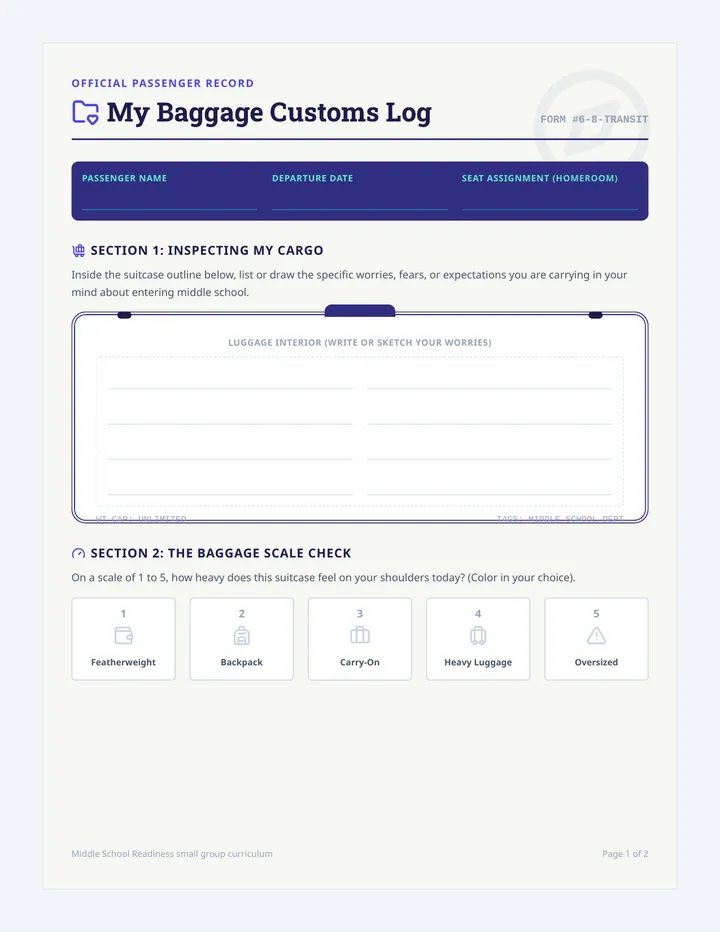
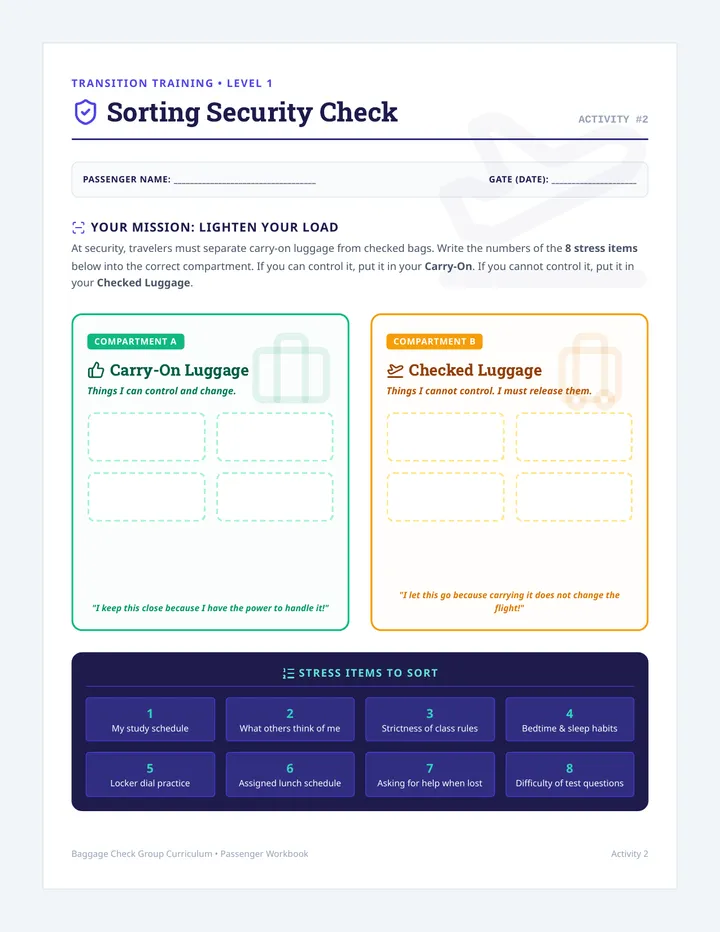
A transition-readiness program for students in grades 4-8. Students navigate the transition to new grades or buildings by identifying changes, interviewing peers, and building a survival guide.
An introductory lesson on the amygdala as the brain's security system, helping students identify their fight/flight/freeze responses and personal triggers using a comic-book aesthetic.
A cognitive flexibility workshop designed to help students 'stretch' their thinking during unexpected changes and setbacks, using a high-energy mental workout theme.
A lesson designed to help middle school students develop executive function skills by breaking down large tasks into manageable steps during study hall sessions.
An activity for Mental Health Awareness Month centered on a fictional candy brand that celebrates neurodiversity and high-energy mind traits.
High school students examine the Acceptable Use Policy as a professional contract, focusing on device ownership, district monitoring, and building digital responsibility for post-secondary success.
2nd and 3rd grade students become 'Kindness Alchemists' to learn how specific, heartfelt compliments can transform their classroom into a magical community of friends.
A hands-on executive functioning simulation where students master the organizational demands of middle school, including locker management and color-coded binder systems.
Focuses on communication, empathy, and advocacy using tag team dynamics from The Rock, Seth Rollins, and The New Day to build a culture of acceptance and 'Championship' level respect.
Focuses on understanding the autism spectrum through the lens of WWE superstars like John Cena and Roman Reigns, reframing neurodiversity as a unique 'superstar' profile rather than a deficit.
An IEP counseling lesson focused on cognitive reframing techniques to help students manage school-based anxiety by transforming unhelpful thoughts into balanced, helpful ones.
A lesson designed to help 6th-grade students manage test anxiety through actionable, science-backed stress relief techniques and strategies.
A middle school intervention lesson that uses the 'ripple' metaphor to illustrate how online conflicts escalate into classroom issues, teaching students to de-escalate digital friction.
Eighth grade students evaluate their digital agency, focusing on self-regulation and building a professional personal brand for high school readiness.
Seventh grade students learn to 'switch gears' between different device modes based on classroom tasks, bridging the gap between rules and agency.
Sixth grade students explore the 'Attention Economy' and learn how their device navigation communicates respect to their learning community.
A group counseling session focused on understanding and setting personal boundaries. Students explore physical, emotional, and digital limits through interactive scenarios and self-reflection.
A social-emotional learning lesson that uses a mechanical engine metaphor to teach students about empathy and perspective-taking. Designed to reduce end-of-year social friction and relational aggression through practical conflict navigation strategies.
A lesson focused on helping students manage anger by identifying physical cues and utilizing parent support through effective communication like 'I-statements'.
A social-behavioral lesson focused on understanding the 'social filter' and choosing appropriate language for different contexts. Students act as 'Lab Technicians' to analyze the impact of their words.
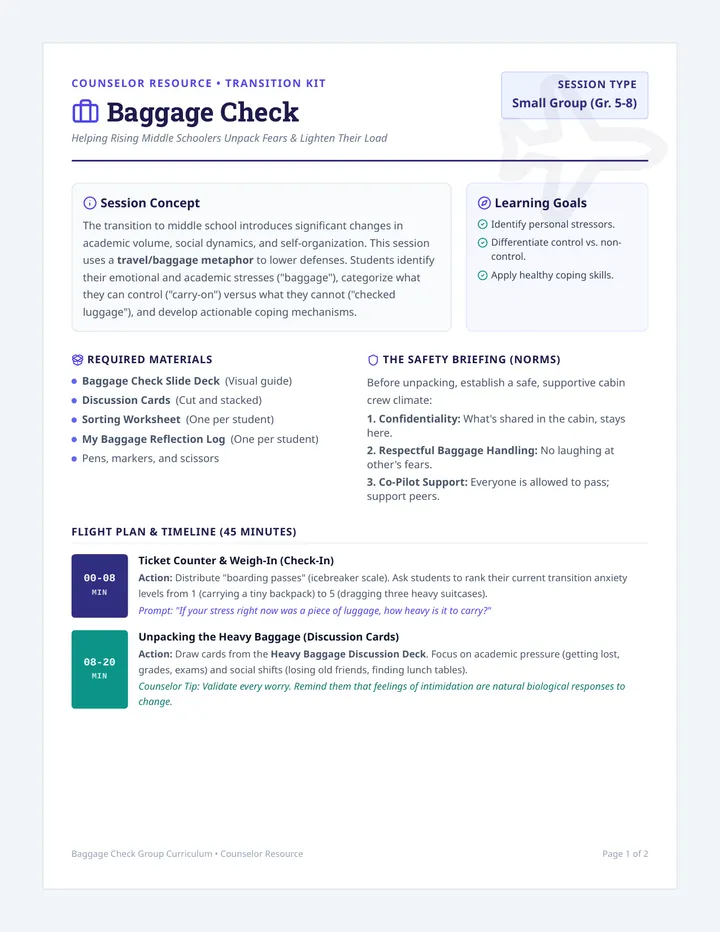
A comprehensive intervention session designed to equip students with emotional and practical tools for navigating school transitions. Students will identify specific anxieties and build a personalized 'toolbox' of coping strategies to manage change.
A cognitive reframing workshop for middle and high school students to identify and transform negative self-talk during testing weeks. Students learn to recognize their 'inner critic' and use a four-point compass tool to navigate toward balanced, compassionate self-statements.
Students document their contributions and service acts to the school, creating a permanent record of their positive 'ledger' of impact.
A 6th-grade individual counseling lesson focused on identifying and challenging common cognitive distortions through a detective-themed investigation. Students learn to spot 'Mind Traps' like all-or-nothing thinking, mind reading, and catastrophizing.
A workshop designed for 6th graders to navigate the natural evolution of middle school friendships. Students will map their social circles, identify healthy traits, and practice kindness through friendship transitions.
A workshop for 6th graders to navigate the evolution of middle school friendships. Students learn to map their social circles, identify healthy friendship traits, and practice 'drifting with dignity' when relationships change.
A workshop designed to help 6th grade students navigate the natural evolution of middle school friendships. Students will learn to map their social circles, identify healthy traits, and practice 'drifting with dignity' when friendships change.
A comprehensive lesson designed to help students build cognitive stamina and prevent burnout during high-stakes testing and project seasons. Students rotate through a 'circuit' of focus, rest, and grounding techniques to create a personalized mental endurance plan.
A lesson using visual metaphors to help students understand multiple perspectives and build empathy through the 'Perspective Lens' framework.
A lesson focused on analyzing the impact of negative peer associations and identifying the underlying social needs for belonging and status that these groups often satisfy.
A comprehensive lesson designed for middle schoolers to audit and optimize their digital and physical organizational systems for the final stretch of the school year. Students will identify workflow bottlenecks and implement immediate organizational 'course corrections'.
A final group session focused on reflecting on personal growth, identifying core strengths, and building the confidence to tackle future challenges. Participants will create a 'Strength Shield' and map out their next 'Hard Thing' using a roadmap approach.
A social skills lesson designed for a 9-year-old student to distinguish between friendly behavior and romantic interest (flirting) in a school setting using a detective-themed investigation approach.
A comprehensive lesson introducing the 5-4-3-2-1 grounding technique through the lens of a 'System Architect' managing their internal activation levels. Includes a presentation with interactive scenarios and a practice worksheet.
A comprehensive SEL lesson on goal setting and self-management, using a mountain climbing metaphor to help students plan, execute, and reflect on their personal goals.
A mental health and emotional regulation lesson for 6th graders using a 'System Architect' metaphor to identify anxiety triggers and apply the 5-4-3-2-1 Grounding technique. Updated for Session 06 with a new 'System Builder' progression theme.
A 60-minute lesson designed to help students manage test anxiety and improve focus through daily meditation practices. This lesson combines psychological insights with practical mindfulness techniques for academic success.
A final review and certification ceremony where students reflect on their growth and receive their 'Master Mechanic' status.
Integrating all 'Mind Mechanic' skills into a final creative project, demonstrating mastery of self-awareness and social reasoning.
Evaluating options and consequences using 'The Choice Circuit,' focusing on making deliberate decisions while reading and writing.
Introducing decision thinking through 'The Logic Loom,' helping students weave together 'how' and 'why' clues in complex texts.
Advanced social reasoning using 'Point of View Goggles' to interpret different perspectives and motivations in stories and real-life situations.
Developing social understanding by using 'Signal Scanners' to detect character emotions and perspectives within texts.
Focuses on using feedback as a 'Toolbox Upgrade,' helping students see mistakes and suggestions as ways to improve their work rather than as failures.
Introduction to growth mindset through 'The Blueprint,' teaching students that skills are built over time with practice and planning.
Building self-esteem by identifying 'Safety Gear'—the positive inner talk and strengths that protect us from fear and frustration.
Focuses on stress handling by introducing 'Coolant Systems'—calming strategies to use when facing difficult tasks or making mistakes.
Exploring the 'Reaction Engine' to understand how the brain responds to stressors during reading and writing, helping students identify their personal triggers.
An introduction to the concept of the mind as a 'workshop' where thoughts and feelings are built, introducing students to their role as Mind Mechanics and establishing basic self-awareness.
A lesson focused on responsible decision-making using the SODAS method. Students navigate a metaphorical jungle of choices to reach the Crystal of Clarity.