Community Builder Lesson Plan Building Our Classroom Community
Lesson Plan • Grades 6-8
25 Minutes
Objective
Students will understand and establish classroom expectations by applying principles of Emotional Intelligence (EI) to real-world classroom scenarios, fostering a respectful and productive learning environment.
Why This Matters
"This lesson ensures students are engaged and have a clear understanding of what is expected of them, setting the tone for a respectful learning environment through collaborative and inquiry-based learning."
Materials Needed
Video: Emotional Intelligence (Slide Deck)
Scenario Cards (1 set per group)
Discussion Guide / Slides
Approaches
Game-Based Collaborative Inquiry-Based
Instructional Steps
2
Mins
Introduction
Welcome students and briefly discuss why clear expectations matter. Introduce **Emotional Intelligence (EI)** and its role in a positive classroom.
4
Mins
Video: Emotional Intelligence
Show the video: Emotional Intelligence Overview
After watching, ask students: "How can EI help us understand and manage our emotions in this room?"
5
Mins
Classroom Discussion
Why is emotional intelligence important in our classroom specifically?
How can we use EI to respect each other's feelings?
How does managing our emotions help our learning focus?
10
Mins
Activity: Expectations Game
1. Divide students into small groups.
2. Give each group a set of **Scenario Cards**.
3. Students discuss how to respond to their assigned scenario using EI principles.
4. Each group presents their scenario and response to the class.
4
Mins
Conclusion & Q&A
Summarize key points. Reinforce that expectations are about mutual respect. Close with a quick Q&A.
Community Connection Slides Middle School Community
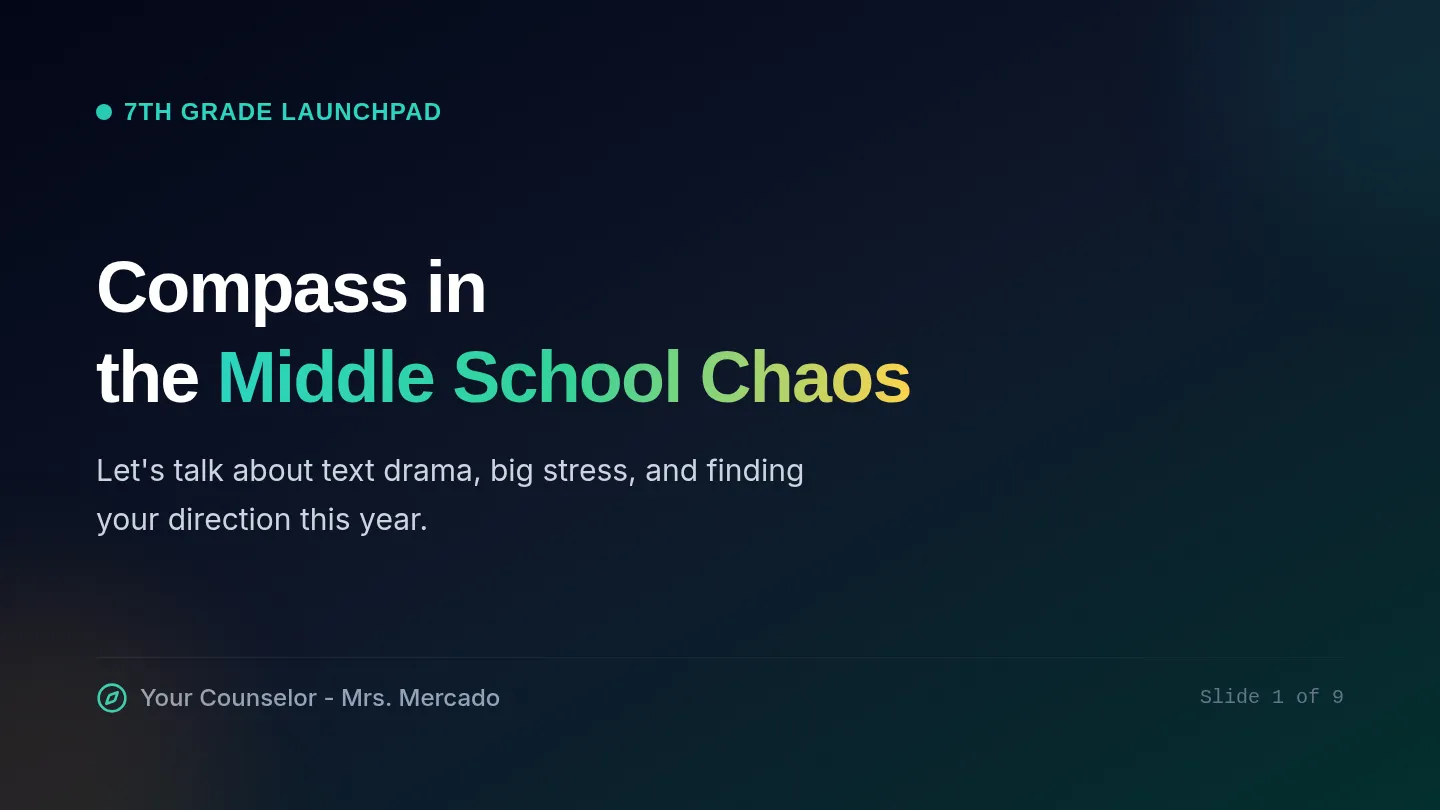
Building Our
Classroom Community
Establishing Expectations through Emotional Intelligence
Connect
Respect
Grow
What is Emotional Intelligence?
Watch & Learn
Embedded media
Pay attention to how EI affects our interactions with others.
Why is Emotional Intelligence important in our classroom?
1
Recognizing how others feel helps us avoid conflict.
2
Managing our own reactions creates a calm space for everyone.
3
EI builds TRUST between students and teachers.
Perspective-Taking
"How would I feel if I were in their shoes?"
Active Listening
"I'm listening not just to hear words, but to understand your feelings."
How can we use EI to respect each other's feelings?
Learning & Regulation
How does managing our emotions help in creating a better learning environment?
Focus
When we aren't stressed or angry, our brains are ready to process new info.
Cooperation
Group work is smoother when we can handle disagreements calmly.
Safety
Everyone feels safe to take risks and make mistakes without fear.
Activity Time
The Expectations Game
1
Read your assigned classroom scenario carefully.
2
Discuss: How can Emotional Intelligence guide your response?
3
Plan a short "expectation" or "rule" based on your scenario.
4
Present your scenario and your team's response to the class.
Community Discussion Guide Classroom Expectations Discussion
Teacher Facilitation Guide • Community Building Lesson
Discussion Guide
Use this guide to facilitate a deep-dive discussion following the Emotional Intelligence video. The goal is to move beyond simple "rules" and help students understand the emotional logic behind a respectful classroom.
1
Why do you think emotional intelligence is important in our classroom?
Teacher Goal
Guide students to understand that recognizing and managing emotions can help create a respectful and supportive environment.
Key Talking Points
Safety: Feeling emotionally safe to share ideas.
Atmosphere: Mood is "contagious"—one positive person can help the whole class.
Self-Correction: Catching yourself before reacting in anger.
Follow-up Question
"Can you think of a time when someone's calm response helped a situation from getting worse?"
2
How can we use emotional intelligence to respect each other's feelings?
Teacher Goal
Encourage students to think about empathy and perspective-taking.
Key Talking Points
Body Language: Reading cues before we speak.
"Pause and Reflect": Taking 2 seconds before responding to a peer.
Active Listening: Showing someone they are heard.
Follow-up Question
"How can you tell if someone is feeling overwhelmed without them saying it?"
3
How can managing our emotions help in creating a better learning environment?
Teacher Goal
Help students link emotional regulation with better focus, cooperation, and conflict resolution.
Key Talking Points
Focus: Stress blocks the brain from learning.
Cooperation: Conflict resolution allows group projects to actually move forward.
Resilience: Handling mistakes without getting frustrated.
Follow-up Question
"What's one thing we can all do when the class gets too 'loud' or energetic?"
Community Scenario Cards Classroom Community Scenarios
Instructions: Cut out these cards. In your group, discuss how to use **Emotional Intelligence** to respond to each situation. Write your group's "Action Plan" on the card.
The Quiet Peer
"A classmate is feeling sad and not participating in class today."
Our Group's EI Response Plan:
The Outsider
"You notice someone being left out of a group activity in the hallway."
Our Group's EI Response Plan:
Team Tension
"During a group project, a disagreement arises about who does what task."
Our Group's EI Response Plan:
The Accident
"Someone accidentally spills their drink on your brand new notebook."
Our Group's EI Response Plan:
Test Anxiety
"A friend seems extremely stressed and panicky right before a big test."
Our Group's EI Response Plan: