Behavior Bridge Accommodations Guide
Behavior Bridge
Actionable 504 Accommodations & Rationales
Teacher Resource
Grade 4 Behavioral Support
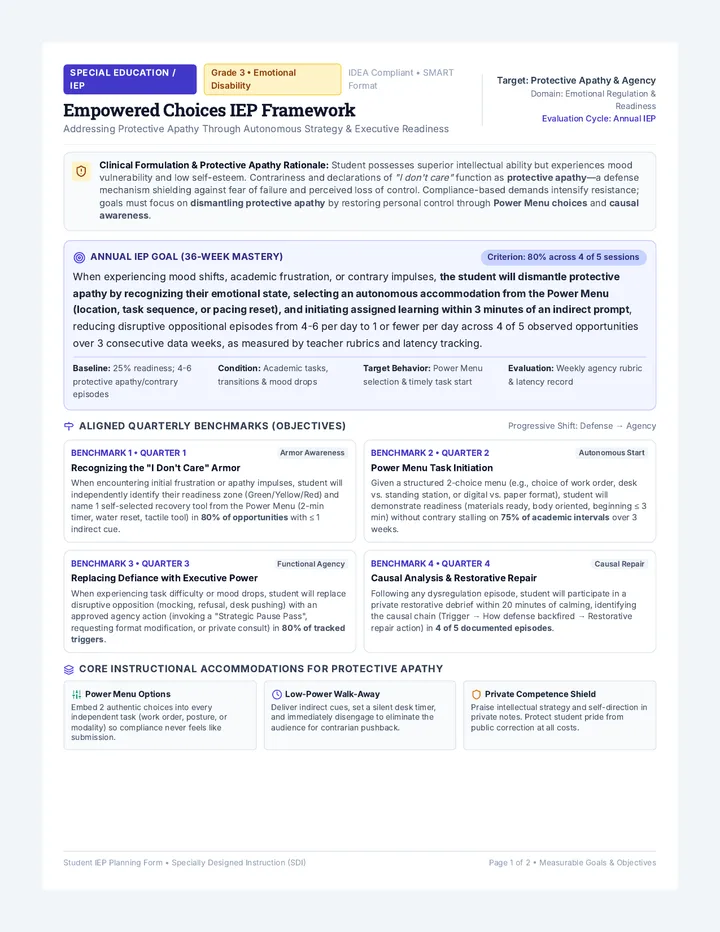
This guide provides specific 504 accommodations designed to address disruptive behaviors, verbal aggression, and defiance. These strategies focus on de-escalation, building autonomy through controlled choices, and fostering accountability in a non-confrontational manner.
Target: Rude Comments & Verbal Defiance
Actionable Accommodation
Rationale & Intent
Implement a "Wait Time" protocol for verbal responses. Teacher will ignore the initial rude tone but acknowledge the student's need for a moment to rephrase (e.g., "I'll come back to you in 2 minutes so you can share that in a classroom-ready way").
Interrupts the "power struggle" cycle. It provides the student with an "exit ramp" to change their behavior without losing face in front of peers.
Provide a "Verbal Reset" card. The student can place this on their desk to signal they are feeling frustrated and need to be bypassed for verbal participation for a set period.
Empowers the student with a non-verbal way to signal distress, preventing the impulsive rude comments that often occur when they feel "on the spot" or overwhelmed.
Target: Social Tone & Non-Verbal Communication ("Attitude")
Actionable Accommodation
Rationale & Intent
Planned Ignoring of Non-Verbal Disrespect. Ignore eye-rolls, sighs, or slumping if the student is still ultimately complying with the instruction.
Avoids escalation over "micro-defiance." Focusing only on the high-priority behavior (task completion) prevents unnecessary power struggles.
Utilization of a "Private Signal" (e.g., a specific tap on the desk) to prompt the student to check their tone or volume before a verbal correction is needed.
Provides a non-embarrassing cue for self-regulation. This allows the student to "fix" their attitude without feeling targeted in front of the class.
Incorporate "Positive Narration." Narrate the student's neutral or positive interactions (e.g., "[Student] just shared his eraser with his neighbor calmly").
Builds a "positive bank account" with the student. Students often use a negative attitude when they feel they only receive attention for negative behaviors.
Target: Refusal to Follow Instructions / Defiance
Actionable Accommodation
Rationale & Intent
Utilize "Choice-Based Delivery." Offer two acceptable ways to complete a task (e.g., "You can write your response or type it").
Specifically addresses the student's need for autonomy. Giving a sense of control decreases the perceived need to "fight" for power.
"Chunking" of multi-step assignments. Provide only 1-2 steps at a time on a separate slip of paper or checklist.
Reduces task-avoidance driven by overwhelm. A perceived "impossible" task often triggers defiance as a defense mechanism.
Target: Fighting / Arguing with Peers
Actionable Accommodation
Rationale & Intent
Preferred Seating and Grouping. Place the student near positive peer models and away from students who tend to engage in conflict.
Minimizes opportunity for friction. Proximity to calm role models can provide "co-regulation" and reduce the frequency of arguments.
Structured "Social Script" or "Role Assigned" group work. Assign the student a specific, high-status role (e.g., Timekeeper, Lead Scribe).
Provides clear boundaries for interaction. Giving a specific role focuses the student's energy and reduces the ambiguity that leads to arguing.
Target: Refusal to Take Responsibility
Actionable Accommodation
Rationale & Intent
Post-incident "Cool-Down and Log." After a conflict, allow 10 minutes of regulated time before the student completes a "Choice Journal."
A brain in "fight or flight" mode cannot take responsibility. De-escalation must come first, followed by written reflection.
Implementation of "Restorative Conversations" rather than traditional discipline. Focus on "Who was harmed?" and "How can we fix it?"
Shifts focus from blame to community repair. Reframes the situation as a problem-solving opportunity rather than a personal failure.
Addressing Parent Defensiveness
Because the parent views behavior as "personal freedom," frame school-based expectations around social navigation skills rather than compliance. Explain that the goal is for the student to "effectively navigate different social settings" (like future jobs or sports) rather than "obeying the teacher." Document behavior using objective, non-judgmental frequency data.
My Choice Journal Reflection Sheet
My Choice
Journal
Name: _______________________
Date: ___________
1
What was happening around me?
(Examples: I was asked to start a task, I was talking with a friend, I felt frustrated with work...)
2
What choice did I make?
(Examples: I used a loud voice, I said "no," I ignored the teacher, I worked on my goal...)
3
How did this choice affect my day and others?
(Examples: My teacher felt disrespected, I lost my recess time, I didn't finish my work...)
4
My "Power Play" for next time:
(What is one thing I could do differently if this happens again?)
This journal is a tool for growing your brain. It is for reflecting, not for blaming.
Positive Partnership Facilitation Guide
Professional Educator Toolkit
Positive Partnership
A Facilitation Guide for Difficult Conversations
The Communication Shift
When a parent believes their child should "act how they want," traditional behavioral language (compliance, rules, defiance) often causes them to retreat or become defensive. To build a bridge, shift the language toward Skill Acquisition and Social Competency.
Avoid
"Your son was rude to me and refused to follow my instructions today."
Try Instead
"Today, [Student] struggled with navigating a group interaction. We are working on 'social agility'—the ability to adjust communication based on the setting—to help him be more successful with peers."
Email/Meeting Script Template
"Dear [Parent Name],
I am writing to share some updates on [Student]’s progress in building his social leadership skills. At school, we treat the classroom like a 'practice field' for the real world, where students learn to navigate different personalities and authority structures.
Today, [Student] encountered a situation where he felt [Frustrated/Challenged]. While his natural reaction was to express himself strongly, we are using his 504 supports to help him learn how to advocate for himself in a way that keeps doors open for him socially and academically.
Our focus isn't on making him change who he is, but on adding 'tools to his belt' so he can choose the best way to handle high-pressure moments. Here is the specific strategy we used today: [Insert Accommodation Used, e.g., The Choice Journal].
I appreciate your support in helping him become a versatile communicator!
Best regards,
[Teacher Name]"
Pro-Tips for 504 Meetings
- Depersonalize the Behavior: Speak about the behavior as a "lagging skill" rather than a character flaw. It's not that he's a "disruptive kid," it's that he has "developing impulse control."
- Use Data, Not Adjectives: Instead of "He was very rude," say "He used a raised volume and three instances of 'no' when asked to open his notebook." This is harder for a parent to argue against.
- Highlight Strengths First: Always begin and end with a genuine strength. If he is a strong arguer, reframe it as "future lawyer potential" or "strong persuasion skills" that just need a bit of "tuning."