Lenny.com
Explore
Create
ActivitiesNewMathEnglish Language ArtsScience & EngineeringSocial StudiesGlobal LanguagesHealth & Physical EducationSpecial EducationCounseling & Life SkillsArts & CreativityESL
Lenny.com
Lenny.com
Explore
Create
ActivitiesNewMathEnglish Language ArtsScience & EngineeringSocial StudiesGlobal LanguagesHealth & Physical EducationSpecial EducationCounseling & Life SkillsArts & CreativityESL
Lenny.com
Lenny.com

Solutions

Lenny for EducatorsLenny for SchoolsLenny for Districts

Product

ExploreSign inCreateSupportAbout

Resources

Getting startedMTSS Acceleration Program

© 2026 Lenny Learning Inc.

TermsPrivacyAccessibility
LinkedInInstagramX
Lenny
Special EducationSensory Processing & RegulationSensory Preferences IdentificationSensory Tool UseCommunicating Sensory NeedsSensory Overload RecognitionDeep Breathing PracticeMovement Break UtilizationIndependent Calming Strategy UsePersonalized Calming RoutinePersonal Sensory Diet CreationProactive Sensory BreaksEmotion Intensity RecognitionDysregulation RecoveryPositive Behavior SupportUnderstanding Social StoriesPersonal Social Story CreationEmotional Regulation FrameworksPersonal Trigger IdentificationSelecting Regulation StrategiesReinforcement System ResponseSelf-Monitoring & RewardsLearning Positive AlternativesCross-Setting Skill GeneralizationSocial CommunicationEye Contact & Personal SpaceContext-Appropriate GreetingsAppropriate Volume & ToneConversation Turn-TakingTopic Maintenance in DiscussionEffective Help-SeekingBody Language InterpretationFacial Expression RecognitionIdioms & Figurative LanguageSocial Problem IdentificationSocial Solution GenerationSocial Decision EvaluationTask ManagementMinimal Prompting Task StartSelf-Talk for StartingStarter Strategies for Difficult TasksAge-Appropriate Task PersistenceStrategic Break ManagementSmooth Task TransitionsAdapting to Plan ChangesObstacle Problem-SolvingMulti-Day Project CompletionPlanning & OrganizationPhysical Material OrganizationVisual Schedule & Timer UseSequential Task BreakingTime Estimation SkillsTask PrioritizationDigital & Physical Workspace ManagementPersonalized Organization StrategiesDetailed Project PlanningMultiple Commitment BalancingAcademic Support StrategiesMath Manipulative UseVisual Math Problem RepresentationComplex Math Problem BreakdownText Highlighting & AnnotationVisualization While ReadingPredictions & Inferences from TextText Structure Graphic OrganizersWriting Graphic OrganizersSentence Frames & TemplatesStudy Guide CreationSpaced Repetition for MemoryAssistive Writing TechnologyWorking Memory SupportSingle-Step Direction FocusMulti-Step Direction FollowingInformation Chunking PracticeVisual Support Memory AidsMnemonic Device ApplicationEfficient Note-Taking SystemsGraphic Organizer Note-TakingNote Review & OrganizationSustained Complex Task AttentionAssistive TechnologySymbol-Word CommunicationAAC Device NavigationSpeech Recognition DictationDictation Text EditingText-to-Speech for ReadingDigital Calendar UseKeyboard Shortcuts NavigationProductivity App ManagementSelf-Advocacy SkillsCommunicating Learning NeedsRequesting AccommodationsAdvocating for Appropriate SupportsIEP & Student RightsUnderstanding IEP ComponentsMeaningful IEP Meeting ParticipationIDEA & Section 504 RightsProgress MonitoringTracking IEP Goal ProgressReflecting on AchievementData-Informed Instructional AdjustmentTransition PlanningCareer & Vocational Goal SettingExploring Post-Secondary OptionsIndependent Living Skills Planning

Character Clue Detectives

A modified 3rd-grade narrative reading comprehension lesson designed for special education students, focusing on question analysis, character traits, and character motivation. Provides targeted narrative prompting routines, scaffolded student companions for Class Clown questions, and a mirrored practice story with differentiated comprehension tasks.

KRKenzie Ruthven

Facilitation Scripts & Misconception Guide

Verbal prompts for Question 2, Extension Question, and actionable small-group redirects.

Teacher Script • Question 2 ("Turning Over a New Leaf") Character Motivation Focus

Step 1 (The Trigger): “Why did Lucas collect leaves? Did he just love trees? No! What did his mother tell him? She said to turn over a new leaf and be a perfect student.”

Step 2 (The Rivalry): “Now look at page 26. Who is Lucas thinking about? Cricket Kaufman! What does he want to see on Cricket's face? His goal is to outshine her and bring more than anyone else.”

Step 3 (Forming the Answer): “Lucas brought a whole bag because he wanted to impress Mrs. Hockaday and outdo Cricket. Point to Sentence Stem 2 on your guide and read it with your partner.”

Teacher Script • Extension Question (Carol Simmons / Astronaut Quote) Character Pride & Ego

The Conflict: “Lucas pretended he was blind in class, but now in the nurse's office, Carol calls him a 'blind astronaut.' How does Lucas react? He says immediately: 'I can see perfectly!'”

The Why: “Why did Lucas drop the act? Because his dream is to be an astronaut! His pride was hurt. He would rather give up the fake glasses than let Carol believe he can't fly a spaceship!”

SPED Misconception Redirect Protocol

× Misconception: "Lucas is clumsy."

Teacher Redirect: “Did he bump desks by accident? Look at what he said right after: 'I think I need eyeglasses.' He bumped into desks on purpose to convince the teacher! That is acting dramatic, not clumsy.”

× Misconception: "He brought leaves for science."

Teacher Redirect: “Did the teacher ask for a whole garbage bag? No, just a few leaves! He brought an entire bag to show off and beat Cricket. His motivation was to win the competition.”

Recommended IEP Accommodations for This Lesson

Classroom Support

• Color-Coded Quotes Highlight evidence in yellow on student texts so copying onto lines is smooth.

• Speech-to-Text / Scribe For students with fine-motor delays, allow oral sentence generation using the companion card.

• Reduced Output Require 1 rich detail + explanation if writing fatigue prevents writing 2 full details.

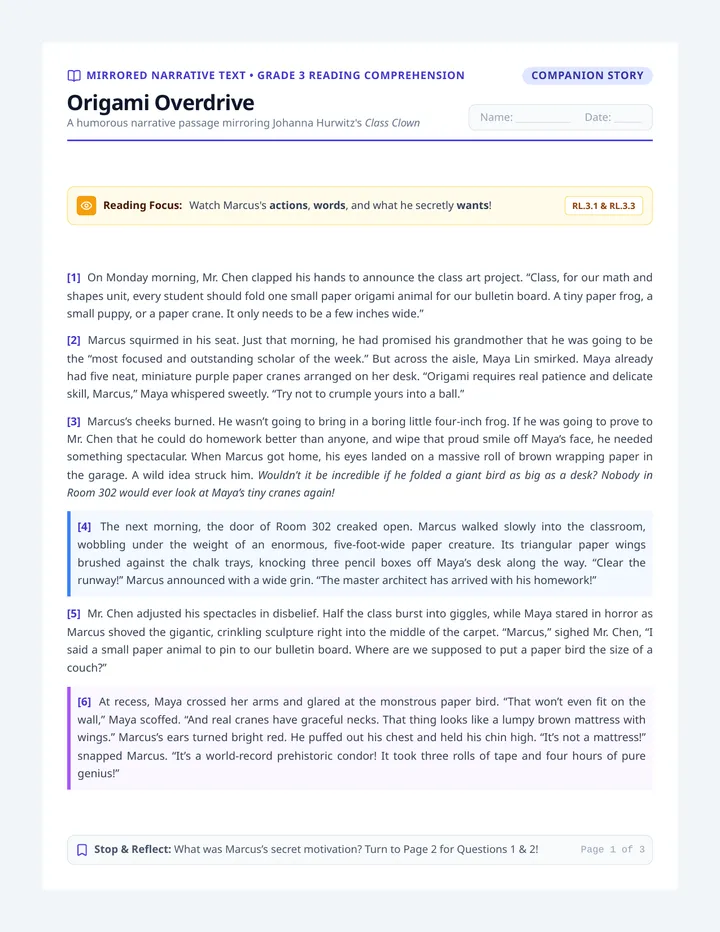
Stop & Reflect: What was Marcus’s secret motivation? Turn to Page 2 for Questions 1 & 2! Page 1 of 3

Question Analysis • Part 1 Page 2 of 3

Origami Overdrive • Character Analysis

Answer each question using two details from the text. Use the lines below to write complete sentences.

1 Character Trait Question (Label: CT — Marcus) Personality

“Marcus walked slowly into the classroom, wobbling under the weight of an enormous, five-foot-wide paper creature... ‘Clear the runway!’ Marcus announced with a wide grin. ‘The master architect has arrived!’”

What does this moment tell you about Marcus’s personality? Use two details from the story to support your thinking.

Sentence Starter: “This moment shows that Marcus is [dramatic / showy / playful] because...”

2 Character Motivation Question (Label: CM — Marcus) Why He Did It

Why does Marcus decide to make a giant five-foot paper bird instead of a small animal? Use two details from the story to support your thinking.

Sentence Starter: “Marcus decides to make a giant bird because he wants to [outshine Maya / keep his promise]...”

Turn to Page 3 for the Extension Question and RACCE Guide →

Question Analysis • Part 2 Page 3 of 3

Extension Task • RACCE Strategy

Analyze peer conflict and prove your thinking using the 5 steps of RACCE.

3 Extension Question • Dialogue & Character Pride Peer Conflict

“That thing looks like a lumpy brown mattress with wings.” Marcus’s ears turned bright red. He puffed out his chest. “It’s not a mattress! It’s a world-record prehistoric condor! It took three rolls of tape and four hours of pure genius!”

Why does Marcus tell Maya that his bird is a world-record prehistoric condor? Use two details from the text to support your thinking.

Sentence Starter: “Marcus tells Maya it is a world-record condor because he is embarrassed and wants to defend his pride...”

R + A

Cite 1

Cite 2

Explain

The 5-Step RACCE Strategy

Master Formula

R

Restate Turn question into sentence start

A

Answer Give your direct trait or reason

C

Cite (1) Copy 1st story detail in “quotes”

C

Cite (2) Copy 2nd story detail in “quotes”

E

Explain Write “This proves that...”

RACCE Self-Check:

R Restated A Answered C Detail 1 C Detail 2 E Explained
You might also like

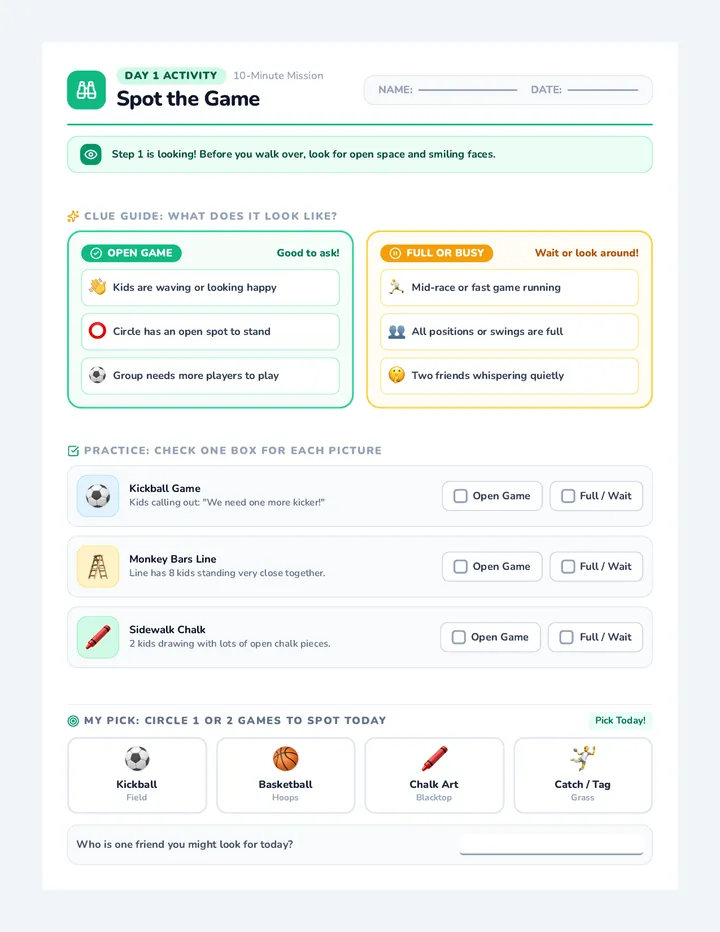
Spot The Game Activity Sheet

Playground Pals

A structured five-day social communication sequence designed for a third grader to learn how to ask peers to play or join in, featuring visual supports, limited language scripts, and portable recess visual cards.

A

acrisafulli

6
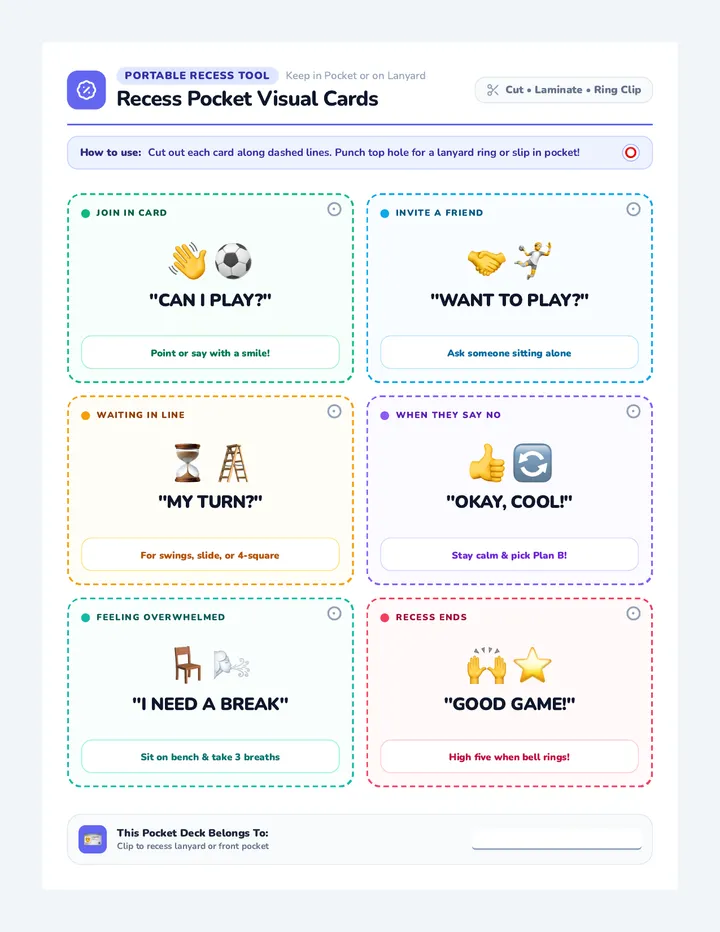
Recess Pocket Visual Cards

Recess Mission

Day 5 equips the student with printable pocket and lanyard visual prompt cards to carry outside and a visual debrief mission checklist to celebrate playground success.

A

acrisafulli

2
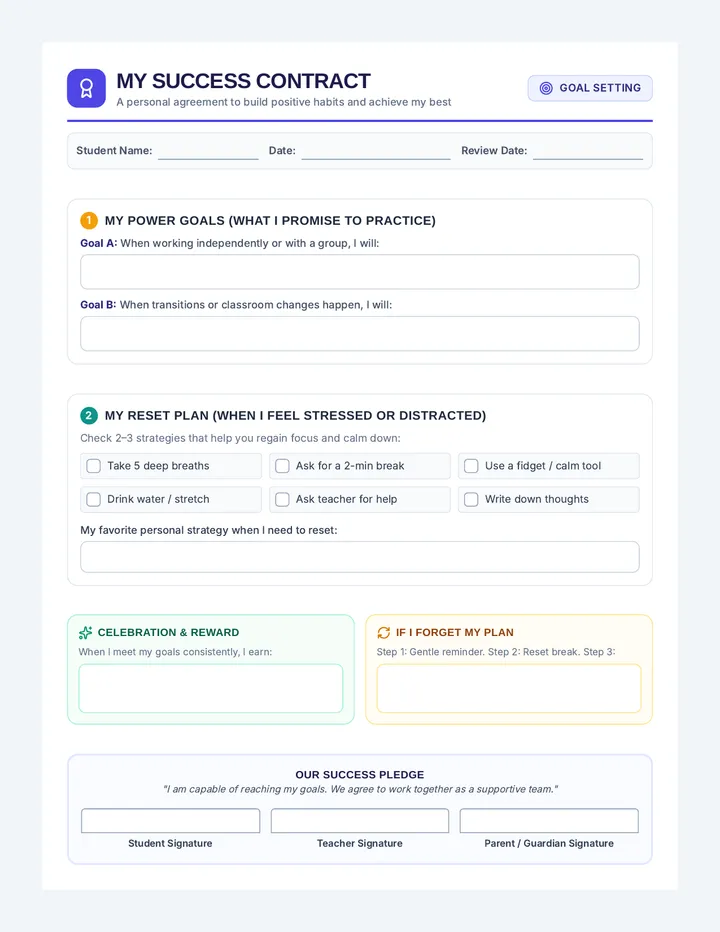
Goal Getter Contract Worksheet

Goal Getter Contract Worksheet

A student-friendly, two-page printable behavior contract and tracking worksheet featuring customizable goal-setting, coping strategies, celebration incentives, official signature pledges, and a five-day progress log.

S

stewart

Sixes Sevens Tiered Worksheet

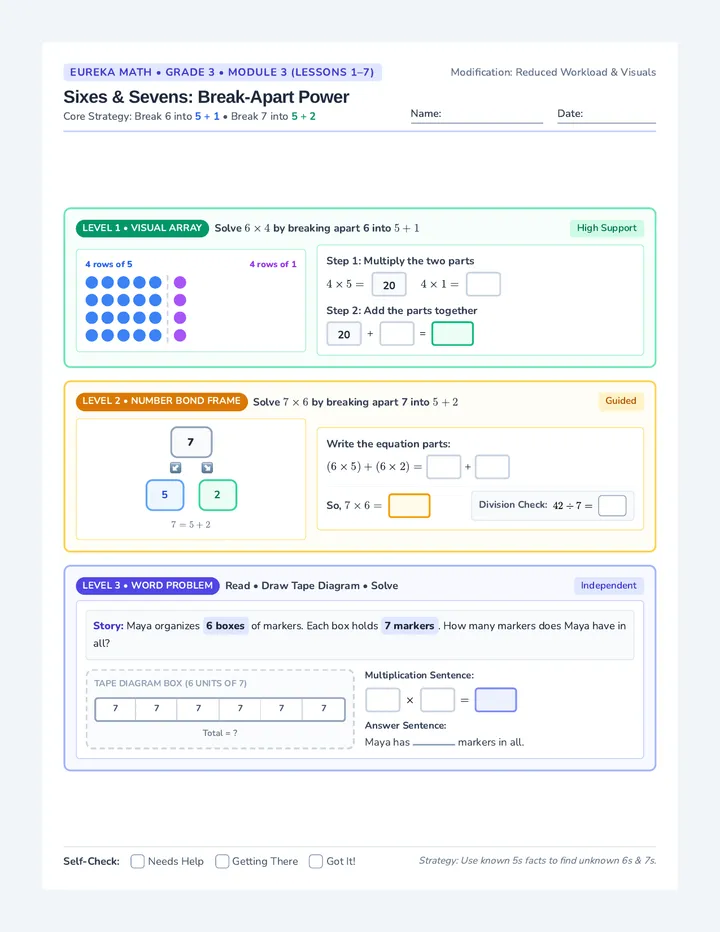
Module Three Math Modifications

A comprehensive instructional sequence providing differentiated, reduced-workload, and visually scaffolded modifications for Eureka Math Grade 3 Module 3. Covers all 21 lessons organized across four focused mastery clusters with multi-tiered student practice and teacher modification guides.

ML

Michelle Low

8
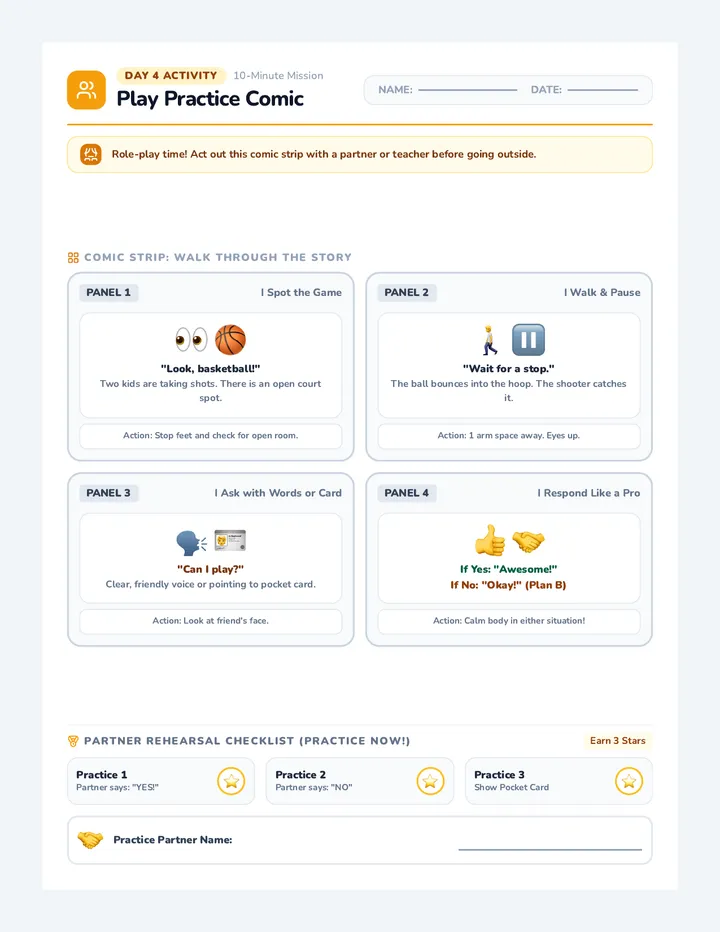
Play Practice Comic Sheet

Practice Crew

Day 4 provides guided role-play scripts, peer pairing routines, and comic strip sequencing to rehearse asking to play before heading outdoors.

A

acrisafulli

1
Origami Overdrive Practice Story

Origami Overdrive Practice Story

A 3-page mirrored narrative reading passage and expanded comprehension workbook. Features 'Origami Overdrive' on page 1, spacious response areas on page 2, and a significantly enlarged 9-line RACCE handwriting area on page 3 with 32px-tall writing lines and 5-step response guidance.

KR

Kenzie Ruthven

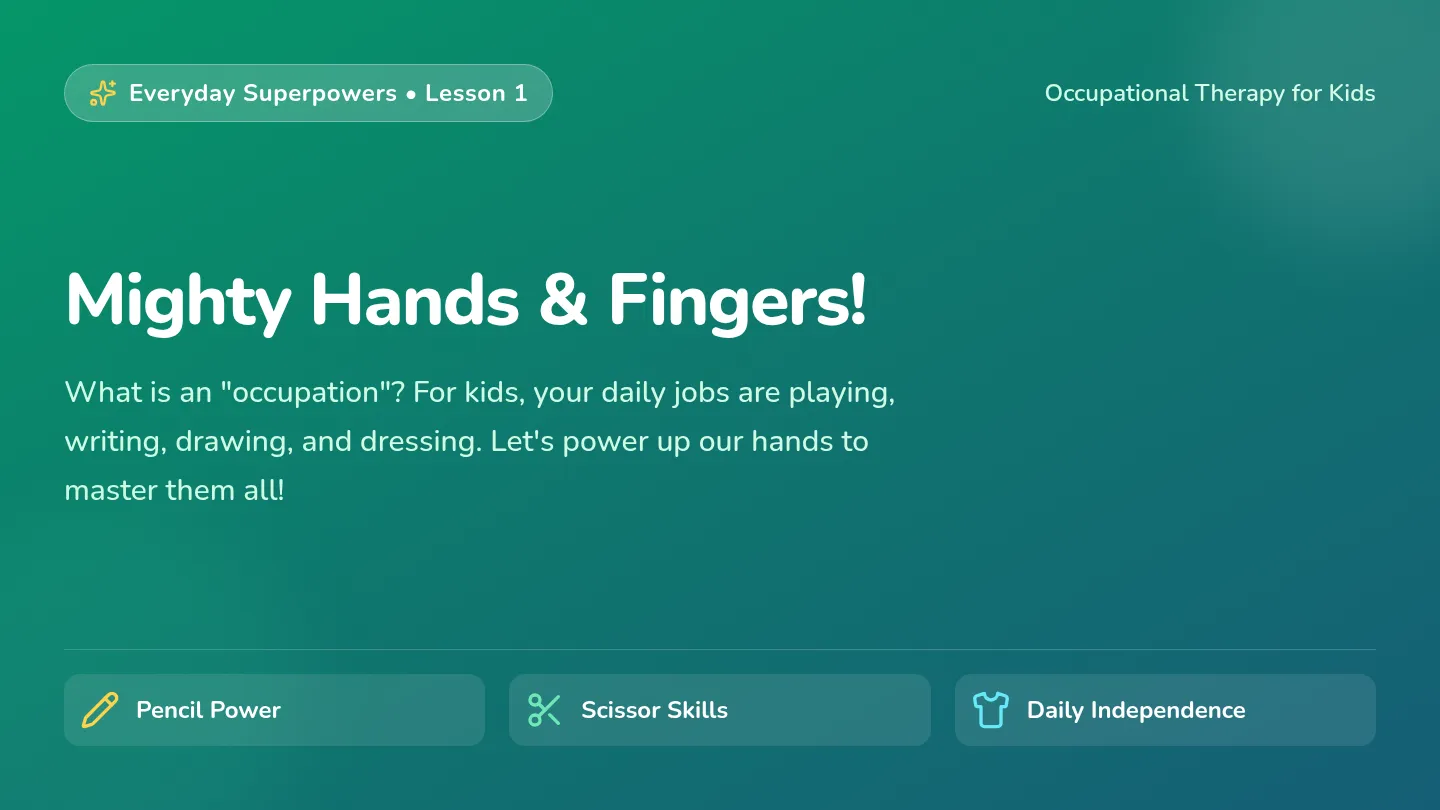
Mighty Hands Slides

Everyday Superpowers

A comprehensive three-lesson elementary sequence introducing occupational therapy through fine motor skills, sensory processing, and daily routines. Students learn how their bodies, brains, and daily habits work together to build independence and classroom success.

Lenny Avatar
Lenny
6
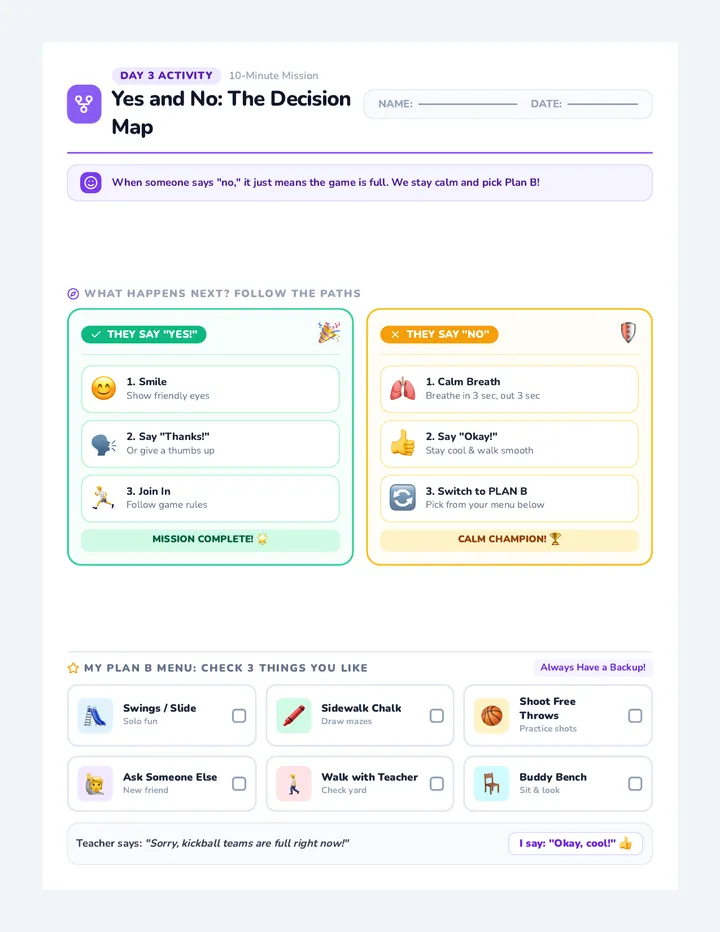
Yes And No Decision Sheet

Yes and No

Day 3 teaches students how to recognize 'yes' and 'no' responses and navigate visual Plan B choices calmly when an activity is full or not available.

A

acrisafulli

1
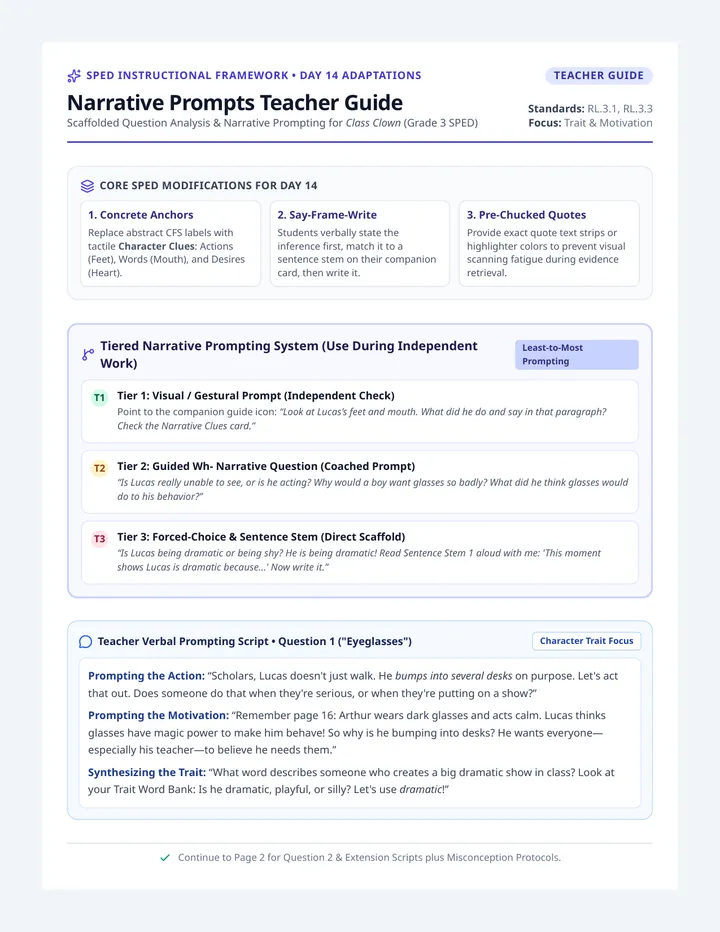
Narrative Prompts Teacher Guide

Narrative Prompts Teacher Guide

A 2-page SPED modification and teacher prompting guide for Day 14 narrative comprehension. Includes tiered prompting hierarchies, verbal scripts for Class Clown questions, misconception redirects, and small-group accommodation strategies.

KR

Kenzie Ruthven

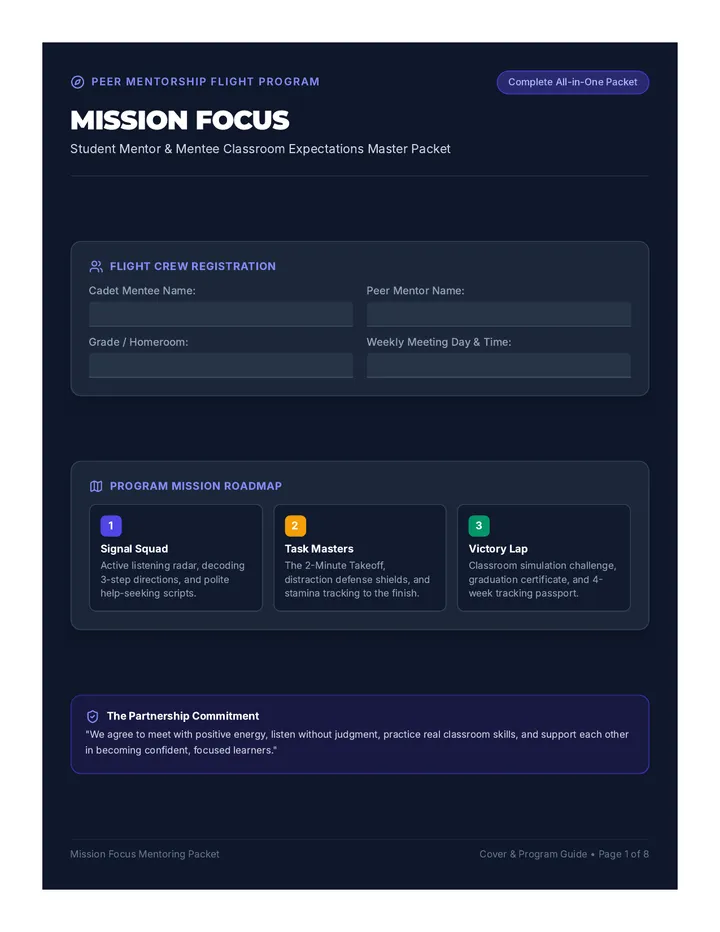
Mission Focus Printable Packet

Mission Focus Mentoring

A three-stage peer-mentoring sequence that equips student mentees with active listening, instruction-following, task initiation, and distraction-management routines through structured mentor coaching.

MP

Melissa Premo

1
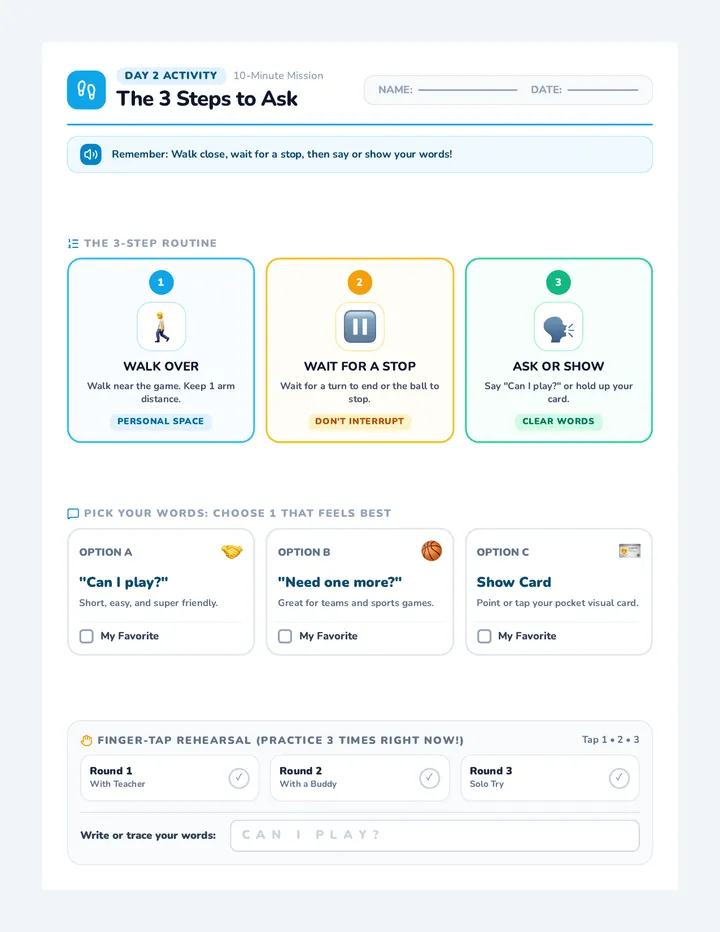
Three Steps Join Action Sheet

Ask to Join

Day 2 introduces the concrete three-step join routine of walking close, pausing for a break in action, and asking to play using limited words or a visual cue.

A

acrisafulli

1
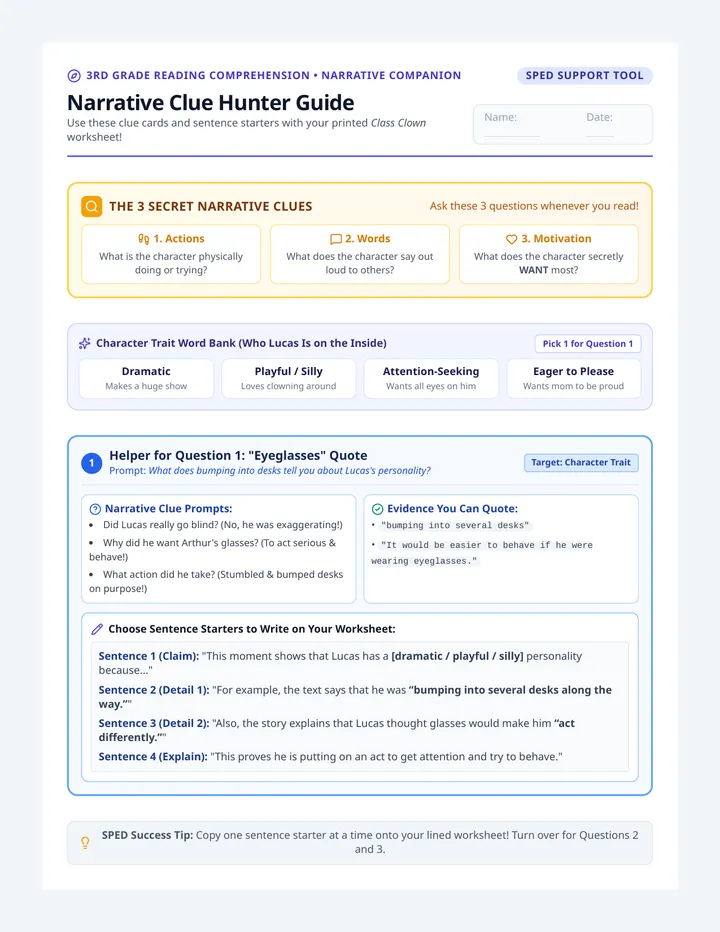
Class Clown Prompting Companion

Class Clown Prompting Companion

A 2-page visual narrative prompting companion for 3rd-grade SPED students to use alongside their printed Class Clown worksheets. Features character clue decoders, trait and motivation banks, guided narrative prompt steps, and structured sentence starters for Questions 1, 2, and 3.

KR

Kenzie Ruthven