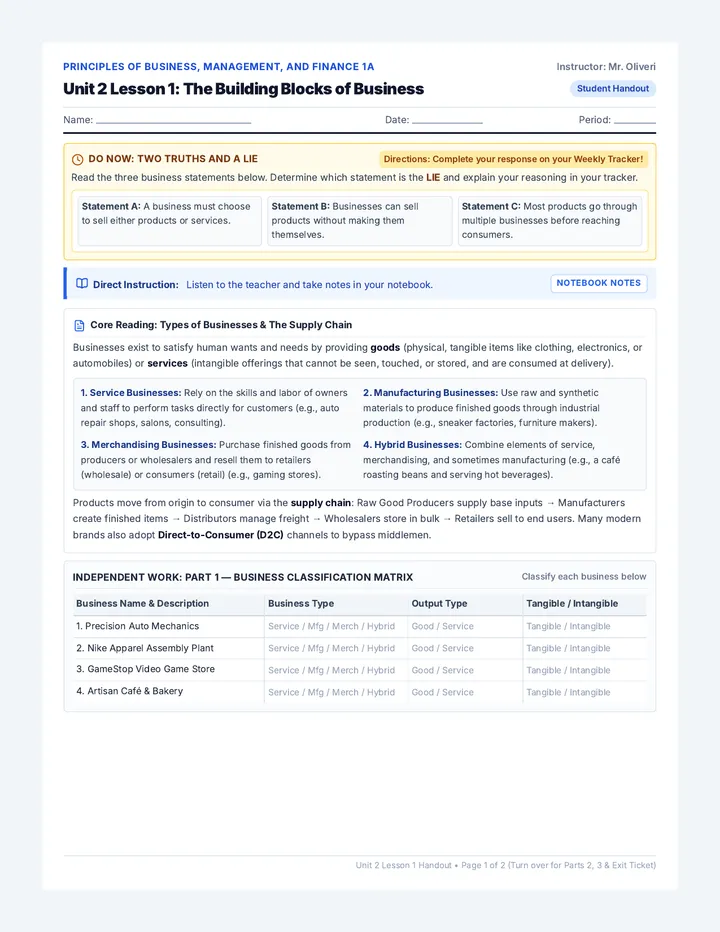
Fundamental principles of supply, demand, and monetary systems alongside micro- and macroeconomic structures. Examines the impact of corporate power, labor market dynamics, and global systems on social mobility and class inequality.
A highly accessible watch guide lesson linking The Wizard of Oz (1939) to Gilded Age politics (Populism, the Gold Standard, and industrial workers), designed specifically for middle school students reading at a 1st-grade level using visual matching, word banks, and literal multiple-choice questions.
A comprehensive lesson exploring the transition from the roaring optimism of the 1920s to the structural causes of the Great Depression, including the agricultural crisis, income inequality, global trade collapse, and the 1929 stock market crash.
An inquiry-based lesson investigating the transition from the roaring 1920s to the Great Depression. Students analyze how economic policies, consumer credit, and social tensions fueled a cultural boom that ended in systemic collapse.
A comprehensive assessment and review module covering the North Carolina standards for Economics and Personal Finance. This lesson provides a rigorous final evaluation for students to demonstrate mastery of economics, income, money management, planning, and consumerism.
Explores the transition from bartering to modern currency, defining the fiat system and the stages of production. Students will understand why money acts as a medium of exchange and how resources are transformed into goods.
A foundational overview of the Economics course, covering classroom policies, grading, and the roadmap for the 9-week term.
Students explore the rise of the Populist movement, investigating how falling crop prices and high railroad costs led farmers to unite through the Grange and the Populist Party. The lesson includes a presentation on core concepts and a hands-on simulation activity exploring the economic challenges faced by 19th-century farmers.
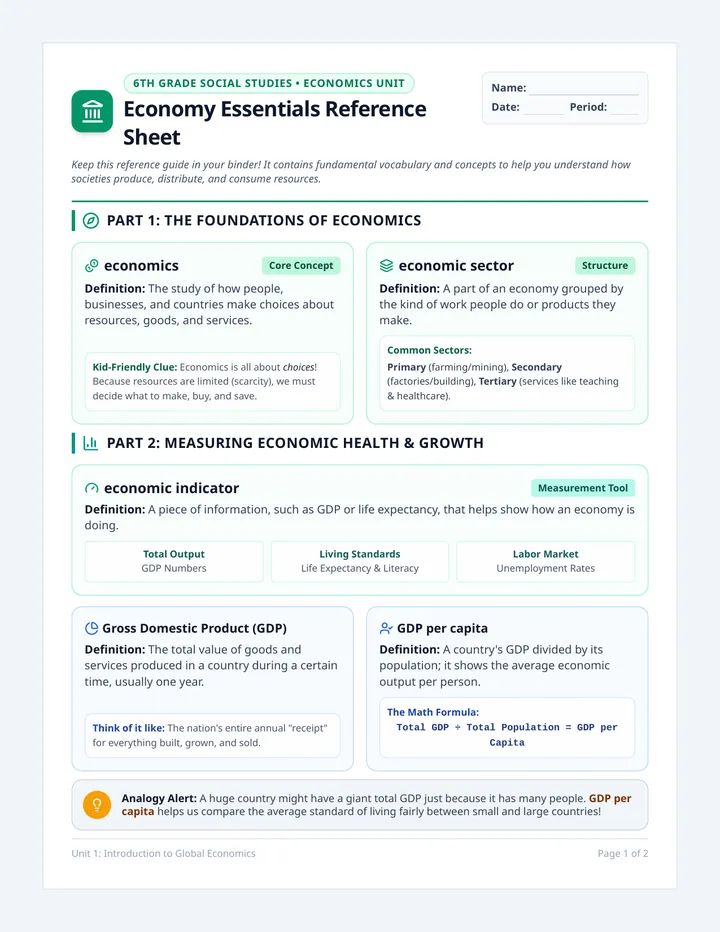
A comprehensive study guide and answer key covering five core units of Economics, including principles, market forces, indicators, and policy.
A comprehensive set of study materials covering fundamental economic concepts, government roles, the Federal Reserve, and the history of money.
A lesson exploring the causes and effects of the Panic of 1873 through a simplified reading passage and vocabulary activities. Students learn how a railroad investment bubble led to a national economic crisis.
An immersive stations-based lesson exploring the causes and consequences of the Panic of 1873, focusing on railroad over-speculation, banking failures, and its impact on Reconstruction.
An inquiry-driven social studies sequence investigating Ancient Greece and Rome across four core pillars: government, philosophy, trade, and engineering. Students engage with primary sources, architectural achievements, and ethical dilemmas to construct arguments about classical legacies.
A comprehensive look at economic systems, competition, and the role of government in regulating markets using the cell phone industry as a primary case study.
A 4-lesson economics sequence for Special Education students. Lessons progress from solving for market equilibrium algebraically, to using data tables, to graphing intersections, and finally interpreting the real-world meaning of surplus, shortage, and the 'sweet spot'.
A comprehensive 5-day reading comprehension packet focusing on European exploration and early American settlements. Each day features a high-rigor historical passage followed by 10 multiple-choice questions designed to build critical ELA skills.
A 4-part exploration of the deep-seated tensions and pivotal events that led the United States to the brink of the Civil War, focusing on economic shifts, legislative compromises, and political flashpoints.
A comprehensive review series covering the New York State Modern World History Regents curriculum, focusing on Units 1 through 9.
A comprehensive exploration of the American Revolution, from the sparks of rebellion to the birth of a new nation.
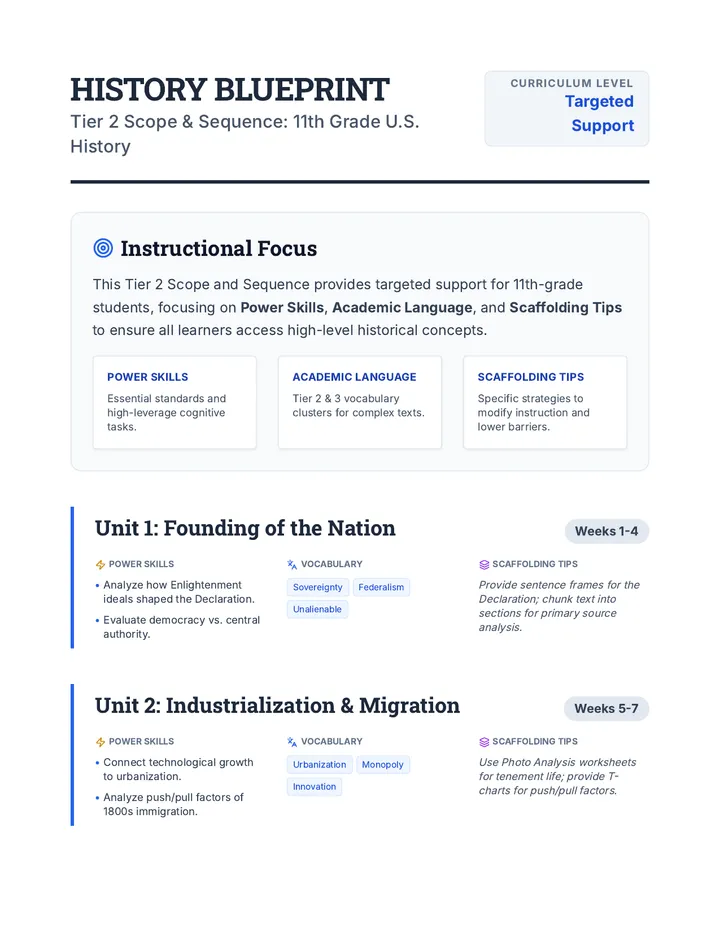
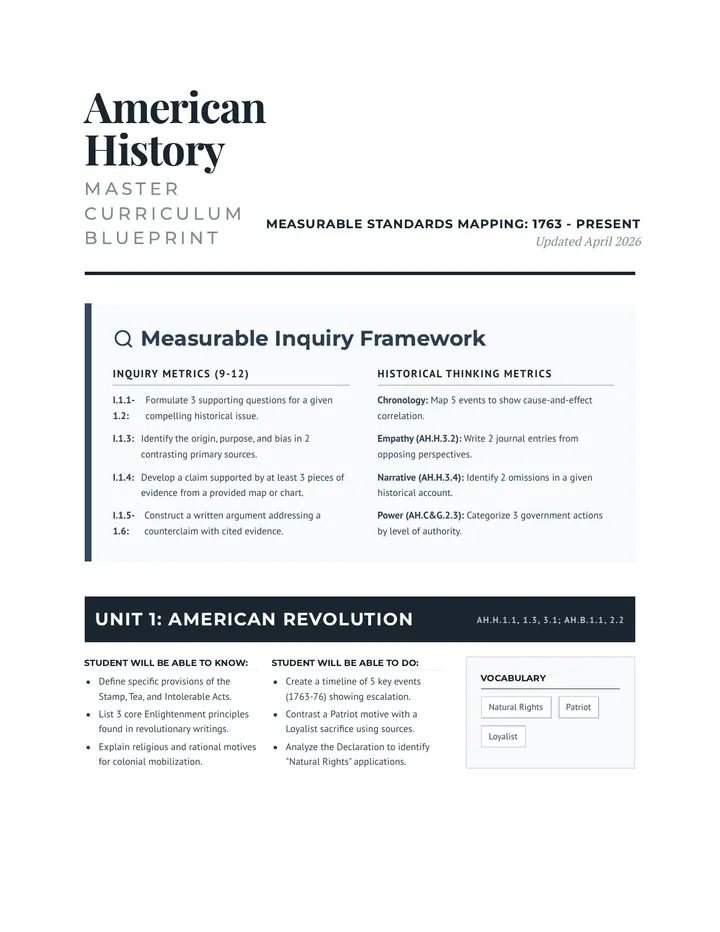
A comprehensive high school curriculum plan for American History, covering 13 units from the American Revolution to the modern era, aligned with North Carolina Social Studies standards.
A comprehensive unit covering the economic boom of the 1920s, the Great Depression, and the New Deal. Includes lessons on the Prosperity Paradox, the Stock Market Collapse, the Dust Bowl, and government responses.
A three-day immersive sequence where 3rd-grade students learn the fundamentals of supply and demand. Students progress from learning basic logic with lemonade to investigating "Price Crimes" as Market Detectives, using economic clues to solve mystery price shifts.
A 6-day credit recovery unit for 11th and 12th grade students exploring America's transition into a global power. The unit uses visual aids, scaffolded reading, and graphic organizers to explain the Spanish-American War, the Panama Canal, and the debates over imperialism.
A comprehensive 5-day unit for 11th and 12th grade US History covering the Industrial Revolution, Westward Expansion, and social reform movements. The unit features kinesthetic activities, primary source analysis, and scaffolded materials for diverse learners.
A teacher-facing reference guide and completed answer key for the Yellow Brick Road Watch Guide. Features high-contrast annotations, lesson delivery tips, and historical background connecting the 1939 film to Populism, the gold standard debate, and industrial labor struggles.
An extremely accessible watch guide packet connecting The Wizard of Oz (1939) to Gilded Age politics, tailored for middle schoolers reading at a 1st-grade level. It is fully formatted as multiple-choice questions for both literal movie events and historical connections.
A 5-question comprehensive quiz for the end of the economics unit. Revised to fit on a single page and fix fill-in-the-blank alignment.
A set of 8 vocabulary flashcards covering key economic terms. Revised to fit all cards on a single page for easier printing.
A teacher's guide for the final lesson, including a pacing guide and quiz answer key. Revised to fix label wrapping, consolidate to one page, and improve readability.
Guided notes for Lesson 2 focusing on money and production. Revised to fix dark backgrounds, increase writing space for blanks, and improve footer legibility.
A visual presentation for Lesson 2 explaining the functions of money, the characteristics of a fiat system, and the three stages of the production process.
A comprehensive teacher's guide for Lesson 2. Revised to consolidate content on a single page and improve padding in formative check.
Guided notes for Lesson 1, providing structured spaces for defining terms. Revised to fit on a single page, increase box sizes, and improve alignment.
A visual presentation for Lesson 1 covering the difference between goods and services, the three types of resources, and the mechanics of the barter system. Revised with higher icon opacity.
A comprehensive teacher's guide for Lesson 1, featuring learning objectives, a detailed pacing guide, classroom activities like the Barter Bazaar, and discussion prompts. Revised to fix page break issues.
A collection of cut-out materials for the 'Harvest Hardships' simulation, including printable $1 harvest tokens and three large scenario cards for the teacher to display or read. The cards detail the income and expense changes for each phase of the simulation.
An exploration of Asia and the Pacific, focusing on diverse cultural traditions, physical features, and the economic engines of the modern world.
An in-depth exploration of Africa and the Middle East, covering physical geography, historical civilizations, and diverse cultures aligned with Indiana 7th Grade Academic Standards.
An intermediate lesson examining how early humans migrated out of Africa, adapted to different global climates, and used cultural and technological innovations to improve their lives.
An introductory lesson exploring how archaeologists, paleontologists, and scientists reconstruct prehistoric human society using fossils, scientific testing, and geographical migration tracks.
A project-based lesson where students explore the dramatic transition from hunter-gatherer societies to early agricultural communities. Students analyze historical evidence to create a comic, short story, or poster detailing daily life in their assigned era.
An in-depth exploration of the factors that drove European powers to seek new trade routes, introducing the GREASES framework for historical analysis of global expansion.
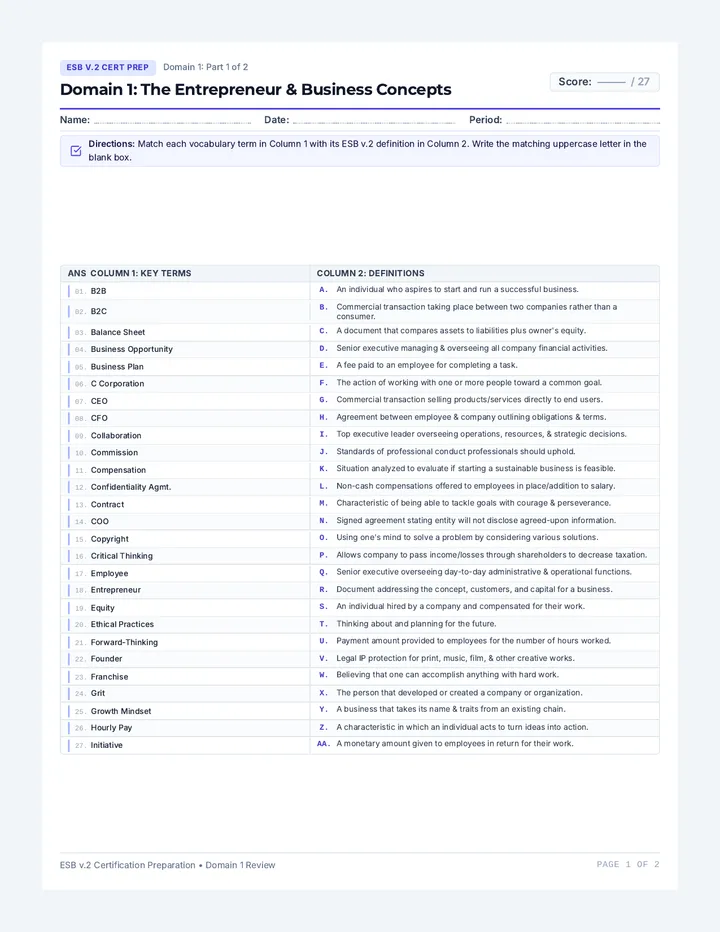
A modified, highly accessible economics assessment package tailored for students with IEP accommodations. Features simplified reading level, reduced multiple-choice options, bolded key terms, clear visual icons, and an intuitive match-by-letter format instead of complex grids.
An inquiry-based lesson exploring how the demographic crisis of the 14th-century Black Death disrupted feudal structures in Europe. Students analyze labor scarcity, roleplay economic shifts, and evaluate primary sources to understand how catastrophe led to working-class empowerment.
A comprehensive, interdisciplinary half-day program designed to transform 3rd graders into interactive business owners while practicing persuasive writing, graphing and data math, and visual design.
Students apply social studies economics concepts (producers, consumers, goods, services, productive resources) and math fractions to design, cost, and budget their own dream ice cream parlor business.
A fast-paced, one-week introductory unit on core economic principles including scarcity, factors of production, and economic systems, designed for 70-minute high school blocks.
A global geography unit focusing on the identification and analysis of the Earth's diverse landscapes. Students will master map-reading skills including elevation, contour lines, and global physical regions to understand how geography shapes our world.
A comprehensive two-week unit covering the social, economic, and political transformations of the 1980s and 1990s, from the Reagan Revolution to the dawn of the Digital Age and the roots of 21st-century security challenges.
A comprehensive 12-day unit for 7th graders covering the origins, events, and aftermath of the Cold War. Using a 'Top Secret Dossier' theme, students explore ideologies, decolonization, proxy wars, and the eventual fall of the Soviet Union through data literacy, source analysis, and collaborative activities.
A comprehensive 4-week microeconomics unit covering elasticity, consumer behavior, production theory, market failures, and labor economics. This sequence blends theoretical models with real-world applications and quantitative analysis.
A unit exploring the geographical, economic, and social differences between the North and South in the mid-19th century, centered on the life of Harriet Tubman and the abolitionist movement.
A 20-lesson inquiry unit for 5th grade exploring the Industrial Revolution's impact on innovation, movement, urbanization, and living conditions using the C3 Framework. Students investigate how steam and steel transformed the American landscape and society from 1800 to 1900.
Séquence d'accompagnement pédagogique pour les élèves de CAP Agricole en Nouvelle-Calédonie, visant à acquérir les compétences de l'Objectif 5 du module MP1 (Insertion du salarié dans l'entreprise) pour leur rapport de stage (PFMP).
A comprehensive historical unit tracking the Age of Exploration, maritime trade routes, and the shift from mercantilism to early capitalism.
A comprehensive 4th-grade social studies unit where students analyze the Olmec, Maya, Aztec, and Inca civilizations. Through primary-source-style document analysis, geographical exploration, and civic action, students discover what made these empires successful and apply ancient engineering solutions to improve the modern City of Surprise.
A comprehensive 3-day unit for Grade 5 exploring the plantation economy, the lived experiences of enslaved people, the abolitionist movement, and the Emancipation Proclamation.
A comprehensive study of the Atlantic slave trade, the plantation economy, forms of resistance, and the eventual path to emancipation.
A comprehensive one-week social studies and ELA integration unit covering North Carolina history and symbols, designed to match the rigor of the NC 3rd Grade E.O.G. assessment.
A four-part exploration of the Reconstruction era, focusing on the economic, social, and legal challenges of rebuilding the United States after the Civil War. Students analyze primary sources to understand the transition from slavery to freedom and the obstacles faced by formerly enslaved people.
A focused exploration of medieval social and economic structures, specifically contrasting the political hierarchy of feudalism with the agricultural economy of manorialism.
A 2-page print-ready teacher resource in high-contrast black and white. It contains complete pacing, station setup guidelines, Massachusetts-specific historical context (Chapter 766), small-group discussion questions, and an exemplar answer key for the Student Guide.
A 4-page print-ready student worksheet in high-contrast black and white. Each of the five stations contains exactly five questions (four core factual review questions and one deep-dive conceptual/empathy question) with dedicated handwriting lines, structured to fit exactly four printable pages. Updated to remove grey printing borders and backgrounds.
Print-ready, high-contrast black-and-white station cards for an 8th-grade Civics activity. Five stations cover the history (Judy Heumann and the Section 504 sit-in), legal differences (504 vs. IEP), federalism (MA Chapter 766 vs. Federal IDEA), funding (unfunded mandates and local taxation), and empathy (student scenarios and policy decisions). Updated to remove grey printing borders and backgrounds.
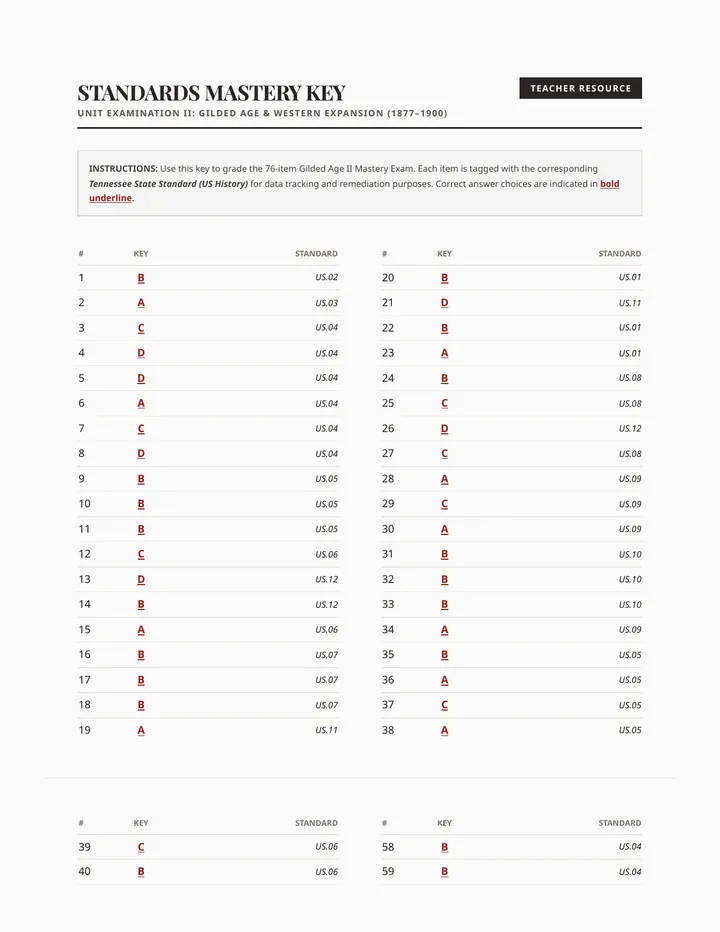
A comprehensive teacher-facing answer key, lesson script, and grading guide for the Boom to Bust investigation packet and guided notes.
A comprehensive teacher answer key and discussion guide for the 'Cracked Prosperity Lecture Companion'. Provides exemplary historical data, model analysis notes for all five political cartoons, and sample scaffolding structures for the student CER debate task.
A student-facing interactive lecture companion designed to be completed live during the 'Cracked Prosperity' slide presentation. Includes structured spaces for active listening, guided notes on the four economic factors, a comprehensive five-cartoon analysis log, and a CER debate scratchpad.
A detailed teacher answer key for the Cartoon Detectives political cartoon analysis activity, providing descriptive decode guides and model connections to economic structural factors.
A rigorous primary source analysis packet featuring three additional historic political cartoons from the National Humanities Center collection, complete with structured decoding prompts.
A detailed teacher answer key for the student exit ticket, providing correct answers, rationale, and sample answers for formative assessment scoring.
A detailed teacher answer key for the student guided worksheet, providing exemplary answers for all guided analysis questions, cartoon analysis prompts, and model CER structures.
A student exit ticket for formative assessment, evaluating comprehension of the four economic factors and checking student understanding of the 1920s to 1930s transition.
A simplified student guided reading and analysis worksheet covering the four economic factors of the Great Depression, optimized with highly accessible text, simplified prompts, and clear scaffolding for the CER task.
An 8th-grade Civics station rotation lesson exploring the history, laws, funding, and federalism of 504 and IEP services, comparing federal mandates with Massachusetts state standards.
A high school lesson where students collaborate to design a tabletop card game centered on real-world ethical choices, applying game theory, logical reasoning, and creative writing to balance competing moral priorities.
A comprehensive lesson plan and visual asset kit introducing the PEGS (Political, Economic, Geographic, Social) framework for social studies analysis. Includes vibrant illustrated wall posters, elegant minimalist binder inserts, educational slides, a student application worksheet, and a teacher's facilitation guide.
Students explore states of matter (solids, liquids, gases) and physical changes through a hands-on lab making ice cream in a bag, investigating how salt alters the freezing point of ice.