Cognitive, social, and emotional shifts during the transition from childhood to adulthood. Examines identity formation, peer influence, and neurobiological development in the adolescent brain.
A two-block introductory unit for Elie Wiesel's 'Night' designed for students with ADHD and SLD, focusing on character introduction, historical context, and the psychological impact of the Holocaust through movement and tactile activities.
Une formation pour les professeurs-documentalistes centrée sur la médiation culturelle et l'accompagnement des pratiques de lecture des adolescents. L'objectif est de concilier la réalité de l'édition actuelle avec les missions pédagogiques du CDI.
A comprehensive 5-day unit exploring the Great Depression's impact on the United States and Minnesota, focusing on economic collapse, rural hardship, urban survival, and New Deal recovery through primary source analysis.
A comprehensive unit on child development from birth through age 18, focusing on physical, cognitive, and social-emotional growth across early childhood, middle childhood, and adolescence.
This sequence explores the psychological journey of adolescence, focusing on identity formation through Erikson's theory, social conformity, digital self-perception, and the quest for autonomy. Students will analyze their own development and the social forces that shape who they are.
A high school psychology unit exploring the biological and environmental underpinnings of addiction, focusing on the nature vs. nurture debate and the brain's capacity for adaptation.
An advanced graduate-level exploration of juvenile jurisprudence, tracking the evolution from historical 'Parens Patriae' origins to modern neuroscience-based Supreme Court decisions. Students analyze the tension between rehabilitative ideals and legal culpability through case law, statistical data, and restorative justice models.
This sequence explores the psychosocial aspects of adolescence, using Erik Erikson's framework to examine identity formation, social influence, digital presence, and family dynamics. Students analyze how internal conflicts and external pressures shape the transition to adulthood.
A comprehensive psychology sequence for 9th-grade students exploring the neurobiological development of the adolescent brain. Students investigate the structural changes, chemical drives, and environmental factors that shape decision-making and behavior during their teenage years.
A comprehensive 5-lesson unit for 10th-grade Psychology exploring the biological mechanisms of circadian rhythms, the architecture of sleep stages, and the societal implications of adolescent sleep needs.
This advanced sequence explores the nuances of trauma narrative work across diverse populations, focusing on Narrative Exposure Therapy (NET), developmental adaptations for youth, cultural sensitivity, overcoming therapeutic resistance, and essential provider self-care strategies.
This sequence explores the lived experience of world religions through the lens of rituals, traditions, and daily practices. Students compare rites of passage, dietary laws, festivals, prayer methods, and religious attire to understand how abstract beliefs are expressed through tangible actions.
A high school child development lesson using a jigsaw strategy to explore Piaget's four stages of cognitive development, featuring expert research and peer-to-peer teaching.
A comprehensive scenario-based assessment on the PIES domains of child development (Physical, Intellectual, Emotional, Social) and the fundamental principles/characteristics of human development.
A lesson exploring the ethical complexities of end-of-life medical decisions through real-world case studies and discussion.
A Year 11 Society and Culture lesson exploring rites of passage, comparing traditional Yolngu initiation ceremonies with contemporary Western adolescent transitions using the film Yolngu Boy.
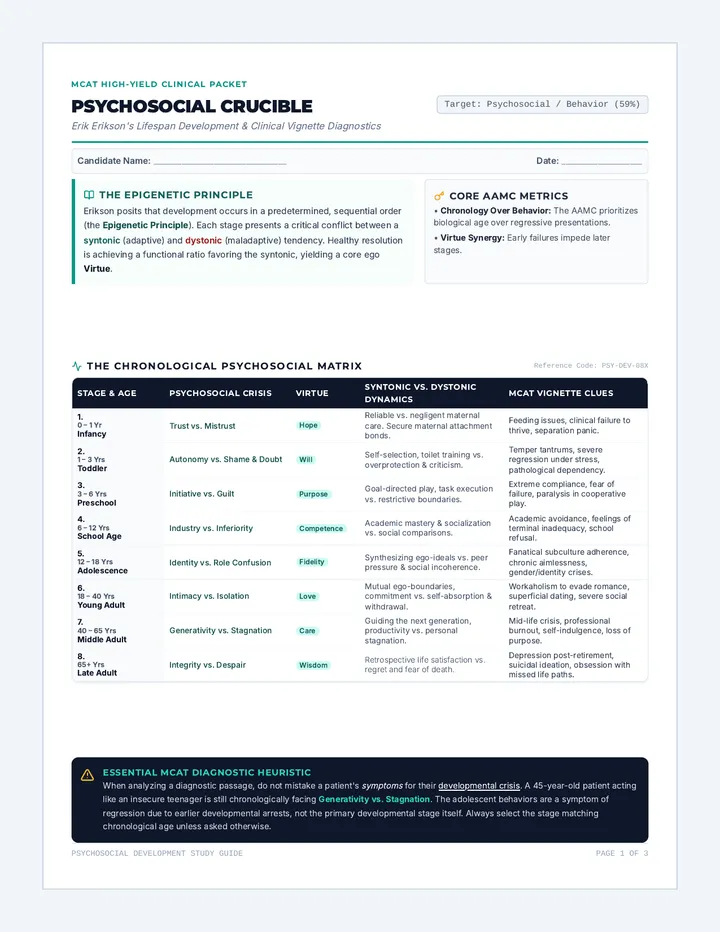
A comprehensive MCAT-focused lesson covering Erik Erikson's 8 stages of psychosocial development, with a deep dive into clinical vignette analysis and board-style exam applications.
This lesson explores the psychological factors and interrogation techniques that lead to confessions, with a specific focus on why innocent suspects might confess to crimes they didn't commit.
A comprehensive lesson examining the stages of cognitive development from prenatal through older adulthood. Students analyze real-world moral dilemmas involving honesty and integrity to understand how cognitive maturation shapes ethical reasoning.
A project-based learning unit exploring human development across the lifespan, focusing on social-emotional, cognitive, and physical growth through creative, higher-order thinking tasks.
An in-depth Society and Culture lesson exploring rites of passage, identity, and cultural transition through the Australian film Yolngu Boy. Students apply Van Gennep's three-stage theory to compare traditional Yolngu initiation with modern secular milestones.
In this undergraduate psychology lesson, students critique evolutionary perspectives on anxiety and design a behavioral activation intervention for happiness. They analyze Katarina Blom's TEDx talk, explore key studies on negativity bias and social connection, and create a targeted "Happiness Intervention" for college freshmen.
A clinical psychology lesson for undergraduates focusing on the categorization of psychotic symptoms using a simulation video as a case study. Students learn to distinguish between positive and cognitive symptoms and compare media representations to DSM-5 diagnostic criteria.
A high school psychology lesson focusing on how mental health conditions, specifically teen depression, manifest physically through somatic symptoms. Students track academic sources in a video and compare simplified media explanations with primary source abstracts.