Lenny.com
Explore
Create
ActivitiesNewMathEnglish Language ArtsScience & EngineeringSocial StudiesGlobal LanguagesHealth & Physical EducationSpecial EducationCounseling & Life SkillsArts & CreativityESL
Lenny.com
Lenny.com
Explore
Create
ActivitiesNewMathEnglish Language ArtsScience & EngineeringSocial StudiesGlobal LanguagesHealth & Physical EducationSpecial EducationCounseling & Life SkillsArts & CreativityESL
Lenny.com
Lenny.com

Solutions

Lenny for EducatorsLenny for SchoolsLenny for Districts

Product

ExploreSign inCreateSupportAbout

Resources

Getting startedMTSS Acceleration Program

Newsletters

School Funding Newsletter

© 2026 Lenny Learning Inc.

TermsPrivacyAccessibility
LinkedInInstagramX
Lenny

Legislative Branch

Bicameral structure, law-making procedures, and the delegated powers of the U.S. Congress. Examines the legislative process, committee roles, and the system of checks and balances between the House and Senate.

Social StudiesSocial Studies PracticesLocation WordsMapsOrder EventsChronology and CausationEvaluating SourcesHistorical ThinkingGeography, Humans, & the EnvironmentAmerican Symbols and LandmarksCitiesStatesState CapitalsRegions of the United StatesGeographic SkillsPhysical GeographyHuman GeographyRegional GeographyGeography of AfricaGeography of AsiaGeography of EuropeGeography of OceaniaGeography of the AmericasSociety and Environment of EuropeSociety and Environment of AsiaSociety and Environment of The AmericasSociety and Environment of the Middle EastSociety and Environment of AfricaHistoryPrehistoryComparing Ancient River CivilizationsAncient MesopotamiaAncient Egypt and KushAncient South AsiaEarly ChinaGreeceRome and the Byzantine EmpireAncient World HistoryNative Peoples of North AmericaNative Peoples of Mesoamerica and South AmericaAfrican EmpiresMedieval AsiaMedieval EuropeThe Silk RoadMedieval HistoryIslamic EmpiresWorld ReligionsRenaissance PeriodAge of ExplorationThe Thirteen ColoniesThe American RevolutionUS History Early RepublicFounding of the United StatesUS History AntebellumUS Civil WarReconstruction PeriodThe Gilded AgeUS ImperialismWorld ImperialismWorld War IUS History 1920sGreat DepressionWorld War IIThe Cold WarUS History 1950-60sUS History 1960s-70sWorld History 20th CenturyContemporary US HistoryContemporary World HistoryHolidaysCivics and GovernmentCitizenshipGovernment FoundationsThe ConstitutionUS ConstitutionExecutive BranchLegislative BranchJudicial BranchState and LocalPolitical ParticipationPublic PolicyPolitical SystemsPower and AuthoritySocial MovementsDefining DevianceTheories of DevianceCrime and Criminal JusticeEconomicsBasic Economic PrinciplesSupply and DemandWhat is MoneyEconomic FundamentalsMicroeconomicsMacroeconomicsBanking and FinanceEconomic SystemsGlobal EconomicsCorporations and PowerThe Changing WorkplaceUnemployment and LaborClass and InequalitySocial MobilityGlobal InequalityPsychologyHistory of PsychologyPsychology as a ScienceBrain and Nervous SystemNeuroscience and BehaviorGenetics and BehaviorSleep and ConsciousnessSensory ProcessesPerceptual OrganizationClassical ConditioningOperant ConditioningObservational LearningCognitive LearningMemory ProcessesThinking and Problem SolvingLanguage and CognitionTheories of MotivationStress and CopingPrenatal and Infant DevelopmentChildhood DevelopmentAdolescent DevelopmentAdulthood and AgingSelf and IdentitySocial CognitionSocial InfluenceAttraction and RelationshipsGroup BehaviorPrejudice and DiscriminationAnxiety and Mood DisordersClinical PsychologyForensic PsychologyPhilosophy & EthicsIntroduction to PhilosophyMajor Philosophers & IdeasMind and Body ProblemFree Will vs DeterminismEthics & MoralityReligion & PhilosophyPolitical Philosophy

Videos

How Constitutional Amendments Changed Government Structure

How Constitutional Amendments Changed Government Structure

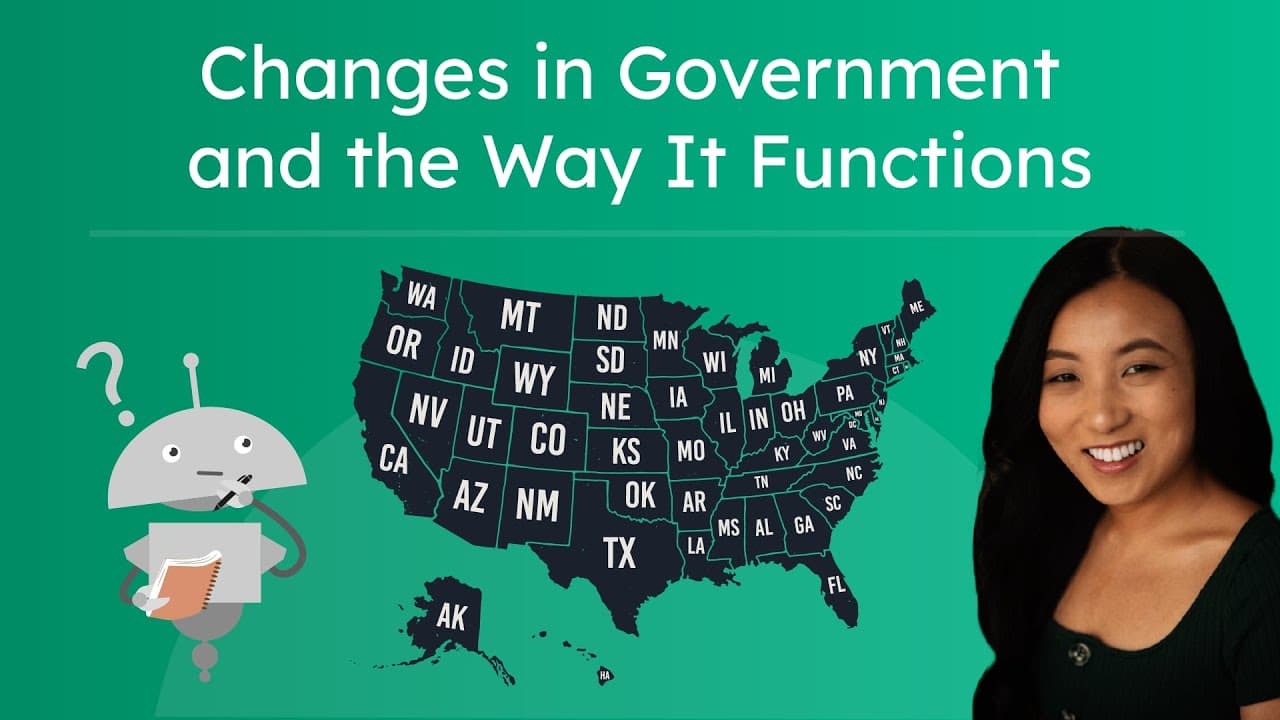
This educational video explores the specific amendments to the U.S. Constitution that altered the structure and function of the federal government, rather than just focusing on individual rights. It categorizes these amendments into two main groups: those dealing with general government procedures (like taxation and congressional pay) and those specifically refining the office of the Presidency (including elections, terms, and succession). The video provides a chronological and thematic breakdown of Amendments 10, 11, 12, 16, 17, 20, 22, 23, 25, and 27. Key historical contexts are provided for each, such as the *Chisholm v. Georgia* Supreme Court case leading to the 11th Amendment and FDR's four terms leading to the 22nd Amendment. It effectively uses visual aids like maps, historical photos, and diagrams to explain complex concepts like Federalism and the Electoral College. Teachers can use this video to deepen students' understanding of U.S. Civics beyond the Bill of Rights. It is particularly useful for units on the Constitution, the Executive Branch, and the evolution of American democracy. The content explains *why* the government operates the way it does today, making abstract political rules concrete through historical examples.

Miacademy & MiaPrep Learning ChannelMiacademy & MiaPrep Learning Channel

8mins 46s

The U.S. Constitution and Bill of Rights Explained

The U.S. Constitution and Bill of Rights Explained

This educational video provides a comprehensive overview of the United States Constitution and the Bill of Rights, serving as an essential primer on American civics. It begins by establishing the historical context, explaining why the original Articles of Confederation were replaced and how the Founding Fathers convened in Philadelphia in 1787 to draft a stronger framework for government. The host, Maya, guides viewers through the structure of the Constitution, breaking down the Preamble and the seven Articles that define the three branches of government and federal relations. The video dedicates a significant portion of its runtime to the Bill of Rights, clarifying that these first ten amendments were added to protect individual liberties in response to citizen concerns. It lists each of the first ten amendments with clear, simplified explanations of the freedoms they secure, such as free speech, the right to bear arms, and protection against unreasonable searches. It also briefly touches upon later amendments, specifically highlighting voting rights changes in the 19th and 26th amendments. For educators, this resource is a valuable tool for introducing or reviewing the structure of the U.S. government. Its systematic breakdown of the Articles (I-VII) and the Bill of Rights (1-10) makes it ideal for note-taking exercises, memorization, and understanding the distinct roles of the Legislative, Executive, and Judicial branches. The clear visual aids and straightforward narration help demystify complex political terminology for students in upper elementary and middle school grades.

Miacademy & MiaPrep Learning ChannelMiacademy & MiaPrep Learning Channel

9mins 16s

How a Bill Becomes a Federal Law in the US

How a Bill Becomes a Federal Law in the US

This educational video provides a clear, step-by-step explanation of the legislative process in the United States, detailing exactly how an idea transforms into a federal law. Hosted by a presenter with supporting animations, the video breaks down complex civics concepts into digestible stages, starting from the initial conception of an idea to the final signature by the President. It clarifies the roles of the Legislative and Executive branches, emphasizing the system of checks and balances inherent in American government. Key themes explored include the structure of the federal government, the specific journey of a bill through the House of Representatives and the Senate, and the various outcomes a bill can face, such as passing, dying in committee, or being vetoed. The video introduces important political vocabulary like "sponsor," "committee," "veto," "pocket veto," and "filibuster," explaining each term with simple analogies and visuals. It also highlights the difficulty of passing legislation, noting that only about 5% of bills actually become laws. For educators, this video is an excellent resource for Civics and Social Studies units on government structure. It moves beyond a simple overview by including specific procedural details like the "hopper," committee research, and the specific majorities needed for different actions. Teachers can use this to scaffold lessons on the legislative branch, inspire classroom simulations of Congress, or help students understand their own power as citizens to contact representatives with ideas for laws.
Miacademy & MiaPrep Learning ChannelMiacademy & MiaPrep Learning Channel

7mins 3s

How Supreme Court Rulings Expanded Congressional Power

How Supreme Court Rulings Expanded Congressional Power

This educational video explores the constitutional tension between federal and state powers through the lens of two critical clauses: the General Welfare Clause and the Necessary and Proper Clause (also known as the Elastic Clause). Using a boxing match metaphor, the narrator introduces the historical conflict between Federalists and Anti-Federalists, connecting them to modern political ideologies. The video analyzes how the Supreme Court serves as the referee in this conflict, interpreting vague constitutional language to define the scope of Congressional authority.

Miacademy & MiaPrep Learning ChannelMiacademy & MiaPrep Learning Channel

8mins 39s

How Slavery Was Written Into the US Constitution

How Slavery Was Written Into the US Constitution

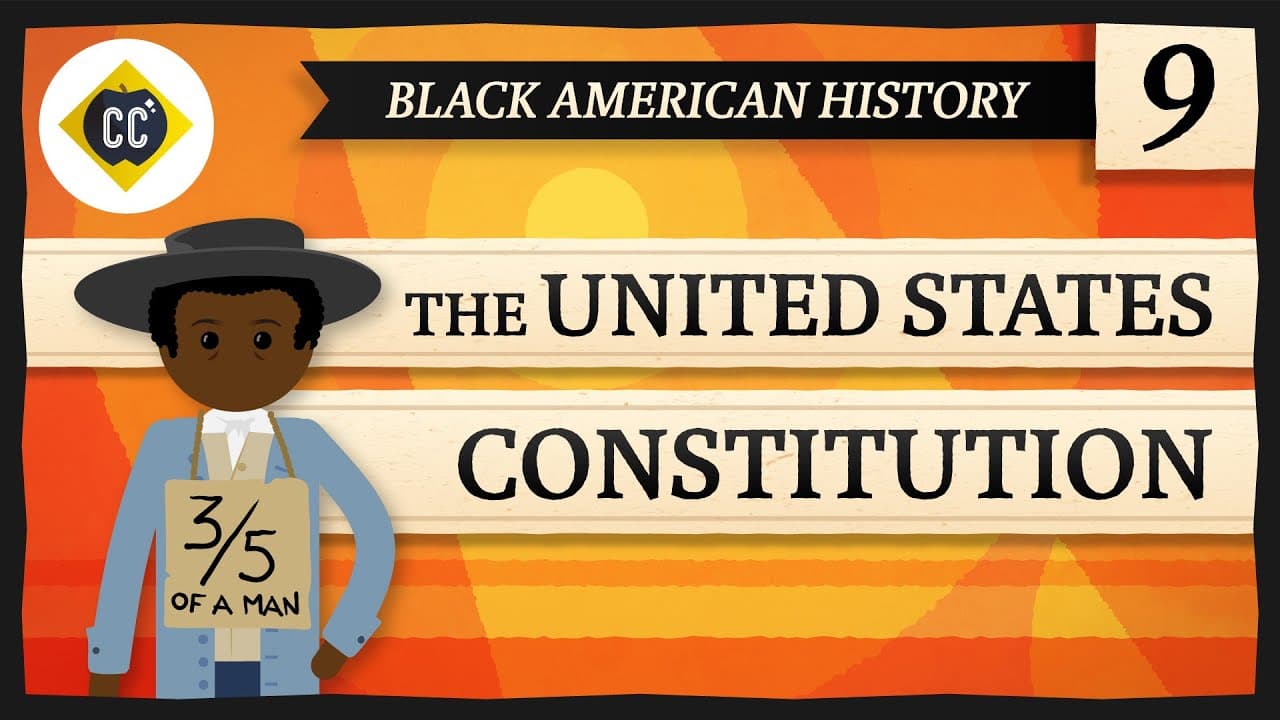
This educational video from Crash Course Black American History provides a critical examination of the United States Constitution's relationship with slavery. Host Clint Smith explores the disconnect between the nation's founding ideals of liberty and the reality of the legal structures created in 1787. The video utilizes a personal metaphor about identity to help students understand how a nation can claim to be one thing while practicing another, specifically addressing how the Constitution entrenched a racial caste system despite never explicitly using the word "slave." The content focuses deeply on two specific constitutional mechanisms: the Three-Fifths Compromise and the Slave Trade Clause (Article 1, Section 9). It breaks down the political mathematics behind the Three-Fifths Compromise, explaining how it artificially inflated Southern political power in the House of Representatives and the Electoral College. Furthermore, it analyzes the economic motivations behind the Slave Trade Clause, which prevented federal restriction of the international slave trade for twenty years, highlighting the complicity of both Northern and Southern states in the economics of slavery. For educators, this video serves as a powerful tool for teaching US Government, Civics, and American History. It moves beyond a superficial reverence for the Founding Fathers to a nuanced analysis of historical complexity, encouraging students to "hold multiple truths" simultaneously: that the Founders created a framework for democracy while also protecting the institution of slavery. This resource is excellent for sparking debates about political compromise, historical memory, and the long-term impacts of these founding decisions on American society.

CrashCourseCrashCourse

10mins 26s

How State and Local Governments Work

How State and Local Governments Work

This educational video provides a clear and accessible introduction to the structure and functions of state and local governments in the United States. It breaks down complex civics concepts into age-appropriate explanations, using analogies like "managers" and "club presidents" to explain the roles of Governors and Mayors. The video creates a distinction between the three branches of state government (Executive, Legislative, and Judicial) and the more direct governance found in towns and cities. The content explores key themes of civic structure, leadership roles, and community management. It details the specific responsibilities of each branch of government, such as making laws, deciding punishments, and managing budgets. Furthermore, it highlights the practical services provided by local governments, including road maintenance, garbage pickup, and park safety, making abstract government concepts concrete for young learners. For educators, this video serves as an excellent foundational tool for social studies and civics units. It explains how citizens can interact with their government—specifically through voting and attending city council meetings—empowering students to understand their own agency within their community. The clear visual aids and relatable examples (like fixing a broken swing) make it easy to spark classroom discussions about community needs and leadership.

Miacademy & MiaPrep Learning ChannelMiacademy & MiaPrep Learning Channel

4mins 16s

Materials

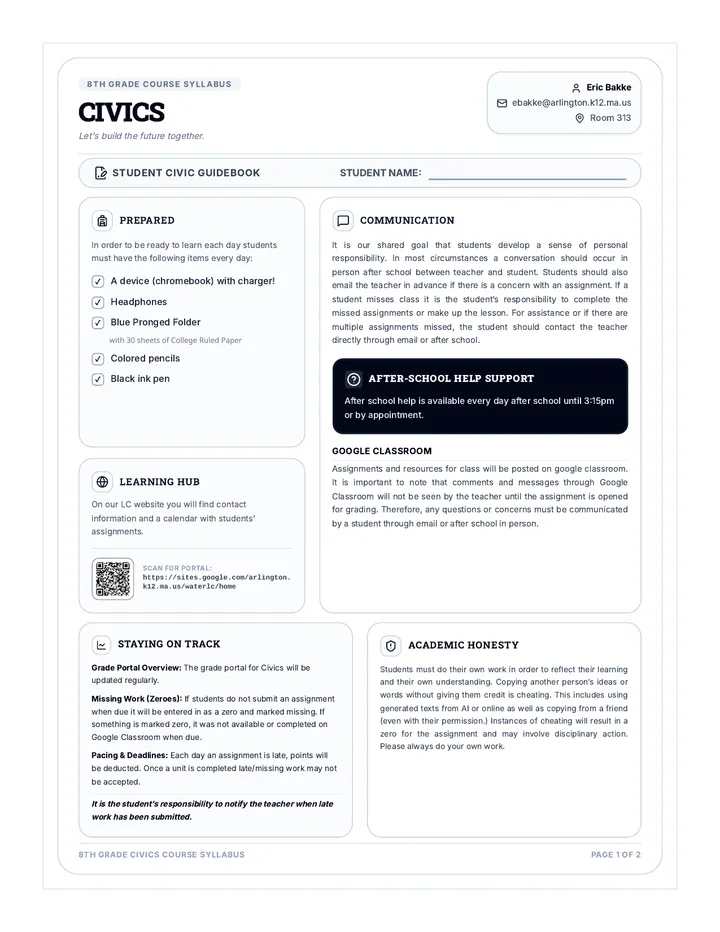
Civics Class Syllabus

Civics Class Syllabus

Civics Class Syllabus updated with an extra large QR code filling approximately half of the Digital Spaces container for maximum visibility and effortless scanning.

E

ebakke

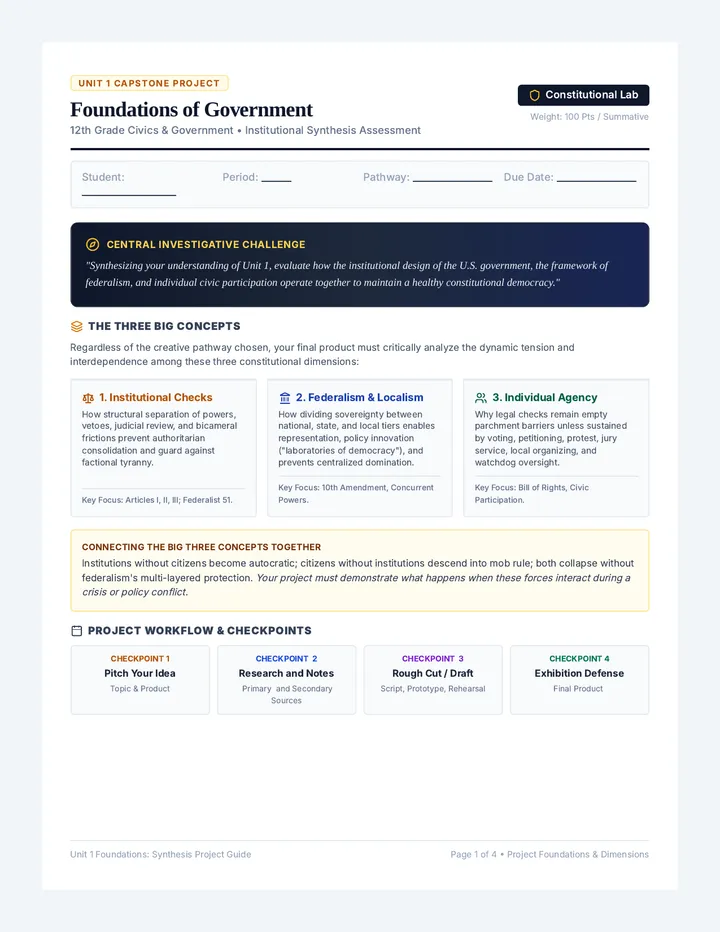
Democracy Design Project Guide

Democracy Design Project Guide

A comprehensive 4-page student project assignment guide for 12th-grade Civics and Government, detailing 5 creative project pathways (podcast, documentary, interview simulation, reader's theater drama, and board/card game), an analytical rubric across the three core constitutional dimensions, and a student planning blueprint.

JG

Joshua Griffith

Government Civics Bilingual Reader

Government Civics Bilingual Reader

A 5th-grade bilingual Spanish-English reading guide exploring the fundamentals of government, the three branches, active citizenship, and constitutional rights. Features side-by-side text, labeled photos of the White House and Capitol, simple civic illustrations, and an illustrated picture-vocabulary section.

M

mngillis

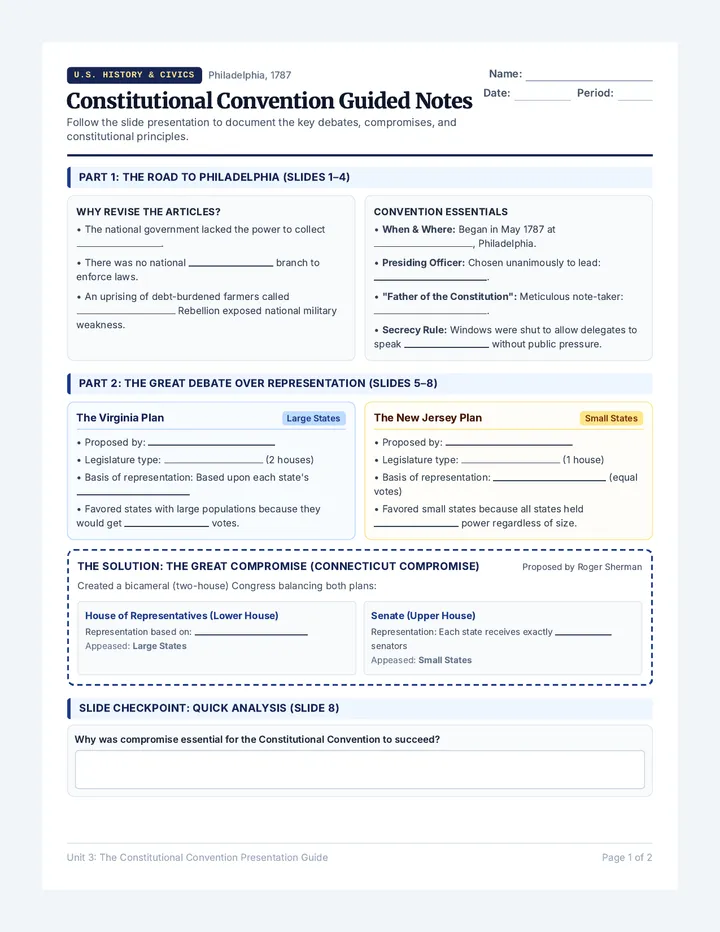
Constitutional Convention Guided Notes

Constitutional Convention Guided Notes

A comprehensive two-page guided note-taking worksheet on the 1787 Constitutional Convention, focusing on the road to Philadelphia, the Great Compromise, and slavery and economic compromises.

D

DOUGLAS.BODIE

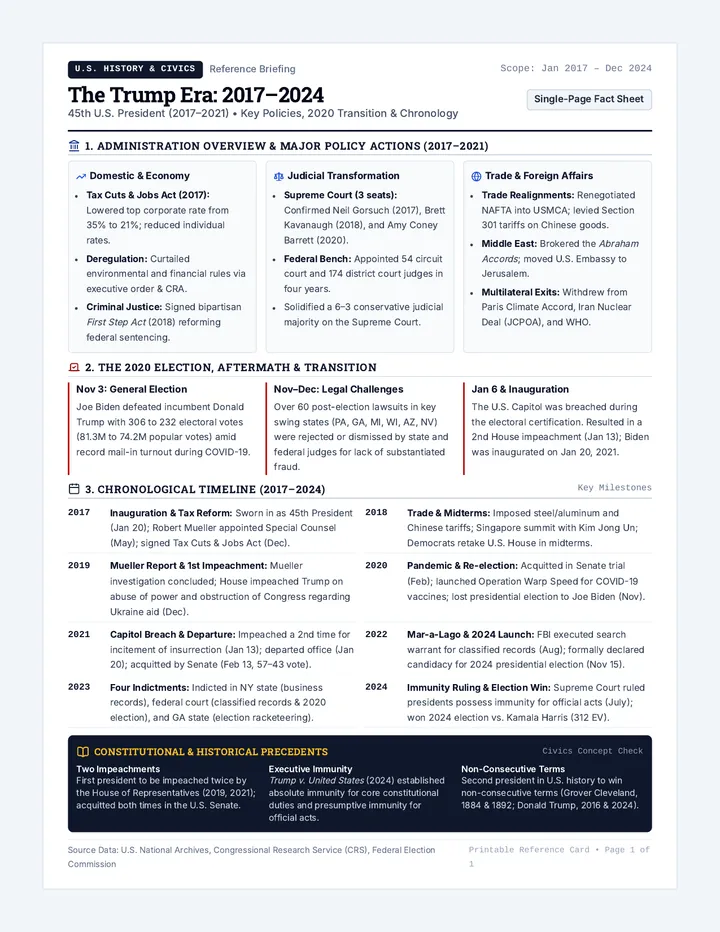
Trump Era Fact Sheet

Trump Era Fact Sheet

A concise, one-page printable fact sheet surveying the Trump presidency (2017–2021), the 2020 election and transition, and a comprehensive historical timeline through 2024 for high school and civics classrooms.

YP

Yovanna Plummer

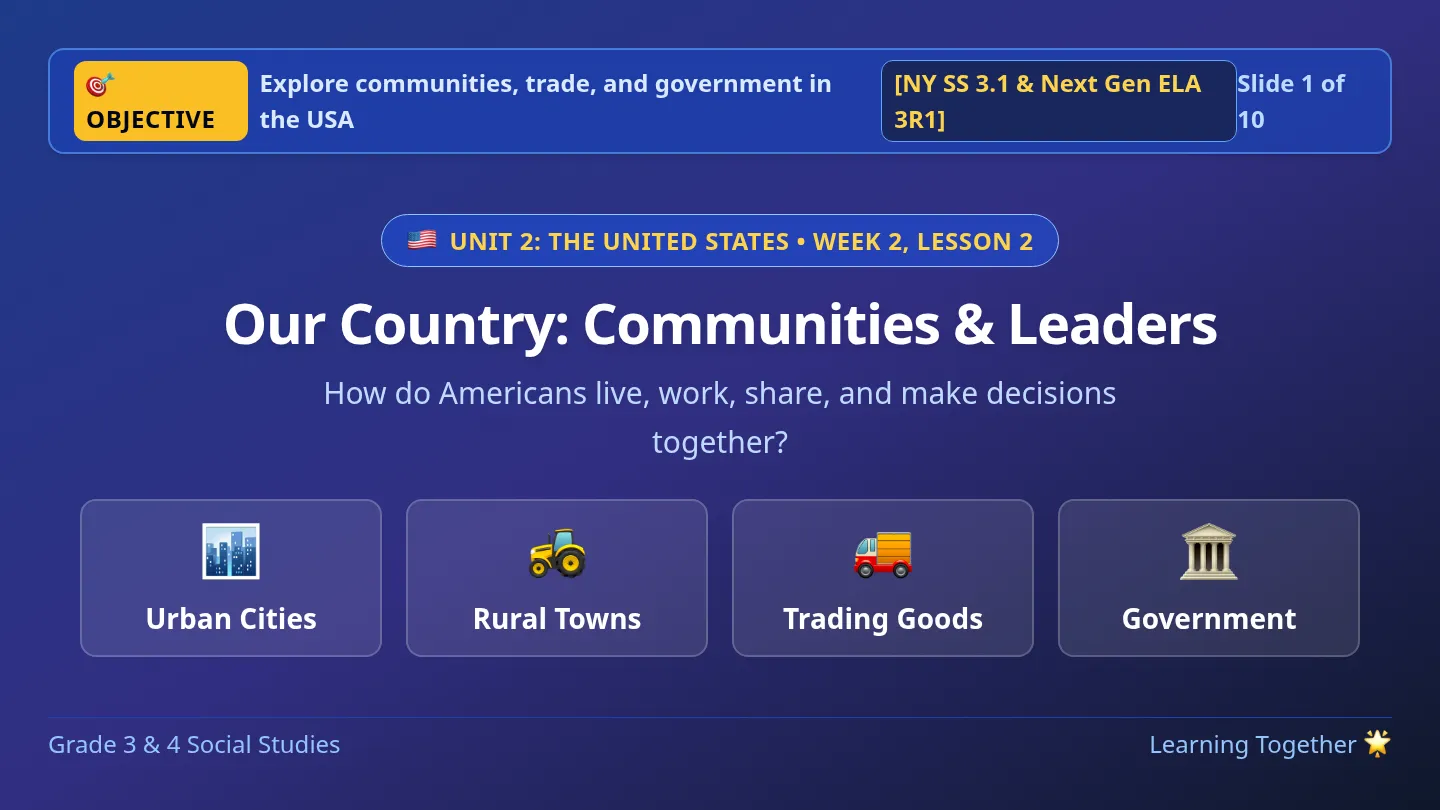
US Communities Slides

US Communities Slides

A 10-slide presentation designed for Grade 3-4 SWD students exploring U.S. communities (urban vs. rural), economic trade, and democratic government. Every slide features an accessible objective paired directly with New York Social Studies and Next Generation ELA learning standard numbers.

ML

Mrs Lindor

Sequences

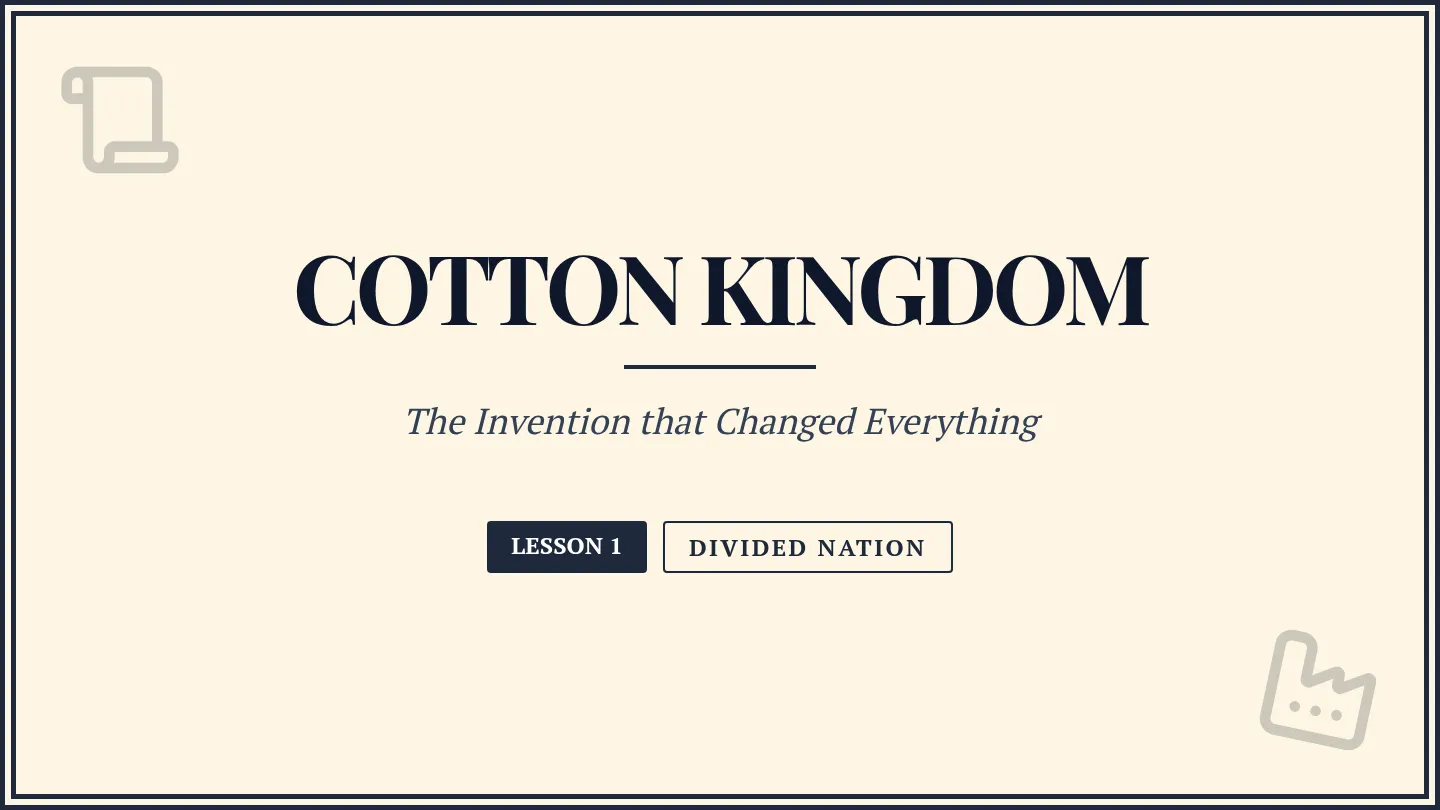
Cotton Kingdom Slides

Divided Nation

A 4-part exploration of the deep-seated tensions and pivotal events that led the United States to the brink of the Civil War, focusing on economic shifts, legislative compromises, and political flashpoints.

IA

Isabella Adkins

9
Thirteen Friends Worksheet

Democratic Foundations

A series of lessons exploring the foundational documents and processes of the United States government, from the birth of the nation to the creation of modern laws.

SB

Stephanie Bizeur

40
Unity Roadmap Teacher Guide

Unity and Growth

A modified Modern US History curriculum (Founding to Present) for Tier 2 and 3 special education students, based on Grade 11 Social Studies standards. Focuses on government, industrialization, world wars, and civil rights.

D

dfleisch

26
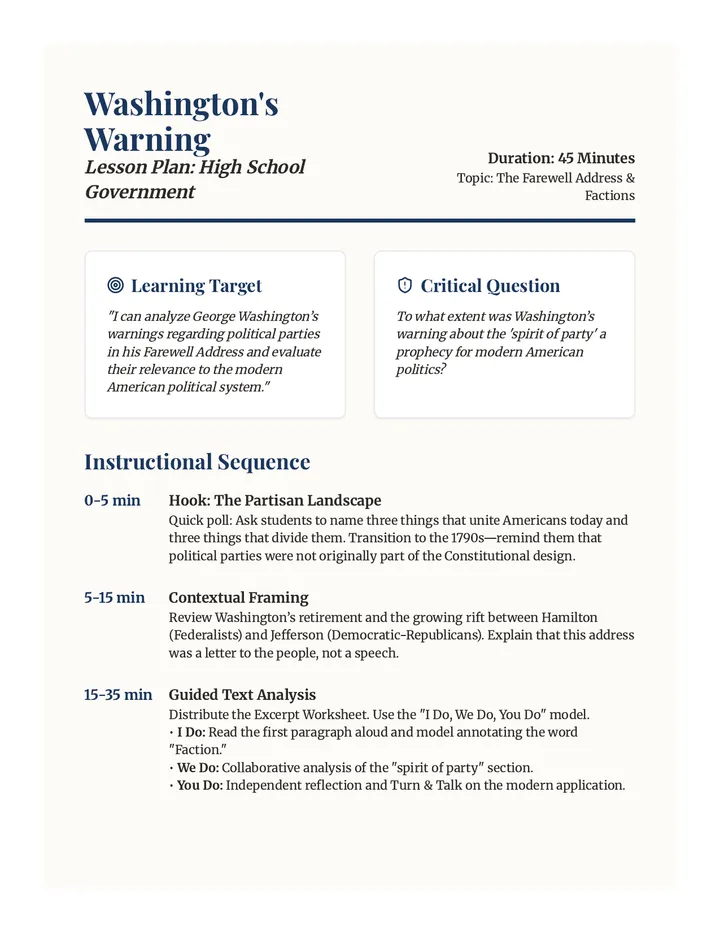
Washingtons Warning Lesson Plan

Washington's Farewell Legacy

A two-part sequence that takes students from a deep-dive analysis of George Washington's Farewell Address to a modern-day evaluation of his warnings regarding political parties, media bias, and national unity.

CE

Chelsea Elliott

24
Master Plan Slides

Power Players

A 5-week unit exploring the foundations of the United States government, the three branches of power, and the responsibilities of citizenship, specifically tailored for 4th-grade learners in Illinois.

KC

Kady Carter

8
Conflict Cards Activity

Century Crossroads

A comprehensive assessment sequence covering the pivotal moments of 20th-century US history, from the build-up to World War II through the height of the Cold War and the diverse Civil Rights movements.

AH

Ashley Hopf

16

Lessons

History Sprint Pacing Guide

STAAR History Sprint

A comprehensive pacing guide and activity resource designed to cover the remaining 11th Grade US History TEKS before the STAAR test on April 16th. This lesson provides a day-by-day calendar for A/B block schedules and high-engagement activities for each remaining historical era.

BB

Bridgette Burdick

51
Constitutional Vocabulary Poster Set

Constitutional Vocabulary

A set of vocabulary posters focused on key terms from the Constitutional Convention, including government structures, legislative roles, and foundational principles like compromise and federalism.

SA

Senta Agnello-Shelton

21
Modern Era Reader Part 1

The Modern Ledger

A comprehensive exploration of the 1990s through the modern day, covering technological shifts, political milestones, military conflicts, and cultural evolution in the United States.

CE

Chelsea Elliott

20
Branch Breakdown Reading

Branch Builders

A comprehensive introduction to the three branches of the U.S. government, focusing on the roles and responsibilities of the Legislative, Executive, and Judicial branches.

GM

Geneva Manus

10
Compromise Conundrum Activity Signs

Compromise Conundrum

A 45-minute stand-alone lesson centered on the Constitutional Convention's debate over representation and the Three-Fifths Compromise. It includes chunked reading for accessibility, a high-engagement 'Four Corners' activity, and a graphic organizer assessment designed for formal observation alignment with the Danielson Framework.

SA

Senta Agnello-Shelton

11
Reason for Revolution Worksheet V4 Refined Final

Architects of Liberty

A lesson exploring how Enlightenment philosophers like Locke, Montesquieu, and Voltaire influenced the founding documents and structure of the United States government.

KB

Kenneth Brown

10