Lenny.com
Explore
Create
ActivitiesNewMathEnglish Language ArtsScience & EngineeringSocial StudiesGlobal LanguagesHealth & Physical EducationSpecial EducationCounseling & Life SkillsArts & CreativityESL
Lenny.com
Lenny.com
Explore
Create
ActivitiesNewMathEnglish Language ArtsScience & EngineeringSocial StudiesGlobal LanguagesHealth & Physical EducationSpecial EducationCounseling & Life SkillsArts & CreativityESL
Lenny.com
Lenny.com

Solutions

Lenny for EducatorsLenny for SchoolsLenny for Districts

Product

ExploreSign inCreateSupportAbout

Resources

Getting startedMTSS Acceleration Program

© 2026 Lenny Learning Inc.

TermsPrivacyAccessibility
LinkedInInstagramX
Lenny

Power and Authority

Examines sources of political legitimacy and the distribution of power within various governance systems. Distinguishes between coercive force and legal-rational authority while addressing how societies establish and limit leadership influence.

Social StudiesSocial Studies PracticesLocation WordsMapsOrder EventsChronology and CausationEvaluating SourcesHistorical ThinkingGeography, Humans, & the EnvironmentAmerican Symbols and LandmarksCitiesStatesState CapitalsRegions of the United StatesGeographic SkillsPhysical GeographyHuman GeographyRegional GeographyGeography of AfricaGeography of AsiaGeography of EuropeGeography of OceaniaGeography of the AmericasSociety and Environment of EuropeSociety and Environment of AsiaSociety and Environment of The AmericasSociety and Environment of the Middle EastSociety and Environment of AfricaHistoryPrehistoryComparing Ancient River CivilizationsAncient MesopotamiaAncient Egypt and KushAncient South AsiaEarly ChinaGreeceRome and the Byzantine EmpireAncient World HistoryNative Peoples of North AmericaNative Peoples of Mesoamerica and South AmericaAfrican EmpiresMedieval AsiaMedieval EuropeThe Silk RoadMedieval HistoryIslamic EmpiresWorld ReligionsRenaissance PeriodAge of ExplorationThe Thirteen ColoniesThe American RevolutionUS History Early RepublicFounding of the United StatesUS History AntebellumUS Civil WarReconstruction PeriodThe Gilded AgeUS ImperialismWorld ImperialismWorld War IUS History 1920sGreat DepressionWorld War IIThe Cold WarUS History 1950-60sUS History 1960s-70sWorld History 20th CenturyContemporary US HistoryContemporary World HistoryHolidaysCivics and GovernmentCitizenshipGovernment FoundationsThe ConstitutionUS ConstitutionExecutive BranchLegislative BranchJudicial BranchState and LocalPolitical ParticipationPublic PolicyPolitical SystemsPower and AuthoritySocial MovementsDefining DevianceTheories of DevianceCrime and Criminal JusticeEconomicsBasic Economic PrinciplesSupply and DemandWhat is MoneyEconomic FundamentalsMicroeconomicsMacroeconomicsBanking and FinanceEconomic SystemsGlobal EconomicsCorporations and PowerThe Changing WorkplaceUnemployment and LaborClass and InequalitySocial MobilityGlobal InequalityPsychologyHistory of PsychologyPsychology as a ScienceBrain and Nervous SystemNeuroscience and BehaviorGenetics and BehaviorSleep and ConsciousnessSensory ProcessesPerceptual OrganizationClassical ConditioningOperant ConditioningObservational LearningCognitive LearningMemory ProcessesThinking and Problem SolvingLanguage and CognitionTheories of MotivationStress and CopingPrenatal and Infant DevelopmentChildhood DevelopmentAdolescent DevelopmentAdulthood and AgingSelf and IdentitySocial CognitionSocial InfluenceAttraction and RelationshipsGroup BehaviorPrejudice and DiscriminationAnxiety and Mood DisordersClinical PsychologyForensic PsychologyPhilosophy & EthicsIntroduction to PhilosophyMajor Philosophers & IdeasMind and Body ProblemFree Will vs DeterminismEthics & MoralityReligion & PhilosophyPolitical Philosophy

Videos

Machiavelli and the Ethics of Political Power

Machiavelli and the Ethics of Political Power

This educational video from Crash Course Political Theory explores the controversial philosophy of Niccolò Machiavelli and his seminal work, 'The Prince.' Rather than dismissing Machiavelli simply as a teacher of evil, the host analyzes his concept of political realism—the idea that effective leadership often requires making morally difficult or 'not good' choices to maintain the state's stability. The video bridges the gap between the 16th century and the modern era by examining how these ideas manifest in the concept of 'Realpolitik.' The content draws powerful connections between Machiavelli's theories and the actions of modern political figures, specifically focusing on Henry Kissinger's controversial career during the Cold War. It delves into the ethical dilemma of 'dirty hands' in politics: is it acceptable for a leader to compromise their morals to achieve a greater good? The video also introduces perspectives from other major political thinkers like Max Weber, Carl Schmitt, Hannah Arendt, and Catherine Zuckert to provide a balanced and nuanced debate. For educators, this resource serves as an excellent prompt for deep classroom discussions about civics, history, and ethics. It challenges students to move beyond black-and-white moralizing and consider the complex trade-offs inherent in governance. By comparing historical theory with 20th-century events like the Vietnam War and diplomatic relations with China, the video helps students understand the practical applications—and devastating consequences—of political realism.

CrashCourseCrashCourse

13mins 1s

From Absolute Kings to Constitutional Rights: The English Civil War

From Absolute Kings to Constitutional Rights: The English Civil War

This episode of Crash Course European History explores the tumultuous 17th-century struggle in Britain between the concept of the "Divine Right of Kings" and the rising power of Parliament. It details the reigns of the Stuart monarchs—James I, Charles I, Charles II, and James II—tracing how their attempts to enforce absolute rule and religious uniformity led to the English Civil War, the execution of a king, and a temporary military dictatorship under Oliver Cromwell. The video delves into the complex intersection of religion and politics, highlighting how conflicts between Catholics, Anglicans, and Puritans fueled social unrest, civil war, and eventually the "Glorious Revolution." It examines the pivotal transition from absolutism to constitutionalism, culminating in the English Bill of Rights of 1689, which established parliamentary sovereignty and limited monarchical power. For educators, this resource serves as an essential primer on the foundations of modern Western democracy. It connects historical events to the influential political philosophies of Thomas Hobbes and John Locke, demonstrating how the chaos of the 17th century birthed the concepts of natural rights—life, liberty, and property—that directly influenced the founding documents of the United States and other modern democracies.
CrashCourseCrashCourse

14mins 36s

How the Constitution Functions as a Social Contract

How the Constitution Functions as a Social Contract

This educational video introduces students to the concept of constitutional government by drawing a relatable analogy to the "Terms and Conditions" agreements found in modern apps and software. It breaks down complex political philosophy into digestible parts, starting with the idea of a social contract as proposed by Jean-Jacques Rousseau. The narrator explains that just as users agree to terms to use an app, citizens and governments enter a social contract where citizens give up certain absolute freedoms in exchange for the protection of rights and an organized society. The video identifies and defines three core principles of constitutional government: Rule of Law (society is governed by laws, not individuals), Limited Government (government authority is restricted), and Popular Sovereignty (the ultimate power rests with the people). It emphasizes that a constitution serves as a written instrument that clearly outlines the powers of the government and, crucially, guarantees specific rights to the citizens that the government cannot infringe upon. Designed for civics and government classrooms, this resource is highly valuable for bridging the gap between abstract political theory and students' daily lives. It includes built-in pause points with reflection questions, making it an interactive tool for introducing the U.S. Constitution. The video concludes with a powerful call to civic engagement, reminding students that an informed citizenry is essential for democracy to function and that they must "vote, debate, and participate."

Miacademy & MiaPrep Learning ChannelMiacademy & MiaPrep Learning Channel

10mins 49s

How the US Two-Party System Began

How the US Two-Party System Began

This educational video explores the historical origins of the two-party political system in the United States, tracing its roots back to the ratification of the Constitution. It begins by acknowledging modern political frustrations—corruption, polarization, and protests—and reveals that these divisions have existed since the nation's founding. The narrator highlights George Washington's prescient warning against political factions in his Farewell Address before delving into the ideological split between Federalists and Anti-Federalists regarding the balance of power between federal and state governments. Key themes include the interpretation of the Constitution (strict vs. loose construction), the tension between the Supremacy Clause and the Tenth Amendment, and the specific rivalry between Alexander Hamilton and Thomas Jefferson. The video uses clear comparison charts to breakdown the opposing viewpoints on government authority, economic policy, and individual liberty. It also features a dramatized re-enactment of the famous "Dinner Table Bargain," illustrating how early political compromises shaped the nation's capital and financial system. This resource is highly valuable for middle and high school Civics and U.S. History classrooms. It clarifies complex constitutional concepts like "reserved powers" and "federal authority" through visual aids and historical narrative. Teachers can use the built-in pause points and guiding questions to facilitate discussions on why the U.S. settled into a two-party system and how early constitutional debates parallel modern political disagreements between liberals and conservatives.

Miacademy & MiaPrep Learning ChannelMiacademy & MiaPrep Learning Channel

12mins 34s

Understanding Government and Politics: The Engine and the Driver

Understanding Government and Politics: The Engine and the Driver

This engaging educational video introduces students to the fundamental concepts of government and politics, distinguishing clearly between the two often-confused terms. Using accessible analogies—specifically comparing government to a car's engine and politics to the driver—the narrator explains how these systems function to organize society. The video emphasizes that government is a tool for social control and management, while politics is the process by which decisions are made regarding society's direction and resource distribution. Key themes include the distinction between power and authority, the crucial role of individual rights in checking government power, and the concept of "mass politics" where ordinary citizens participate through voting, debating, and protesting. The lesson also explores the historical origins of governance, tracing it back to family units, clans, and early agricultural societies like the Natufians, showing how increased population density necessitated written laws and formal structures. This resource is highly valuable for Civics and Social Studies classrooms as it simplifies abstract political science concepts into tangible examples. It empowers students by highlighting their role as future active citizens who hold the ultimate political power. The video sets a strong foundation for units on the Constitution, types of government, or the evolution of human civilization.

Miacademy & MiaPrep Learning ChannelMiacademy & MiaPrep Learning Channel

8mins 39s

Exploring the History and Forms of Democracy

Exploring the History and Forms of Democracy

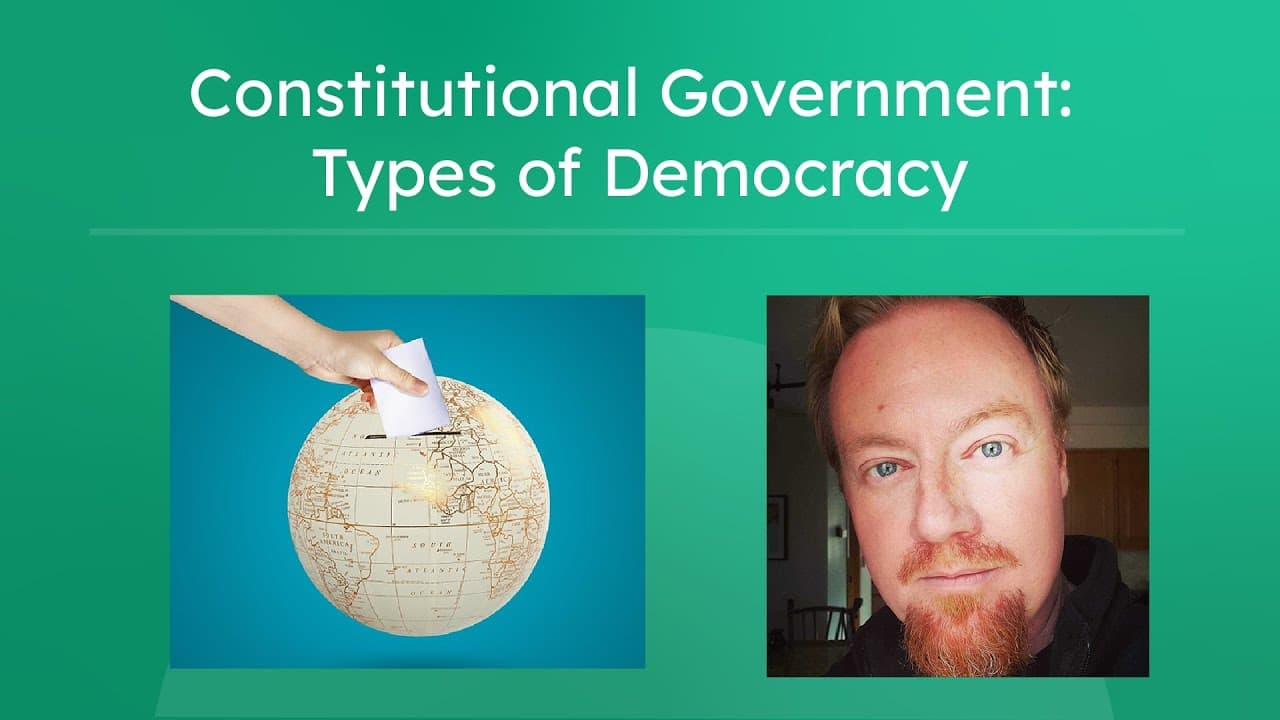
This educational video provides a comprehensive overview of the history, definitions, and forms of democracy. It begins by tracing the roots of democratic government back to Ancient Athens, introducing key historical figures like Cleisthenes and explaining foundational Greek concepts such as the Boule and Ecclesia. The narration breaks down the etymology of the word "democracy" and connects ancient practices to modern civic responsibilities. The core of the video analyzes three distinct forms of democracy: Direct, Pluralist, and Representative. Using relatable analogies like a family vacation planning session, it explains how direct democracy functions versus the efficiency and challenges of representative systems. It also explores the concept of pluralism, where various interest groups compete to influence policy, and contrasts this with authoritarian or single-view systems. For educators, this resource serves as an excellent primer for Civics and Government units. It moves beyond simple definitions to explore the "how" and "why" of government structures. The video emphasizes the critical role of the citizen, encouraging students not just to understand the system, but to actively participate through voting, debating, and staying informed. It is particularly useful for introducing the concept of a Republic and the balance between government efficiency and individual accountability.

Miacademy & MiaPrep Learning ChannelMiacademy & MiaPrep Learning Channel

11mins 24s

Materials

Bilingual Civics Picture Quiz

Bilingual Civics Picture Quiz

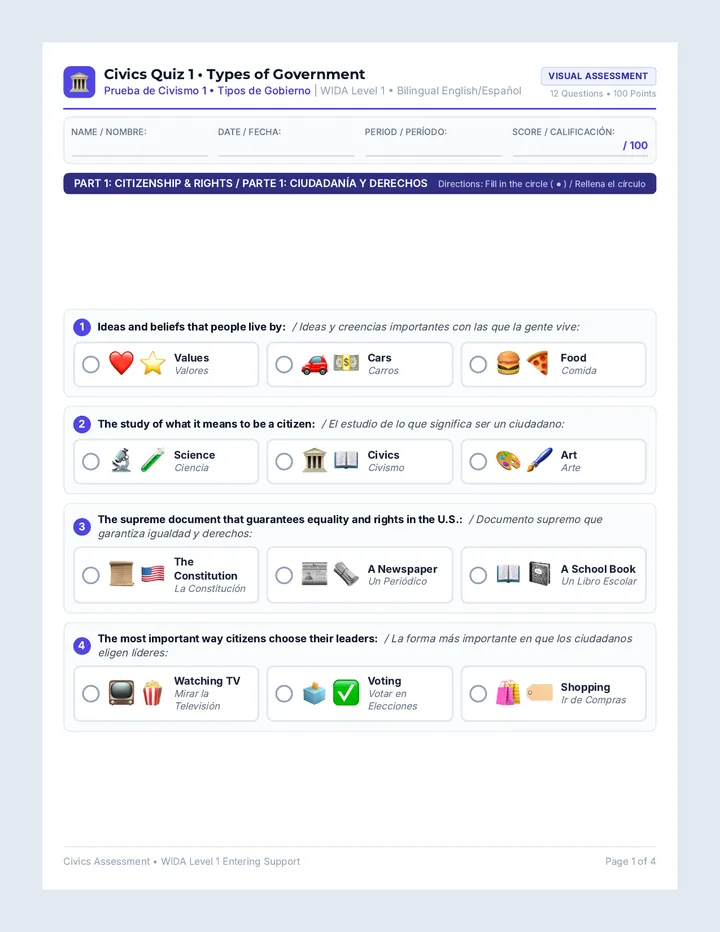
A 4-page print-ready bilingual (English and Spanish) Civics and Types of Government quiz specifically modified for WIDA Level 1 English Learners, featuring simplified sentence frames, pictorial icons for every prompt and choice, identical answer styling, and an educator scoring and accommodations guide.

N

nebouchard

Central American Freedom Reading Worksheet

Central American Freedom Reading Worksheet

A Grade 8-9 dual-language reading and multiple-choice worksheet covering Central American Independence Day (September 15, 1821). Features a 4-paragraph parallel English and Spanish text alongside 6 standards-aligned bilingual multiple choice questions assessing key historical concepts, leaders, and civic traditions.

GJ

Gerardo Jimenez Ramirez

Pocket Vocab Lab Activity Templates

Pocket Vocab Lab Activity Templates

A printable horizontal mini-composition notebook interactive vocabulary toolkit for Ohio 6th Grade Social Studies. Features wide horizontal inserts for dual-coding icon vaults, relational analogy engines, geographic semantic webs, and historical context decoders with cut lines and glue tabs.

MG

Mary Grose

Planet Architect Blueprint Worksheet

Planet Architect Blueprint Worksheet

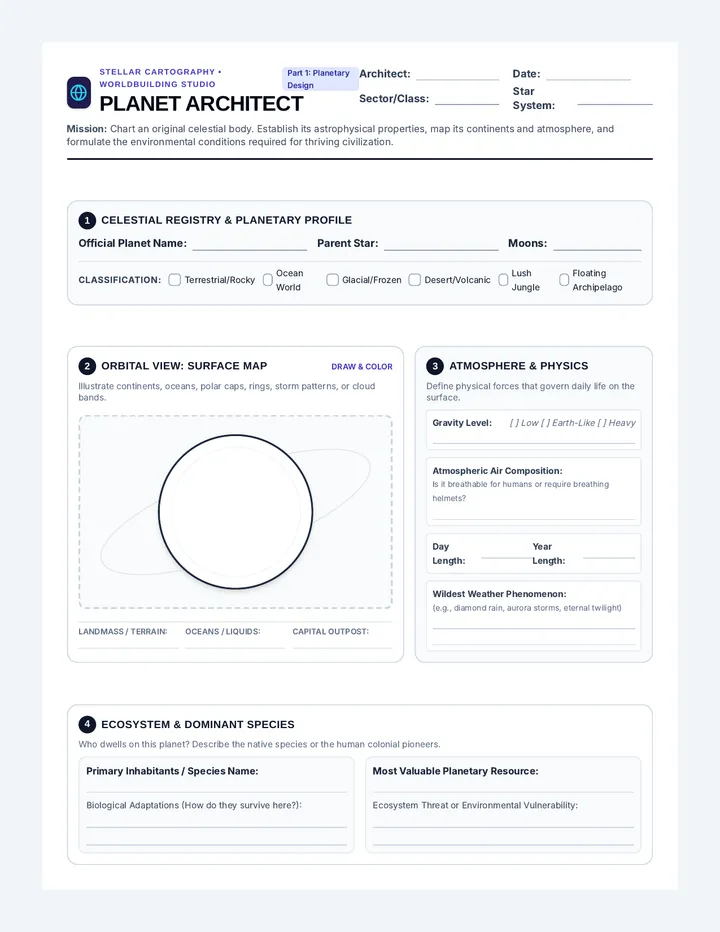
A comprehensive two-page worldbuilding and civics worksheet where students design a new planet, map its geography and environment, establish its governance, and draft its supreme laws.

DW

Destiny Williams

Nonantum Crossroads Worksheet

Nonantum Crossroads Worksheet

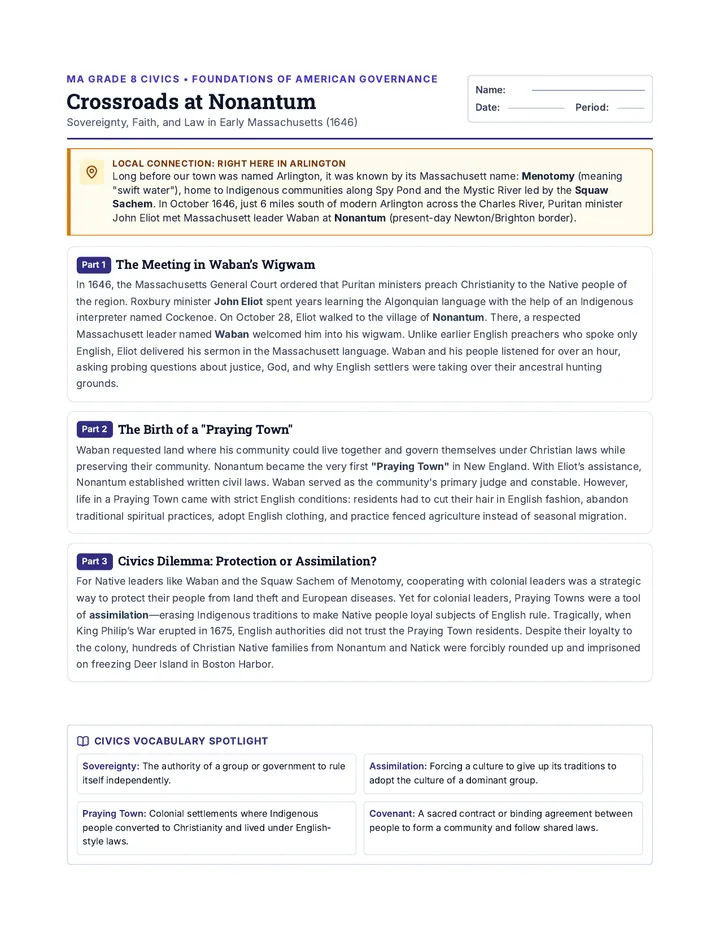
An 8th-grade inclusion civics worksheet exploring John Eliot, Waban, and the Praying Town of Nonantum (1646). Features clean print styling without grey backgrounds, chunked historical reading, local Menotomy connections, an explicit civics comparison question with writing lines in Section 2, and an extended ruled student writing response area in Section 3 that fills the page.

E

ebakke

Octo Leaps Worksheet

Octo Leaps Worksheet

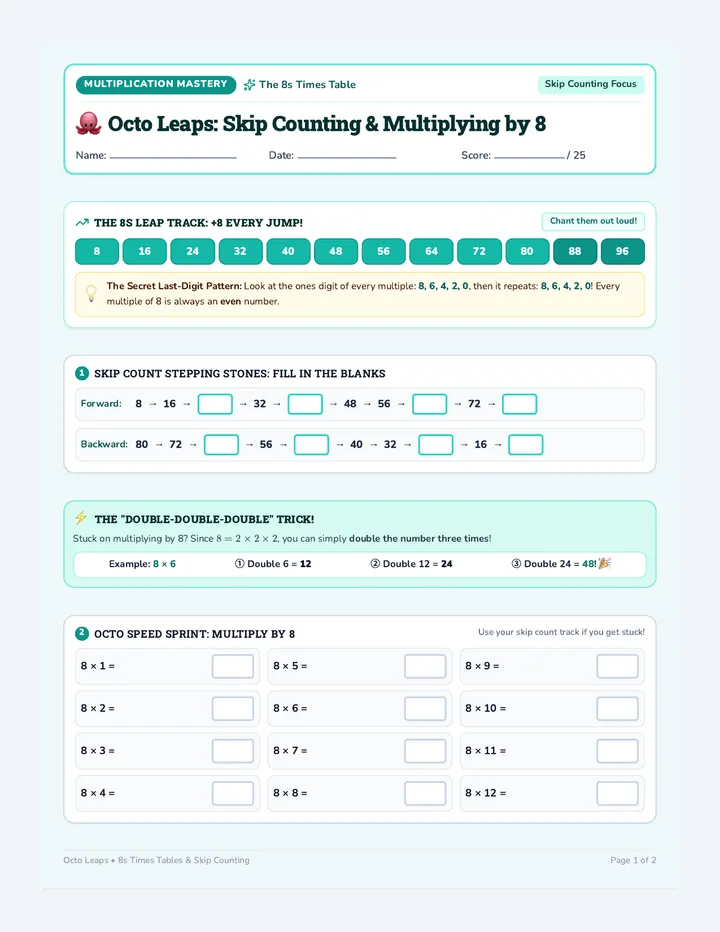
A vibrant two-page 8s multiplication and skip-counting worksheet featuring visual skip-counting tracks, the Double-Double-Double mental math hack, missing number trails, an 8s multiples grid maze, equal-groups modeling, and real-world word problems.

M

meagan_asp

Sequences

Invention Boom Slides

Modern Era Odyssey

A 13-day journey through modern American history, from the Industrial Revolution to the present day, focusing on key historical figures and major conflicts as outlined in the 5th Grade TEKS. Each lesson is designed for a quick 30-minute block, integrating multimedia and primary source analysis.

CH

Courtney Holdren

49
Cotton Kingdom Slides

Divided Nation

A 4-part exploration of the deep-seated tensions and pivotal events that led the United States to the brink of the Civil War, focusing on economic shifts, legislative compromises, and political flashpoints.

IA

Isabella Adkins

9
Liberty Ledger Annotation Worksheet

Spirit of Independence

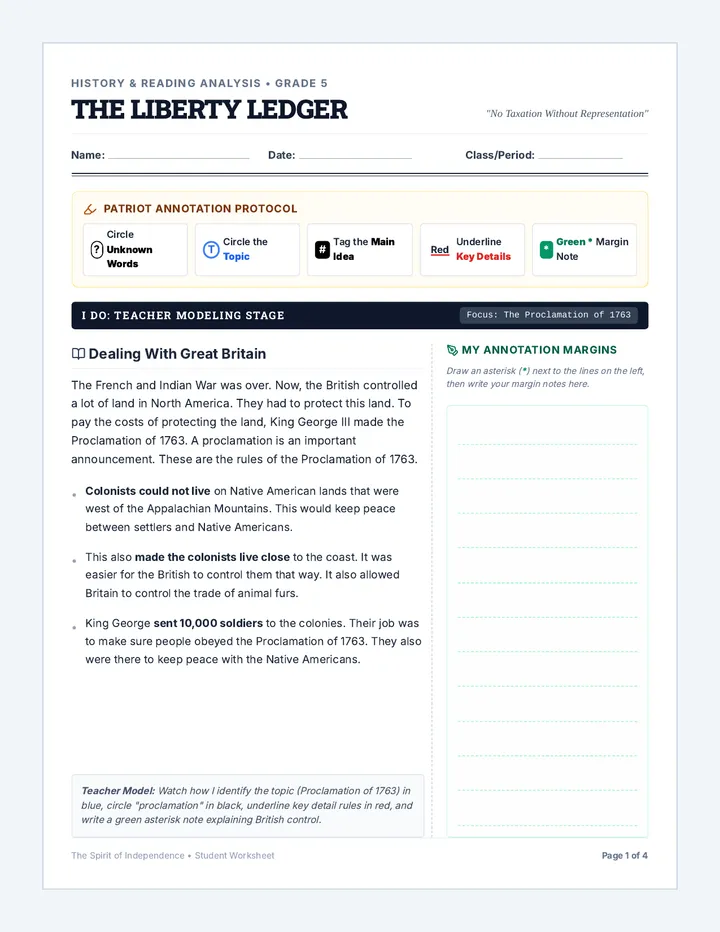
A fifth-grade social studies and active reading unit exploring the growing friction between Great Britain and the American colonies, focusing on the causes, consequences, and motivated actions that led to the American Revolution.

MN

Monica Nava

7
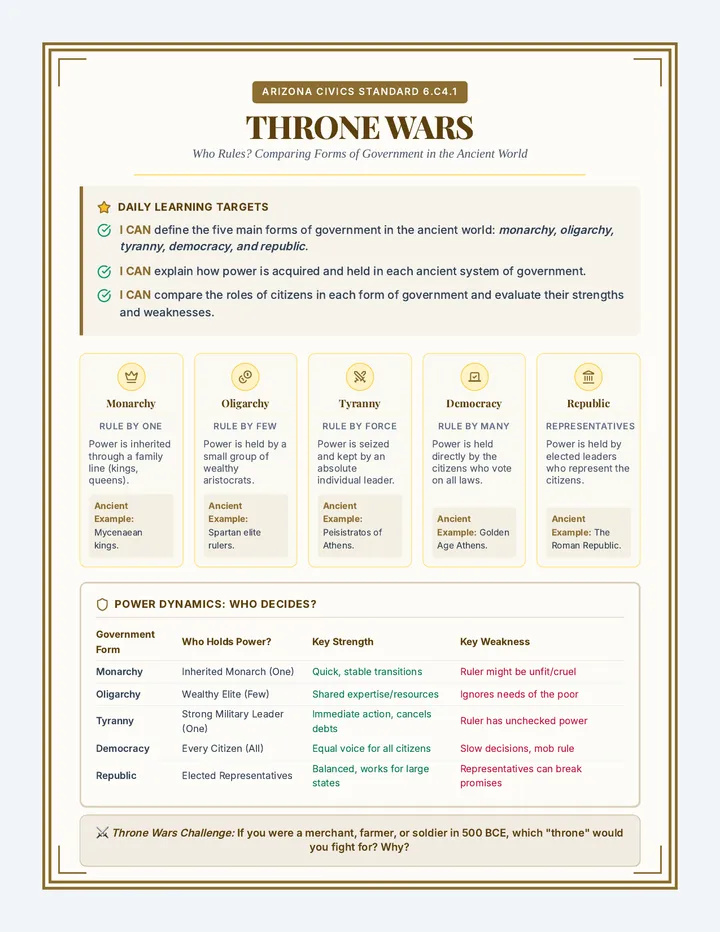
Throne Wars Anchor Chart

Rise of Civilization

A comprehensive 6th-grade social studies unit exploring the trajectory of human history, from nomadic hunter-gatherers and the cognitive evolution of early humans, to the agricultural revolution, and finally the development of structured ancient governments.

SZ

Sandy Zoerhoff

10
Teacher Facilitation Guide

Revolutionary Dilemmas

A comprehensive book club unit for the historical fiction novel 'My Brother Sam is Dead', focusing on the moral complexities of the Revolutionary War, character transformation, and historical context.

KL

Kim Leary

8
Thirteen Friends Worksheet

Democratic Foundations

A series of lessons exploring the foundational documents and processes of the United States government, from the birth of the nation to the creation of modern laws.

SB

Stephanie Bizeur

40