Lenny.com
Explore
Create
ActivitiesNewMathEnglish Language ArtsScience & EngineeringSocial StudiesGlobal LanguagesHealth & Physical EducationSpecial EducationCounseling & Life SkillsArts & CreativityESL
Lenny.com
Lenny.com
Explore
Create
ActivitiesNewMathEnglish Language ArtsScience & EngineeringSocial StudiesGlobal LanguagesHealth & Physical EducationSpecial EducationCounseling & Life SkillsArts & CreativityESL
Lenny.com
Social StudiesSocial Studies PracticesLocation WordsMapsOrder EventsChronology and CausationEvaluating SourcesHistorical ThinkingGeography, Humans, & the EnvironmentAmerican Symbols and LandmarksCitiesStatesState CapitalsRegions of the United StatesGeographic SkillsPhysical GeographyHuman GeographyRegional GeographyGeography of AfricaGeography of AsiaGeography of EuropeGeography of OceaniaGeography of the AmericasSociety and Environment of EuropeSociety and Environment of AsiaSociety and Environment of The AmericasSociety and Environment of the Middle EastSociety and Environment of AfricaHistoryPrehistoryComparing Ancient River CivilizationsAncient MesopotamiaAncient Egypt and KushAncient South AsiaEarly ChinaGreeceRome and the Byzantine EmpireAncient World HistoryNative Peoples of North AmericaNative Peoples of Mesoamerica and South AmericaAfrican EmpiresMedieval AsiaMedieval EuropeThe Silk RoadMedieval HistoryIslamic EmpiresWorld ReligionsRenaissance PeriodAge of ExplorationThe Thirteen ColoniesThe American RevolutionUS History Early RepublicFounding of the United StatesUS History AntebellumUS Civil WarReconstruction PeriodThe Gilded AgeUS ImperialismWorld ImperialismWorld War IUS History 1920sGreat DepressionWorld War IIThe Cold WarUS History 1950-60sUS History 1960s-70sWorld History 20th CenturyContemporary US HistoryContemporary World HistoryHolidaysCivics and GovernmentCitizenshipGovernment FoundationsThe ConstitutionUS ConstitutionExecutive BranchLegislative BranchJudicial BranchState and LocalPolitical ParticipationPublic PolicyPolitical SystemsPower and AuthoritySocial MovementsDefining DevianceTheories of DevianceCrime and Criminal JusticeEconomicsBasic Economic PrinciplesSupply and DemandWhat is MoneyEconomic FundamentalsMicroeconomicsMacroeconomicsBanking and FinanceEconomic SystemsGlobal EconomicsCorporations and PowerThe Changing WorkplaceUnemployment and LaborClass and InequalitySocial MobilityGlobal InequalityPsychologyHistory of PsychologyPsychology as a ScienceBrain and Nervous SystemNeuroscience and BehaviorGenetics and BehaviorSleep and ConsciousnessSensory ProcessesPerceptual OrganizationClassical ConditioningOperant ConditioningObservational LearningCognitive LearningMemory ProcessesThinking and Problem SolvingLanguage and CognitionTheories of MotivationStress and CopingPrenatal and Infant DevelopmentChildhood DevelopmentAdolescent DevelopmentAdulthood and AgingSelf and IdentitySocial CognitionSocial InfluenceAttraction and RelationshipsGroup BehaviorPrejudice and DiscriminationAnxiety and Mood DisordersClinical PsychologyForensic PsychologyPhilosophy & EthicsIntroduction to PhilosophyMajor Philosophers & IdeasMind and Body ProblemFree Will vs DeterminismEthics & MoralityReligion & PhilosophyPolitical Philosophy
Lenny.com

Solutions

Lenny for EducatorsLenny for SchoolsLenny for Districts

Product

ExploreSign inCreateSupportAbout

Resources

Getting startedMTSS Acceleration Program

© 2026 Lenny Learning Inc.

TermsPrivacyAccessibility
LinkedInInstagramX
Lenny

US History Antebellum

Sectional tensions, westward expansion, and escalating conflicts over slavery between the War of 1812 and the Civil War. Examines legislative compromises, the abolitionist movement, and the economic divergence between the industrial North and agrarian South.

Videos

Defining Heroes and Traitors in American History

Defining Heroes and Traitors in American History

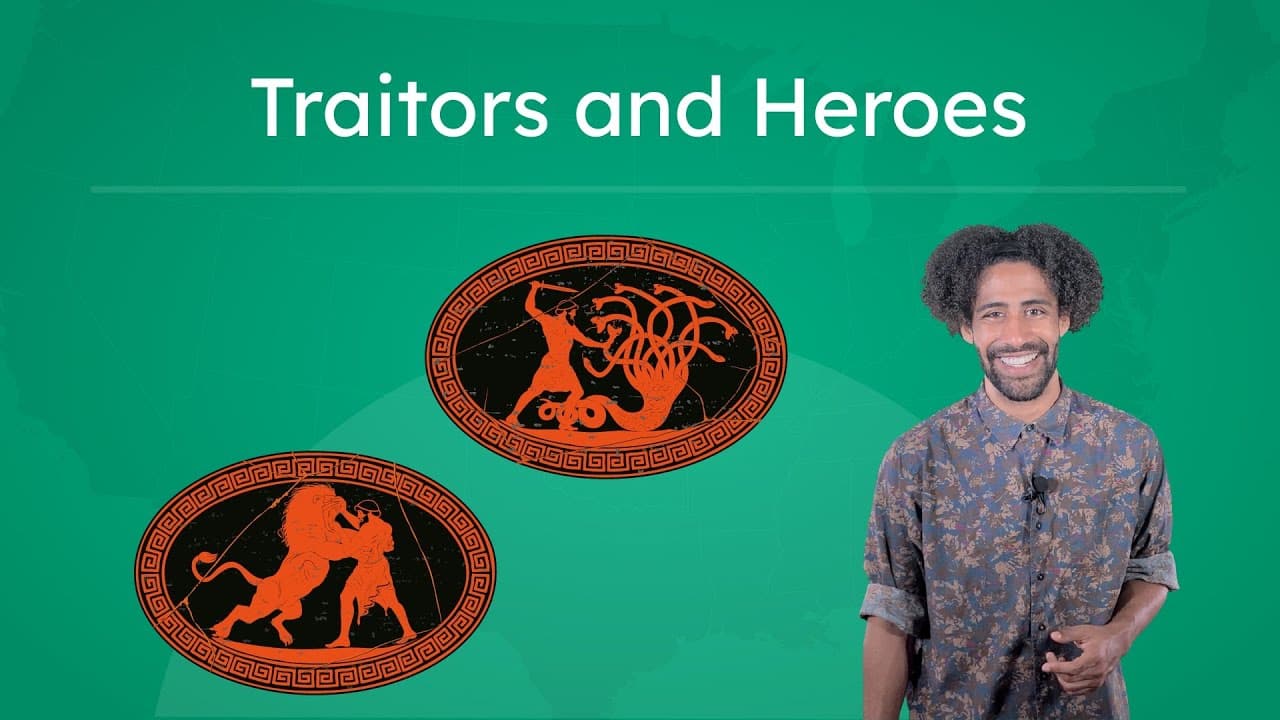
This educational video explores the complex and often subjective definitions of "hero" and "traitor" through three distinct case studies from American history. The narrator challenges students to look beyond simple definitions and consider how historical context, personal values, and perspective shape these labels. The video examines John Adams' controversial defense of British soldiers after the Boston Massacre, Colonel John Chivington's role in the horrific Sand Creek Massacre, and Carry Nation's radical "hatchetations" during the temperance movement. The video delves into deep ethical questions about justice, duty, and morality. It asks students to evaluate whether John Adams was a traitor to the colonial cause or a hero of justice for defending the enemy. It contrasts Chivington's self-proclaimed heroism in protecting settlers with the brutal reality of massacring peaceful Cheyenne and Arapaho people. Finally, it analyzes Carry Nation's crusade against alcohol, asking if her violent methods undermined her virtuous goals. Each segment includes pauses for reflection and specific guiding questions. Teachers can use this video to foster critical thinking and historical analysis skills. It serves as an excellent anchor for lessons on the American Revolution, Native American history, or the Prohibition era. By presenting historical figures who defy easy categorization, the video encourages students to engage with nuance and ambiguity. It is particularly useful for sparking debates about the rule of law, the ethics of war, and the validity of different protest methods.

Miacademy & MiaPrep Learning ChannelMiacademy & MiaPrep Learning Channel

11mins 30s

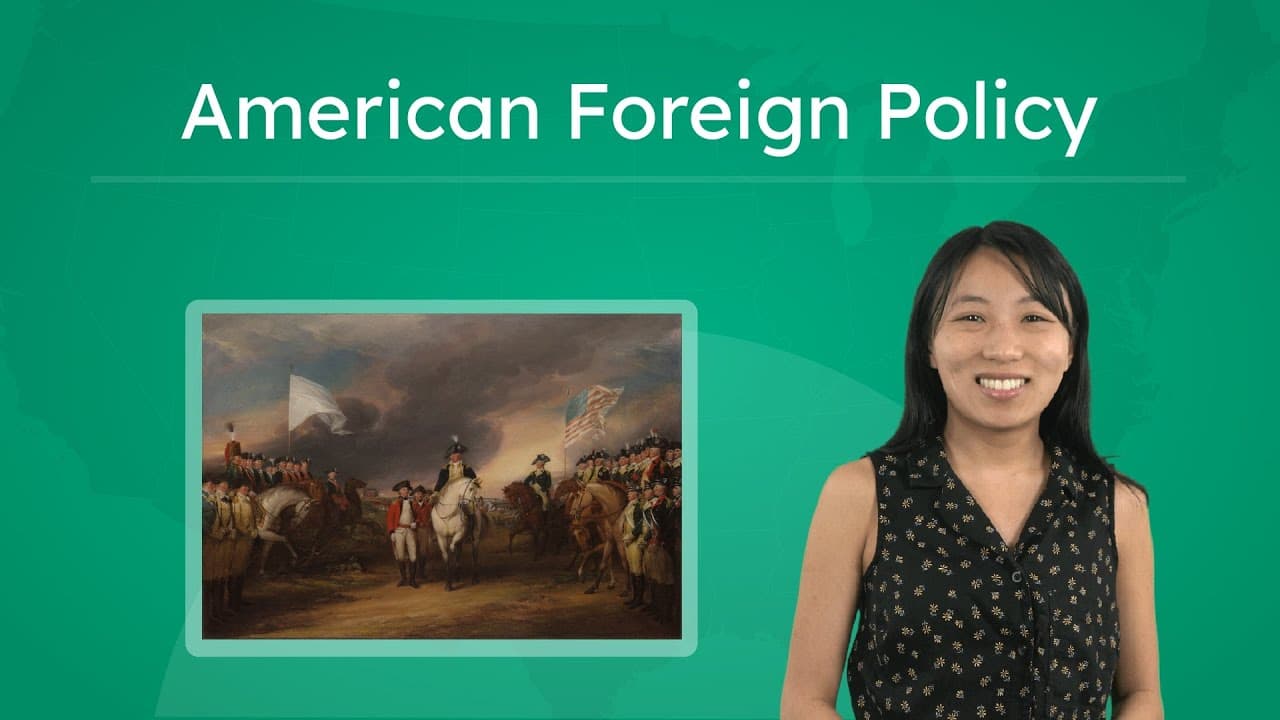
How U.S. Foreign Policy Evolved: Isolationism to Imperialism

How U.S. Foreign Policy Evolved: Isolationism to Imperialism

This educational video explores the evolution of United States foreign policy throughout the 19th and early 20th centuries, using an engaging analogy of a teenager going through different life phases. The narrator breaks down complex political concepts into three main categories: Isolationism, Interventionism, and Imperialism. By comparing a nation's growth to human development, the video makes abstract historical strategies accessible and relatable for students.

Miacademy & MiaPrep Learning ChannelMiacademy & MiaPrep Learning Channel

12mins 18s

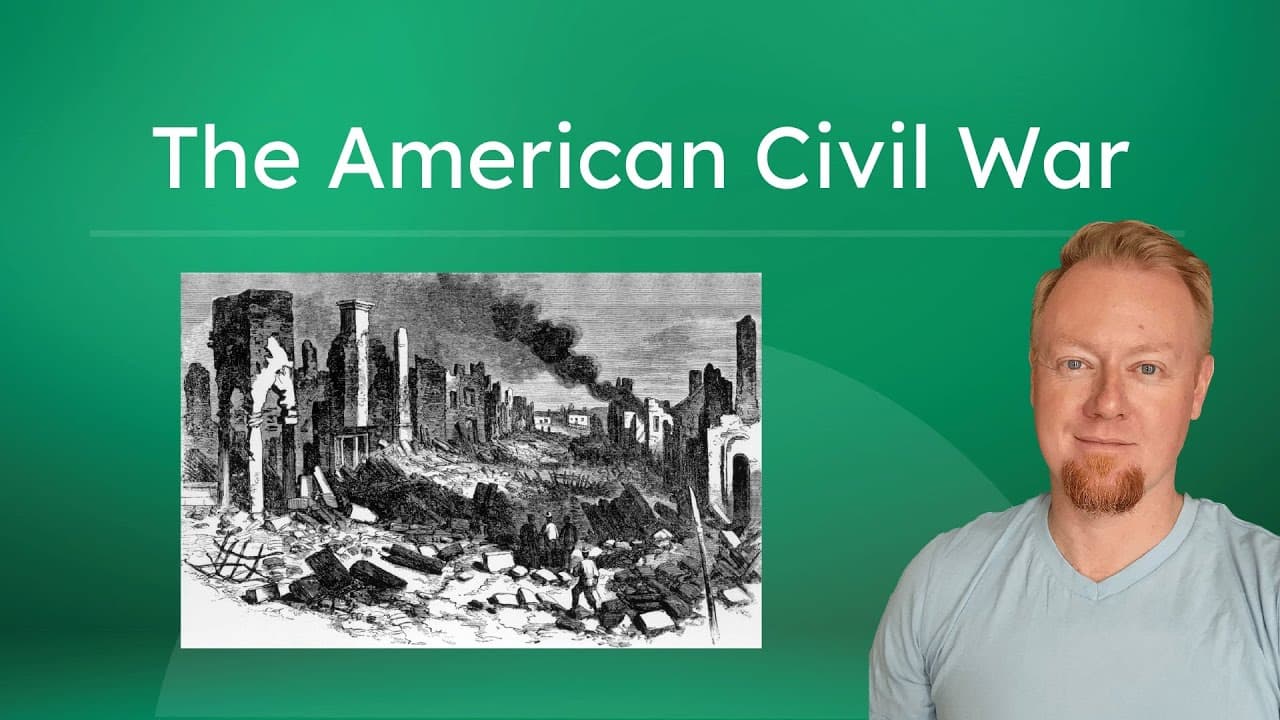
Causes and Aftermath of the American Civil War

Causes and Aftermath of the American Civil War

This comprehensive educational video provides a detailed overview of the American Civil War, tracing its origins from deep-seated economic and political divisions between the North and South to the lasting impacts of the Reconstruction era. It uses a clear, inquiry-based structure centered around four guiding questions that explore the causes of the conflict, the specific events that triggered the outbreak of war, the human and financial toll of the fighting, and the major changes that occurred in the United States afterward. The content delves into complex historical themes, including the failure of political compromises like the Missouri Compromise and the Compromise of 1850, the legal ramifications of the Dred Scott decision, and the economic drivers behind slavery. It doesn't shy away from the harsh realities of the era, discussing the casualities of war, the assassination of President Lincoln, and the subsequent rise of Jim Crow laws that undermined the progress of the 13th Amendment. For educators, this video serves as an excellent anchor for a unit on the Civil War and Reconstruction. Its structured approach allows teachers to pause and discuss specific historical milestones, while the inclusion of maps, graphs, and primary source quotes offers multiple entry points for analysis. It effectively connects the political machinations of the 1850s to the social struggles of the post-war era, helping students understand the long-term consequences of this pivotal chapter in American history.
Miacademy & MiaPrep Learning ChannelMiacademy & MiaPrep Learning Channel

11mins 10s

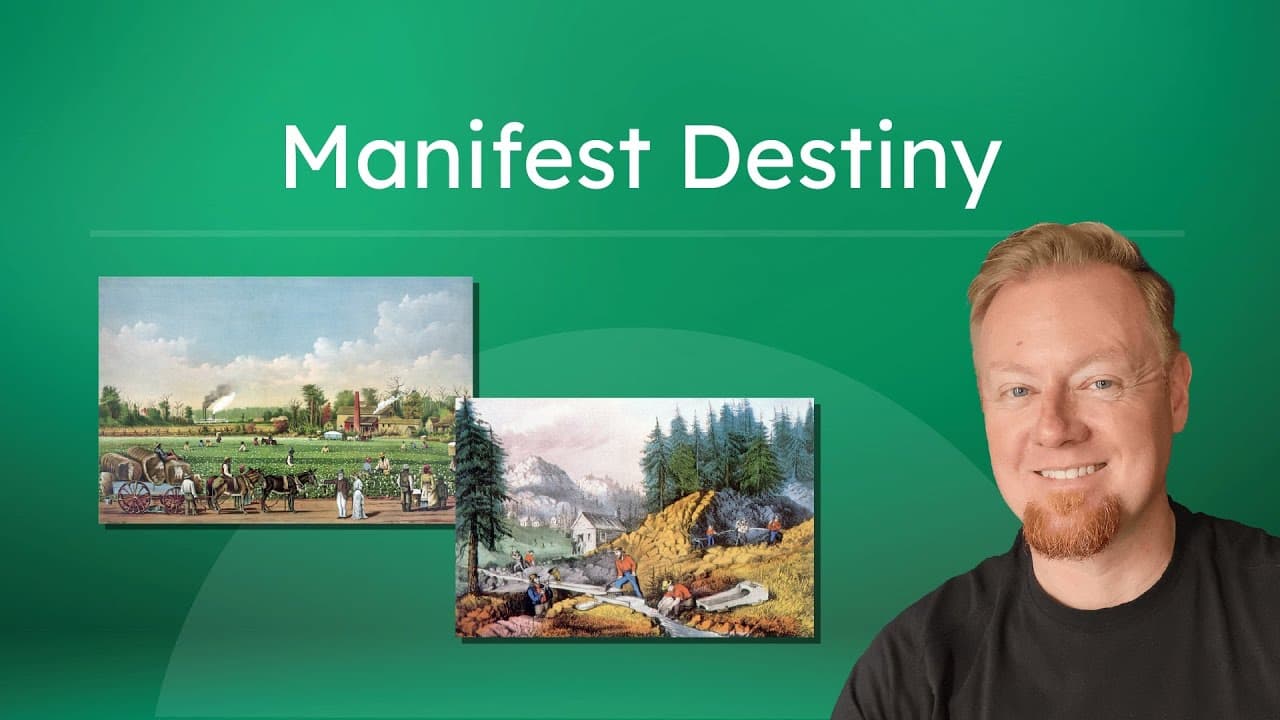
How Westward Expansion Divided America

How Westward Expansion Divided America

This educational video explores the complex history of Westward Expansion in the United States during the 19th century, linking the concept of Manifest Destiny to the eventual outbreak of the Civil War. It examines how the drive to settle the frontier was motivated by a desire for land, freedom, and the spread of democratic values, while simultaneously exposing deep hypocrisies regarding the treatment of Native Americans and the expansion of slavery. The narrator details the political mechanisms of statehood, such as the Northwest Ordinance, and explains how the addition of new territories upset the delicate balance of power in Congress. Key historical themes include the ideology of Manifest Destiny, the democratization of voting rights for white men, the forced removal of indigenous populations (Trail of Tears), and the economic entrenchment of slavery in the South. The video specifically highlights critical turning points like the Missouri Compromise of 1820 and the election of Abraham Lincoln, demonstrating how territorial growth fueled sectional tensions between the North and South. Ideally suited for middle and high school U.S. History curriculums, this video serves as an excellent primer on the causes of the Civil War. It encourages students to think critically about American values by contrasting the ideals of the Declaration of Independence with the realities of Indian Removal and slavery. Teachers can use the built-in guiding questions to facilitate class discussions on how geography shapes politics and how economic interests can drive social conflict.

Miacademy & MiaPrep Learning ChannelMiacademy & MiaPrep Learning Channel

11mins 23s

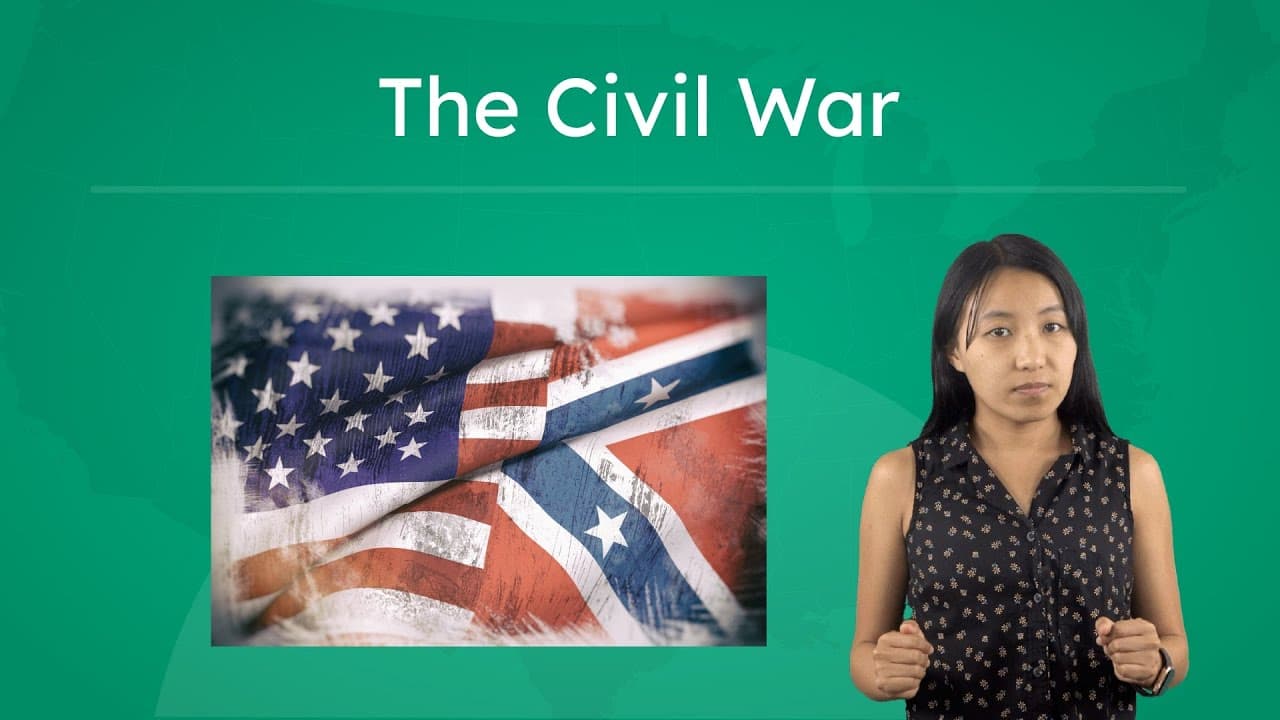
How Sectionalism Divided America Before the Civil War

How Sectionalism Divided America Before the Civil War

This educational video provides a comprehensive analysis of the sectional differences between the Northern and Southern United States that precipitated the American Civil War. Moving beyond simple timelines, the narrator breaks down the conflict into three distinct categories: economic disparities, cultural divides, and conflicting political ideologies. The video uses the dramatic historical event of the caning of Senator Charles Sumner as a framing device to illustrate how deep the animosity had run by the 1850s. The content explores how the North's industrial economy, fueled by immigrant labor and government infrastructure, clashed with the South's agrarian, slave-based economy. It details how these economic realities created two distinct cultures: a mobile, urbanizing North versus a rigid, rural Southern hierarchy. Furthermore, it explains how these differences led to incompatible interpretations of the Constitution regarding state versus federal power and the rights of individuals. For educators, this video serves as an excellent foundational tool for a Civil War unit. It moves students beyond memorizing battles to understanding the structural causes of the war. The video includes built-in guiding questions and pause points, making it ready-made for interactive classroom viewing. It is particularly useful for teaching students how to categorize historical causes (economic, social, political) and analyze how regional differences can fracture a nation.

Miacademy & MiaPrep Learning ChannelMiacademy & MiaPrep Learning Channel

11mins 54s

The History of Religion and Diversity in America

The History of Religion and Diversity in America

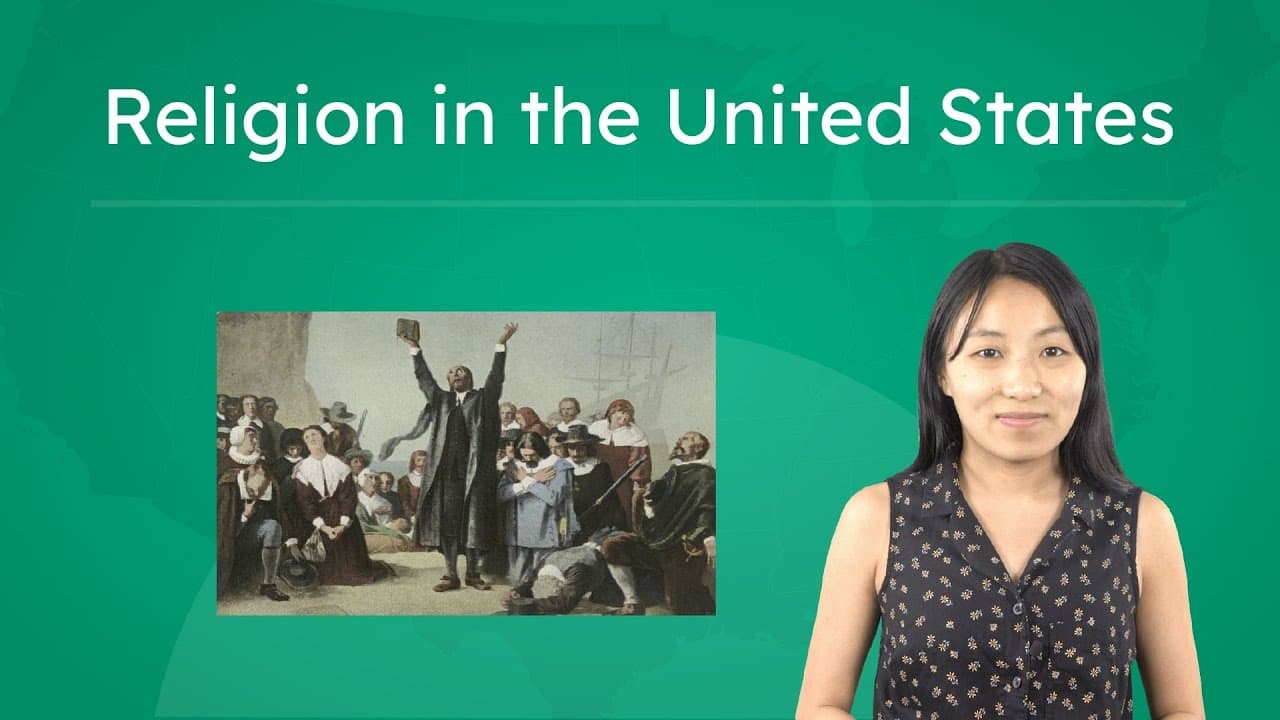
This educational video explores the evolution of the religious landscape in the United States, tracing the journey from a predominantly Protestant nation to a diverse "kaleidoscope" of faiths. The narrator guides students through three major historical phases: the dominance of Protestant Christianity reinforced by the Great Awakening, the diversification brought about by waves of immigration, and the challenges of discrimination faced by minority religious groups. Through clear definitions and historical examples, the video connects these past events to the modern cultural fabric of America. Key themes include the tension between religious freedom and societal discrimination, the impact of immigration on cultural demographics, and the role of religious revivals in American history. The video specifically highlights the Great Awakening's effect on Protestantism, the influx of Catholic and non-Christian immigrants in the 19th century, and a detailed case study on the antisemitism faced by Jewish immigrants. It emphasizes how legal protections like the First Amendment often conflicted with social realities. This resource is highly valuable for U.S. History and Civics classrooms. It provides a structured framework for understanding how American society became religiously diverse. Teachers can use the built-in pause points to facilitate analysis of primary sources (like Jonathan Edwards' sermons) or discuss the gap between constitutional ideals and historical practices. The video encourages critical thinking about tolerance, diversity, and the immigrant experience.

Miacademy & MiaPrep Learning ChannelMiacademy & MiaPrep Learning Channel

11mins 56s

Materials

Market Economy Seminar Ledger

Market Economy Seminar Ledger

A detailed 5-page seminar preparation ledger for the Industrial Revolution and Market Economy lesson. Features a dedicated cover page with relevant historical icons and a prominent Socratic prompt, three separate article analysis pages, and a final synthesis evaluation. Writing lines are darkened for optimal print quality.

JG

Joshua Griffith

Zoom Out History Packet

Zoom Out History Packet

A 6-page bilingual scaffolded 8th grade history packet on the ANEZZC writing method and Zoom Out strategy translated primarily into Spanish with English glossary, bilingual scaffolds, and visual supports for ELL/SGI students.

SP

Sheridan Pickett

APUSH Blue Book DBQ Essay Booklet

APUSH Blue Book DBQ Essay Booklet

An authentic AP US History Blue Book styled essay booklet featuring a printer-friendly light-colored cover page and 5 pages of college-ruled writing paper for print or digital completion.

JG

Joshua Griffith

Story that Changed History Worksheet

Story that Changed History Worksheet

Polished worksheet with refined page breaks after each part. Increased writing space on Page 2 and Page 3 for better student work areas and visual balance. Corrected text alignment in the matching section.

DO

Darcy O'Connor

Road to Conflict Chart

Road to Conflict Chart

A printable graphic organizer chart for students to analyze the causes of the Mexican-American War, tracking key events and how each escalated tensions between the United States and Mexico.

AM

Alex Martinez

Westward Trails Morning Packet

Westward Trails Morning Packet

An 8-page Westward Expansion DBQ morning work packet for 8th-grade US History featuring primary sources, document analysis skill-building (Context, Audience, POV, Claim), and structured text-dependent questions without full essay writing.

AW

Austin WIllis

Sequences

Cotton Kingdom Slides

Divided Nation

A 4-part exploration of the deep-seated tensions and pivotal events that led the United States to the brink of the Civil War, focusing on economic shifts, legislative compromises, and political flashpoints.

IA

Isabella Adkins

9
Curriculum Blueprint Document v2

History Horizon Sequence

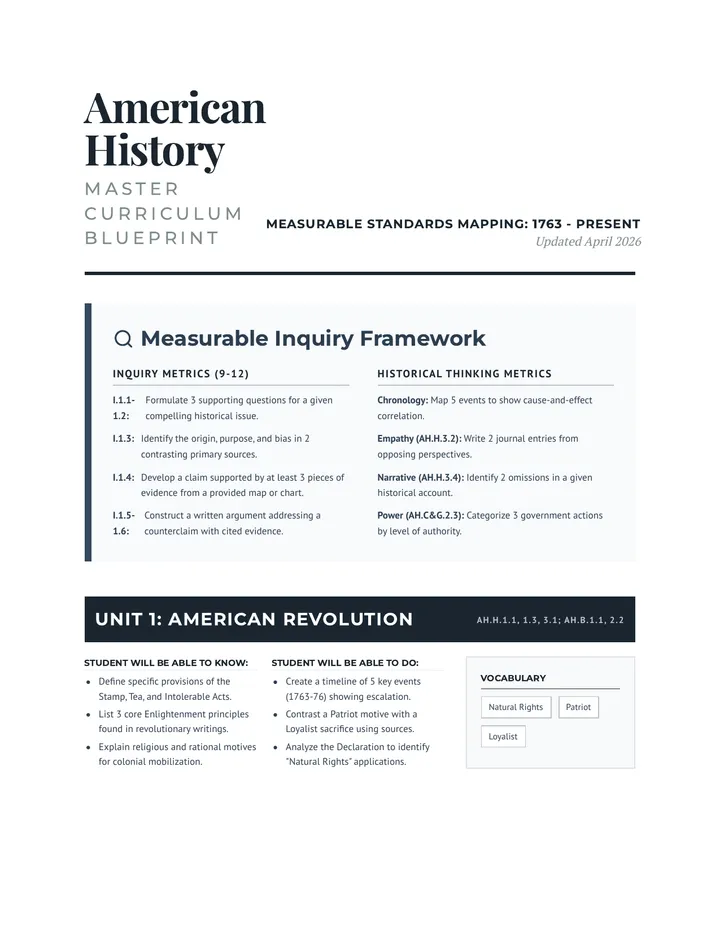
A comprehensive high school curriculum plan for American History, covering 13 units from the American Revolution to the modern era, aligned with North Carolina Social Studies standards.

AK

Amity Kea

21
Freedom Seekers Lesson Plan

Freedom Seekers

A comprehensive 3-day unit for Grade 5 exploring the plantation economy, the lived experiences of enslaved people, the abolitionist movement, and the Emancipation Proclamation.

TZ

Terri Zappala

6
Blueprint Slides

Republic Reboot

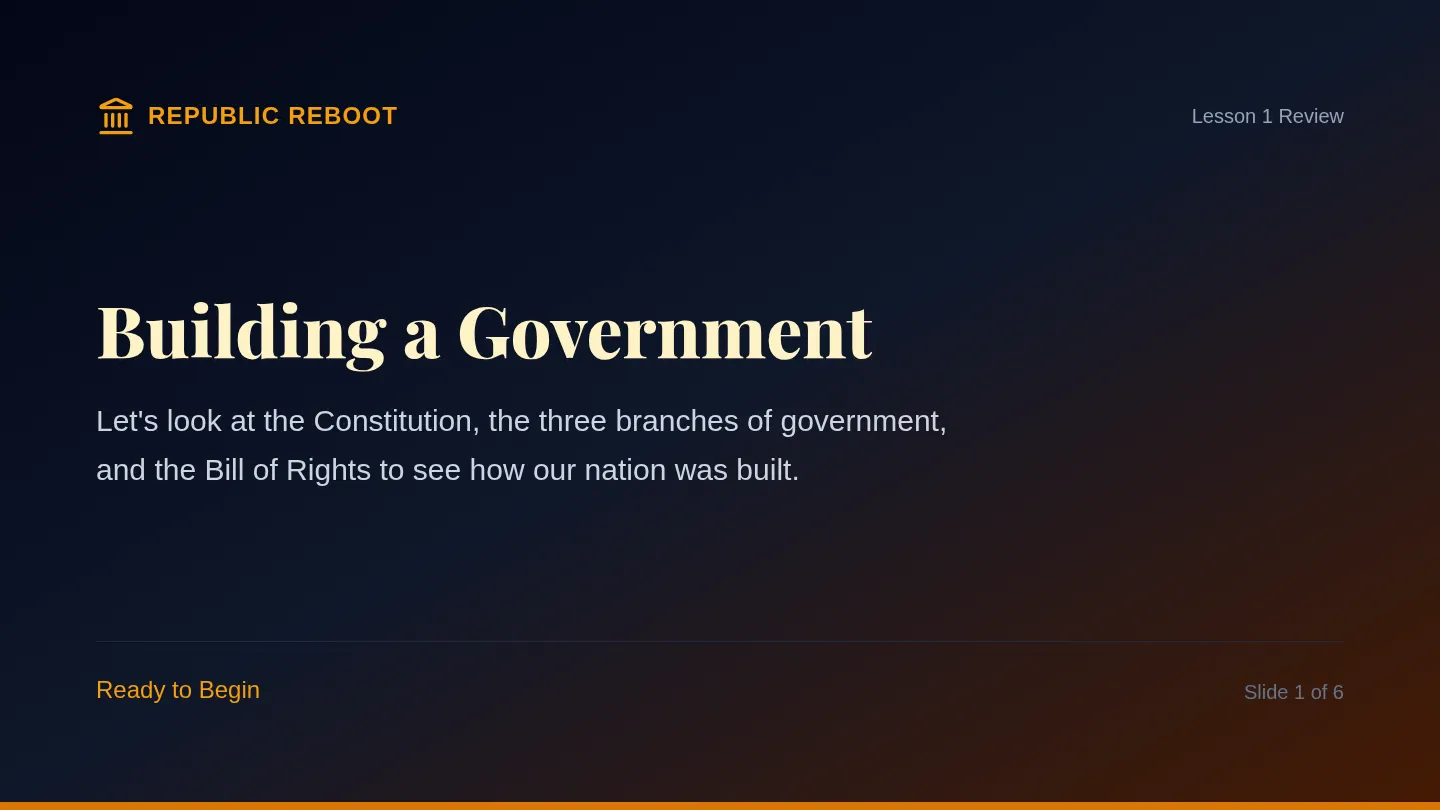
A comprehensive review unit for incoming 8th graders covering early American history to 1850. Students will review the structure of the US government, the Bill of Rights, early presidential administrations, the War of 1812, and the impacts of westward expansion.

AM

Amy Metheny

8
Spotlight on History Slides

Idaho History Stage

A comprehensive set of historical skits and supporting materials for 4th-grade students to explore Idaho's past through performance. Students engage with the lives of pioneers, trappers, miners, sheepherders, and indigenous peoples.

AG

Angela Grant

4
Westward Dreams Slides

Westward Bound

A unit on Westward Expansion designed for students working at a 3rd-grade academic level, focusing on the reasons for moving west and daily life on the Oregon Trail.

KM

Kristina Martin

10

Lessons

History Sprint Pacing Guide

STAAR History Sprint

A comprehensive pacing guide and activity resource designed to cover the remaining 11th Grade US History TEKS before the STAAR test on April 16th. This lesson provides a day-by-day calendar for A/B block schedules and high-engagement activities for each remaining historical era.

BB

Bridgette Burdick

51
Border Lines Activity

Harriet Tubman Escape

A lesson exploring Harriet Tubman's 1850 escape and the significance of the Mason-Dixon Line as a geographical and legal boundary in the pre-Civil War United States.

TL

Tanya Larson

46
Massachusetts Milestones Slideshow

New England Chronicles

An expansive journey through the history of New England, divided into state-by-state volumes. This series provides middle school students with 180 daily historical warm-ups, exploring major milestones from pre-colonial times to modern innovations.

SF

Steven Flint

6
Settlement Guide Teacher Notes

Plotting the Plains

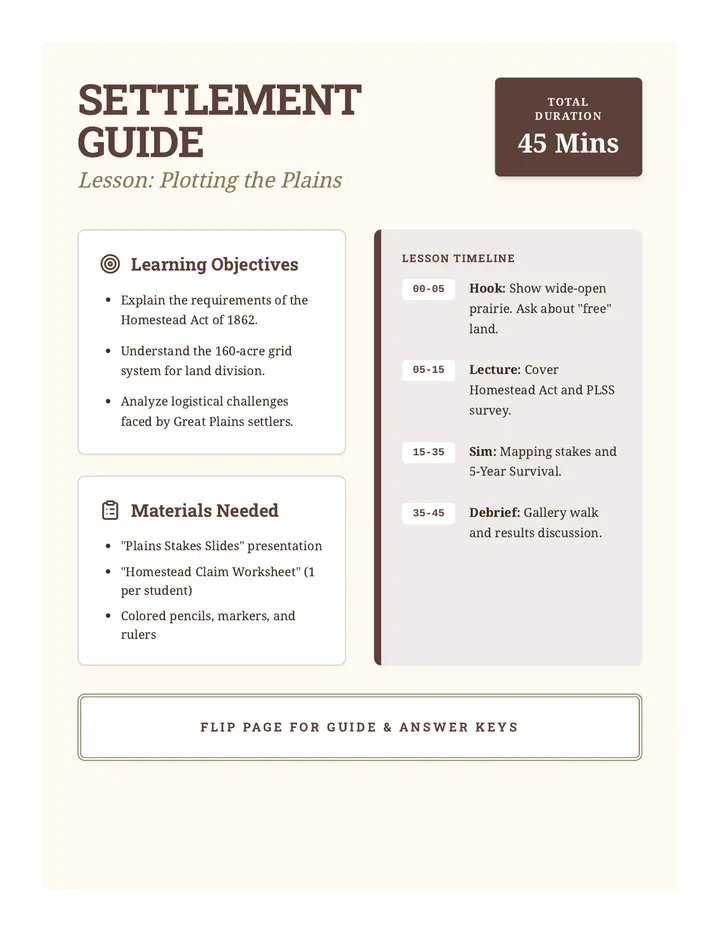
This lesson explores the Homestead Act of 1862 and the logistical realities of settling the American West, focusing on the grid system and survival challenges.

LB

Laurie Baron

3
Choice Board Evaluation Key

Removal Rhetoric Analysis

A comprehensive analysis of Andrew Jackson's 1830 speech to Congress, focusing on how his perspective and purpose shaped the rhetoric used to justify the Indian Removal Act. Students will evaluate primary source excerpts through Think-Pair-Share and a Quiz Bee competition.

V

vivianbelarmino

7
Black History Scavenger Hunt Lesson Plan

Black History Scavenger Hunt

A game-based lesson where students solve clues to discover significant figures and events in Black history, promoting cultural awareness and teamwork.

JH

Jade Hodge

5