Westward Trails Morning Packet
U.S. History 8 Unit 5: The American West
Quarter 2 • Week 3
Week 3 Morning Work
Westward Expansion, Migration & Frontier Conflict (1830–1890)
"A daily primary source laboratory to master Point of View, Historical Context, Audience, and Author Claims."
Student Name:
Class Period:
Date Assigned:
Teacher:
The DBQ Core 4 Analysis Toolkit (Your Daily Guide)
1. Historical Context (When/Where)
What major events, laws, or cultural shifts were happening when this document was created?
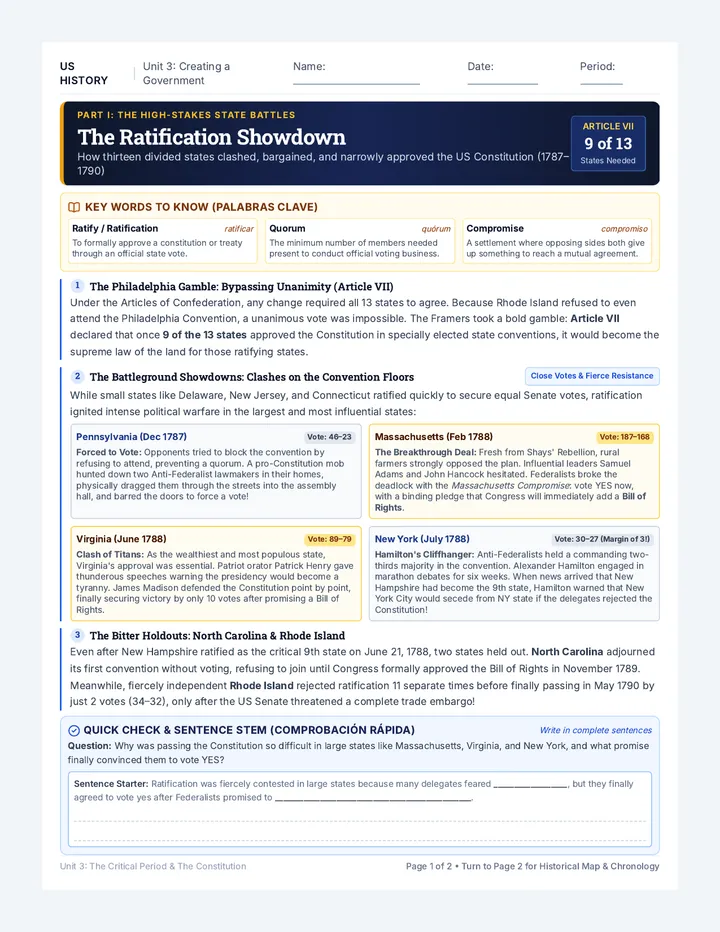
2. Intended Audience (To Whom)
Who was this specifically created for? (Voters, lawmakers, settlers, public, foreign nations?)
3. Point of View / POV (Who & Why)
Who is the author? What is their background, bias, motive, or personal stake in the topic?
4. Author's Claim (What)
What main argument, demand, or message is the creator attempting to prove or communicate?
Weekly Packet Roadmap & Tracker
Day 1 (Page 2): Manifest Destiny & The Texas Debate
Doc A: John L. O'Sullivan [ ]
Day 2 (Page 3): Trails West & Overland Migrations
Doc B: Pioneer Diaries & Guidebooks [ ]
Day 3 (Page 4): The California Gold Rush & Miner Protests
Doc C: Norman Asing & Tax Acts [ ]
Day 4 (Page 5): The Homestead Act & The Exodusters
Doc D: Homestead Law & Broadside [ ]
Day 5 (Page 6): The Transcontinental Railroad & The Plains
Doc E: Central Pacific & Sheridan [ ]
Day 6 (Page 7): Indigenous Sovereignty & The Dawes Act
Doc F: Chief Joseph & Allotment Act [ ]
Review (Page 8): Master DBQ Crosswalk & Claim Lab
Synthesis & Evidence Matching [ ]
Instructions: Complete one assigned page each morning (10–12 minutes). Bring daily to class. Page 1 of 8
Day 1 • Morning Work
Manifest Destiny & Expansionist Ideology
Date: ____________
Score: ___ / 10 pts
Document A: Editorial on American Territorial Destiny July–August 1845
"Texas is now ours... Her star and her stripe may already be said to have taken their place in the glorious blazon of our common nationality... Other nations have undertaken to intrude themselves into it, between us and the proper parties to the case, in a spirit of hostile interference against us, for the avowed object of thwarting our policy and hampering our power, limiting our greatness and checking the fulfillment of our manifest destiny to overspread the continent allotted by Providence for the free development of our yearly multiplying millions."
— John L. O'Sullivan, editor, The United States Democratic Review, "Annexation" Topic: Annexation of Texas & Western Lands
Step 1: Core 4 Document Deconstruction
1. Historical Context:
What major debate was happening regarding Texas and western borders in 1845?
2. Intended Audience:
Who was O'Sullivan trying to convince or rally behind annexation?
3. Point of View (POV):
What political or nationalist perspective influences O'Sullivan's tone?
4. Author's Main Claim:
What is his central claim about why the U.S. has the right to expand?
Step 2: Evidence Analysis Questions
Question 5: What specific word does O'Sullivan use to suggest that American expansion is guided by a higher divine power, and how does that justify taking new territory?
Question 6: How might a Mexican diplomat or a Native American tribal leader view O'Sullivan's claim about European and rival "hostile interference"?
Week 3 Morning Work • U.S. History Grade 8 Page 2 of 8
Day 2 • Morning Work
Overland Migrations & The Oregon Trail
Date: ____________
Score: ___ / 10 pts
Doc B1: Pioneer Diary Entry 1853
"June 1: We have had a terrible day. Passed five fresh graves. The dust is almost suffocating... Some wagons broke an axle crossing the river. Husband is down with fever and children are crying for clean water. There is no wood for fires; we must burn buffalo chips."
— Amelia Stewart Knight, mother traveling to Oregon with 7 children
Doc B2: Emigrant Guidebook 1845
"In Oregon and California, perpetual summer reigns! The soil yields ninety bushels of wheat to the acre without labor. Inexhaustible timber, mild climates, and flowing rivers await all enterprising families who make the simple overland journey."
— Lansford W. Hastings, The Emigrants' Guide to Oregon and California
Step 1: Comparative Core 4 Analysis
1. Historical Context:
Why were hundreds of thousands of Americans moving along western trails in the 1840s–1850s?
2. Intended Audience:
How did Lansford Hastings' intended audience differ from Amelia Knight's diary audience?
3. Point of View & Bias:
Why might Hastings exaggerate the ease of the journey compared to Knight's account?
4. Contrasting Claims:
State one claim in Hastings that is directly disproven by Knight's eyewitness diary.
Step 2: Evidence Analysis Questions
Question 5: Cite two specific environmental hardships mentioned in Document B1 that made the overland crossing dangerous for pioneer families.
Question 6: If you were a historian evaluating the risks of the Oregon Trail, which source would you consider more reliable for daily life, and why?
Week 3 Morning Work • U.S. History Grade 8 Page 3 of 8
Day 3 • Morning Work
The Gold Rush & Diverse Experiences
Date: ____________
Score: ___ / 10 pts
Document C: Open Letter to California Governor John Bigler May 1852
"Sir: The effect of your late message has been to prejudice the public mind against my countrymen... You have argued that we are an inferior race, incapable of progress, and that our labor degrades white men... But we have paid the Foreign Miners' Tax; we have built stores, drained rivers, and opened roads. We are not degraded convicts; we are industrious merchants, farmers, and miners who seek liberty and lawful industry under your Constitution."
— Norman Asing, Chinese merchant & community leader in San Francisco Topic: Foreign Miners' Tax & Nativism
Step 1: Core 4 Document Deconstruction
1. Historical Context:
What event caused tens of thousands of global migrants to rush to California after 1848?
2. Target Audience:
Who is Norman Asing addressing directly, and who is his broader public audience?
3. Point of View (POV):
How does Asing's status as an immigrant merchant influence his argument for equal treatment?
4. Author's Main Claim:
What central claim does Asing make about Chinese contributions to California?
Step 2: Evidence Analysis Questions
Question 5: What specific economic evidence does Asing cite to prove that Chinese immigrants were contributing positively to the state of California?
Question 6: Why did white miners and politicians support the Foreign Miners' Tax during the Gold Rush? What does this reveal about economic competition on the frontier?
Week 3 Morning Work • U.S. History Grade 8 Page 4 of 8
Day 4 • Morning Work
The Homestead Act & Exoduster Migration
Date: ____________
Score: ___ / 10 pts
Doc D1: Federal Homestead Act May 20, 1862
"Be it enacted, That any person who is the head of a family, or who has arrived at the age of twenty-one years, and is a citizen of the United States, or who shall have filed his declaration... shall be entitled to enter one quarter section (160 acres) of unappropriated public lands... after five years of continuous residence and cultivation."
— 37th U.S. Congress, signed by Abraham Lincoln
Doc D2: Exoduster Broadside Flyer 1878
"Ho for Kansas! Brethren, Friends, & Fellow Citizens: I say unto you, go West! In the South we are bound by sharecropping, Klan violence, and denial of our votes. Kansas is the land of John Brown, of freedom, and of cheap homestead soil. Pack up your families and seek peace in the West."
— Benjamin 'Pap' Singleton, leader of the Exoduster migration
Step 1: Core 4 Document Deconstruction
1. Historical Context:
Why was the U.S. government eager to settle western lands during the Civil War era?
2. Intended Audience:
Who was Benjamin Singleton's intended audience in Document D2?
3. Point of View (POV):
How does Singleton's experience as a formerly enslaved man shape his view of Kansas?
4. Author's Main Claim:
What is Singleton's primary argument for why African Americans should leave the South?
Step 2: Evidence Analysis Questions
Question 5: According to Document D1, what two conditions did a person have to meet in order to earn legal ownership of 160 acres of land?
Question 6: Connect Documents D1 and D2: How did federal land policy create opportunities for formerly enslaved people seeking to escape post-Reconstruction oppression?
Week 3 Morning Work • U.S. History Grade 8 Page 5 of 8
Day 5 • Morning Work
Transcontinental Railroad & Environmental Transformation
Date: ____________
Score: ___ / 10 pts
Doc E1: Railroad Labor Testimony 1869
"They are quiet, peaceable, patient, and economical. A man would feel as safe in their camps as in his own home. Without the twelve thousand Chinese laborers, it would have been impossible to blast through the granite summits of the Sierra Nevada Mountains and complete the western line."
— Charles Crocker, director, Central Pacific Railroad Company
Doc E2: Military Report on Bison 1875
"The railroad has done more to settle the Indian question than the entire army. These hide-hunters have done in two seasons more to subjugate the wild tribes than the military has in thirty years. For the sake of lasting peace, let them kill, skin, and sell until the buffalo are exterminated."
— General Philip Sheridan, U.S. Army Commander of the Division of the Missouri
Step 1: Core 4 Document Deconstruction
1. Historical Context:
What major technological project connected the Atlantic and Pacific coasts in 1869?
2. Intended Audience:
Who is General Sheridan trying to convince about the benefits of buffalo destruction?
3. Point of View (POV):
What is General Sheridan's primary goal as a military commander facing Plains tribes?
4. Author's Main Claim:
What claim does Crocker make about the indispensability of immigrant labor?
Step 2: Evidence Analysis Questions
Question 5: Why did the U.S. military view the destruction of the buffalo as a tactic to force Native American tribes onto reservations?
Question 6: How does Document E1 contrast with the anti-immigrant sentiment seen on Day 3 (Norman Asing)? What motivated Crocker's praise?
Week 3 Morning Work • U.S. History Grade 8 Page 6 of 8
Day 6 • Morning Work
Native Resistance, Sovereignty & Assimilation
Date: ____________
Score: ___ / 10 pts
Doc F1: Chief Joseph's Address Washington D.C., 1879
"I have heard talk and talk, but nothing is done. Good words do not last long unless they amount to something... If the white man wants to live in peace with the Indian he can live in peace. There need be no trouble. Treat all men alike. Give them all the same law. Give them all an even chance to live and grow."
— Chief Joseph (Hin-mah-too-yah-lat-kekt), Nez Perce
Doc F2: The Dawes Severalty Act February 8, 1887
"An Act to provide for the allotment of lands in severalty to Indians on the various reservations... to break up tribal relations, divide communal reservation lands into individual plots of 160 acres, and grant citizenship only to those who adopt the habits of civilized life."
— 49th U.S. Congress, assimilation policy statute
Step 1: Core 4 Document Deconstruction
1. Historical Context:
What happened to Native lands and treaties as white settlements expanded after the Civil War?
2. Intended Audience:
Who was Chief Joseph speaking to during his 1879 trip to the national capital?
3. Point of View (POV):
What perspective does Chief Joseph bring as a displaced leader fighting for his people's survival?
4. Author's Main Claim:
What is Chief Joseph's core demand regarding legal equality and human rights?
Step 2: Evidence Analysis Questions
Question 5: What was the explicit goal of the Dawes Act regarding tribal lands and Native American culture, and what happened to "surplus" reservation land?
Question 6: Contrast Chief Joseph's vision of equality with the federal government's policy of forced assimilation in the Dawes Act.
Week 3 Morning Work • U.S. History Grade 8 Page 7 of 8
Weekly Mastery • Review Lab
DBQ Document Cross-Examination & Evidence Lab
Date: ____________
Final Score: ___ / 20 pts
Part 1: Match the Document to the Historical Skill
Write the correct Document Letter (Doc A through Doc F) next to the corresponding analytical description.
1. Author's Claim: Western expansion is a God-ordained destiny for American democracy. [ ________ ]
2. Target Audience: Southern freedpeople looking to escape violence and sharecropping. [ ________ ]
3. Historical Context: Chinese immigrants challenged nativist laws during the 1850s Gold Rush. [ ________ ]
4. Point of View: A military commander who sees bison extermination as a tool of conquest. [ ________ ]
5. Author's Claim: Demanding equal laws and justice rather than broken promises and forced division. [ ________ ]
Part 2: "Be the Historian" Claim-Testing Activity
Read the historian's thesis claim below. Provide two specific pieces of primary source evidence from your packet that support or challenge this claim (no essay needed!).
Historical Thesis Claim:
"While 19th-century westward settlement was advertised as a journey of boundless freedom and economic opportunity, in reality it created severe racial, environmental, and cultural conflict."
Evidence Piece #1 (Cite Doc & explain how it supports the claim):
Evidence Piece #2 (Cite Doc & explain how it supports the claim):
Weekly Skill Confidence Check (Rate yourself 1–4 stars):
Historical Context ★ ★ ★ ★
Target Audience ★ ★ ★ ★
Point of View ★ ★ ★ ★
Author's Claim ★ ★ ★ ★
Week 3 Morning Work • Westward Settlement Complete Packet Page 8 of 8