Lenny.com
Explore
Create
ActivitiesNewMathEnglish Language ArtsScience & EngineeringSocial StudiesGlobal LanguagesHealth & Physical EducationSpecial EducationCounseling & Life SkillsArts & CreativityESL
Lenny.com
Lenny.com
Explore
Create
ActivitiesNewMathEnglish Language ArtsScience & EngineeringSocial StudiesGlobal LanguagesHealth & Physical EducationSpecial EducationCounseling & Life SkillsArts & CreativityESL
Lenny.com
Social StudiesSocial Studies PracticesLocation WordsMapsOrder EventsChronology and CausationEvaluating SourcesHistorical ThinkingGeography, Humans, & the EnvironmentAmerican Symbols and LandmarksCitiesStatesState CapitalsRegions of the United StatesGeographic SkillsPhysical GeographyHuman GeographyRegional GeographyGeography of AfricaGeography of AsiaGeography of EuropeGeography of OceaniaGeography of the AmericasSociety and Environment of EuropeSociety and Environment of AsiaSociety and Environment of The AmericasSociety and Environment of the Middle EastSociety and Environment of AfricaHistoryPrehistoryComparing Ancient River CivilizationsAncient MesopotamiaAncient Egypt and KushAncient South AsiaEarly ChinaGreeceRome and the Byzantine EmpireAncient World HistoryNative Peoples of North AmericaNative Peoples of Mesoamerica and South AmericaAfrican EmpiresMedieval AsiaMedieval EuropeThe Silk RoadMedieval HistoryIslamic EmpiresWorld ReligionsRenaissance PeriodAge of ExplorationThe Thirteen ColoniesThe American RevolutionUS History Early RepublicFounding of the United StatesUS History AntebellumUS Civil WarReconstruction PeriodThe Gilded AgeUS ImperialismWorld ImperialismWorld War IUS History 1920sGreat DepressionWorld War IIThe Cold WarUS History 1950-60sUS History 1960s-70sWorld History 20th CenturyContemporary US HistoryContemporary World HistoryHolidaysCivics and GovernmentCitizenshipGovernment FoundationsThe ConstitutionUS ConstitutionExecutive BranchLegislative BranchJudicial BranchState and LocalPolitical ParticipationPublic PolicyPolitical SystemsPower and AuthoritySocial MovementsDefining DevianceTheories of DevianceCrime and Criminal JusticeEconomicsBasic Economic PrinciplesSupply and DemandWhat is MoneyEconomic FundamentalsMicroeconomicsMacroeconomicsBanking and FinanceEconomic SystemsGlobal EconomicsCorporations and PowerThe Changing WorkplaceUnemployment and LaborClass and InequalitySocial MobilityGlobal InequalityPsychologyHistory of PsychologyPsychology as a ScienceBrain and Nervous SystemNeuroscience and BehaviorGenetics and BehaviorSleep and ConsciousnessSensory ProcessesPerceptual OrganizationClassical ConditioningOperant ConditioningObservational LearningCognitive LearningMemory ProcessesThinking and Problem SolvingLanguage and CognitionTheories of MotivationStress and CopingPrenatal and Infant DevelopmentChildhood DevelopmentAdolescent DevelopmentAdulthood and AgingSelf and IdentitySocial CognitionSocial InfluenceAttraction and RelationshipsGroup BehaviorPrejudice and DiscriminationAnxiety and Mood DisordersClinical PsychologyForensic PsychologyPhilosophy & EthicsIntroduction to PhilosophyMajor Philosophers & IdeasMind and Body ProblemFree Will vs DeterminismEthics & MoralityReligion & PhilosophyPolitical Philosophy

Age of Exploration

European maritime expansion and the development of global trade networks from the 15th to 17th centuries. Examines navigation advancements, the Columbian Exchange, and the socio-economic impacts of colonization on indigenous populations.

Lenny.com

Solutions

Lenny for EducatorsLenny for SchoolsLenny for Districts

Product

ExploreSign inCreateSupportAbout

Resources

Getting startedMTSS Acceleration Program

Newsletters

School Funding Newsletter

© 2026 Lenny Learning Inc.

TermsPrivacyAccessibility
LinkedInInstagramX
Lenny

Videos

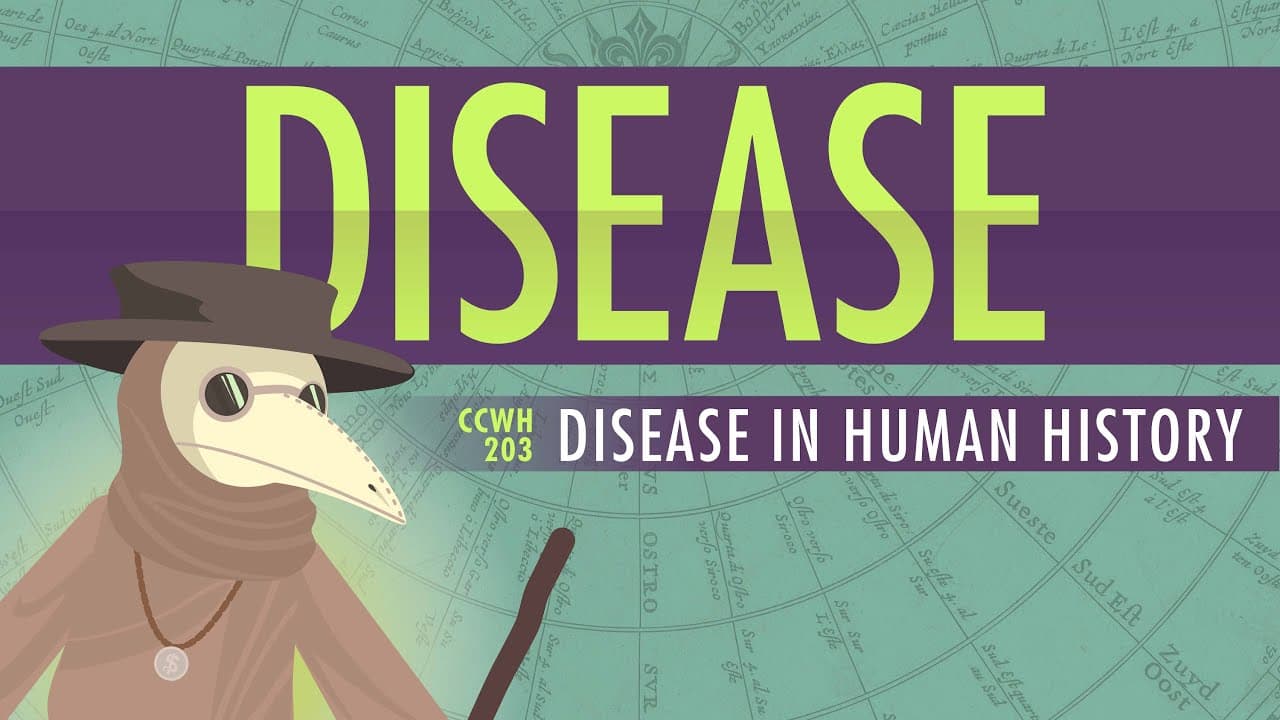
How Disease Shaped Human History

How Disease Shaped Human History

This episode of Crash Course World History explores the profound impact of disease on human history, challenging the traditional view that history is driven solely by human decisions and actions. Host John Green argues that microorganisms have often been more influential than emperors or generals, shaping the rise and fall of civilizations from ancient river valleys to the modern era. The video covers how the development of agriculture and cities created breeding grounds for epidemics and how trade networks facilitated their spread across continents. Key historical events analyzed include the Plague of Athens, the decline of the Roman Empire, and most notably, the Black Death in medieval Europe. The video details the biological origins of the bubonic plague, its transmission via the Silk Road, and its massive demographic, economic, and religious consequences. It also addresses the "Great Dying" in the Americas following the Columbian Exchange, highlighting the devastating effect of Old World diseases on indigenous populations. For educators, this video serves as an excellent tool for teaching historical causality, human-environment interaction, and the interconnectedness of world regions. It connects biological concepts with historical events, making it suitable for interdisciplinary lessons. The "Thought Bubble" segment provides a clear case study on how demographic shifts (mass death) can lead to economic restructuring (higher wages) and cultural changes, offering tangible examples for students to analyze.

CrashCourseCrashCourse

11mins 37s

How Geography Shapes Global Food Security

How Geography Shapes Global Food Security

This educational video explores the complex field of agricultural geography, examining why food insecurity persists in a world that produces enough calories to feed everyone. Host Alizé Carrère guides viewers through the intricate web of historical, political, economic, and environmental factors that determine who has access to food. The narrative moves from local examples of farming to global systems, explaining how colonialism, the Columbian Exchange, and various agricultural revolutions have shaped our modern food landscape. The video covers critical themes including the distinction between subsistence and commercial farming, the shift from polyculture to monoculture, and the impact of the Green Revolution. It delves into the geography of hunger, explaining concepts like food deserts and the difference between food availability and food access. Significant attention is paid to how historical events, such as the triangular trade and colonization, disrupted indigenous food systems and established export-oriented economies that still influence global food distribution today. For educators, this resource serves as a powerful tool to connect geography, history, and economics. It moves beyond simple definitions to show students the systems thinking required to understand global challenges. The video provides excellent opportunities for classroom discussions on food justice, the environmental impacts of industrial agriculture, and the importance of biodiversity. It is particularly useful for units on human geography, economic development, and sustainability.
CrashCourseCrashCourse

11mins 32s

How the Modern Revolution Shaped Our World

How the Modern Revolution Shaped Our World

In this episode of Crash Course Big History, John Green and Hank Green explore the Modern Revolution, a period of dramatic acceleration in human collective learning and complexity. The video defines the "modern" era, distinguishing between the Early Modern period (starting c. 1500) and the full Modern period (c. 1750), while analyzing the pivotal role of global unification. It details how the connecting of the four isolated world zones led to the exchange of goods, ideas, and crops, but also to horrific consequences like the trans-Atlantic slave trade and the devastation of indigenous populations by disease. The narrative then shifts to the Industrial Revolution, examining why it began in Great Britain rather than China. The hosts discuss the transition from muscle and wind power to fossil fuels, comparing this cultural explosion of innovation to the biological Cambrian Explosion. Key concepts such as the "Anthropocene" and the exponential rise in human complexity are introduced, framing human history within a cosmic perspective. This video is an excellent resource for World History, Geography, and Science classrooms. It helps students understand the interconnectedness of historical events, challenging Eurocentric narratives by highlighting global contributions to industrialization (such as Chinese gunpowder and Islamic mathematics). Teachers can use this to spark discussions on historical causality, the ethics of progress, and the environmental impact of human advancement.

CrashCourseCrashCourse

13mins 58s

How Globalization Connects the World: Then and Now

How Globalization Connects the World: Then and Now

This engaging educational video explores the history and evolution of globalization, tracing human connection from ancient trade routes to the modern digital age. The narrator defines globalization as the process of increasing interconnectedness and dependence between people, businesses, and countries. The video contrasts early examples like the Silk Road, Indian Ocean trade networks, and the Columbian Exchange with today's high-speed, technology-driven global economy. It highlights three major catalysts for modern acceleration: technology, global supply chains, and international cooperation through supranational organizations.

Miacademy & MiaPrep Learning ChannelMiacademy & MiaPrep Learning Channel

10mins 35s

Geography of Faith: How Religion Spreads and Shapes Culture

Geography of Faith: How Religion Spreads and Shapes Culture

This educational video explores the intricate relationship between geography, religion, and culture. Hosted by a narrator named Justin, the lesson begins by observing religious diversity in an urban setting before diving into the geographic origins of major world religions. It examines how faiths like Christianity, Islam, Hinduism, and Buddhism spread from their ancient cultural hearths through processes such as migration, trade, and colonization. The video introduces key human geography concepts, specifically focusing on 'cultural diffusion' and 'cultural integration.' It uses historical examples, such as the spread of Catholicism to Latin America and the subsequent blending with indigenous traditions (demonstrated through art analysis), to illustrate how religions evolve when they move to new regions. The content also addresses how religion influences modern society, shaping ethical codes, dietary restrictions, family structures, and even government systems through theocracies or religiously influenced laws. Teachers can use this video to introduce units on World Geography, Human Culture, or World Religions. It is particularly valuable for visualizing abstract concepts like cultural diffusion and integration. The video provides built-in pause points for classroom discussion on topics like migration effects and the ethics of colonization, making it an interactive tool for critical thinking about how belief systems shape the human experience across the globe.

Miacademy & MiaPrep Learning ChannelMiacademy & MiaPrep Learning Channel

12mins 31s

How the Haitian Revolution Ended Slavery and Defeated Empires

How the Haitian Revolution Ended Slavery and Defeated Empires

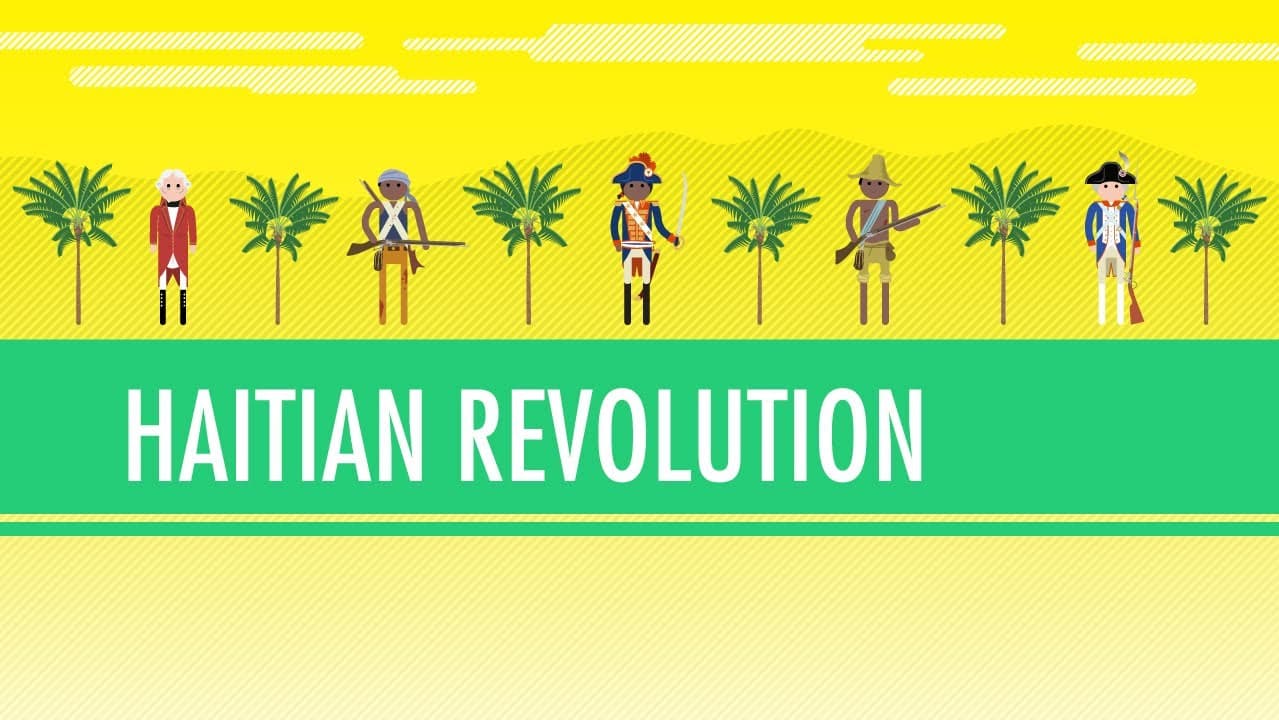
This educational video provides a fast-paced and comprehensive overview of the Haitian Revolution, arguably the most successful slave rebellion in history. Host John Green explains the complex social and economic structures of the French colony Saint-Domingue, detailing how a hierarchy of wealthy white planters, free people of color, poor whites, and enslaved Africans created a powder keg that ignited alongside the French Revolution. The narrative traces the transition from a pirate outpost to the world's most valuable sugar colony, highlighting the brutal conditions of plantation slavery that necessitated constant importation of human lives.

CrashCourseCrashCourse

12mins 35s

Materials

Ancient World Explorer Graphic Organizer

Ancient World Explorer Graphic Organizer

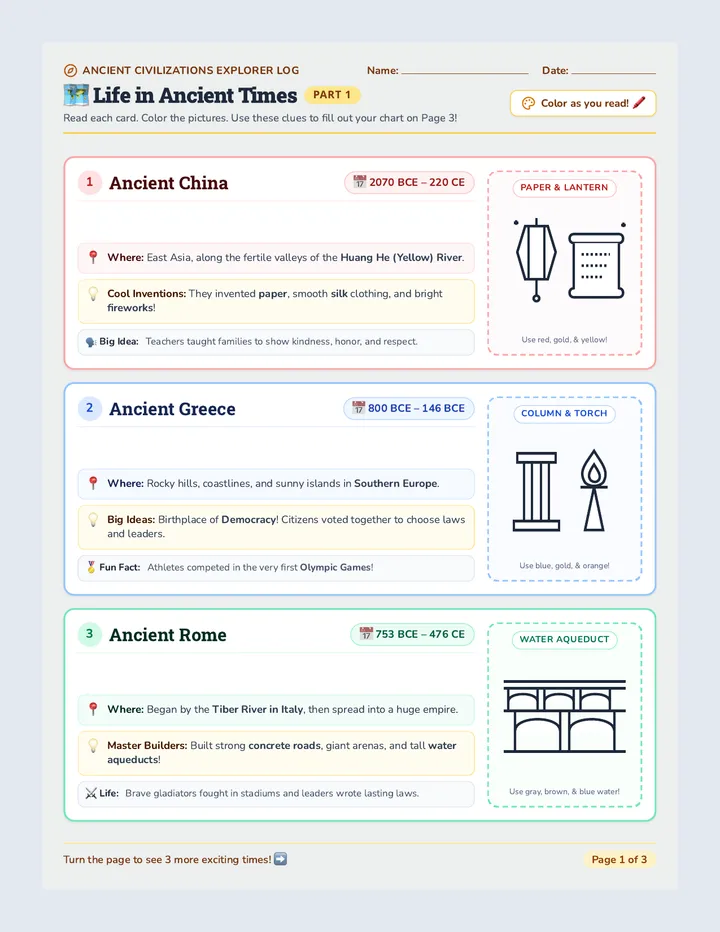
An accessible, highly visual 3-page ancient civilizations comparison activity designed for a 7th grade student reading at a 2nd grade level. Revised to eliminate awkward vertical gaps on the reading pages by expanding the cards with larger text, kid-friendly vocabulary callouts, and spacious coloring illustrations.

KC

Kasie Costopulos

Central American Freedom Reading Worksheet

Central American Freedom Reading Worksheet

A Grade 8-9 dual-language reading and multiple-choice worksheet covering Central American Independence Day (September 15, 1821). Features a 4-paragraph parallel English and Spanish text alongside 6 standards-aligned bilingual multiple choice questions assessing key historical concepts, leaders, and civic traditions.

GJ

Gerardo Jimenez Ramirez

Ancient Creativity Comprehension Packet

Ancient Creativity Comprehension Packet

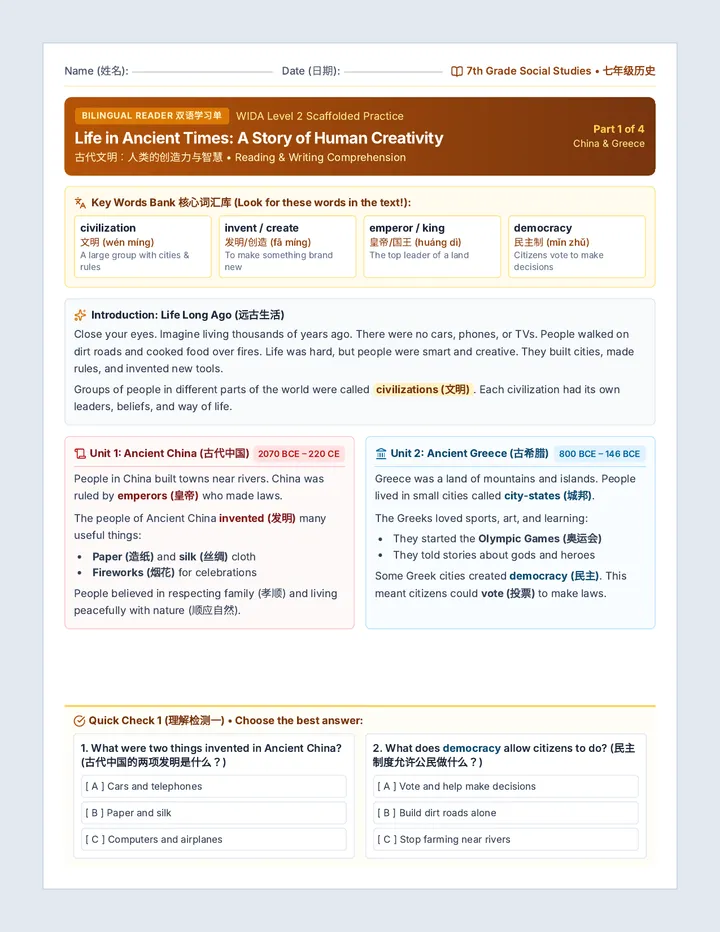
A 4-page scaffolded reading and writing comprehension packet for 7th-grade social studies, tailored for a Chinese-speaking WIDA Level 2 English learner. Includes bilingual vocabulary glossaries (English, Simplified Chinese, and Pinyin), chunked passages, visual icons, comprehension checks, and guided sentence-frame writing exercises.

KC

Kasie Costopulos

Texas Legends Slideshow Rubric

Texas Legends Slideshow Rubric

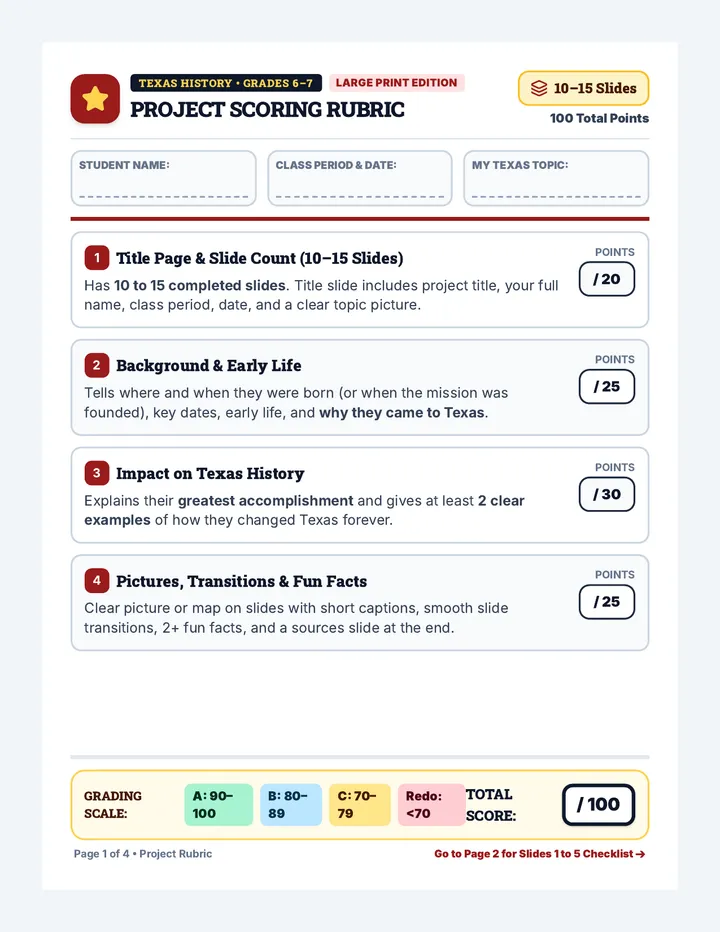
A 4-page true large-print, accommodated rubric and slide-by-slide checklist (16pt+ body text and large checkboxes) for 6th and 7th grade students creating a 10–15 slide Texas History presentation.

LR

Linda Rector

The Age of Exploration Bellringer

The Age of Exploration Bellringer

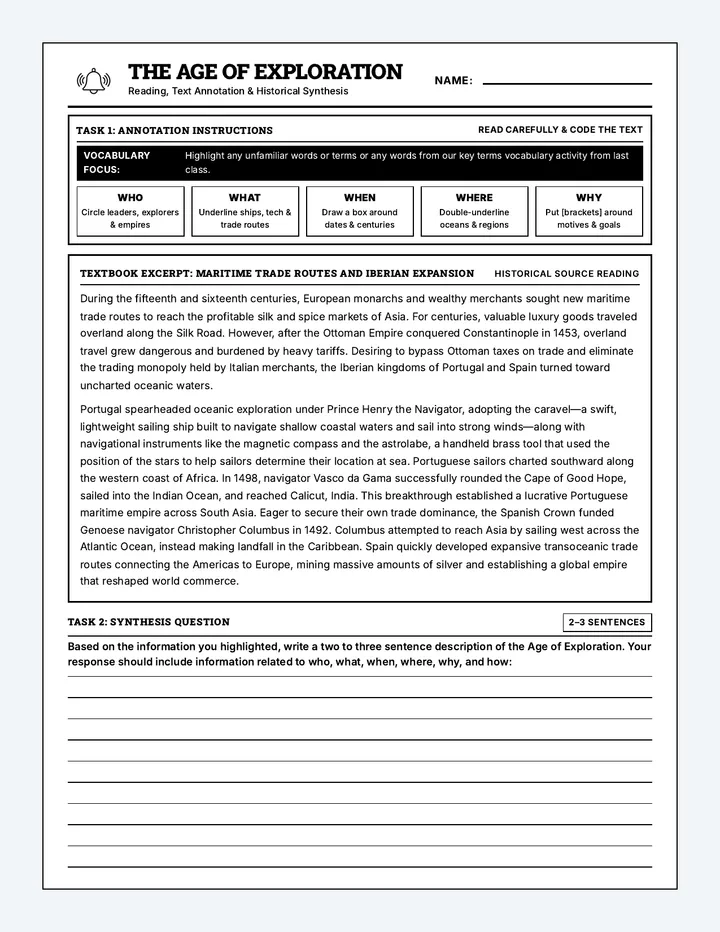
A high-contrast black-and-white 9th-grade bellringer featuring a bell icon, textbook excerpt on Spanish and Portuguese maritime trade routes during the Age of Exploration with context clues for caravel and astrolabe, unbolded text with 5 Ws and vocabulary annotation instructions, and an open 10-line response section prompting students to include who, what, when, where, why, and how.

KT

Kyle Trocolla

Exploration Motives DBQ Packet

Exploration Motives DBQ Packet

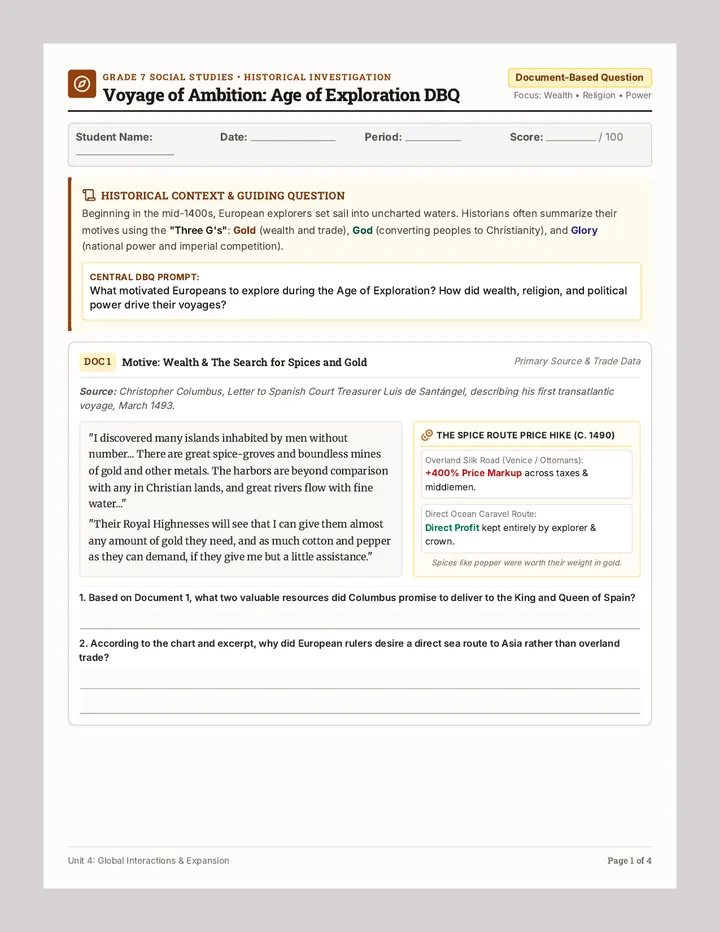
A complete 4-page Document-Based Question (DBQ) student packet for 7th-grade social studies on European motivations during the Age of Exploration. Features primary and secondary sources, an infographic spice trade chart, an engraved visual source, a Treaty of Tordesillas map, scaffolded analysis questions, a synthesis matrix, a thesis builder, and structured lined essay response pages.

A

aross

Sequences

Detective Evidence Log Worksheet

Nation State Detectives

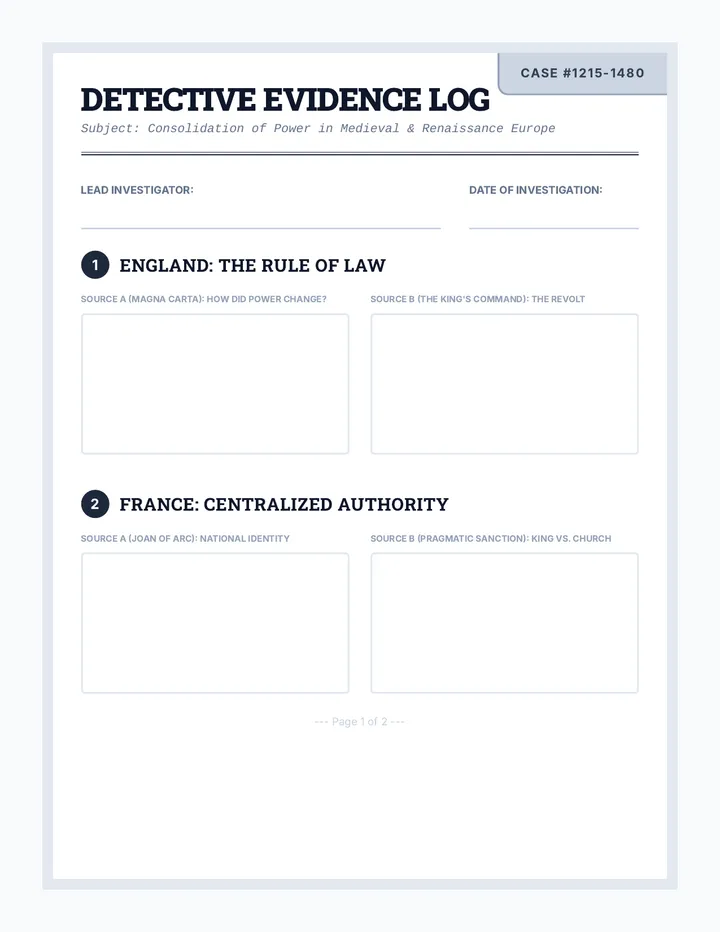
A comprehensive middle school history unit where students act as 'history detectives' to investigate the rise of nation-states in England, France, Spain, and Russia through primary source analysis.

HO

Helen O'Keefe

11
Curriculum Blueprint Document v2

History Horizon Sequence

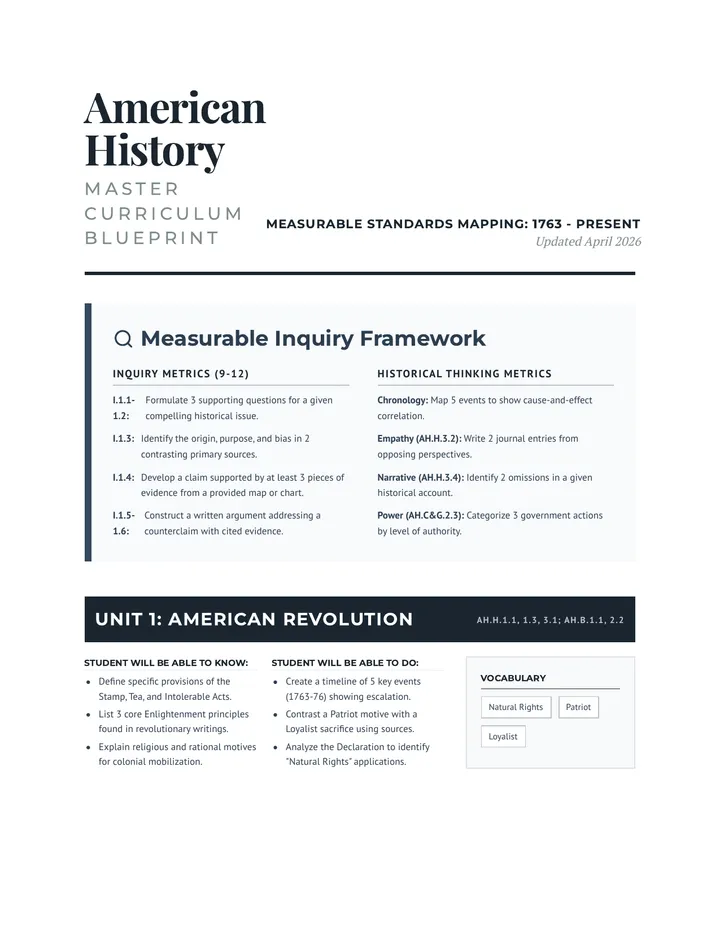
A comprehensive high school curriculum plan for American History, covering 13 units from the American Revolution to the modern era, aligned with North Carolina Social Studies standards.

AK

Amity Kea

21
Canyon Lands Slides

Desert Wonders

A comprehensive 5-lesson unit exploring the unique geography, climate, natural resources, diverse cultures, and political boundaries of the Southwest region of the United States.

NP

Natalie Pelletier

16
Ancient Foundations Worksheet

Europe Explorer Remediation

A comprehensive week-long remediation packet covering Europe's history, culture, economics, and the European Union through reading passages and high-level analysis.

KB

Kenneth Brown

8
Remediation Answer Key

Europe Explorer Remediation

A comprehensive week-long remediation packet covering Europe's history, culture, economics, and the European Union through reading passages and high-level analysis.

KB

Kenneth Brown

6
Architects of Power Teacher Guide

Rise of Nations

A unit covering the transition from feudalism to the rise of powerful nation-states across Europe, focusing on the centralization of authority.

HO

Helen O'Keefe

5

Lessons

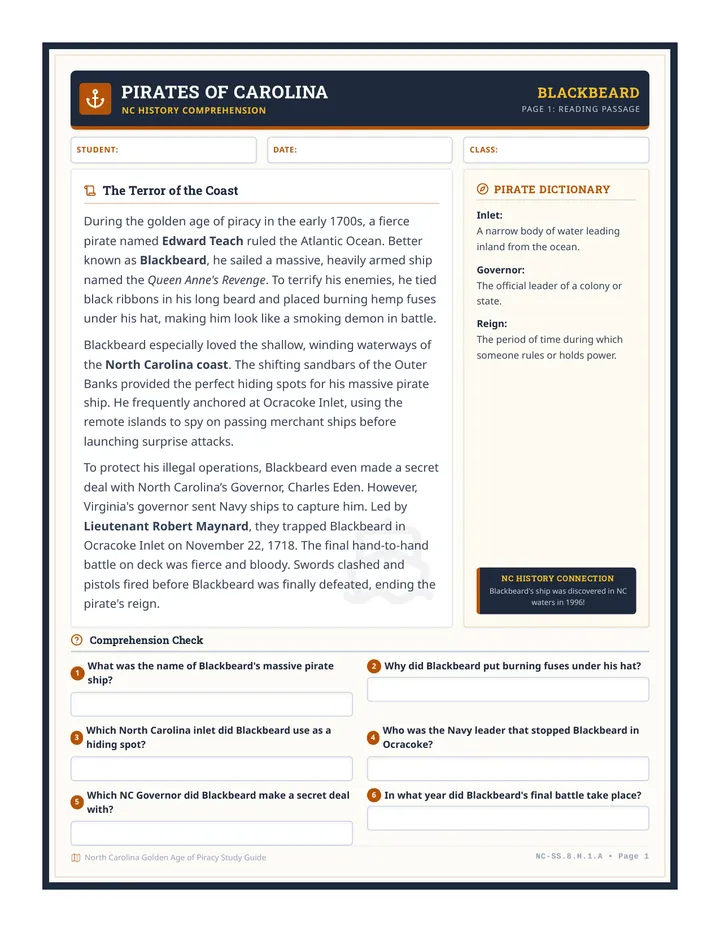
Blackbeard Legends Worksheet A

Pirates of Carolina

This lesson features differentiated reading comprehension worksheets about Blackbeard the Pirate along the North Carolina coast. Tailored for middle school special education students, it provides 2nd-grade and 5th-grade level texts in visually identical layouts to preserve student dignity.

KS

Kathleen Suther

11
Chronicle Study Guide Student

Modern Era Mastery

A comprehensive review and assessment package covering World History from the Enlightenment through the Cold War, aligned with state standards.

AH

Ashley Hopf

16
Explorer Epochs Wall Chart

Early World Explorers

A comprehensive lesson on early world exploration from 300 BCE to 1500 CE, focusing on the geographical, cultural, and religious impacts of key explorers across different continents.

J

jcasey

14
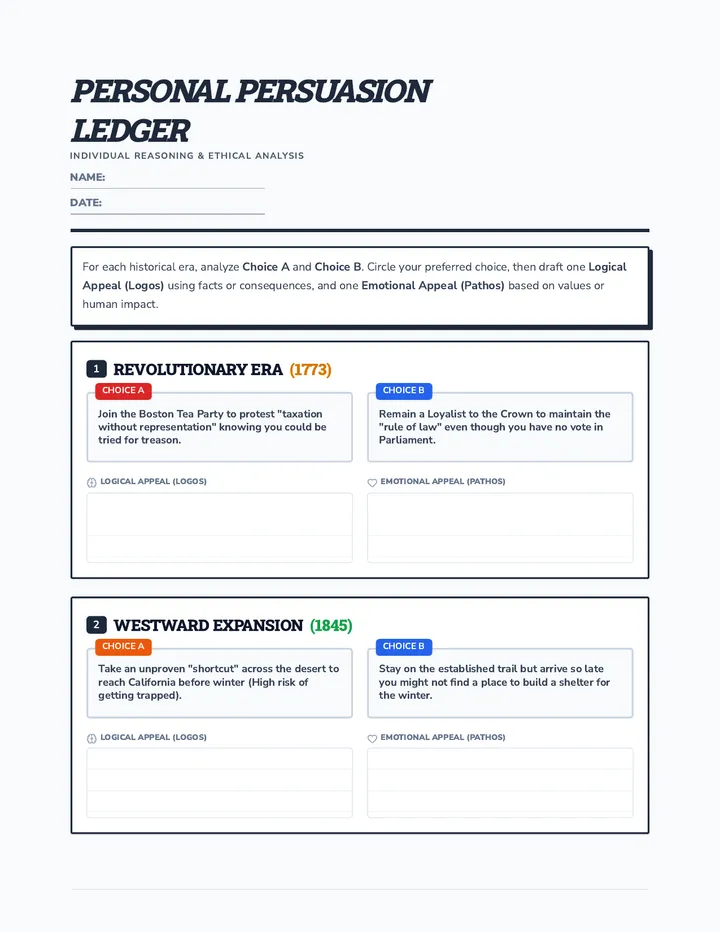
Personal Persuasion Ledger Worksheet

Hard History Choices

A middle school American History and Ethics lesson where students use 'Would You Rather' scenarios to practice logical and emotional appeals. Students work individually to form arguments before engaging in group debates to reach a consensus.

DC

Dennis Cronin

4
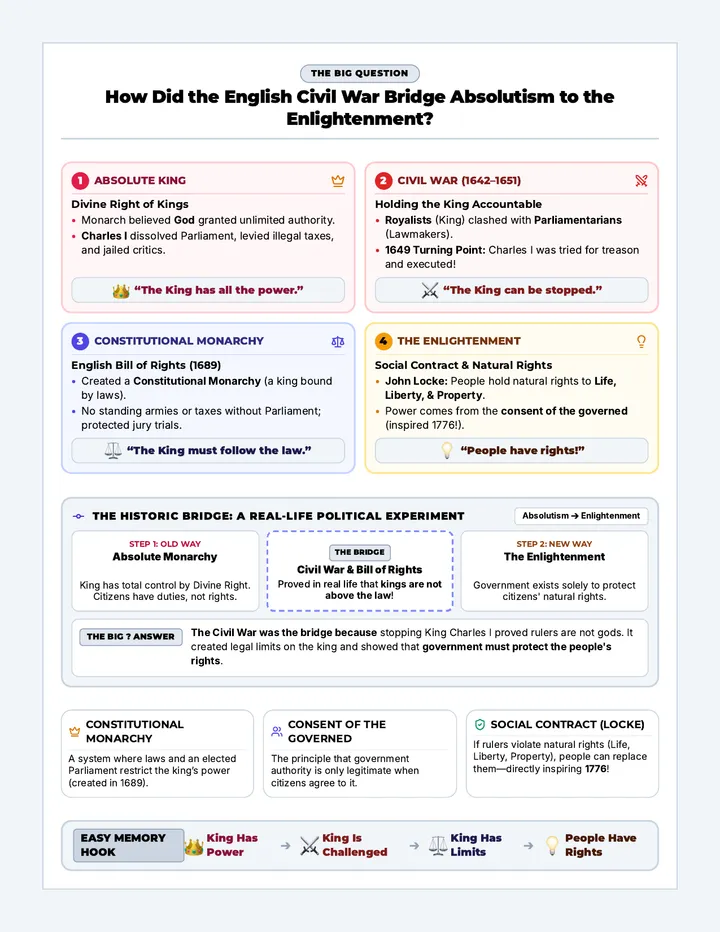
Civil War Bridge Anchor Chart

Bridge to Rights

A comprehensive 8th-9th grade history and civics lesson exploring how the English Civil War bridged the Age of Absolutism and the Enlightenment. Features a visual anchor chart and an accessible matching review quiz tailored for diverse learners.

S

snpierce

5
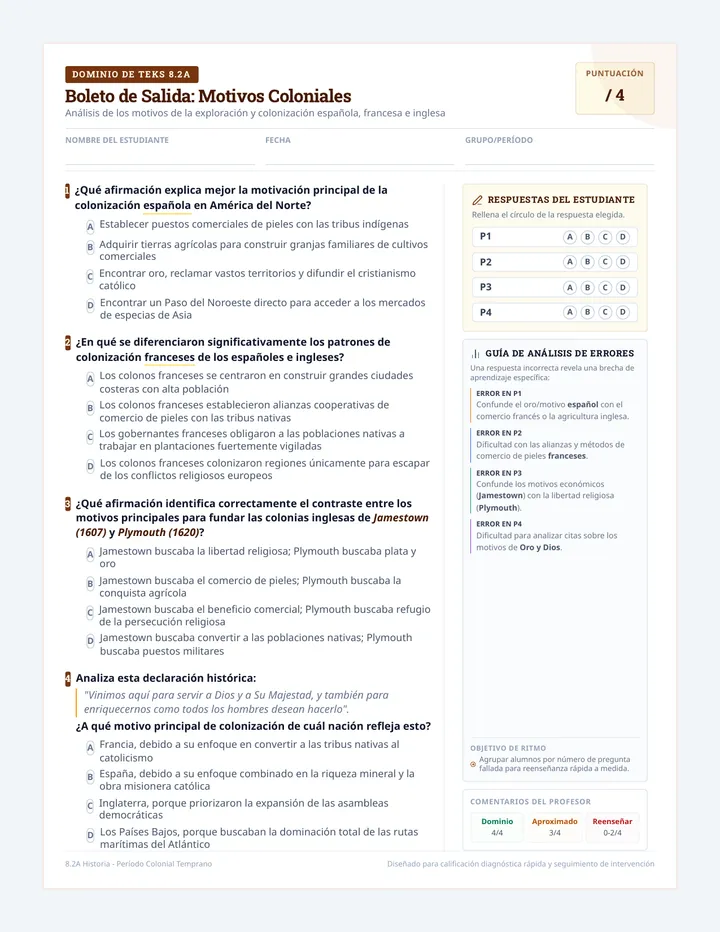
Colonial Motives Exit Ticket

Colonial Motives

A standard-focused lesson investigating the primary motivations behind English, Spanish, and French exploration and colonization of North America. Students examine the economic, religious, and political drives that shaped the early settlement patterns of the three major European rivals.

VS

Villanka Stroud

2