Lenny.com
Explore
Create
ActivitiesNewMathEnglish Language ArtsScience & EngineeringSocial StudiesGlobal LanguagesHealth & Physical EducationSpecial EducationCounseling & Life SkillsArts & CreativityESL
Lenny.com
Lenny.com
Explore
Create
ActivitiesNewMathEnglish Language ArtsScience & EngineeringSocial StudiesGlobal LanguagesHealth & Physical EducationSpecial EducationCounseling & Life SkillsArts & CreativityESL
Lenny.com
Lenny.com

Solutions

Lenny for EducatorsLenny for SchoolsLenny for Districts

Product

ExploreSign inCreateSupportAbout

Resources

Getting startedMTSS Acceleration Program

Newsletters

School Funding Newsletter

© 2026 Lenny Learning Inc.

TermsPrivacyAccessibility
LinkedInInstagramX
Lenny

Greece

Ancient Greek mythology, philosophy, and the birth of democracy in city-states like Athens and Sparta. Examines historical impacts from the Bronze Age through the Hellenistic period.

Social StudiesSocial Studies PracticesLocation WordsMapsOrder EventsChronology and CausationEvaluating SourcesHistorical ThinkingGeography, Humans, & the EnvironmentAmerican Symbols and LandmarksCitiesStatesState CapitalsRegions of the United StatesGeographic SkillsPhysical GeographyHuman GeographyRegional GeographyGeography of AfricaGeography of AsiaGeography of EuropeGeography of OceaniaGeography of the AmericasSociety and Environment of EuropeSociety and Environment of AsiaSociety and Environment of The AmericasSociety and Environment of the Middle EastSociety and Environment of AfricaHistoryPrehistoryComparing Ancient River CivilizationsAncient MesopotamiaAncient Egypt and KushAncient South AsiaEarly ChinaGreeceRome and the Byzantine EmpireAncient World HistoryNative Peoples of North AmericaNative Peoples of Mesoamerica and South AmericaAfrican EmpiresMedieval AsiaMedieval EuropeThe Silk RoadMedieval HistoryIslamic EmpiresWorld ReligionsRenaissance PeriodAge of ExplorationThe Thirteen ColoniesThe American RevolutionUS History Early RepublicFounding of the United StatesUS History AntebellumUS Civil WarReconstruction PeriodThe Gilded AgeUS ImperialismWorld ImperialismWorld War IUS History 1920sGreat DepressionWorld War IIThe Cold WarUS History 1950-60sUS History 1960s-70sWorld History 20th CenturyContemporary US HistoryContemporary World HistoryHolidaysCivics and GovernmentCitizenshipGovernment FoundationsThe ConstitutionUS ConstitutionExecutive BranchLegislative BranchJudicial BranchState and LocalPolitical ParticipationPublic PolicyPolitical SystemsPower and AuthoritySocial MovementsDefining DevianceTheories of DevianceCrime and Criminal JusticeEconomicsBasic Economic PrinciplesSupply and DemandWhat is MoneyEconomic FundamentalsMicroeconomicsMacroeconomicsBanking and FinanceEconomic SystemsGlobal EconomicsCorporations and PowerThe Changing WorkplaceUnemployment and LaborClass and InequalitySocial MobilityGlobal InequalityPsychologyHistory of PsychologyPsychology as a ScienceBrain and Nervous SystemNeuroscience and BehaviorGenetics and BehaviorSleep and ConsciousnessSensory ProcessesPerceptual OrganizationClassical ConditioningOperant ConditioningObservational LearningCognitive LearningMemory ProcessesThinking and Problem SolvingLanguage and CognitionTheories of MotivationStress and CopingPrenatal and Infant DevelopmentChildhood DevelopmentAdolescent DevelopmentAdulthood and AgingSelf and IdentitySocial CognitionSocial InfluenceAttraction and RelationshipsGroup BehaviorPrejudice and DiscriminationAnxiety and Mood DisordersClinical PsychologyForensic PsychologyPhilosophy & EthicsIntroduction to PhilosophyMajor Philosophers & IdeasMind and Body ProblemFree Will vs DeterminismEthics & MoralityReligion & PhilosophyPolitical Philosophy

Videos

Exploring the History and Forms of Democracy

Exploring the History and Forms of Democracy

This educational video provides a comprehensive overview of the history, definitions, and forms of democracy. It begins by tracing the roots of democratic government back to Ancient Athens, introducing key historical figures like Cleisthenes and explaining foundational Greek concepts such as the Boule and Ecclesia. The narration breaks down the etymology of the word "democracy" and connects ancient practices to modern civic responsibilities. The core of the video analyzes three distinct forms of democracy: Direct, Pluralist, and Representative. Using relatable analogies like a family vacation planning session, it explains how direct democracy functions versus the efficiency and challenges of representative systems. It also explores the concept of pluralism, where various interest groups compete to influence policy, and contrasts this with authoritarian or single-view systems. For educators, this resource serves as an excellent primer for Civics and Government units. It moves beyond simple definitions to explore the "how" and "why" of government structures. The video emphasizes the critical role of the citizen, encouraging students not just to understand the system, but to actively participate through voting, debating, and staying informed. It is particularly useful for introducing the concept of a Republic and the balance between government efficiency and individual accountability.

Miacademy & MiaPrep Learning ChannelMiacademy & MiaPrep Learning Channel

11mins 24s

Why the Bronze Age Civilizations Collapsed

Why the Bronze Age Civilizations Collapsed

In this episode of Crash Course World History, John Green explores the mysterious collapse of the Bronze Age civilizations in the Eastern Mediterranean around 1200 BCE. The video challenges the traditional narrative of separate, isolated civilizations by demonstrating how Egypt, the Hittites, the Mycenaeans, and others formed a highly interconnected international system defined by trade, diplomacy, and war. It examines the evidence for this interdependence, including the famous Uluburun shipwreck and the Amarna Letters.

CrashCourseCrashCourse

12mins 58s

Life and Government in Ancient Sparta

Life and Government in Ancient Sparta

This engaging educational video transports students back to Ancient Greece to explore the unique and rigorous society of Sparta. Unlike its neighbor Athens, which focused on arts and philosophy, Sparta is presented as a military-centric polis where life revolved around discipline, strength, and service to the state. The video breaks down the complex Spartan political structure, including its dual kingship and the powerful Ephors, while also detailing the rigid social hierarchy of Citizens, Perioikoi, and Helots. Key themes include the contrast between individual freedom and collective duty, the role of geography in shaping political alliances, and the cultural prioritization of military readiness. The narrative covers the intense upbringing of Spartan children, the formation of the Peloponnesian League, and the eventual conflict with Athens. Through animated characters and historical imagery, complex concepts like oligarchy and social stratification are made accessible. For educators, this video serves as an excellent resource for comparing Ancient Greek city-states. It provides clear definitions of specific historical terms and offers natural pause points for discussions about government types and social values. The content connects well with lessons on the Peloponnesian War, ancient political systems, and the diverse cultures within the ancient Mediterranean world.

Miacademy & MiaPrep Learning ChannelMiacademy & MiaPrep Learning Channel

9mins

How History Defined Europe as a Functional Region

How History Defined Europe as a Functional Region

This educational video explores the concept of Europe as a "functional region," examining how its boundaries and influence have been defined not just by physical geography, but by historical connections, trade networks, and cultural legacies. The narrator guides viewers through a chronological journey, starting with the Greco-Roman era and moving through the Crusades, the Age of Exploration, the Scramble for Africa, the Cold War, and finally the modern European Union. The video explains how these events created networks of interaction that extended Europe's "functional" borders far beyond its physical continent. Key themes include the difference between formal and functional regions, the lasting impact of Roman infrastructure and language, the spread of religion (Christianity and Islam), the geopolitical consequences of colonization, and the role of economic integration in the modern era. It specifically addresses how political ideologies during the Cold War divided the continent into two distinct functional zones and how the EU has since worked to reintegrate them through trade and a common currency. For educators, this video serves as an excellent bridge between geography and history, demonstrating how spatial relationships change over time. It provides concrete examples of abstract geographic concepts like "functional regions" and "spheres of influence." Teachers can use this resource to help students understand complex topics such as why French Guiana is part of Europe, how the Roman Empire laid the groundwork for modern Western culture, and the economic rationale behind the European Union.
Miacademy & MiaPrep Learning ChannelMiacademy & MiaPrep Learning Channel

9mins 54s

Why Democracy Feels Broken: Models, Critiques, and Theory

Why Democracy Feels Broken: Models, Critiques, and Theory

This educational video from Crash Course Political Theory explores the complex nature of democracy, addressing the common modern sentiment that democratic systems are "broken." Hosted by Dr. Ellie Anderson, the video investigates whether dissatisfaction with democracy is a new phenomenon or an inherent feature of the system. It traces critiques of democracy back to ancient philosophers like Plato, who worried about the chaos of "unmixed freedom," and contrasts historical Athenian practices with the egalitarian decision-making of indigenous hunter-gatherer societies.

CrashCourseCrashCourse

12mins 5s

How War Shaped Civilization and State Building

How War Shaped Civilization and State Building

In this thought-provoking episode of Crash Course World History, John Green challenges the conventional wisdom that war is exclusively destructive. While acknowledging the tragic human cost of conflict, the video explores the counter-intuitive historical theory that war—or the threat of it—was a primary driver in the development of civilization itself. Green argues that the need for defense against raids may have spurred humans to congregate in walled cities even before the full development of agriculture, suggesting that war might be the mother of invention for the state itself. The video covers a sweeping timeline, moving from ancient hunter-gatherer societies to the Zulu Kingdom, the Roman Empire, and the Gunpowder Revolution of the early modern era. Key themes include the relationship between military technology and state bureaucracy (how cannons required taxes), the shift from citizen militias to mercenaries, and the eventual transition from conquest-based economies to trade-based economies. The episode examines how the rising cost of war and the mutual benefits of global trade have, in modern times, made large-scale conflict between major powers less economically viable. For educators, this video is an excellent tool for teaching AP World History concepts regarding state formation and the consolidation of power. It models high-level historical thinking by asking students to consider complex causality and the unintended consequences of historical events. It is particularly useful for units on the rise of empires, the development of political systems, or discussions about the economic motivations behind historical conflicts versus modern diplomacy.

CrashCourseCrashCourse

12mins 48s

Materials

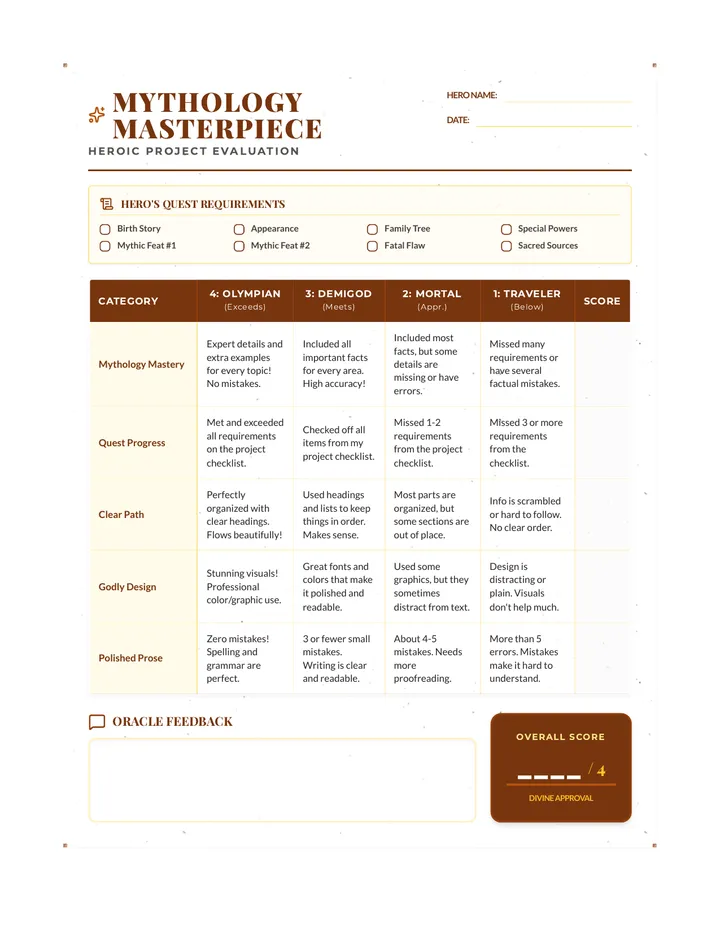
Mythology Masterpiece Rubric

Mythology Masterpiece Rubric

A single-page rubric for the Greek Mythology project, redesigned for space efficiency and readability. It features a horizontal checklist and consolidated footer to ensure the Oracle Feedback and Overall Score sections fit perfectly on one page without sacrificing text size. The final score is now explicitly labeled 'overall score _/4'.

SD

Stephany Durtsche

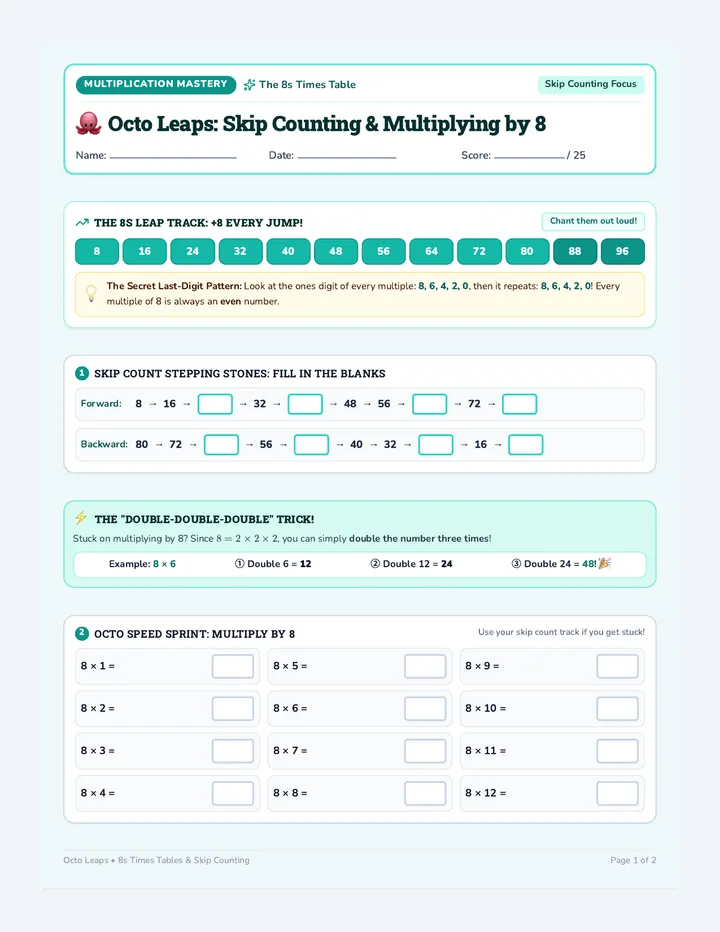
Octo Leaps Worksheet

Octo Leaps Worksheet

A vibrant two-page 8s multiplication and skip-counting worksheet featuring visual skip-counting tracks, the Double-Double-Double mental math hack, missing number trails, an 8s multiples grid maze, equal-groups modeling, and real-world word problems.

M

meagan_asp

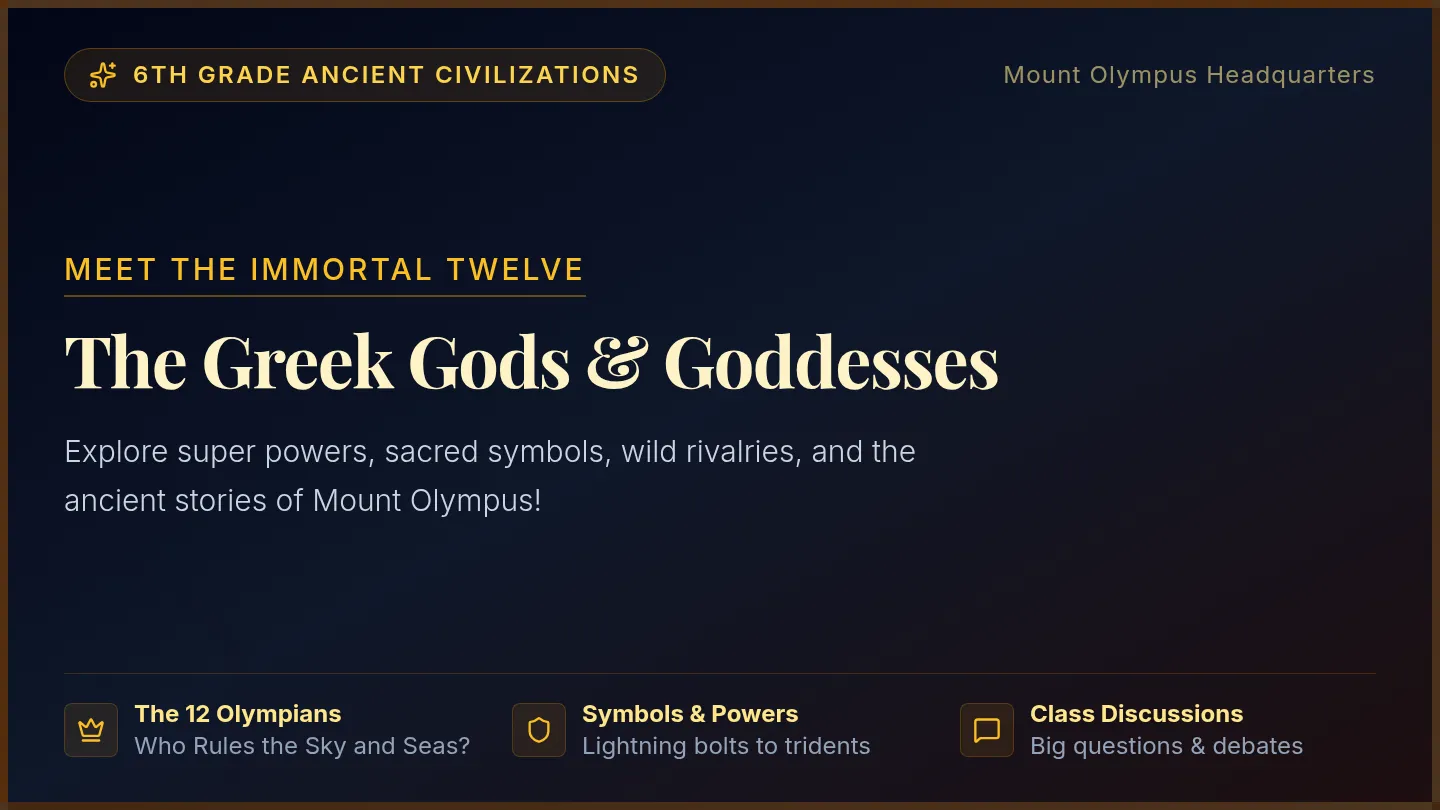
Olympian Pantheon Slides

Olympian Pantheon Slides

A 6th-grade appropriate 12-slide presentation introducing major Greek Olympians with high-interest facts, symbols, foundational myths, and middle-school discussion questions.

MS

Megan St.Germain

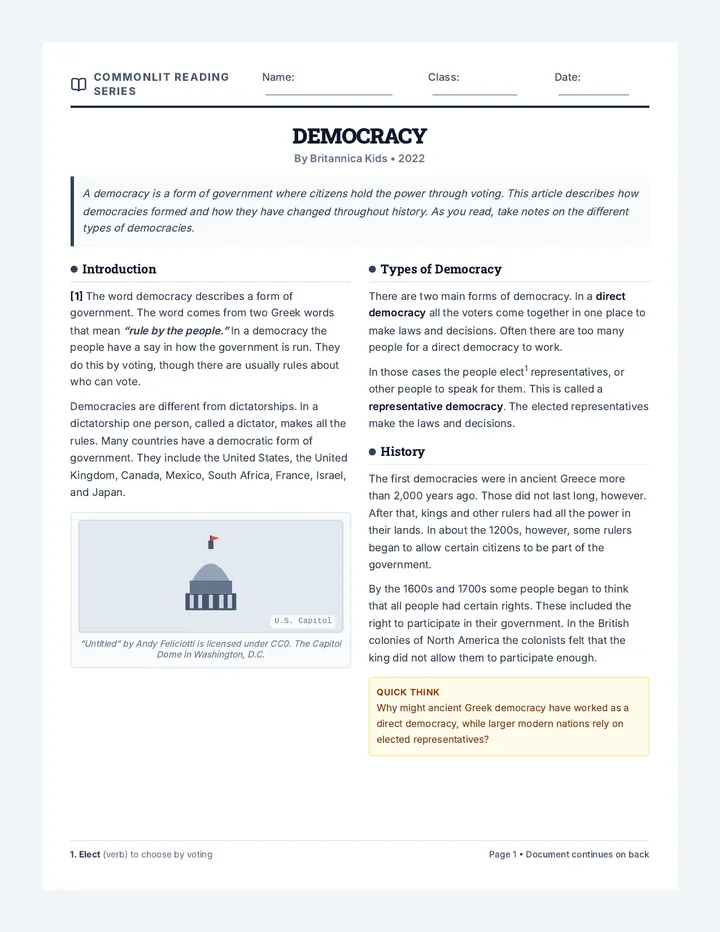
Democracy Student Packet

Democracy Student Packet

A 4-page double-sided printable student packet on Democracy from Britannica Kids, formatted with space-saving two-column layouts, containing the complete reading passage with illustrations and footnotes, all five text-dependent questions with lined response space, and three in-depth discussion prompts with dedicated student writing lines.

TD

Taylor Doucet

Greek Civilization Parent Rubric

Greek Civilization Parent Rubric

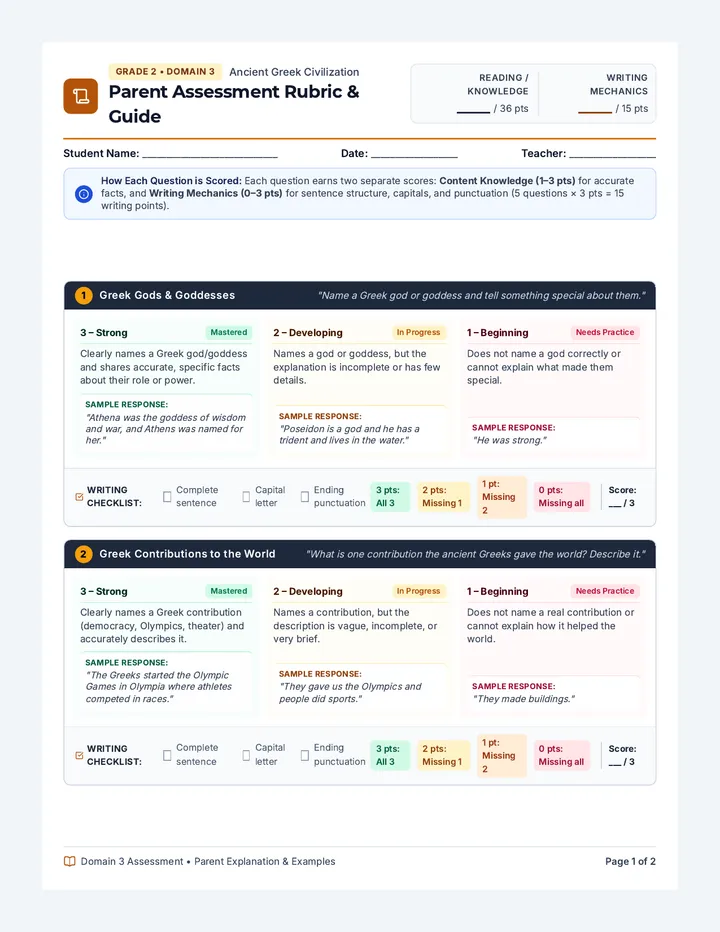
A parent-friendly 2-page assessment rubric for Grade 2 Ancient Greek Civilization with a 36-point reading/knowledge score, 3-point writing conventions checklist, and scoring breakdown integrated directly into each of the 5 question cards.

J

Jennifer.Beiers

Greek Civilization Parent Rubric

Greek Civilization Parent Rubric

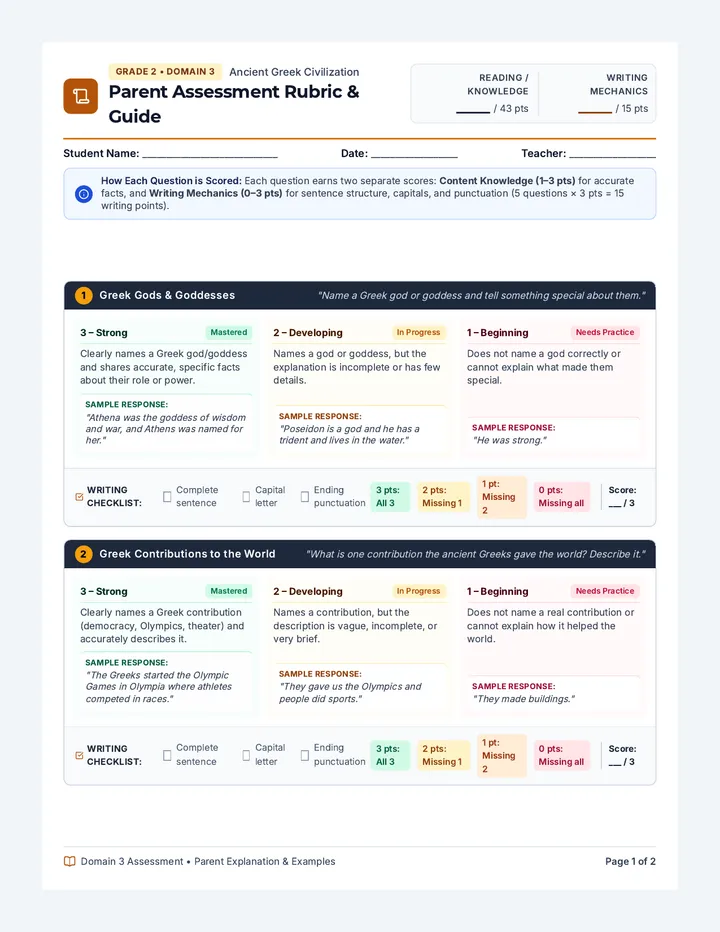
A parent-friendly 2-page assessment rubric for Grade 2 Ancient Greek Civilization with the 3-point writing conventions checklist and scoring breakdown integrated directly into each of the 5 question cards, alongside concrete sample responses for Strong, Developing, and Beginning work.

J

Jennifer.Beiers

Sequences

Master Organizer Slides

Think Like Aristotle

A four-part series for middle schoolers on Aristotelian logic and philosophy, focusing on categorization, reasoning, and ethics, with a historical tie-in to Alexander the Great.

DB

Danielle Burham

21
The Imaginer Teacher Guide

The Imaginer Plato Logic

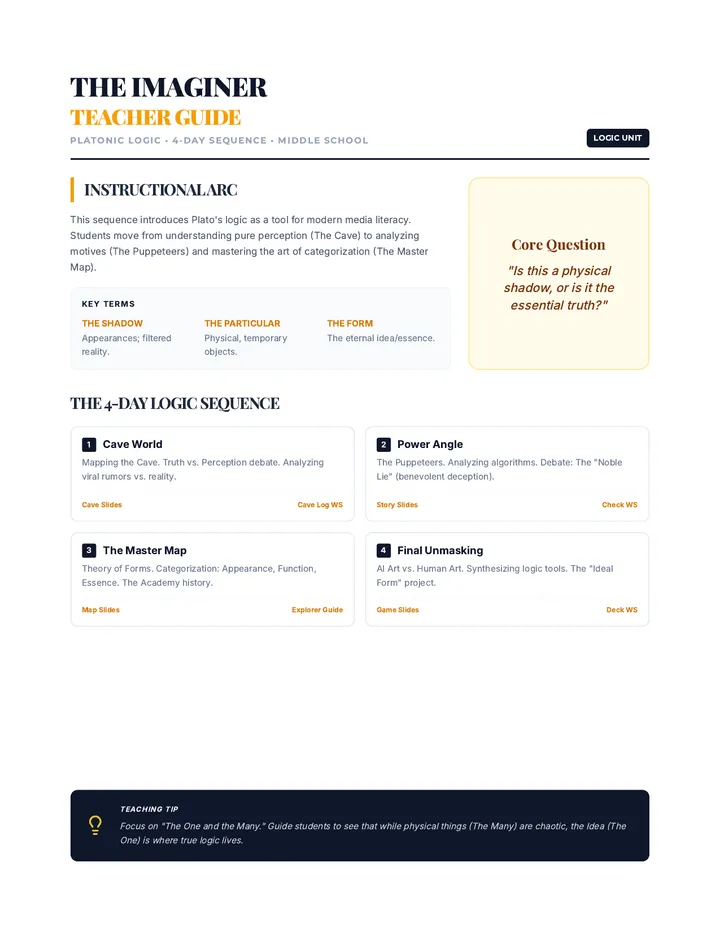
A four-day introductory logic and philosophy sequence for middle schoolers focusing on Plato's 'Thinking Style.' Students explore the Allegory of the Cave, perception vs. reality, and the Theory of Forms through the lens of 'The Imaginer,' culminating in a visual analysis game.

DB

Danielle Burham

12
Throne Wars Anchor Chart

Rise of Civilization

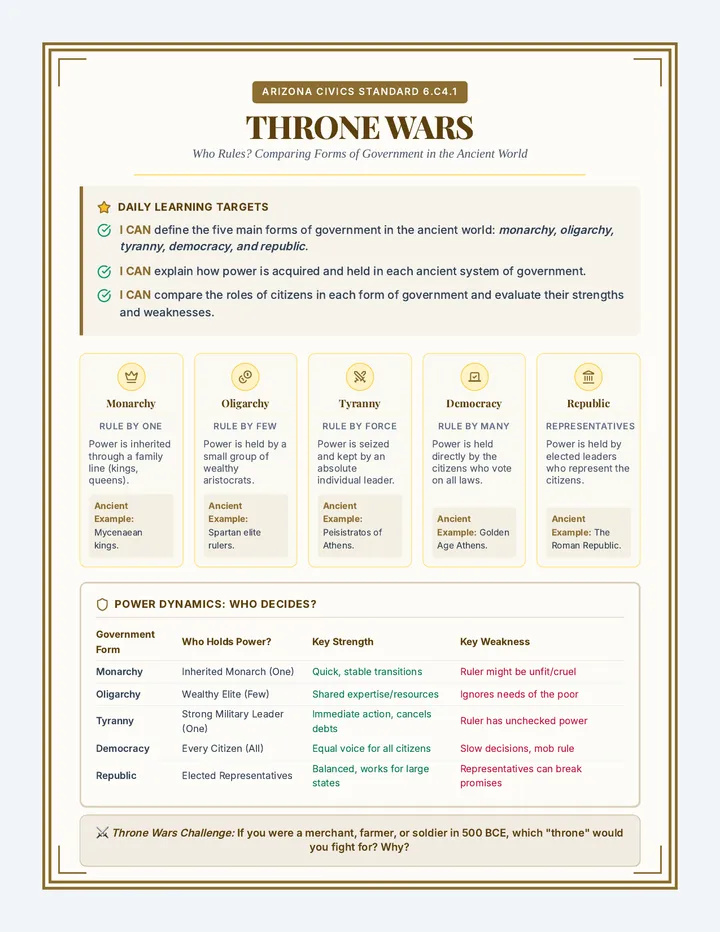
A comprehensive 6th-grade social studies unit exploring the trajectory of human history, from nomadic hunter-gatherers and the cognitive evolution of early humans, to the agricultural revolution, and finally the development of structured ancient governments.

SZ

Sandy Zoerhoff

10
Spartan Stand Teacher Guide

Spartan Stand

A two-day exploration of the Battle of Thermopylae, focusing on strategic geography, historical context, and the concept of valor through evidence-based analysis and targeted vocabulary acquisition.

S

scortese

6
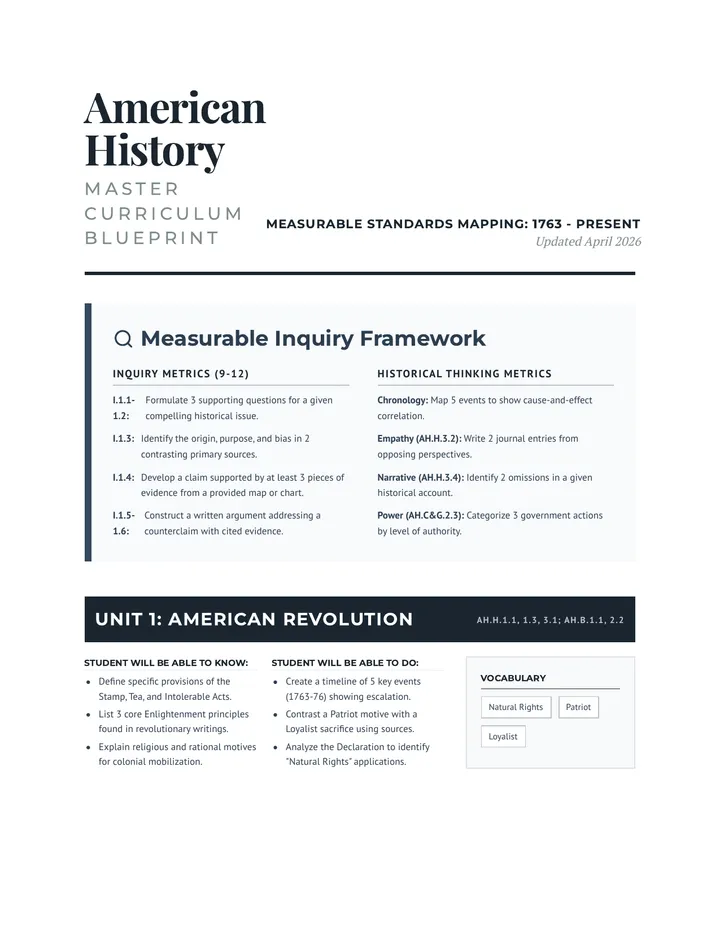
Curriculum Blueprint Document v2

History Horizon Sequence

A comprehensive high school curriculum plan for American History, covering 13 units from the American Revolution to the modern era, aligned with North Carolina Social Studies standards.

AK

Amity Kea

21
Day 1 American Republic Reader

Global Governance Remediation

A comprehensive 7-day remediation unit covering various forms of government, comparing the U.S. constitutional republic to historical and contemporary systems, and analyzing executive structures.

CE

Chelsea Elliott

16

Lessons

Explorer Epochs Wall Chart

Early World Explorers

A comprehensive lesson on early world exploration from 300 BCE to 1500 CE, focusing on the geographical, cultural, and religious impacts of key explorers across different continents.

J

jcasey

14
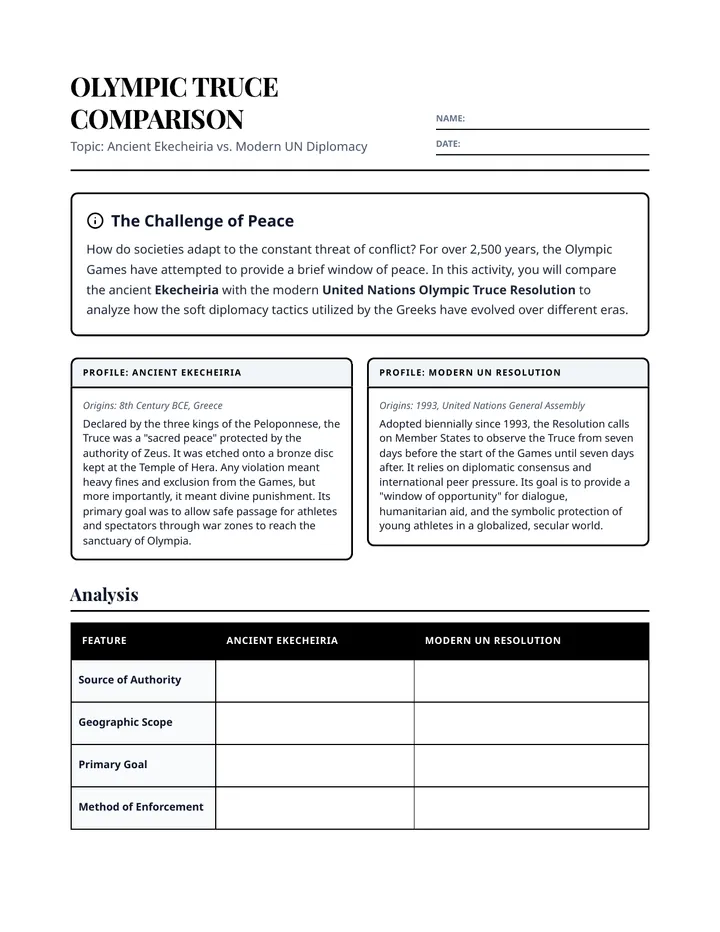
Olympic Truce Comparison Final Worksheet Final Final Expanded

Olympic Truce Diplomacy

A high school social studies lesson exploring the origins, evolution, and effectiveness of the Olympic Truce from ancient Greece to the modern United Nations era. Students analyze how this institution addresses societal and political challenges through international cooperation.

KK

Kathleen Kelsh

6
War Room Slides

Diplomatic Duel

Students step into the shoes of Athenian or Spartan diplomats during the Peloponnesian War. Using the RAFT strategy, they will craft persuasive diplomatic letters to recruit neutral Greek city-states to their side.

GC

Gregory Clancy

3
Agora Adventure Slides

Agora Adventure

An introductory lesson on the economy of Ancient Greece, focusing on maritime trade, agriculture, specialization, and the use of coinage through a simulated marketplace experience.

LB

Laurel Bartos

7
Olympian Origins Slides

Olympian Origins

An introductory lesson to Ancient Greek Mythology, focusing on the Olympian gods, their unique powers, and the complex family tree that connects them.

D

destiny.lanier

5
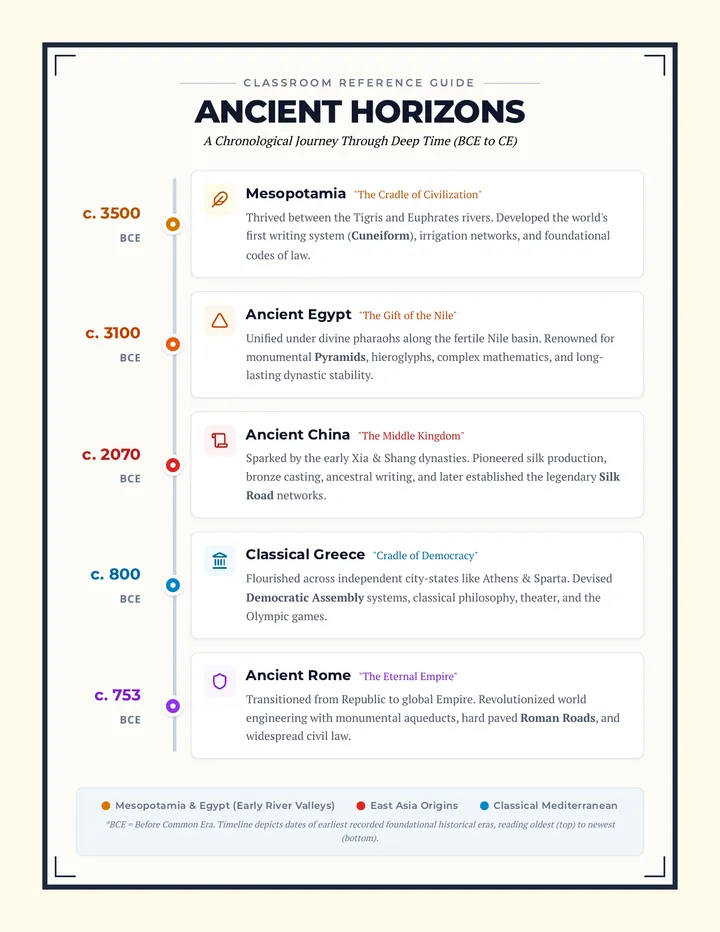
Ancient Horizons Timeline Poster

Ancient Civilizations Timeline

A lesson package designed to introduce the chronology of five fundamental ancient civilizations. It includes a high-impact master reference poster and printable large-scale timeline cards for classroom display.

SZ

Sandra Zoerhoff

2