Lenny.com
Explore
Create
ActivitiesNewMathEnglish Language ArtsScience & EngineeringSocial StudiesGlobal LanguagesHealth & Physical EducationSpecial EducationCounseling & Life SkillsArts & CreativityESL
Lenny.com
Lenny.com
Explore
Create
ActivitiesNewMathEnglish Language ArtsScience & EngineeringSocial StudiesGlobal LanguagesHealth & Physical EducationSpecial EducationCounseling & Life SkillsArts & CreativityESL
Lenny.com
Lenny.com

Solutions

Lenny for EducatorsLenny for SchoolsLenny for Districts

Product

ExploreSign inCreateSupportAbout

Resources

Getting startedMTSS Acceleration Program

© 2026 Lenny Learning Inc.

TermsPrivacyAccessibility
LinkedInInstagramX
Lenny

Society and Environment of Asia

Geographic features, environmental adaptation, and urban development across East, South, and Southeast Asia. Analyzes the impact of monsoons, mountain ranges, and river systems on human societies and resource management.

Social StudiesSocial Studies PracticesLocation WordsMapsOrder EventsChronology and CausationEvaluating SourcesHistorical ThinkingGeography, Humans, & the EnvironmentAmerican Symbols and LandmarksCitiesStatesState CapitalsRegions of the United StatesGeographic SkillsPhysical GeographyHuman GeographyRegional GeographyGeography of AfricaGeography of AsiaGeography of EuropeGeography of OceaniaGeography of the AmericasSociety and Environment of EuropeSociety and Environment of AsiaSociety and Environment of The AmericasSociety and Environment of the Middle EastSociety and Environment of AfricaHistoryPrehistoryComparing Ancient River CivilizationsAncient MesopotamiaAncient Egypt and KushAncient South AsiaEarly ChinaGreeceRome and the Byzantine EmpireAncient World HistoryNative Peoples of North AmericaNative Peoples of Mesoamerica and South AmericaAfrican EmpiresMedieval AsiaMedieval EuropeThe Silk RoadMedieval HistoryIslamic EmpiresWorld ReligionsRenaissance PeriodAge of ExplorationThe Thirteen ColoniesThe American RevolutionUS History Early RepublicFounding of the United StatesUS History AntebellumUS Civil WarReconstruction PeriodThe Gilded AgeUS ImperialismWorld ImperialismWorld War IUS History 1920sGreat DepressionWorld War IIThe Cold WarUS History 1950-60sUS History 1960s-70sWorld History 20th CenturyContemporary US HistoryContemporary World HistoryHolidaysCivics and GovernmentCitizenshipGovernment FoundationsThe ConstitutionUS ConstitutionExecutive BranchLegislative BranchJudicial BranchState and LocalPolitical ParticipationPublic PolicyPolitical SystemsPower and AuthoritySocial MovementsDefining DevianceTheories of DevianceCrime and Criminal JusticeEconomicsBasic Economic PrinciplesSupply and DemandWhat is MoneyEconomic FundamentalsMicroeconomicsMacroeconomicsBanking and FinanceEconomic SystemsGlobal EconomicsCorporations and PowerThe Changing WorkplaceUnemployment and LaborClass and InequalitySocial MobilityGlobal InequalityPsychologyHistory of PsychologyPsychology as a ScienceBrain and Nervous SystemNeuroscience and BehaviorGenetics and BehaviorSleep and ConsciousnessSensory ProcessesPerceptual OrganizationClassical ConditioningOperant ConditioningObservational LearningCognitive LearningMemory ProcessesThinking and Problem SolvingLanguage and CognitionTheories of MotivationStress and CopingPrenatal and Infant DevelopmentChildhood DevelopmentAdolescent DevelopmentAdulthood and AgingSelf and IdentitySocial CognitionSocial InfluenceAttraction and RelationshipsGroup BehaviorPrejudice and DiscriminationAnxiety and Mood DisordersClinical PsychologyForensic PsychologyPhilosophy & EthicsIntroduction to PhilosophyMajor Philosophers & IdeasMind and Body ProblemFree Will vs DeterminismEthics & MoralityReligion & PhilosophyPolitical Philosophy

Videos

How 19th Century Imperialism Shaped the Modern World

How 19th Century Imperialism Shaped the Modern World

This episode of Crash Course European History explores the complex and often brutal history of 19th-century European imperialism. Host John Green examines the paradox of European nations expanding rights and democracy at home while simultaneously stripping rights and sovereignty from people across Asia, Africa, and the Pacific. The video details the economic motivations behind expansion, such as the demand for raw materials like palm oil, rubber, and diamonds, and the specific mechanisms used to enforce control. Key themes include the "Tools of Empire"—technological advancements like steamships, machine guns, railroads, and the medical breakthrough of quinine—that enabled Europeans to penetrate and dominate the interiors of Africa and Asia. The video also highlights the shift in justification for empire from religious conversion to "Social Darwinism," a pseudoscientific belief in racial superiority used to excuse exploitation. Crucially, the video moves beyond the perspective of the colonizers to focus on indigenous resistance and experience. It covers the Opium Wars in China, the Indian Rebellion of 1857, and forms of non-violent resistance such as "reproductive strikes" in the Congo and Caribbean. This resource is invaluable for helping students understand the systemic nature of colonialism, the technological disparity of the era, and the lasting geopolitical legacy of these events.

CrashCourseCrashCourse

13mins 14s

Exploring the Geography and Culture of Turkey, Iran, and Cyprus

Exploring the Geography and Culture of Turkey, Iran, and Cyprus

This educational video takes students on a comprehensive journey through three key nations in Southwest Asia: Turkey, Iran, and Cyprus. Hosted by an engaging narrator, the lesson explores the physical geography, government structures, economic drivers, and rich cultural traditions of these countries. It highlights how they are geographically linked to the Fertile Crescent and explores their unique positions as bridges between Europe and Asia.

Miacademy & MiaPrep Learning ChannelMiacademy & MiaPrep Learning Channel

11mins 24s

How Ancient Trade Routes Connected the World

How Ancient Trade Routes Connected the World

This video explores the concept of global interconnectedness long before the advent of the internet or modern transportation. Starting with a relatable family dinner scene, the narrator challenges viewers to consider the origins of their food and clothing, using this as a springboard to introduce the historical mechanism of trade. The video defines cultural diffusion and illustrates how ancient trade routes like the Silk Road, Indian Ocean maritime routes, Trans-Saharan network, and Mediterranean Sea served as the "superhighways" of the ancient world, linking distant civilizations. Key themes include the definition and impact of cultural diffusion, the geography of major ancient trade networks, and the specific exchange of goods, ideas, technologies, and religions. The video highlights how the Indian Ocean trade facilitated the spread of Islam, how the Trans-Saharan route moved gold and salt, and how the Mediterranean connected Europe to ancient wisdom. It also details the "Four Great Inventions" of Ancient China—paper, printing, the compass, and gunpowder—and their profound effects on global society. For educators, this video serves as an excellent introduction to units on World History, global trade, or ancient civilizations. It features built-in "pause points" that invite students to check the tags on their own clothes, brainstorm inventions, and reflect on historical impacts, making it highly interactive. By connecting the abstract concept of cultural diffusion to tangible items like spices and clothing, the video helps students visualize how historical economic activities shaped the political, religious, and technological landscape of the modern world.
Miacademy & MiaPrep Learning ChannelMiacademy & MiaPrep Learning Channel

11mins 42s

The Advanced Engineering of Ancient India's Harappan Civilization

The Advanced Engineering of Ancient India's Harappan Civilization

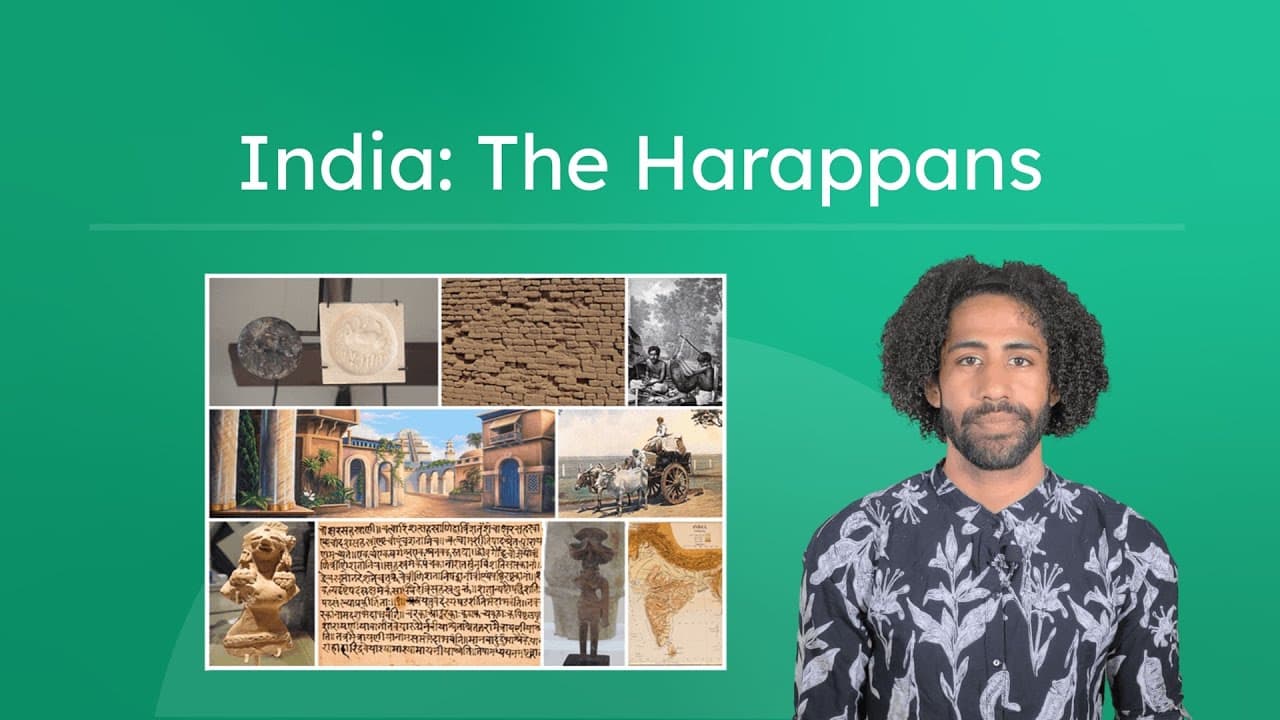
This engaging educational video introduces students to the Harappan civilization of the Indus Valley, one of the world's earliest urban societies. Beginning with a relatable hook about modern plumbing versus ancient outhouses, the narrator reveals that the Harappans developed sophisticated drainage systems thousands of years ago. The video covers the civilization's geography, emphasizing how the Indus River, Himalayas, and Thar Desert protected and isolated the region while providing fertile land for agriculture.

Miacademy & MiaPrep Learning ChannelMiacademy & MiaPrep Learning Channel

9mins 59s

World Trip: A Journey Through Asia's Geography

World Trip: A Journey Through Asia's Geography

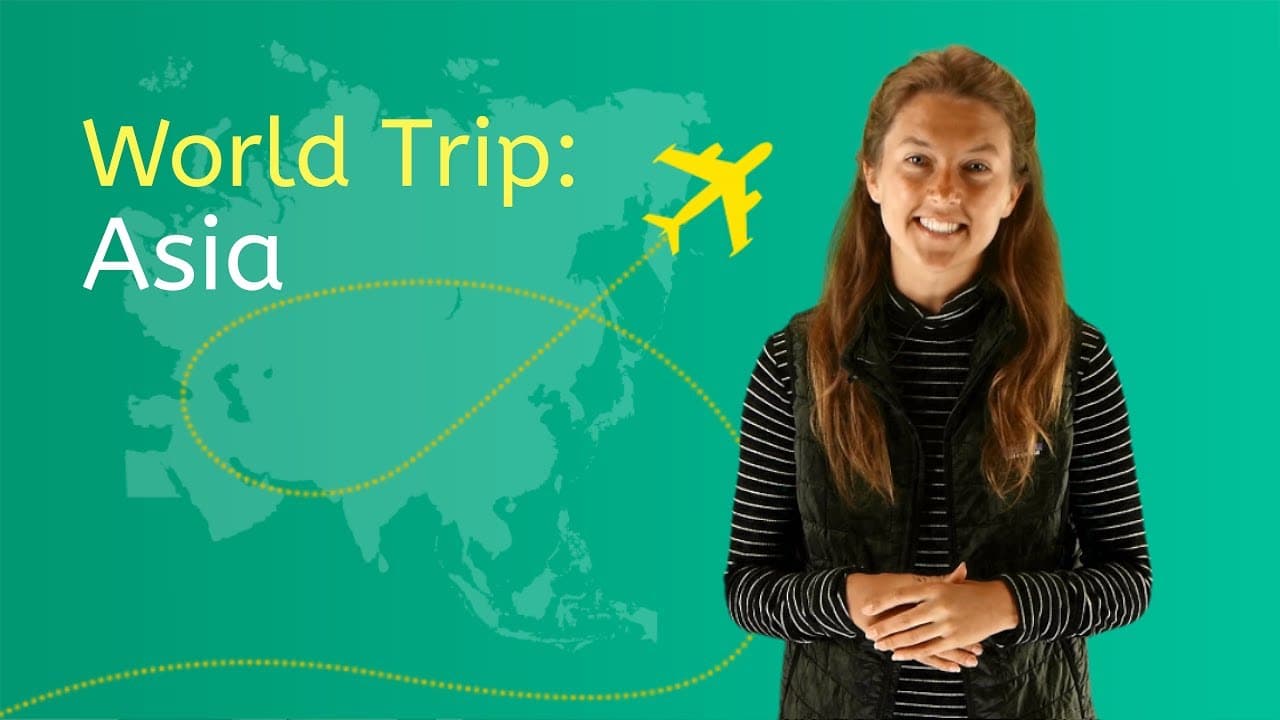
This educational video takes students on a comprehensive geographic tour of the continent of Asia, hosted by a presenter named Kylie. It begins by situating Asia among the seven continents, highlighting its status as the world's largest and most populous continent. The video breaks down the massive continent into five distinct regions: Southeast Asia, East Asia, South Asia, Southwest Asia (the Middle East), and Central Asia. For each region, the narrator describes the climate, key physical features, and lists major countries, providing interesting cultural or geographic facts for many of them. The video covers essential geographic concepts such as hemispheres, oceans, equators, and climate zones (from tropical monsoons to arid deserts). It introduces students to specific vocabulary like "transcontinental countries" (nations spanning two continents like Russia and Turkey) and "landlocked" countries. Additionally, it touches on political geography, briefly mentioning complex situations like the status of Taiwan and Palestine in a neutral, factual manner suitable for intermediate learners. For educators, this resource serves as an excellent introduction or review of Asian geography. It is packed with map visuals that highlight countries and regions, making it ideal for map-labeling activities. The video's structure allows teachers to pause after each region to discuss specific countries, climates, or cultures in depth. It connects geography to real-world topics like population density, trade goods (tea, spices), and biodiversity, offering numerous jumping-off points for research projects and classroom discussions.

Miacademy & MiaPrep Learning ChannelMiacademy & MiaPrep Learning Channel

9mins 12s

Exploring Economic Sustainability and the Global Economy

Exploring Economic Sustainability and the Global Economy

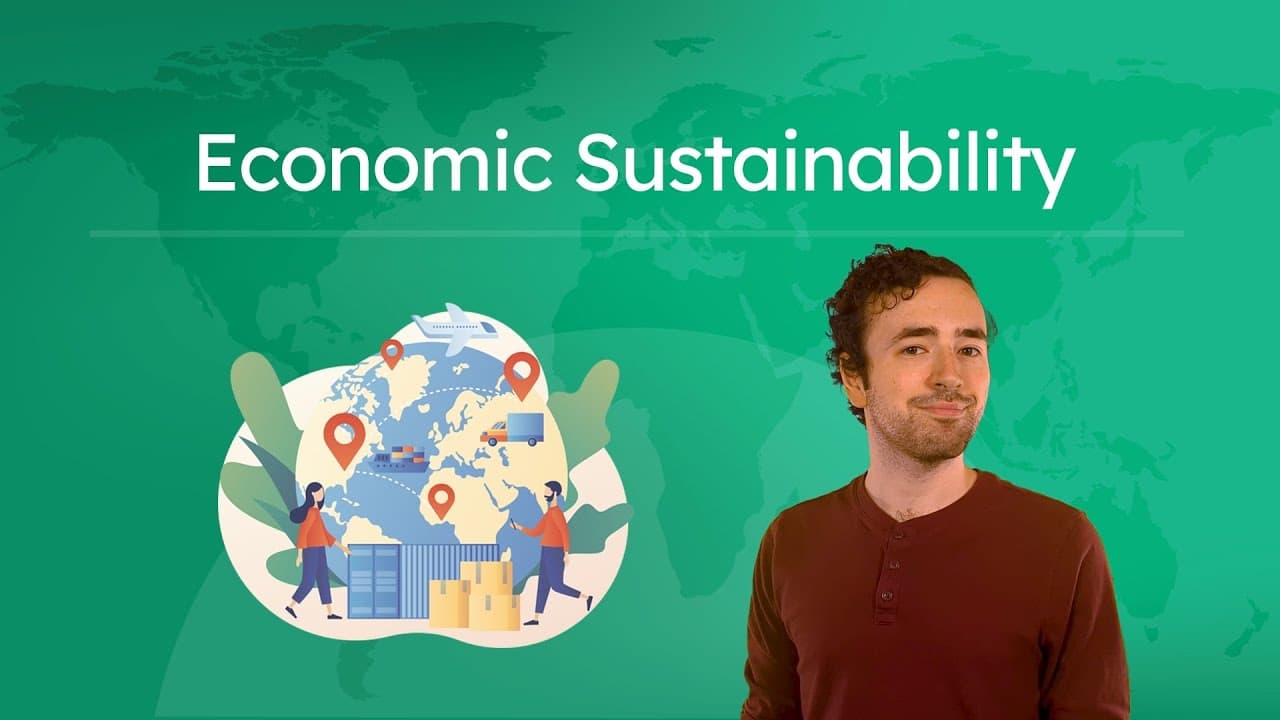
This educational video introduces students to the concept of economic sustainability through the metaphor of a "Global Fair." Hosted by a narrator named Justin, the video explores how businesses and governments can build strong economies that support current populations without compromising the future. The lesson is structured around three main "exhibits" corresponding to the three pillars of sustainability: Environmental Protection, Social Inclusion, and Economic Growth. The video covers a wide range of complex economic and environmental topics using real-world case studies. It examines the shift from linear to circular economies using Apple as an example, explains carbon emissions trading through the European Union's policies, and discusses the impact of electric vehicles with Ford. It delves into social sustainability by analyzing global wage gaps, the Rana Plaza tragedy, and fair trade practices with Starbucks. Finally, it addresses economic growth and diversification, using Saudi Arabia's "Vision 2030" and Google's investment in AI as examples of adapting to a changing world. For educators, this video serves as an excellent anchor for units on globalization, economics, or environmental science. It transforms abstract economic theories into concrete examples using recognizable brands, making the content highly relevant to students. The clear segmentation of the video allows teachers to either watch the whole piece or focus on specific pillars (environment, social justice, or economic growth) for targeted lessons.

Miacademy & MiaPrep Learning ChannelMiacademy & MiaPrep Learning Channel

12mins 31s

Materials

River Cradle Slides

River Cradle Slides

A dark-themed, visually vibrant classroom slide deck labeled Unit 2: Lesson 3.1 Geography of Mesopotamia, aligned with Arizona History and Social Science standards on every slide, featuring rich photography, high-contrast color-coded cards, and interactive review prompts.

SZ

Sandra Zoerhoff

Mesopotamia Adventure Packet

Mesopotamia Adventure Packet

A 6-page printable-ready student adventure packet about ancient Mesopotamia with enlarged readable Nunito fonts, a 5-paragraph reading passage, 4 text-dependent questions, scaffolded missions, and a culminating Settler Council simulation.

D

destiny.lanier

World Celebrations Slides

World Celebrations Slides

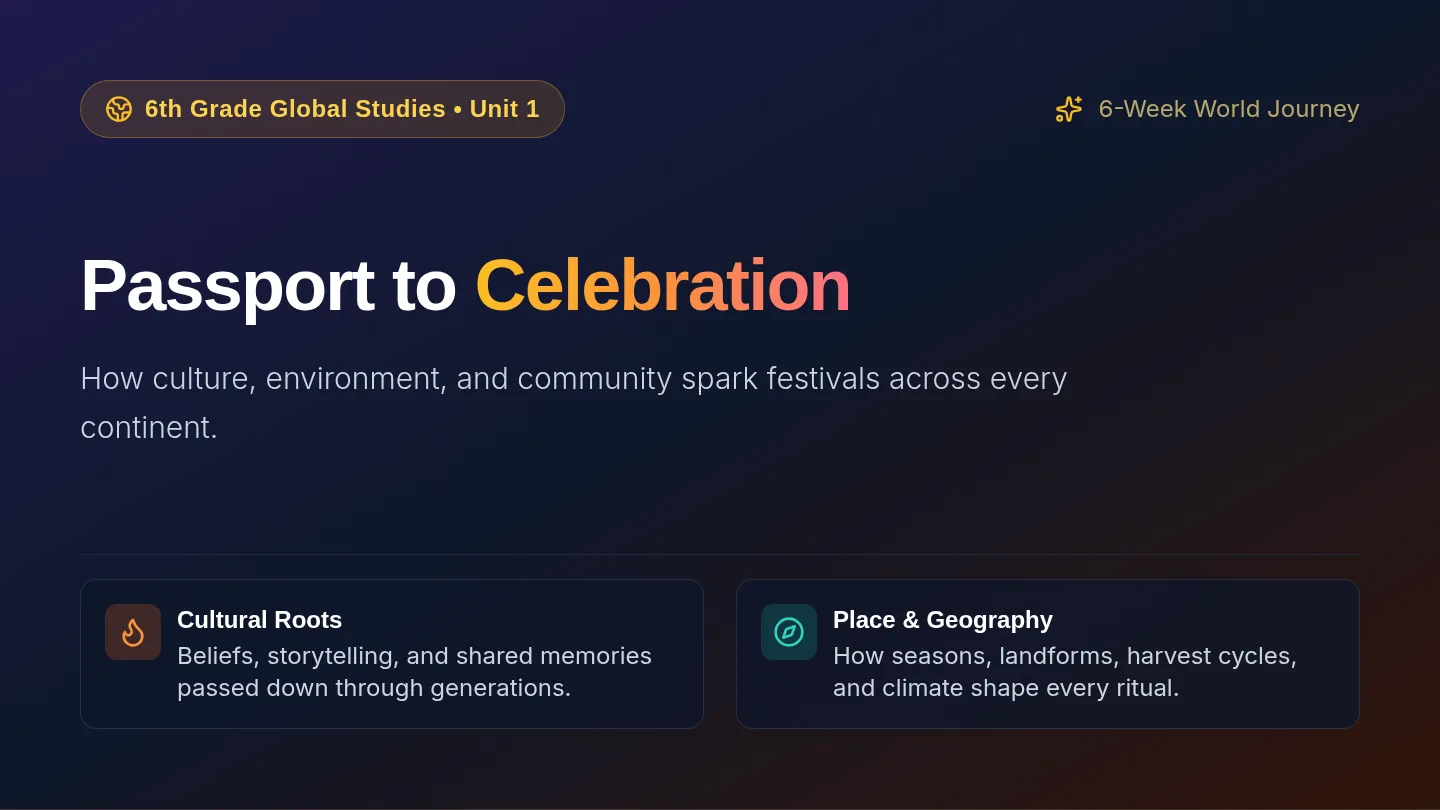
An engaging 8-slide classroom presentation for 6th grade introducing global festivals, exploring how cultural traditions, beliefs, and geographic environments shape celebrations worldwide.

J

Jojones

Indus Planned Cities Slides

Indus Planned Cities Slides

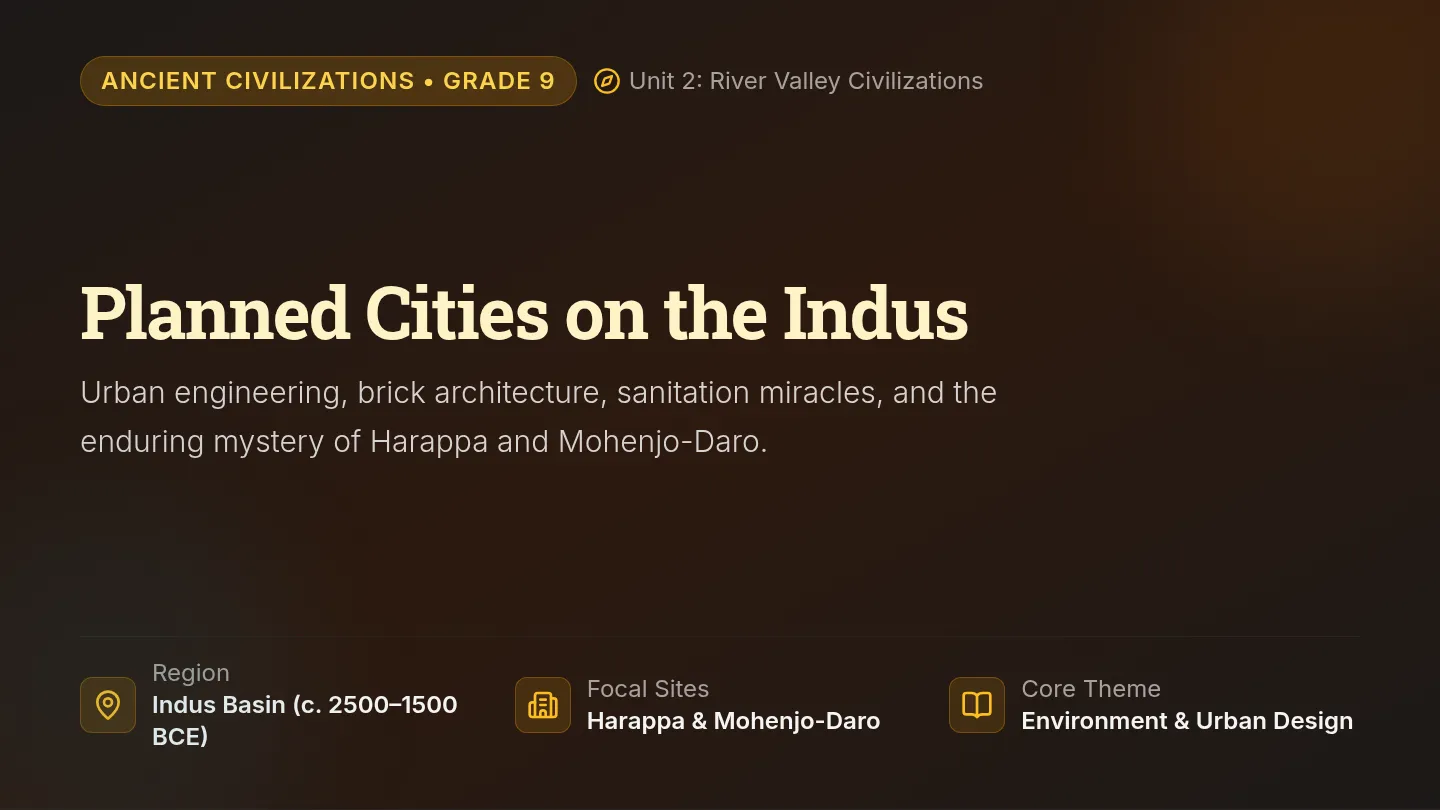
A comprehensive 12-slide instructional deck for 9th grade Ancient Civilizations covering the geography, urban planning, sanitation, culture, undeciphered language, trade, and collapse of the Indus Valley civilization.

E

ebakke

Bizarre Malaysia Trivia Slides

Bizarre Malaysia Trivia Slides

An expanded 8-slide presentation featuring a dedicated morning breakfast poll with iconic Malaysian favorites (Nasi Lemak/Roti Canai, Milo & Biscuits, and Kaya Toast & Half-Boiled Eggs), standalone question and reveal slides for each bizarre Malaysian trivia round, and an open-floor cultural sharing wrap-up.

HI

Husna Izzati

Cultural Geography Curriculum Map

Cultural Geography Curriculum Map

A comprehensive 5-page annual curriculum map and pacing guide aligning BJU Cultural Geography (4th Edition) with 6th Grade Social Studies Texas TEKS standards, organized month-by-month from August to May with essential questions, weekly lesson breakdowns, map quizzes, chapter tests, and quarterly project milestones.

L

lindseyward.inspiretx

Sequences

Global Grid Student Handbook

Power of Position

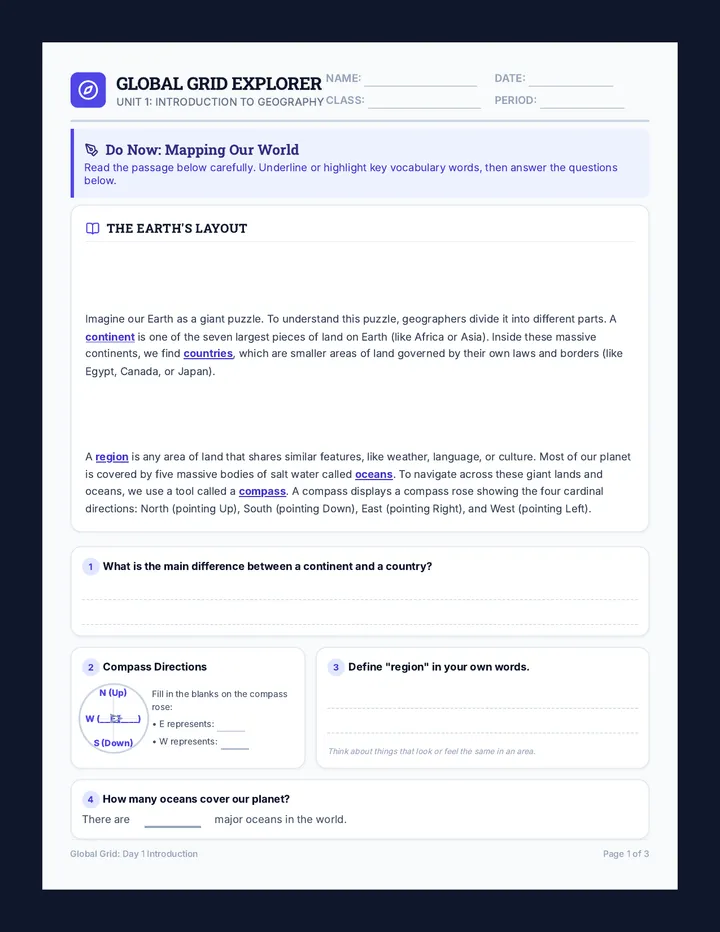
A 4-day introductory world history sequence exploring how geographic location, natural barriers, and famous trade routes shaped the rise, wealth, and power of global empires.

AG

Amina Gueye

14
Curriculum Blueprint Document v2

History Horizon Sequence

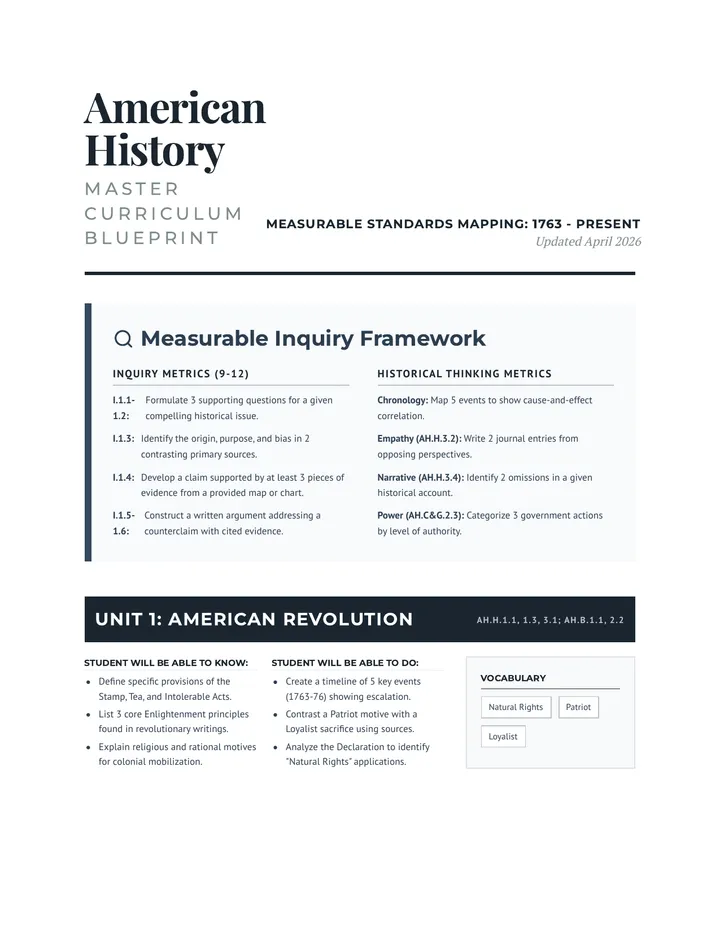
A comprehensive high school curriculum plan for American History, covering 13 units from the American Revolution to the modern era, aligned with North Carolina Social Studies standards.

AK

Amity Kea

21
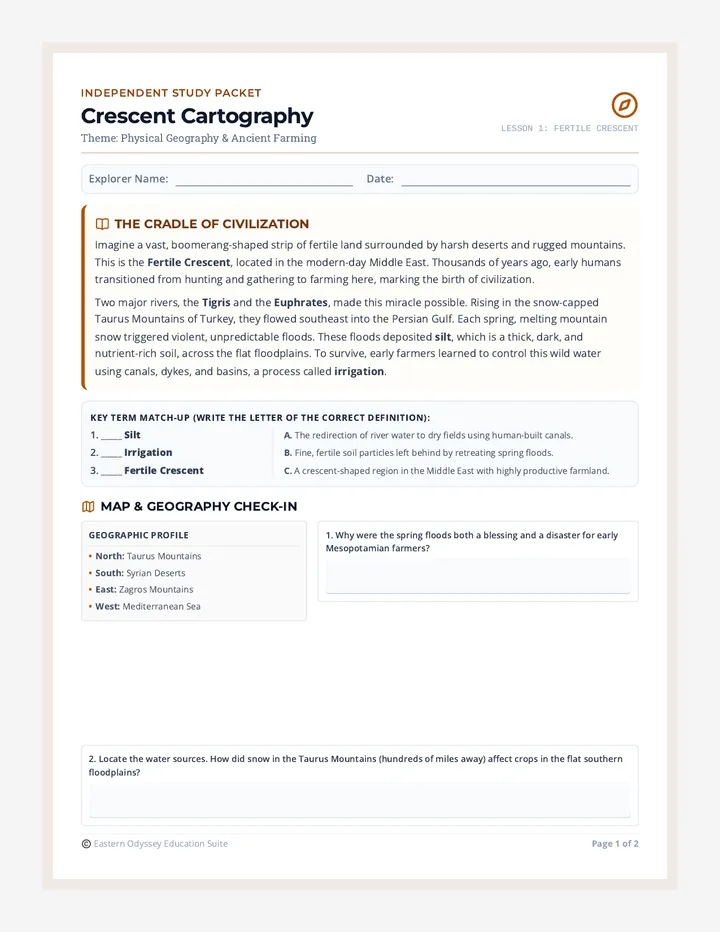
Crescent Cartography Student Packet

Eastern Odyssey Sub Packets

A sequence of 5 highly engaging, self-guided emergency sub plans for 6th-grade Eastern Hemisphere Social Studies, focusing on Ancient Egypt, Mesopotamia, the Fertile Crescent, Monsoon Asia, and Japan's island geography. Each sub plan includes a student packet and a teacher guide.

T

tpayne

10
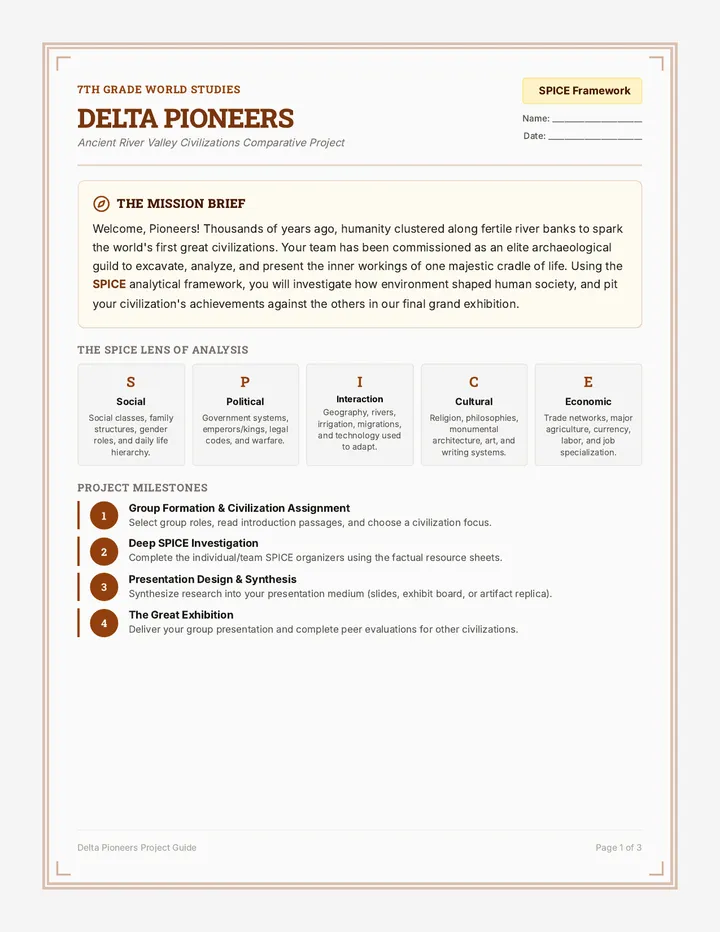
Pioneer Portfolio Project Guide

River Kingdoms

An immersive historical sequence guiding 7th-grade students through the excavation, comparison, and long-term legacy of the world's four primary river valley civilizations using the SPICE framework.

NE

Nicole Elder

9
Earth's Anatomy Slides

Global Landscapes Mastery

A global geography unit focusing on the identification and analysis of the Earth's diverse landscapes. Students will master map-reading skills including elevation, contour lines, and global physical regions to understand how geography shapes our world.

YP

Yovanna Plummer

27
Blueprint Prep Slides

Regents Blueprint Series

An intensive review series for the Modern World History NYS Regents exam, structured as high-speed 30-minute 'blueprint' sessions focusing on key units and test-taking strategies.

J

james.shaw

18

Lessons

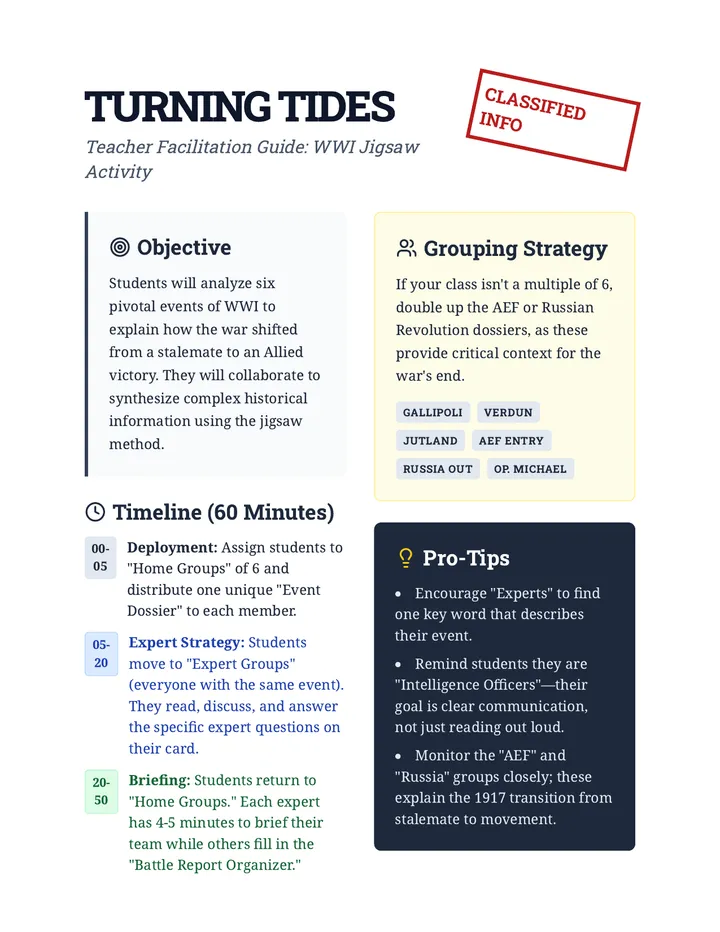
Turning Tides Teacher Guide

Turning Tides

A comprehensive jigsaw activity focusing on six pivotal events of World War I, designed for a 60-minute class session. Students act as intelligence officers to piece together the shifting dynamics of the Great War.

B

bliddy

34
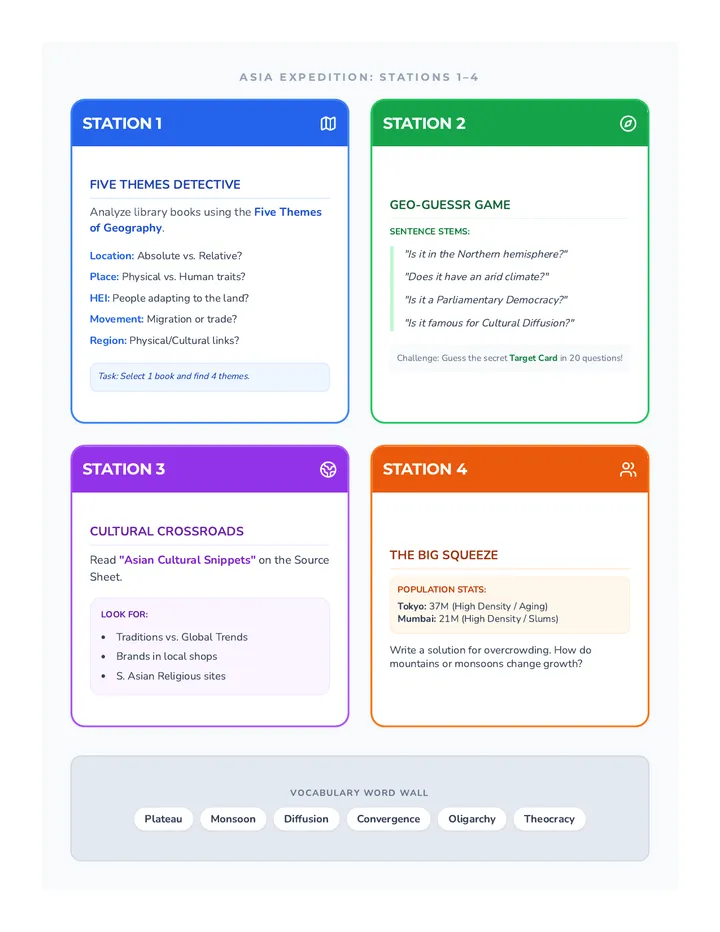
Asia Expedition Task Cards Resource

Asia Expedition Stations

A set of five interactive learning stations focused on the physical and cultural geography of Asia, including population challenges, globalization, and natural disasters. Students practice reading, writing, listening, and speaking skills while analyzing the five themes of geography.

JR

Jessica Ross

4
Asia Expedition Teacher Guide

Asia Expedition Stations微

A four-station rotation activity exploring the geography, culture, and innovations of Asia. Students investigate literary themes, analyze historical conflicts and migrations, map technological impacts, and play a geography-themed speaking game.

JR

Jessica Ross

6
Iran Today Lesson Plan

Iran Today Current Events

A single 30-minute lesson introducing 8th-grade students to current events in Iran while developing media literacy skills. Students analyze diverse news sources to understand regional developments and global impacts.

J

jlangberg

5
Freedom Struggles Unit Assessment

Freedom Struggles

A comprehensive lesson exploring the divergent paths to independence in India and Vietnam, examining non-violent resistance, armed struggle, and the influence of Cold War ideologies.

AH

Ashley Hopf

8
Explorer Epochs Wall Chart

Early World Explorers

A comprehensive lesson on early world exploration from 300 BCE to 1500 CE, focusing on the geographical, cultural, and religious impacts of key explorers across different continents.

J

jcasey

14