Lenny.com
Explore
Create
ActivitiesNewMathEnglish Language ArtsScience & EngineeringSocial StudiesGlobal LanguagesHealth & Physical EducationSpecial EducationCounseling & Life SkillsArts & CreativityESL
Lenny.com
Lenny.com
Explore
Create
ActivitiesNewMathEnglish Language ArtsScience & EngineeringSocial StudiesGlobal LanguagesHealth & Physical EducationSpecial EducationCounseling & Life SkillsArts & CreativityESL
Lenny.com
Lenny.com

Solutions

Lenny for EducatorsLenny for SchoolsLenny for Districts

Product

ExploreSign inCreateSupportAbout

Resources

Getting startedMTSS Acceleration Program

Newsletters

School Funding Newsletter

© 2026 Lenny Learning Inc.

TermsPrivacyAccessibility
LinkedInInstagramX
Lenny

The Constitution

Fundamental principles of U.S. governance, including the Preamble, Articles, and the Bill of Rights. Examines the separation of powers, checks and balances, and the amendment process.

Social StudiesSocial Studies PracticesLocation WordsMapsOrder EventsChronology and CausationEvaluating SourcesHistorical ThinkingGeography, Humans, & the EnvironmentAmerican Symbols and LandmarksCitiesStatesState CapitalsRegions of the United StatesGeographic SkillsPhysical GeographyHuman GeographyRegional GeographyGeography of AfricaGeography of AsiaGeography of EuropeGeography of OceaniaGeography of the AmericasSociety and Environment of EuropeSociety and Environment of AsiaSociety and Environment of The AmericasSociety and Environment of the Middle EastSociety and Environment of AfricaHistoryPrehistoryComparing Ancient River CivilizationsAncient MesopotamiaAncient Egypt and KushAncient South AsiaEarly ChinaGreeceRome and the Byzantine EmpireAncient World HistoryNative Peoples of North AmericaNative Peoples of Mesoamerica and South AmericaAfrican EmpiresMedieval AsiaMedieval EuropeThe Silk RoadMedieval HistoryIslamic EmpiresWorld ReligionsRenaissance PeriodAge of ExplorationThe Thirteen ColoniesThe American RevolutionUS History Early RepublicFounding of the United StatesUS History AntebellumUS Civil WarReconstruction PeriodThe Gilded AgeUS ImperialismWorld ImperialismWorld War IUS History 1920sGreat DepressionWorld War IIThe Cold WarUS History 1950-60sUS History 1960s-70sWorld History 20th CenturyContemporary US HistoryContemporary World HistoryHolidaysCivics and GovernmentCitizenshipGovernment FoundationsThe ConstitutionUS ConstitutionExecutive BranchLegislative BranchJudicial BranchState and LocalPolitical ParticipationPublic PolicyPolitical SystemsPower and AuthoritySocial MovementsDefining DevianceTheories of DevianceCrime and Criminal JusticeEconomicsBasic Economic PrinciplesSupply and DemandWhat is MoneyEconomic FundamentalsMicroeconomicsMacroeconomicsBanking and FinanceEconomic SystemsGlobal EconomicsCorporations and PowerThe Changing WorkplaceUnemployment and LaborClass and InequalitySocial MobilityGlobal InequalityPsychologyHistory of PsychologyPsychology as a ScienceBrain and Nervous SystemNeuroscience and BehaviorGenetics and BehaviorSleep and ConsciousnessSensory ProcessesPerceptual OrganizationClassical ConditioningOperant ConditioningObservational LearningCognitive LearningMemory ProcessesThinking and Problem SolvingLanguage and CognitionTheories of MotivationStress and CopingPrenatal and Infant DevelopmentChildhood DevelopmentAdolescent DevelopmentAdulthood and AgingSelf and IdentitySocial CognitionSocial InfluenceAttraction and RelationshipsGroup BehaviorPrejudice and DiscriminationAnxiety and Mood DisordersClinical PsychologyForensic PsychologyPhilosophy & EthicsIntroduction to PhilosophyMajor Philosophers & IdeasMind and Body ProblemFree Will vs DeterminismEthics & MoralityReligion & PhilosophyPolitical Philosophy

Videos

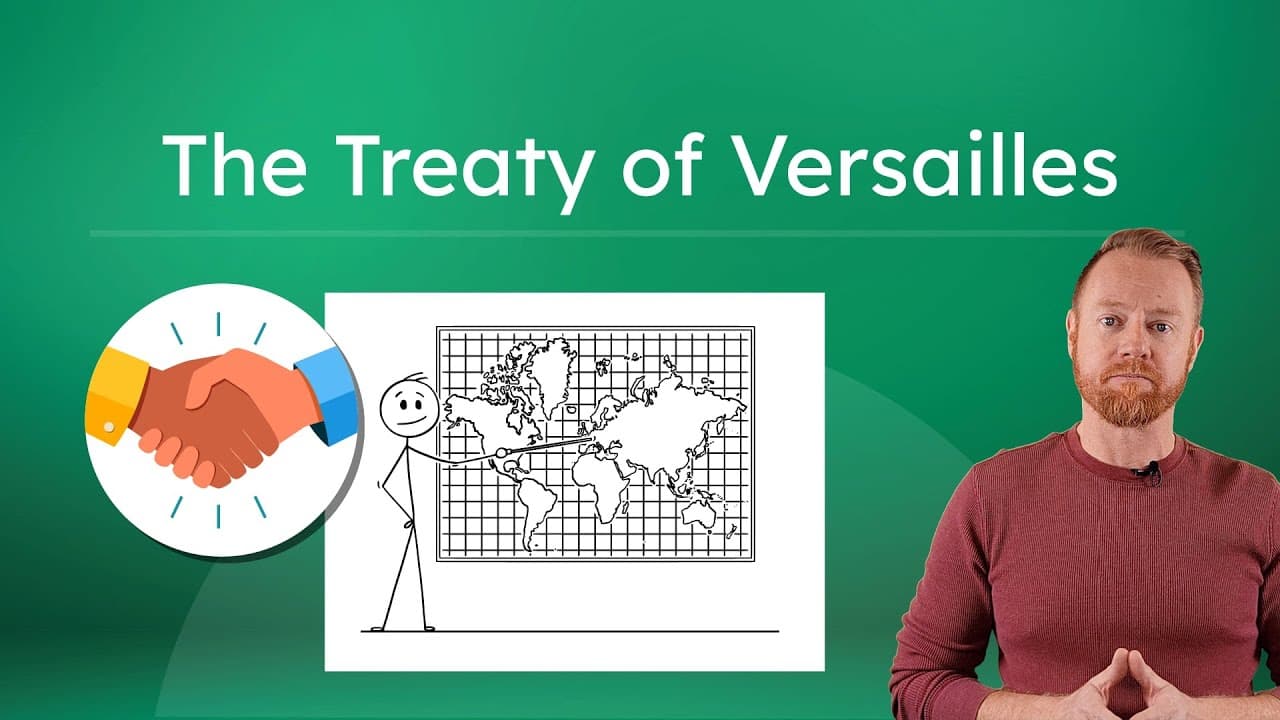
The Treaty of Versailles and the Failed Peace of World War I

The Treaty of Versailles and the Failed Peace of World War I

This educational video provides a comprehensive overview of the Treaty of Versailles, the peace agreement that officially ended World War I. Using a mix of news-broadcast style reenactments and direct instruction, the video breaks down the complex diplomatic goals of the "Big Four" nations—Britain, France, Italy, and the United States—during the Paris Peace Conference. It details the conflicting agendas of leaders like Woodrow Wilson, who sought lasting peace through his Fourteen Points, versus European leaders who demanded reparations and territorial concessions from Germany. The content meticulously explains the specific terms of the treaty, including the controversial Article 231 "War Guilt Clause," the staggering reparations demanded of Germany, and the significant redrawing of European and Middle Eastern borders. It highlights how the treaty established new nations while simultaneously planting seeds of resentment in Germany. The video also covers the domestic political battle in the United States regarding the League of Nations and the eventual rejection of the treaty by the U.S. Senate. This resource is highly valuable for history classrooms as it connects the diplomatic decisions of 1919 directly to the geopolitical tensions that led to World War II. By exploring the perspectives of both the victors and the defeated, it allows students to analyze how a peace treaty intended to end all wars ultimately laid the groundwork for future conflict. The video uses visual aids, maps, and guided questions to help students grasp these complex historical cause-and-effect relationships.

Miacademy & MiaPrep Learning ChannelMiacademy & MiaPrep Learning Channel

10mins 3s

How Federal Indian Law Shapes Native Sovereignty

How Federal Indian Law Shapes Native Sovereignty

This episode of Crash Course Native American History tackles the incredibly complex and often confusing subject of Federal Indian Law. Host Che Jim explains that this isn't just a single set of rules, but a centuries-long accumulation of treaties, court cases, executive orders, and statutes that define the legal relationship between the United States government and Native nations. The video uses the metaphor of a tangled string of Christmas lights to visualize how messy and interconnected these legal precedents are, covering everything from international travel to criminal jurisdiction. The video explores three main levels of impact: the individual, the community, and the land. It provides concrete examples for each, such as the Haudenosaunee lacrosse team's struggle to travel on their own passports, the jurisdictional crisis contributing to the Missing and Murdered Indigenous Women (MMIW) epidemic, and the legal hurdles regarding land use and hunting rights. The concept of "Domestic Dependent Nations" is introduced to explain how tribes retain sovereignty while still being subject to U.S. federal power. For educators, this video is a vital resource for civics, government, and U.S. history classes. It moves beyond abstract definitions of sovereignty to show real-world consequences of legal technicalities. It addresses hard truths about systemic inequalities while also highlighting Indigenous resilience and legal victories, such as the restoration of hunting rights and the revival of traditional ecological practices like clam gardening to combat climate change.

CrashCourseCrashCourse

10mins 44s

Affirmative Action: History and Supreme Court Rulings

Affirmative Action: History and Supreme Court Rulings

This episode of Crash Course Government and Politics provides a comprehensive overview of affirmative action in the United States, exploring its definition, legal history, and the intense political debate surrounding it. Host Craig Benzine navigates the complex topic by focusing on how the Supreme Court has interpreted affirmative action policies through the lens of the 14th Amendment's Equal Protection Clause. The video distinguishes between "equality of opportunity" and "equality of outcome" and uses analogies to explain the differing perspectives on these policies. The content dives deep into landmark Supreme Court cases that have shaped current laws, specifically Regents of the University of California v. Bakke (1973), Adarand Constructors v. Peña (1995), and the 2003 Michigan cases (Gratz v. Bollinger and Grutter v. Bollinger). It explains critical legal concepts like "strict scrutiny," "compelling government interest," and "narrowly tailored" policies. Additionally, it covers state-level reactions, such as California's Proposition 209, and analyzes the statistical impact of these bans on university enrollment. For educators, this video is an invaluable resource for teaching the judicial branch, civil rights, and constitutional interpretation. It models civil discourse on a polarized issue by presenting legal facts and historical context without taking a partisan stance. It serves as an excellent primer for classroom debates on admissions policies, discussions on the role of government in correcting historical wrongs, and lessons on how the Supreme Court balances individual rights against state interests.

CrashCourseCrashCourse

7mins 14s

Thomas Jefferson's Presidency and Contradictions

Thomas Jefferson's Presidency and Contradictions

This episode of Crash Course US History explores the complex presidency of Thomas Jefferson, the third President of the United States. Host John Green examines the election of 1800, often called the "Revolution of 1800," and contrasts Jefferson's idealized agrarian vision for America with the pragmatic realities he faced in office. The video navigates through significant events including the Louisiana Purchase, the Barbary Wars, and the Embargo Act of 1807, while analyzing how these actions often contradicted Jefferson's own strict constructionist philosophy. A major focus of the video is the deep moral contradiction at the heart of Jefferson's life and legacy: his authorship of the Declaration of Independence and rhetoric about liberty versus his status as a lifelong slave owner who held racist views. The video details Gabriel's Rebellion to illustrate the enslaved people's desire for freedom and discusses the landmark Supreme Court case Marbury v. Madison, which established the principle of judicial review. This resource is highly valuable for high school American History and Civics classrooms. It moves beyond a simple biography to challenge students to think critically about historical figures who are "revered and reviled." It provides excellent entry points for discussions on the role of the Supreme Court, the elasticity of the Constitution, and the unintended economic consequences of foreign policy.

CrashCourseCrashCourse

13mins 19s

How the Three Branches of U.S. Government Work Together

How the Three Branches of U.S. Government Work Together

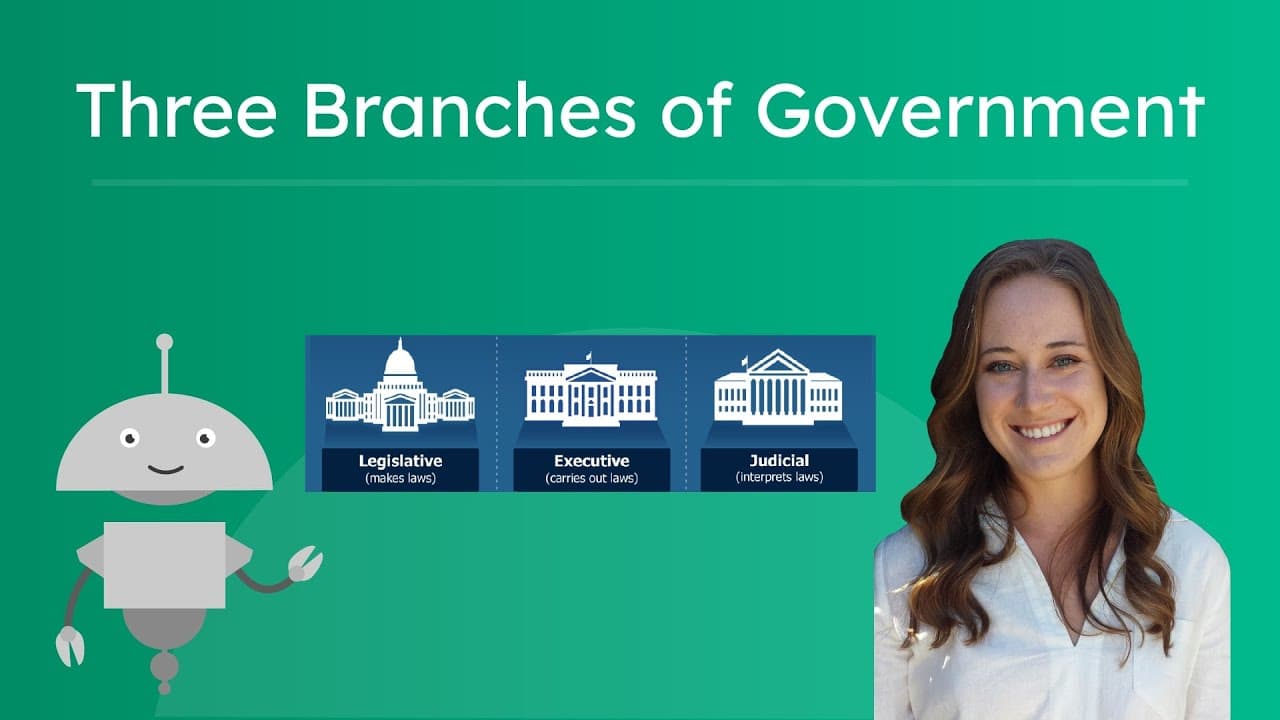
This educational video provides a clear and structured overview of the United States government's three branches, explaining the fundamental concept of a representative democracy. It breaks down how the U.S. government is organized to ensure a separation of powers, preventing any single entity from gaining too much control. The narrator introduces the specific roles, responsibilities, and key members of the Legislative, Executive, and Judicial branches in a way that is accessible for elementary and middle school students. The content explores the distinct functions of Congress (Senate and House of Representatives) in making laws, the President's role in enforcing laws and leading the military, and the Supreme Court's duty to interpret laws and the Constitution. It also covers essential vocabulary such as legislation, veto, unconstitutional, and diplomacy, while explaining the checks and balances inherent in the system, such as how judges are appointed for life or how the President can veto legislation. For educators, this video serves as an excellent foundational resource for civics and social studies units. It simplifies complex political structures into digestible segments with clear visual aids, making it ideal for introducing the Constitution or government systems. The video can spark meaningful classroom discussions about why rules are important, how decisions are made in a group, and the importance of having different people in charge of different tasks to ensure fairness.
Miacademy & MiaPrep Learning ChannelMiacademy & MiaPrep Learning Channel

5mins 24s

How the Electoral College Works: History and Mechanics

How the Electoral College Works: History and Mechanics

This educational video provides a comprehensive overview of the United States Electoral College, exploring its historical origins, the debates that shaped it, and its modern-day mechanics. Hosted by Justin from MiaPrep, the lesson breaks down complex civics concepts into digestible segments, starting with the Constitutional Convention of 1787. It explains why the Founding Fathers were hesitant to establish a direct popular vote and details the three main proposals considered before the Electoral College was adopted as a compromise between congressional selection and direct election.

Miacademy & MiaPrep Learning ChannelMiacademy & MiaPrep Learning Channel

9mins 47s

Materials

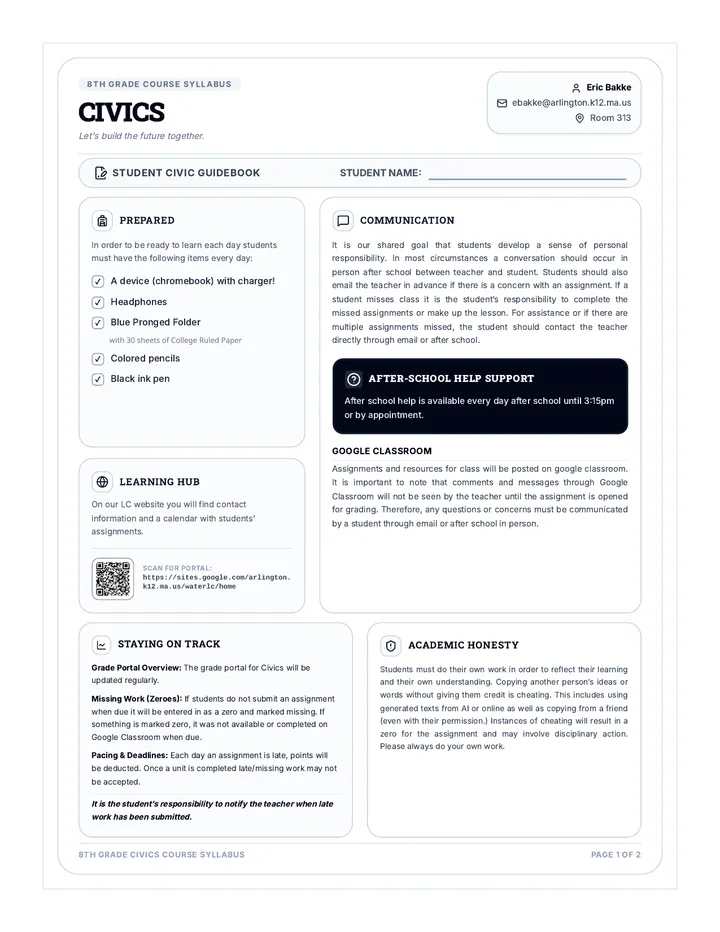
Civics Class Syllabus

Civics Class Syllabus

Civics Class Syllabus updated with an extra large QR code filling approximately half of the Digital Spaces container for maximum visibility and effortless scanning.

E

ebakke

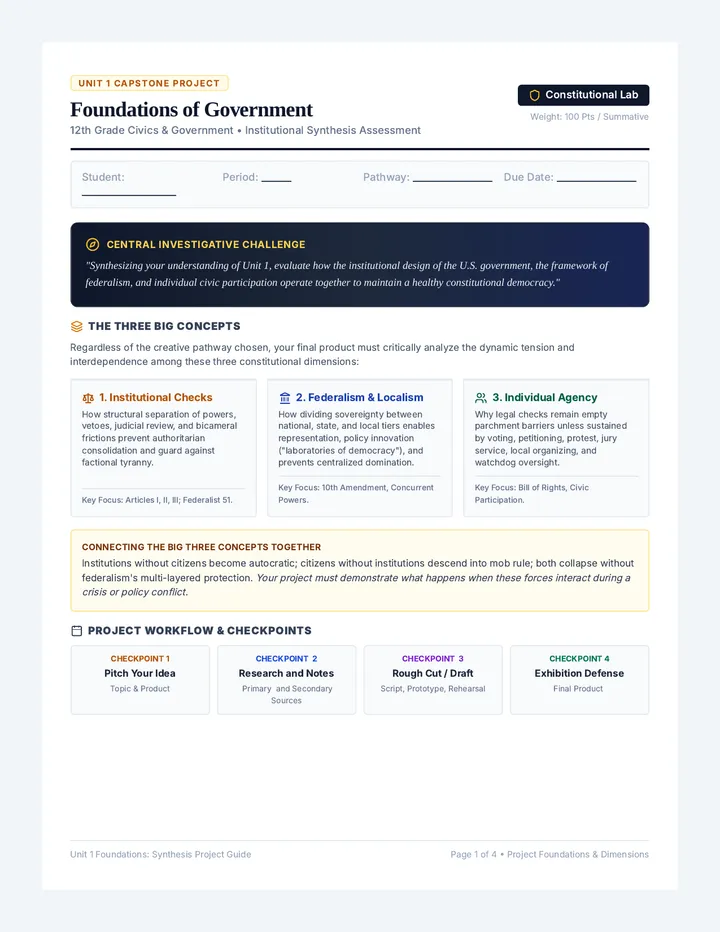
Democracy Design Project Guide

Democracy Design Project Guide

A comprehensive 4-page student project assignment guide for 12th-grade Civics and Government, detailing 5 creative project pathways (podcast, documentary, interview simulation, reader's theater drama, and board/card game), an analytical rubric across the three core constitutional dimensions, and a student planning blueprint.

JG

Joshua Griffith

Government Civics Bilingual Reader

Government Civics Bilingual Reader

A 5th-grade bilingual Spanish-English reading guide exploring the fundamentals of government, the three branches, active citizenship, and constitutional rights. Features side-by-side text, labeled photos of the White House and Capitol, simple civic illustrations, and an illustrated picture-vocabulary section.

M

mngillis

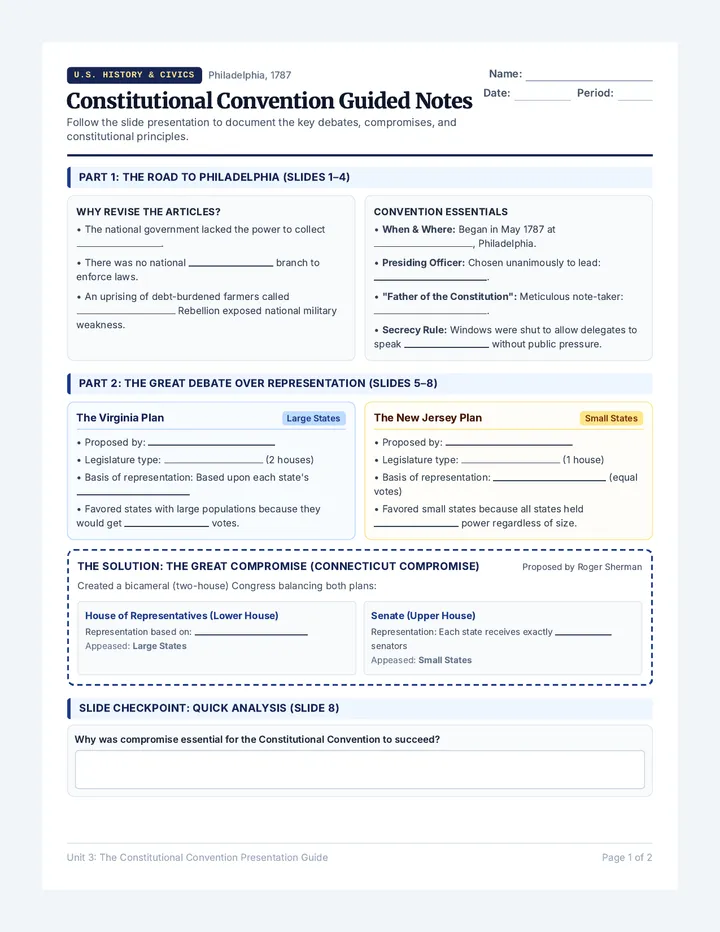
Constitutional Convention Guided Notes

Constitutional Convention Guided Notes

A comprehensive two-page guided note-taking worksheet on the 1787 Constitutional Convention, focusing on the road to Philadelphia, the Great Compromise, and slavery and economic compromises.

D

DOUGLAS.BODIE

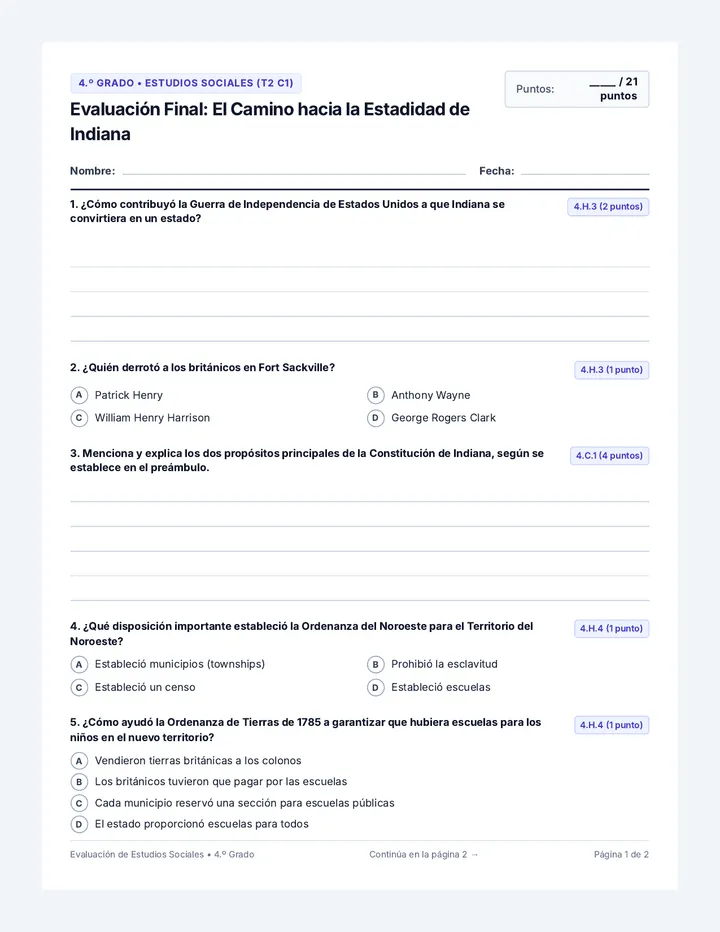
Indiana Statehood Spanish Test

Indiana Statehood Spanish Test

A Spanish translation of the 4th-grade social studies post-assessment on Indiana's journey to statehood, historical ordinances, and early governance. Includes 11 standards-aligned questions with designated response areas and clear multiple-choice options.

JS

Jennifer Swallow

Loving Legacy Worksheet

Loving Legacy Worksheet

A comprehensive, two-page student worksheet and reading comprehension guide about the landmark Supreme Court case Loving v. Virginia (1967). Designed for 8th-grade civics, it utilizes a clean legal-docket theme and includes deep reading passages on the 14th Amendment, followed by critical-thinking analysis prompts with dedicated writing areas.

T

tsundstrom

Sequences

Leaders of the Storm Slides

Civil War Dispatch

A comprehensive 4-lesson unit for 5th grade exploring the pivotal figures, major conflicts, and the courageous escape routes of the American Civil War. Students engage with historical primary-source styles while learning about leadership and the quest for freedom.

IA

Isabella Adkins

12
Thirteen Friends Worksheet

Democratic Foundations

A series of lessons exploring the foundational documents and processes of the United States government, from the birth of the nation to the creation of modern laws.

SB

Stephanie Bizeur

40
Unity Roadmap Teacher Guide

Unity and Growth

A modified Modern US History curriculum (Founding to Present) for Tier 2 and 3 special education students, based on Grade 11 Social Studies standards. Focuses on government, industrialization, world wars, and civil rights.

D

dfleisch

26
Washingtons Warning Lesson Plan

Washington's Farewell Legacy

A two-part sequence that takes students from a deep-dive analysis of George Washington's Farewell Address to a modern-day evaluation of his warnings regarding political parties, media bias, and national unity.

CE

Chelsea Elliott

24
Amendment Evolution Slides

Constitutional Crossroads

A deep dive into the foundations of American government, covering the evolution of constitutional amendments and the structure and power of the judicial system.

GM

Geneva Manus

11
Master Plan Slides

Power Players

A 5-week unit exploring the foundations of the United States government, the three branches of power, and the responsibilities of citizenship, specifically tailored for 4th-grade learners in Illinois.

KC

Kady Carter

8

Lessons

History Sprint Pacing Guide

STAAR History Sprint

A comprehensive pacing guide and activity resource designed to cover the remaining 11th Grade US History TEKS before the STAAR test on April 16th. This lesson provides a day-by-day calendar for A/B block schedules and high-engagement activities for each remaining historical era.

BB

Bridgette Burdick

51
Border Lines Activity

Harriet Tubman Escape

A lesson exploring Harriet Tubman's 1850 escape and the significance of the Mason-Dixon Line as a geographical and legal boundary in the pre-Civil War United States.

TL

Tanya Larson

46
Constitutional Vocabulary Poster Set

Constitutional Vocabulary

A set of vocabulary posters focused on key terms from the Constitutional Convention, including government structures, legislative roles, and foundational principles like compromise and federalism.

SA

Senta Agnello-Shelton

21
Modern Era Reader Part 1

The Modern Ledger

A comprehensive exploration of the 1990s through the modern day, covering technological shifts, political milestones, military conflicts, and cultural evolution in the United States.

CE

Chelsea Elliott

20
Branch Breakdown Reading

Branch Builders

A comprehensive introduction to the three branches of the U.S. government, focusing on the roles and responsibilities of the Legislative, Executive, and Judicial branches.

GM

Geneva Manus

10
Compromise Conundrum Activity Signs

Compromise Conundrum

A 45-minute stand-alone lesson centered on the Constitutional Convention's debate over representation and the Three-Fifths Compromise. It includes chunked reading for accessibility, a high-engagement 'Four Corners' activity, and a graphic organizer assessment designed for formal observation alignment with the Danielson Framework.

SA

Senta Agnello-Shelton

11