Acquisition Vocabulary Poster Acquisition
Definition
The act of getting or gaining something.
Constitutional Context
"The acquisition of new Western territories after the Revolutionary War forced delegates at the Constitutional Convention to decide how new states would eventually join the Union."
Constitutional Convention Vocabulary Series
Constitutional Vocabulary Poster Set Acquisition
Definition
The act of getting or gaining something.
Constitutional Context
"The acquisition of new territories forced delegates to decide how states would join the Union."
Constitutional Vocabulary Series
Justify
Definition
To provide a reason or explanation for an action.
Constitutional Context
"Delegates had to justify a strong central government to those who feared tyranny."
Constitutional Vocabulary Series
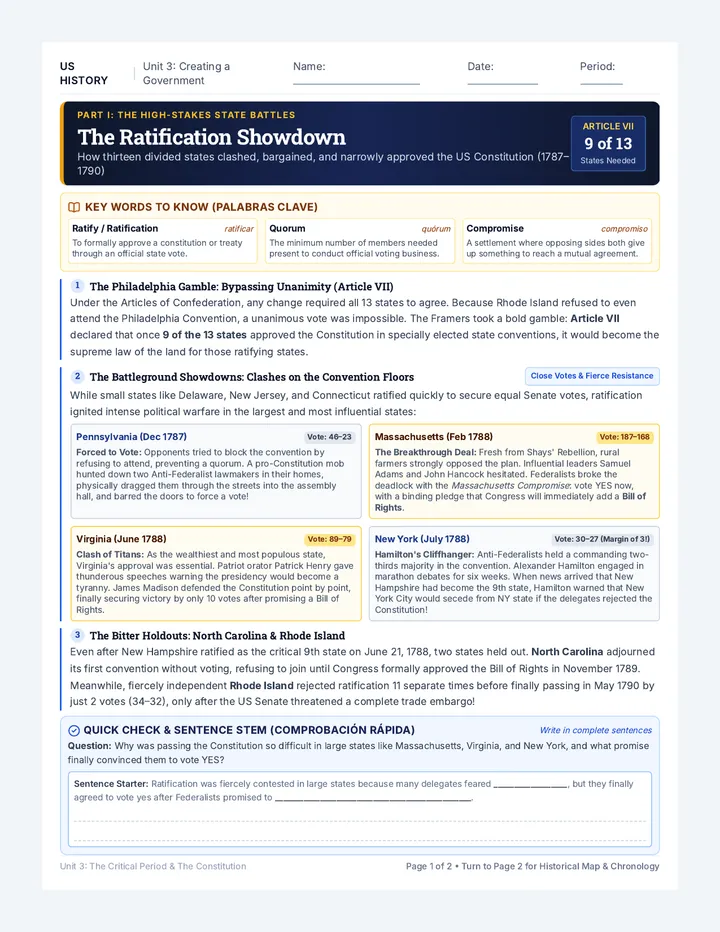
Compromise
Definition
An agreement where both sides give up something.
Constitutional Context
"The Great Compromise settled the debate between large and small states over representation."
Constitutional Vocabulary Series
Ratify
Definition
To formally approve or give official consent to a document.
Constitutional Context
"Before the Constitution could become law, nine out of the thirteen states had to ratify it."
Constitutional Vocabulary Series
Amendment
Definition
A formal change or addition designed to update a document.
Constitutional Context
"The delegates created a process for adding an amendment so the Constitution could adapt."
Constitutional Vocabulary Series
Federalism
Definition
A system where power is shared between national and state governments.
Constitutional Context
"By establishing federalism, the Constitution balanced national unity and state independence."
Constitutional Vocabulary Series
Sovereignty
Definition
The supreme power or authority to govern.
Constitutional Context
"Popular sovereignty means that the government's power comes from the consent of the people."
Constitutional Vocabulary Series
Bicameral
Definition
A legislative system having two separate branches or houses.
Constitutional Context
"The Great Compromise created a bicameral legislature: the House and the Senate."
Constitutional Vocabulary Series
Republic
Definition
Government where power is held by the people and their representatives.
Constitutional Context
"When asked what government was created, Franklin replied, 'A republic, if you can keep it.'"
Constitutional Vocabulary Series
Preamble
Definition
An introduction to a document that explains its purpose.
Constitutional Context
"The Preamble begins with 'We the People,' establishing that power comes from citizens."
Constitutional Vocabulary Series
Delegate
Definition
A person chosen or elected to represent others.
Constitutional Context
"Fifty-five delegates gathered in Philadelphia in 1787 to draft the Constitution."
Constitutional Vocabulary Series
U.S. Government
Also Known As
National | Central | Federal
Definition
The highest level of government in the country.
Constitutional Context
"Delegates debated whether the federal government should be more powerful than states."
Constitutional Vocabulary Series
Legislature
Congress
LEGISLATE to make laws
LEGISLATOR a person who makes laws
Definition
The branch of government that makes laws.
Constitutional Context
"Article I establishes the Legislature, giving Congress power to write federal laws."
Constitutional Vocabulary Series
Executive
Definition
The branch of government that carries out laws.
Constitutional Context
"Article II defines the Executive Branch, settling the debate over who should lead."
Constitutional Vocabulary Series
Judicial
Definition
The branch of government that interprets laws.
Constitutional Context
"Article III establishes the Judicial Branch, vesting power in the Supreme Court."
Constitutional Vocabulary Series
State Sizes
Large State
Large Population
Small State
Small Population
Important Note
Size refers to population, not land area.
Constitutional Context
"Virginia was a large state (many people), while Delaware was a small state."
Constitutional Vocabulary Series
State Status
Slave State
Slavery was Legal
Free State
Slavery was Illegal
Definition
Whether a state allowed or prohibited slavery.
Constitutional Context
"The division between free states and slave states led to heated debates."
Constitutional Vocabulary Series
Houses
Definition
Separate groups of lawmakers.
Constitutional Context
"The Great Compromise split Congress into two houses—the House and the Senate."
Constitutional Vocabulary Series
Constitutional Vocabulary Poster Set Acquisition
Definition
The act of getting or gaining something.
Constitutional Context
"The acquisition of new territories forced delegates to decide how states would join the Union."
Constitutional Vocabulary Series
Justify
Definition
To provide a reason or explanation for an action.
Constitutional Context
"Delegates had to justify a strong central government to those who feared tyranny."
Constitutional Vocabulary Series
Compromise
Definition
An agreement where both sides give up something.
Constitutional Context
"The Great Compromise settled the debate between large and small states over representation."
Constitutional Vocabulary Series
Ratify
Definition
To formally approve or give official consent to a document.
Constitutional Context
"Before the Constitution could become law, nine out of the thirteen states had to ratify it."
Constitutional Vocabulary Series
Amendment
Definition
A formal change or addition designed to update a document.
Constitutional Context
"The delegates created a process for adding an amendment so the Constitution could adapt."
Constitutional Vocabulary Series
Federalism
Definition
A system where power is shared between national and state governments.
Constitutional Context
"By establishing federalism, the Constitution balanced national unity and state independence."
Constitutional Vocabulary Series
Sovereignty
Definition
The supreme power or authority to govern.
Constitutional Context
"Popular sovereignty means that the government's power comes from the consent of the people."
Constitutional Vocabulary Series
Bicameral
Definition
A legislative system having two separate branches or houses.
Constitutional Context
"The Great Compromise created a bicameral legislature: the House and the Senate."
Constitutional Vocabulary Series
Republic
Definition
Government where power is held by the people and their representatives.
Constitutional Context
"When asked what government was created, Franklin replied, 'A republic, if you can keep it.'"
Justify Vocabulary Poster Justify
Definition
To provide a reason or explanation for an action.
Constitutional Context
"Delegates had to justify the creation of a strong central government to those who feared it would become as tyrannical as the British monarchy."
Constitutional Convention Vocabulary Series
Constitutional Vocabulary Poster Set Acquisition
Definition
The act of getting or gaining something.
Constitutional Context
"The acquisition of new territories forced delegates to decide how states would join the Union."
Constitutional Vocabulary Series
Justify
Definition
To provide a reason or explanation for an action.
Constitutional Context
"Delegates had to justify a strong central government to those who feared tyranny."
Constitutional Vocabulary Series
Compromise
Definition
An agreement where both sides give up something.
Constitutional Context
"The Great Compromise settled the debate between large and small states over representation."
Constitutional Vocabulary Series
Ratify
Definition
To formally approve or give official consent to a document.
Constitutional Context
"Before the Constitution could become law, nine out of the thirteen states had to ratify it."
Constitutional Vocabulary Series
Amendment
Definition
A formal change or addition designed to update a document.
Constitutional Context
"The delegates created a process for adding an amendment so the Constitution could adapt."
Constitutional Vocabulary Series
Federalism
Definition
A system where power is shared between national and state governments.
Constitutional Context
"By establishing federalism, the Constitution balanced national unity and state independence."
Constitutional Vocabulary Series
Sovereignty
Definition
The supreme power or authority to govern.
Constitutional Context
"Popular sovereignty means that the government's power comes from the consent of the people."
Constitutional Vocabulary Series
Bicameral
Definition
A legislative system having two separate branches or houses.
Constitutional Context
"The Great Compromise created a bicameral legislature: the House and the Senate."
Constitutional Vocabulary Series
Republic
Definition
Government where power is held by the people and their representatives.
Constitutional Context
"When asked what government was created, Franklin replied, 'A republic, if you can keep it.'"
Compromise Vocabulary Poster Compromise
Definition
An agreement where both sides give up something to reach a deal.
Constitutional Context
"The Great Compromise settled the debate between large and small states by creating a two-house legislature with different forms of representation."
Constitutional Convention Vocabulary Series
Ratify Vocabulary Poster Ratify
Definition
To formally approve or give official consent to a document.
Constitutional Context
"Before the Constitution could become the law of the land, nine out of the thirteen states had to ratify it through special state conventions."
Constitutional Convention Vocabulary Series
Amendment Vocabulary Poster Amendment
Definition
A formal change or addition designed to update a document.
Constitutional Context
"The delegates created a process for adding an amendment so the Constitution could adapt to the needs of future generations."
Constitutional Convention Vocabulary Series
Federalism Vocabulary Poster Federalism
Definition
A system where power is shared between a central and state governments.
Constitutional Context
"By establishing federalism, the Constitution balanced the need for national unity with the states' desire for independence."
Constitutional Convention Vocabulary Series
Sovereignty Vocabulary Poster Sovereignty
Definition
The supreme power or authority to govern.
Constitutional Context
"The principle of popular sovereignty means that the government's power comes from the consent of the governed—the people."
Constitutional Convention Vocabulary Series
Bicameral Vocabulary Poster Bicameral
Definition
A legislative system having two separate branches or houses.
Constitutional Context
"The Great Compromise created a bicameral legislature: the House of Representatives and the Senate."
Constitutional Convention Vocabulary Series
Republic Vocabulary Poster Republic
Definition
Government where power is held by the people and their elected representatives.
Constitutional Context
"When asked what kind of government the convention had created, Benjamin Franklin famously replied, 'A republic, if you can keep it.'"
Constitutional Convention Vocabulary Series
Preamble Vocabulary Poster Preamble
Definition
An introduction to a document that explains its purpose.
Constitutional Context
"The Preamble to the Constitution begins with the famous words, 'We the People,' establishing that power comes from citizens."
Constitutional Convention Vocabulary Series
Delegate Vocabulary Poster Delegate
Definition
A person chosen or elected to represent others.
Constitutional Context
"Fifty-five delegates from twelve states gathered in Philadelphia in 1787 to draft the Constitution."
Constitutional Convention Vocabulary Series
U.S. Government Names Poster U.S. Government
Many Names, One Authority
National
Central
Federal
Definition
The highest level of government in the country.
Constitutional Context
"The delegates debated whether the new federal government should be more powerful than the state governments."
Constitutional Convention Vocabulary Series
Legislature Vocabulary Poster Legislature
Congress
Legislate to make laws
Legislation the laws themselves
Legislator a person who makes laws
Definition
The branch of government that makes laws.
Constitutional Context
"Article I of the Constitution establishes the Legislature, giving Congress the power to write and pass federal laws."
Constitutional Convention Vocabulary Series
Executive Branch Vocabulary Poster Executive
Definition
The branch of government that carries out and enforces laws.
Constitutional Context
"Article II defines the Executive Branch, settling the debate over whether one person or a group should lead the country."
Constitutional Convention Vocabulary Series
Judicial Branch Vocabulary Poster Judicial
Definition
The branch of government that interprets laws and decides if they are constitutional.
Constitutional Context
"Article III establishes the Judicial Branch, ensuring that the judicial power is vested in one Supreme Court."
Constitutional Convention Vocabulary Series
State Population Poster State Sizes
Large State
Large Population
Small State
Small Population
Important Note
In the Constitution, size refers to how many people live there, not land area.
Constitutional Context
"Virginia was a large state because it had the most people, while Delaware was a small state because it had fewer people."
Constitutional Convention Vocabulary Series
Slave vs Free State Poster State Status
Slave State
Slavery was Legal
Free State
Slavery was Illegal
Definition
A term used to describe whether a state allowed or prohibited slavery.
Constitutional Context
"The division between free states and slave states led to heated debates at the Convention, including how enslaved people would be counted for representation."
Constitutional Convention Vocabulary Series
Houses Vocabulary Poster Houses
Definition
Separate groups of lawmakers that make up a legislature.
Constitutional Context
"The Great Compromise split Congress into two houses—the House of Representatives and the Senate—to balance power between states."
Constitutional Convention Vocabulary Series