Ratification Showdown Reading
US History | Unit 3: Creating a Government
Name: Date: Period:
Part I: The High-Stakes State Battles
The Ratification Showdown
How thirteen divided states clashed, bargained, and narrowly approved the US Constitution (1787–1790)
Article VII 9 of 13 States Needed
Key Words to Know (Palabras Clave)
Ratify / Ratification ratificar
To formally approve a constitution or treaty through an official state vote.
Quorum quórum
The minimum number of members needed present to conduct official voting business.
Compromise compromiso
A settlement where opposing sides both give up something to reach a mutual agreement.
1 The Philadelphia Gamble: Bypassing Unanimity (Article VII)
Under the Articles of Confederation, any change required all 13 states to agree. Because Rhode Island refused to even attend the Philadelphia Convention, a unanimous vote was impossible. The Framers took a bold gamble: Article VII declared that once 9 of the 13 states approved the Constitution in specially elected state conventions, it would become the supreme law of the land for those ratifying states.
2 The Battleground Showdowns: Clashes on the Convention Floors
Close Votes & Fierce Resistance
While small states like Delaware, New Jersey, and Connecticut ratified quickly to secure equal Senate votes, ratification ignited intense political warfare in the largest and most influential states:
Pennsylvania (Dec 1787) Vote: 46–23
Forced to Vote: Opponents tried to block the convention by refusing to attend, preventing a quorum. A pro-Constitution mob hunted down two Anti-Federalist lawmakers in their homes, physically dragged them through the streets into the assembly hall, and barred the doors to force a vote!
Massachusetts (Feb 1788) Vote: 187–168
The Breakthrough Deal: Fresh from Shays' Rebellion, rural farmers strongly opposed the plan. Influential leaders Samuel Adams and John Hancock hesitated. Federalists broke the deadlock with the Massachusetts Compromise: vote YES now, with a binding pledge that Congress will immediately add a Bill of Rights.
Virginia (June 1788) Vote: 89–79
Clash of Titans: As the wealthiest and most populous state, Virginia's approval was essential. Patriot orator Patrick Henry gave thunderous speeches warning the presidency would become a tyranny. James Madison defended the Constitution point by point, finally securing victory by only 10 votes after promising a Bill of Rights.
New York (July 1788) Vote: 30–27 (Margin of 3!)
Hamilton's Cliffhanger: Anti-Federalists held a commanding two-thirds majority in the convention. Alexander Hamilton engaged in marathon debates for six weeks. When news arrived that New Hampshire had become the 9th state, Hamilton warned that New York City would secede from NY state if the delegates rejected the Constitution!
3 The Bitter Holdouts: North Carolina & Rhode Island
Even after New Hampshire ratified as the critical 9th state on June 21, 1788, two states held out. North Carolina adjourned its first convention without voting, refusing to join until Congress formally approved the Bill of Rights in November 1789. Meanwhile, fiercely independent Rhode Island rejected ratification 11 separate times before finally passing in May 1790 by just 2 votes (34–32), only after the US Senate threatened a complete trade embargo!
Quick Check & Sentence Stem (Comprobación Rápida) Write in complete sentences
Question: Why was passing the Constitution so difficult in large states like Massachusetts, Virginia, and New York, and what promise finally convinced them to vote YES?
Sentence Starter: Ratification was fiercely contested in large states because many delegates feared __________________, but they finally agreed to vote yes after Federalists promised to ________________________________________________.
Unit 3: The Critical Period & The Constitution Page 1 of 2 • Turn to Page 2 for Historical Map & Chronology
Part II
Primary Source Map: Ratification of the Federal Constitution (1787–1790)
Cartographic Investigation
Coast vs. Backcountry: Support was divided between commercial seaports along the Atlantic Coast and farming regions in the Inland Backcountry.
Study the map, color key, and timeline below
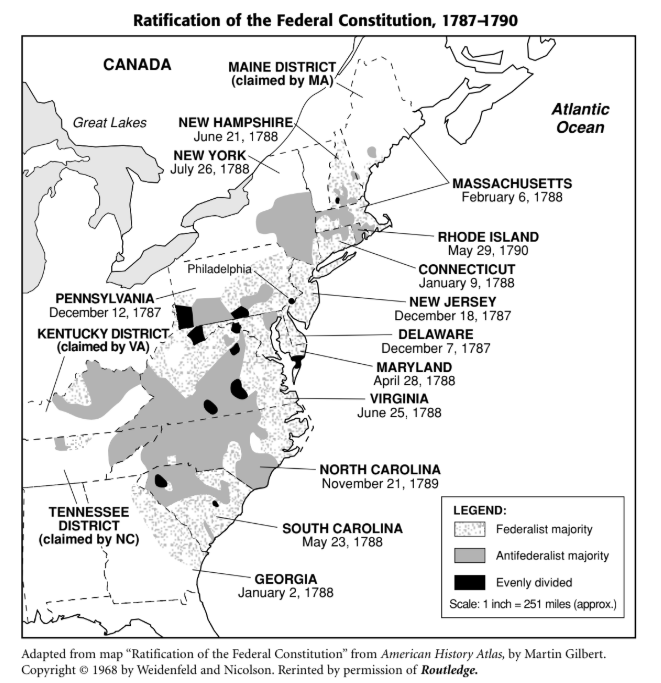
Historical Map: Martin Gilbert, American History Atlas (Weidenfeld & Nicolson / Routledge)
Map Key Helper: What the Three Colors Mean
::: Stippled Pattern
Federalist Majority
Voted YES for Constitution. Concentrated in Atlantic shipping ports and trading centers.
Solid Gray
Antifederalist Majority
Opposed Constitution. Concentrated in inland farming and rural backcountry regions.
Solid Black
Evenly Divided
Districts where convention delegates were tied or split evenly between the two sides.
Ratification Order 13 States in Order
1. Delaware Dec 7, 1787
2. Pennsylvania Dec 12, 1787
3. New Jersey Dec 18, 1787
4. Georgia Jan 2, 1788
5. Connecticut Jan 9, 1788
6. Massachusetts Feb 6, 1788
7. Maryland Apr 28, 1788
8. South Carolina May 23, 1788
9. New Hampshire Jun 21, 1788
★ 9th State: Took Effect
10. Virginia Jun 25, 1788
11. New York Jul 26, 1788
12. North Carolina Nov 21, 1789
13. Rhode Island May 29, 1790
Final State (34–32)
Article VII New Hampshire made the Constitution official law for the nation.
Primary Source Cartography Sheet Page 2 of 2 • Companion Resource for Ratification Worksheet
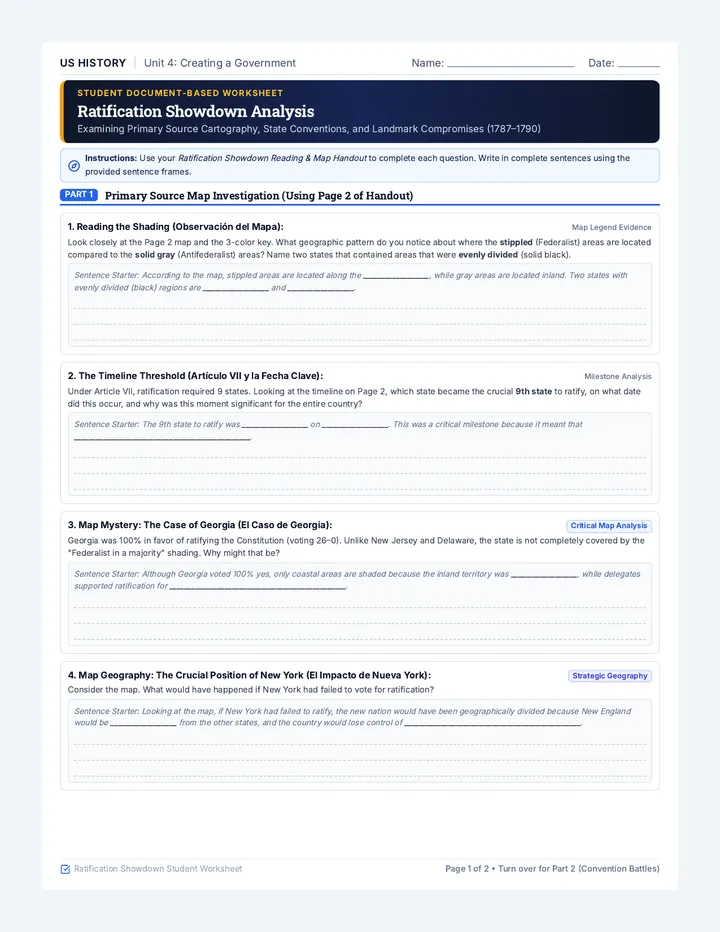
Ratification Analysis Worksheet
US History | Unit 4: Creating a Government
Name: Date:
Student Document-Based Worksheet
Ratification Showdown Analysis
Examining Primary Source Cartography, State Conventions, and Landmark Compromises (1787–1790)
Instructions: Use your Ratification Showdown Reading & Map Handout to complete each question. Write in complete sentences using the provided sentence frames.
Part 1
Primary Source Map Investigation (Using Page 2 of Handout)
1. Reading the Shading (Observación del Mapa): Map Legend Evidence
Look closely at the Page 2 map and the 3-color key. What geographic pattern do you notice about where the stippled (Federalist) areas are located compared to the solid gray (Antifederalist) areas? Name two states that contained areas that were evenly divided (solid black).
Sentence Starter: According to the map, stippled areas are located along the __________________, while gray areas are located inland. Two states with evenly divided (black) regions are __________________ and __________________.
2. The Timeline Threshold (Artículo VII y la Fecha Clave): Milestone Analysis
Under Article VII, ratification required 9 states. Looking at the timeline on Page 2, which state became the crucial 9th state to ratify, on what date did this occur, and why was this moment significant for the entire country?
Sentence Starter: The 9th state to ratify was __________________ on __________________. This was a critical milestone because it meant that ________________________________________________.
3. Map Mystery: The Case of Georgia (El Caso de Georgia): Critical Map Analysis
Georgia was 100% in favor of ratifying the Constitution (voting 26–0). Unlike New Jersey and Delaware, the state is not completely covered by the "Federalist in a majority" shading. Why might that be?
Sentence Starter: Although Georgia voted 100% yes, only coastal areas are shaded because the inland territory was __________________, while delegates supported ratification for ________________________________________________.
4. Map Geography: The Crucial Position of New York (El Impacto de Nueva York): Strategic Geography
Consider the map. What would have happened if New York had failed to vote for ratification?
Sentence Starter: Looking at the map, if New York had failed to ratify, the new nation would have been geographically divided because New England would be __________________ from the other states, and the country would lose control of ________________________________________________.
Ratification Showdown Student Worksheet Page 1 of 2 • Turn over for Part 2 (Convention Battles)