Lenny.com
Explore
Create
ActivitiesNewMathEnglish Language ArtsScience & EngineeringSocial StudiesGlobal LanguagesHealth & Physical EducationSpecial EducationCounseling & Life SkillsArts & CreativityESL
Lenny.com
Lenny.com
Explore
Create
ActivitiesNewMathEnglish Language ArtsScience & EngineeringSocial StudiesGlobal LanguagesHealth & Physical EducationSpecial EducationCounseling & Life SkillsArts & CreativityESL
Lenny.com
Lenny.com

Solutions

Lenny for EducatorsLenny for SchoolsLenny for Districts

Product

ExploreSign inCreateSupportAbout

Resources

Getting startedMTSS Acceleration Program

Newsletters

School Funding Newsletter

© 2026 Lenny Learning Inc.

TermsPrivacyAccessibility
LinkedInInstagramX
Lenny

Rome and the Byzantine Empire

Political structures of the Roman Republic and Empire alongside the cultural shift toward the Byzantine East. Addresses engineering achievements, legal foundations, and the rise of Orthodox Christianity.

Social StudiesSocial Studies PracticesLocation WordsMapsOrder EventsChronology and CausationEvaluating SourcesHistorical ThinkingGeography, Humans, & the EnvironmentAmerican Symbols and LandmarksCitiesStatesState CapitalsRegions of the United StatesGeographic SkillsPhysical GeographyHuman GeographyRegional GeographyGeography of AfricaGeography of AsiaGeography of EuropeGeography of OceaniaGeography of the AmericasSociety and Environment of EuropeSociety and Environment of AsiaSociety and Environment of The AmericasSociety and Environment of the Middle EastSociety and Environment of AfricaHistoryPrehistoryComparing Ancient River CivilizationsAncient MesopotamiaAncient Egypt and KushAncient South AsiaEarly ChinaGreeceRome and the Byzantine EmpireAncient World HistoryNative Peoples of North AmericaNative Peoples of Mesoamerica and South AmericaAfrican EmpiresMedieval AsiaMedieval EuropeThe Silk RoadMedieval HistoryIslamic EmpiresWorld ReligionsRenaissance PeriodAge of ExplorationThe Thirteen ColoniesThe American RevolutionUS History Early RepublicFounding of the United StatesUS History AntebellumUS Civil WarReconstruction PeriodThe Gilded AgeUS ImperialismWorld ImperialismWorld War IUS History 1920sGreat DepressionWorld War IIThe Cold WarUS History 1950-60sUS History 1960s-70sWorld History 20th CenturyContemporary US HistoryContemporary World HistoryHolidaysCivics and GovernmentCitizenshipGovernment FoundationsThe ConstitutionUS ConstitutionExecutive BranchLegislative BranchJudicial BranchState and LocalPolitical ParticipationPublic PolicyPolitical SystemsPower and AuthoritySocial MovementsDefining DevianceTheories of DevianceCrime and Criminal JusticeEconomicsBasic Economic PrinciplesSupply and DemandWhat is MoneyEconomic FundamentalsMicroeconomicsMacroeconomicsBanking and FinanceEconomic SystemsGlobal EconomicsCorporations and PowerThe Changing WorkplaceUnemployment and LaborClass and InequalitySocial MobilityGlobal InequalityPsychologyHistory of PsychologyPsychology as a ScienceBrain and Nervous SystemNeuroscience and BehaviorGenetics and BehaviorSleep and ConsciousnessSensory ProcessesPerceptual OrganizationClassical ConditioningOperant ConditioningObservational LearningCognitive LearningMemory ProcessesThinking and Problem SolvingLanguage and CognitionTheories of MotivationStress and CopingPrenatal and Infant DevelopmentChildhood DevelopmentAdolescent DevelopmentAdulthood and AgingSelf and IdentitySocial CognitionSocial InfluenceAttraction and RelationshipsGroup BehaviorPrejudice and DiscriminationAnxiety and Mood DisordersClinical PsychologyForensic PsychologyPhilosophy & EthicsIntroduction to PhilosophyMajor Philosophers & IdeasMind and Body ProblemFree Will vs DeterminismEthics & MoralityReligion & PhilosophyPolitical Philosophy

Videos

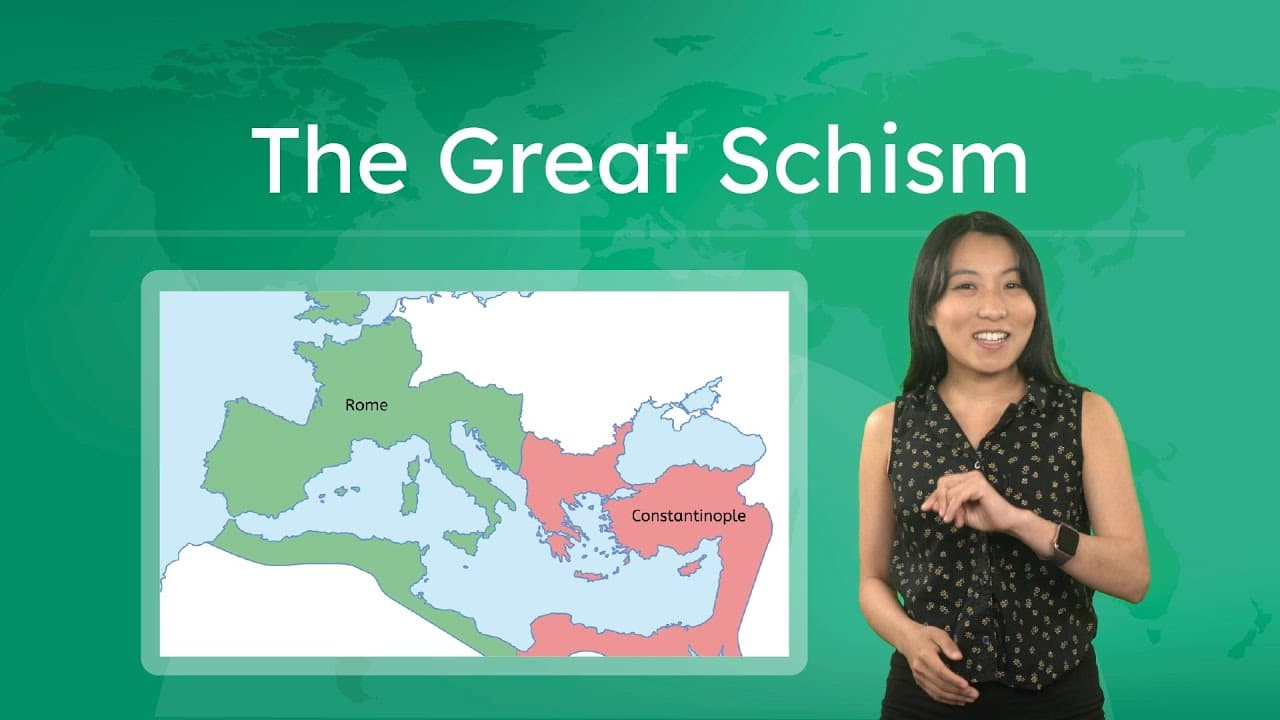
The Great Schism: The Church's Historic Breakup

The Great Schism: The Church's Historic Breakup

This engaging world history video breaks down the Great Schism of 1054, framing the historic split between the Roman Catholic and Eastern Orthodox churches as a "dramatic breakup" between two empires. Using relatable analogies like sibling rivalries and arguments between best friends, the narrator explains complex historical concepts such as excommunication, the role of the Pope versus the Patriarch, and the theological disputes over religious icons. The video traces the history from the initial split of the Roman Empire through the rise of Christianity, leading up to the formal separation and its long-term consequences. The content explores key themes of political power versus religious authority, cultural divergence, and cause-and-effect in history. It details how the Roman and Byzantine Empires drifted apart due to language, geography, and leadership disputes, culminating in mutual excommunication. Furthermore, it connects this religious divide to significant geopolitical shifts, specifically the weakening of the Byzantine Empire, the Crusades, and the eventual fall of Constantinople to the Ottoman Empire. For educators, this video serves as an excellent introduction to the Middle Ages and Church history. It transforms a potentially dry topic into an accessible narrative by using a "mystery question" format that encourages active viewing. The video includes built-in pause points for student predictions and utilizes clear maps and animations to visualize the geographic divide. It effectively scaffolds vocabulary like "schism" and "excommunicate," making it a valuable tool for middle school social studies curriculums focusing on World History and geography.

Miacademy & MiaPrep Learning ChannelMiacademy & MiaPrep Learning Channel

11mins 25s

The History of Money: Debt, Barter, and War

The History of Money: Debt, Barter, and War

Hosted by John Green, this episode of Crash Course World History challenges the traditional economic narrative that money evolved naturally from barter systems to solve logistical problems. Instead, it presents anthropologist David Graeber's theory that complex credit and debt systems existed long before coinage, and that physical money (coins) emerged primarily as a tool for states to fund wars and professional armies.

CrashCourseCrashCourse

14mins 4s

Why the Roman Empire Survived Until the 15th Century

Why the Roman Empire Survived Until the 15th Century

In this installment of Crash Course World History, John Green challenges the traditional narrative that the Roman Empire fell in 476 CE. Instead, he argues that the empire merely shifted its center of gravity eastward to Constantinople, where it survived and thrived as the Byzantine Empire for another thousand years. The video explores the strategic advantages of the East, the continuity of Roman law and culture, and the evolution of Christianity into the Eastern Orthodox tradition. Key themes include the fluidity of historical periodization, the intersection of religion and politics (specifically the concept of Caesaropapism), and the preservation of legal systems. The video highlights the reign of Emperor Justinian and Empress Theodora, detailing their contributions to Roman law through the Digest and Institutes, their massive building projects like the Hagia Sophia, and their handling of political unrest like the Nika Riots. For educators, this video serves as an excellent tool for AP World History or general high school history classes to discuss how historians define "empires" and "falls." It provides a clear contrast between the chaotic fragmentation of Western Europe and the centralized, wealthy stability of the Byzantine East. It also offers opportunities to discuss gender roles in history through the figure of Theodora and the long-term impact of Roman civil law on modern European legal systems.

CrashCourseCrashCourse

12mins 44s

How History Defined Europe as a Functional Region

How History Defined Europe as a Functional Region

This educational video explores the concept of Europe as a "functional region," examining how its boundaries and influence have been defined not just by physical geography, but by historical connections, trade networks, and cultural legacies. The narrator guides viewers through a chronological journey, starting with the Greco-Roman era and moving through the Crusades, the Age of Exploration, the Scramble for Africa, the Cold War, and finally the modern European Union. The video explains how these events created networks of interaction that extended Europe's "functional" borders far beyond its physical continent. Key themes include the difference between formal and functional regions, the lasting impact of Roman infrastructure and language, the spread of religion (Christianity and Islam), the geopolitical consequences of colonization, and the role of economic integration in the modern era. It specifically addresses how political ideologies during the Cold War divided the continent into two distinct functional zones and how the EU has since worked to reintegrate them through trade and a common currency. For educators, this video serves as an excellent bridge between geography and history, demonstrating how spatial relationships change over time. It provides concrete examples of abstract geographic concepts like "functional regions" and "spheres of influence." Teachers can use this resource to help students understand complex topics such as why French Guiana is part of Europe, how the Roman Empire laid the groundwork for modern Western culture, and the economic rationale behind the European Union.

Miacademy & MiaPrep Learning ChannelMiacademy & MiaPrep Learning Channel

9mins 54s

Exploring the Major Mountain Ranges of Europe

Exploring the Major Mountain Ranges of Europe

This comprehensive geography lesson takes students on a tour of the European continent's major mountain ranges and geological features. The video begins by explaining the scientific processes behind mountain formation, specifically orogeny (tectonic plate collision) and volcanism, before conducting a region-by-region breakdown of Europe's topography. The narrator uses maps, satellite imagery, and photographs to visually locate and describe key ranges including the Alps, Pyrenees, Carpathians, Urals, and more. Key themes include physical geography, plate tectonics, and the intersection of geography with history and culture. The video highlights how physical features define borders (like the Pyrenees and Urals), influence climate (like the rain shadow of the Scandinavian mountains), and impact human history (such as the destruction of Pompeii by Mt. Vesuvius). It also weaves in cultural folklore, connecting specific mountains to legends like Dracula and the Djinn. This resource is highly valuable for middle and high school social studies and earth science classrooms. It provides a clear visual framework for understanding European geography, moving beyond simple memorization to explain *why* the landscape looks the way it does. Teachers can use this video to support units on European geography, plate tectonics, or as a bridge between physical geography and European history lessons.

Miacademy & MiaPrep Learning ChannelMiacademy & MiaPrep Learning Channel

12mins 10s

How to Read a Cultural Landscape in Cities

How to Read a Cultural Landscape in Cities

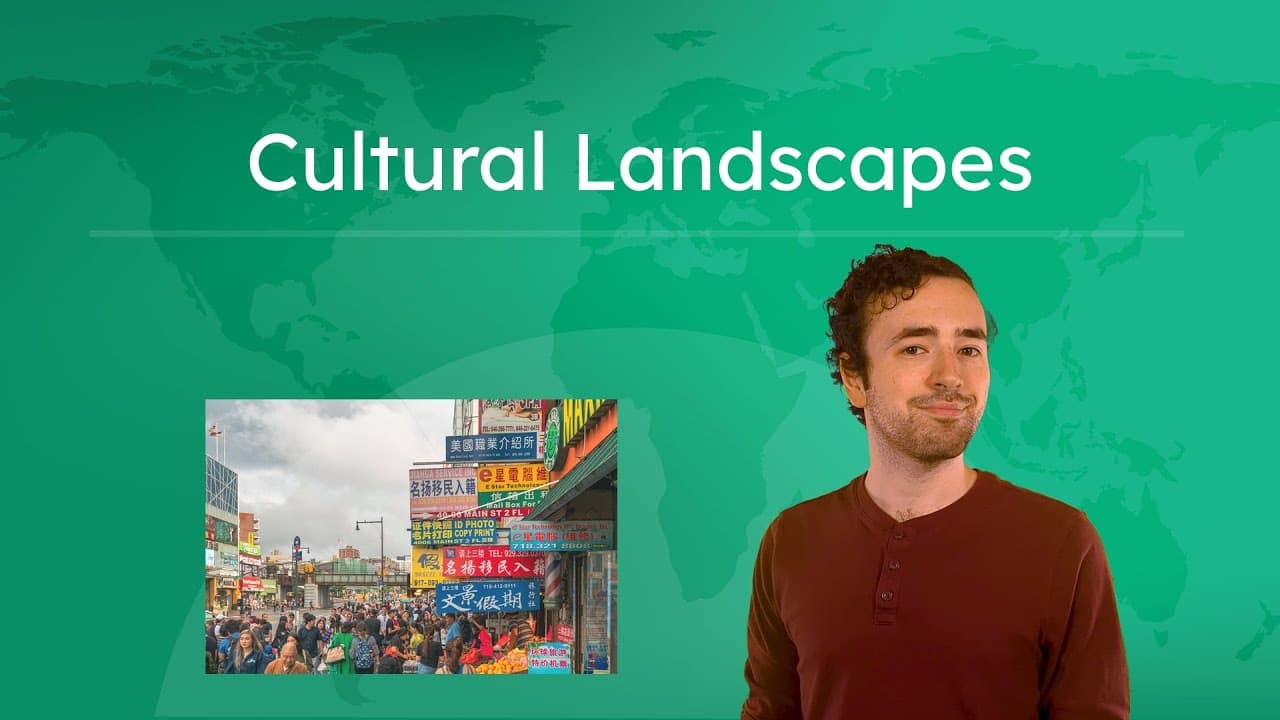
This educational video takes students on a virtual field trip to explore the concept of "cultural landscapes" through the lens of human geography. Hosted by a guide named Justin, the video uses Flushing Chinatown in Queens, New York, as a primary case study to demonstrate how human culture leaves visible imprints on the physical environment. Viewers learn to "read" a neighborhood by analyzing its built environment, land use patterns, signage, architecture, and cultural markers, revealing deep insights into the values and identity of the people who live there. The video delves into complex geographical concepts such as "sequent occupance"—the notion that successive societies leave their cultural imprints on a place, contributing to the cumulative cultural landscape. It traces the history of Queens from the indigenous Lenape people through European colonization, industrialization, and modern immigration. The lesson then shifts to Istanbul, Turkey, providing a comparative analysis of how history (Byzantine, Ottoman, and modern Turkey) is layered within the architecture of the Hagia Sophia. Ideal for geography and social studies classrooms, this resource transforms abstract definitions into concrete visual examples. It encourages students to become active observers of their own communities, prompting them to look for evidence of history, economy, and culture in their everyday surroundings. The video models critical thinking skills by asking students to make inferences based on visual evidence, making it a strong tool for developing visual literacy and geographical reasoning.
Miacademy & MiaPrep Learning ChannelMiacademy & MiaPrep Learning Channel

11mins 14s

Materials

Empire Frontiers Reference Map

Empire Frontiers Reference Map

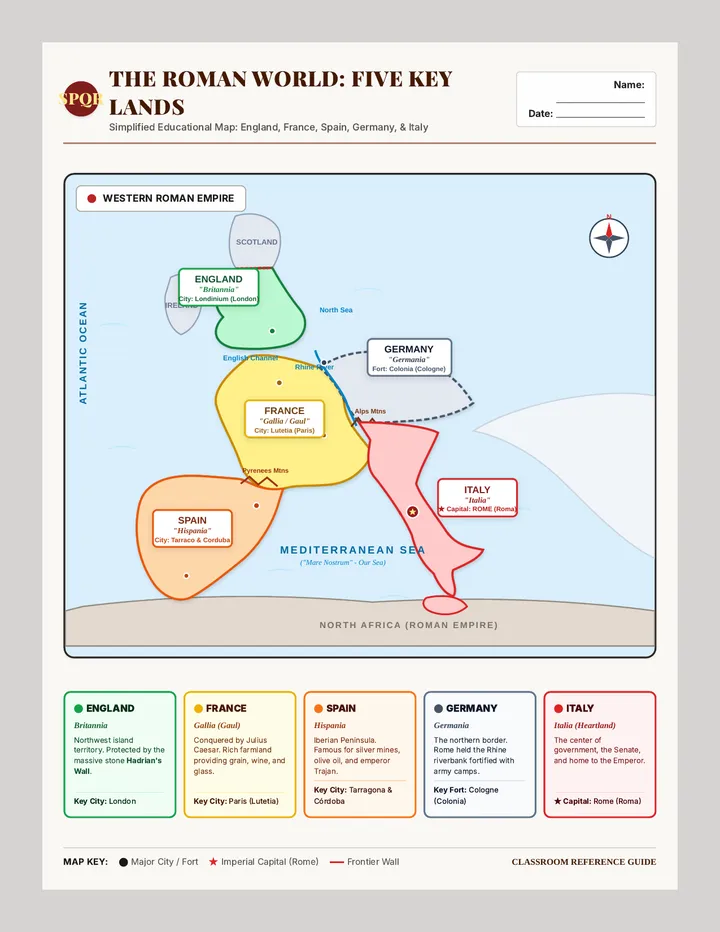
A simplified, high-clarity single-page reference map of Western Europe under Roman rule. Clearly highlights and labels Spain (Hispania), France (Gallia), England (Britannia), Germany (Germania), and Italy (Italia) with bold color coding, ancient and modern names, key capitals, and a student reference guide.

JT

Julie Teske

Ancient World Explorer Graphic Organizer

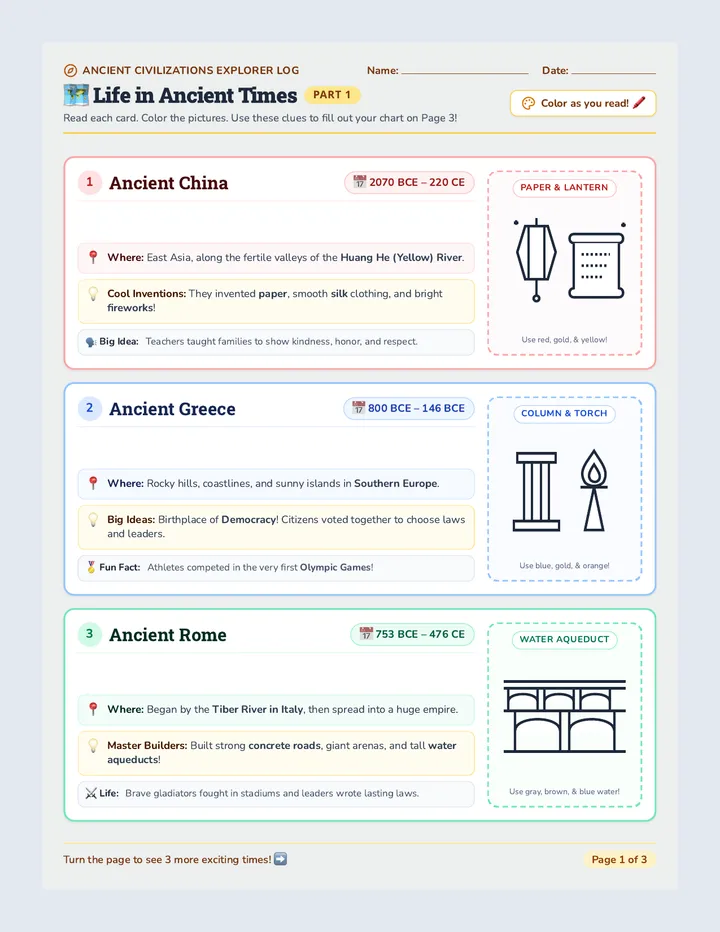
Ancient World Explorer Graphic Organizer

An accessible, highly visual 3-page ancient civilizations comparison activity designed for a 7th grade student reading at a 2nd grade level. Revised to eliminate awkward vertical gaps on the reading pages by expanding the cards with larger text, kid-friendly vocabulary callouts, and spacious coloring illustrations.

KC

Kasie Costopulos

Ancient Creativity Comprehension Packet

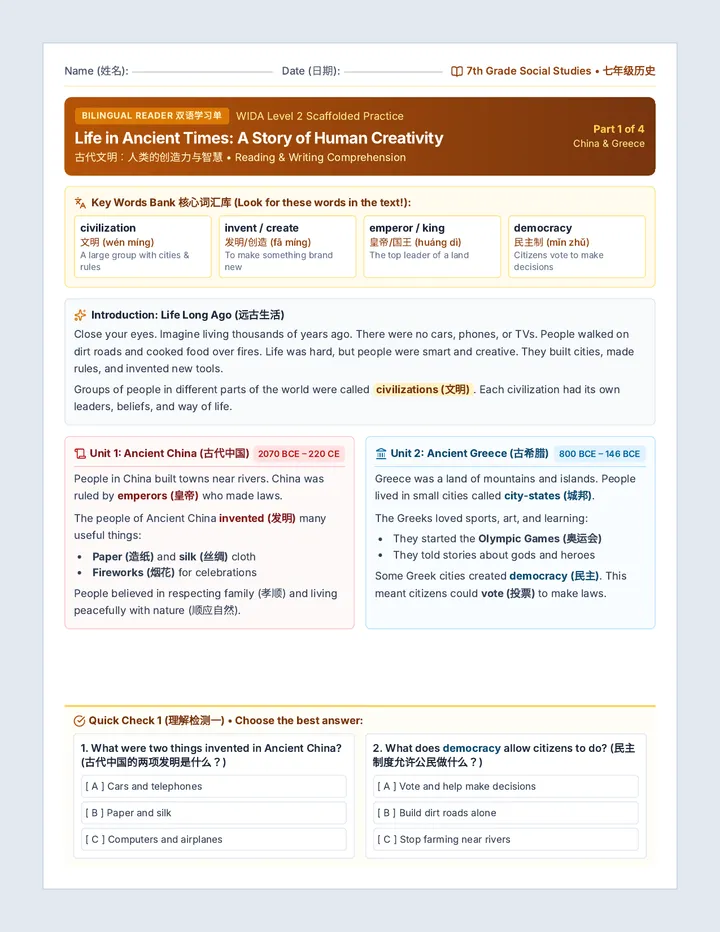
Ancient Creativity Comprehension Packet

A 4-page scaffolded reading and writing comprehension packet for 7th-grade social studies, tailored for a Chinese-speaking WIDA Level 2 English learner. Includes bilingual vocabulary glossaries (English, Simplified Chinese, and Pinyin), chunked passages, visual icons, comprehension checks, and guided sentence-frame writing exercises.

KC

Kasie Costopulos

Source Clash Task Cards

Source Clash Task Cards

A 5-page printable task card set featuring eight paired-source historical corroboration bellringers, with Card 07 specifically detailing when and why the Alternative Center for Excellence (ACE) in Danbury CT opened in 1977, paired with a weekly student analysis log.

KT

Kyle Trocolla

Antiquity Faceoff Rubric

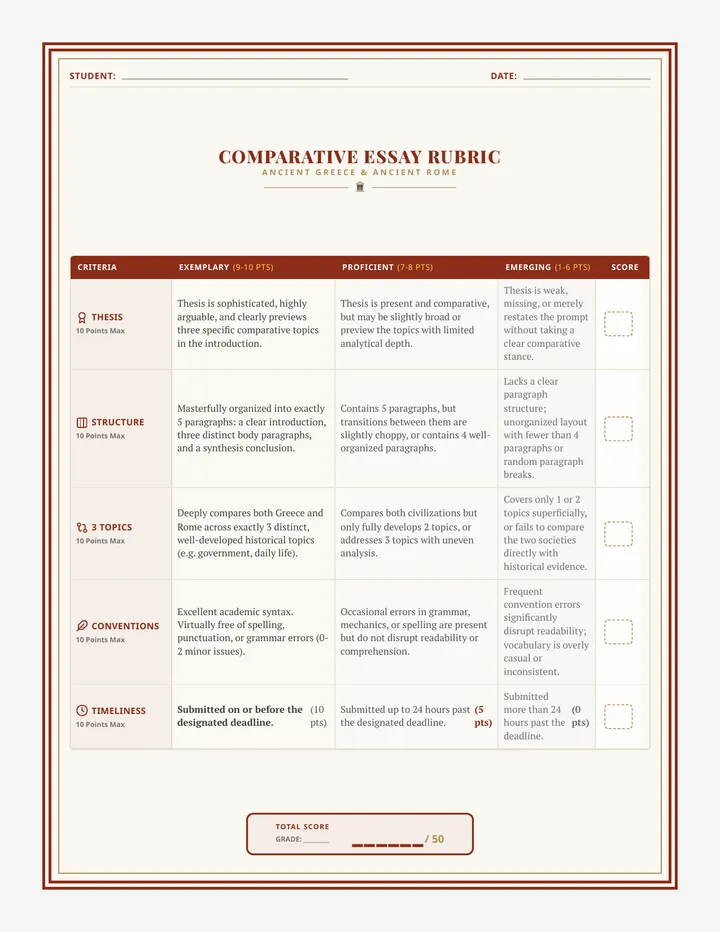
Antiquity Faceoff Rubric

An elegant, classical-themed rubric for a comparative essay on Ancient Greece and Ancient Rome. Evaluates thesis statements, 5-paragraph structure, comparative topics, writing conventions, and timeliness across a 50-point scale. Modified with streamlined headers and an expanded, comfortable layout to prevent vertical clipping.

E

ebakke

Empire Rhyme Rubric

Empire Rhyme Rubric

A condensed 1-page student-facing rubric for the Roman Empire Rap project, optimized to fit on a single sheet while maintaining the thematic Roman aesthetic.

SD

Stephany Durtsche

Sequences

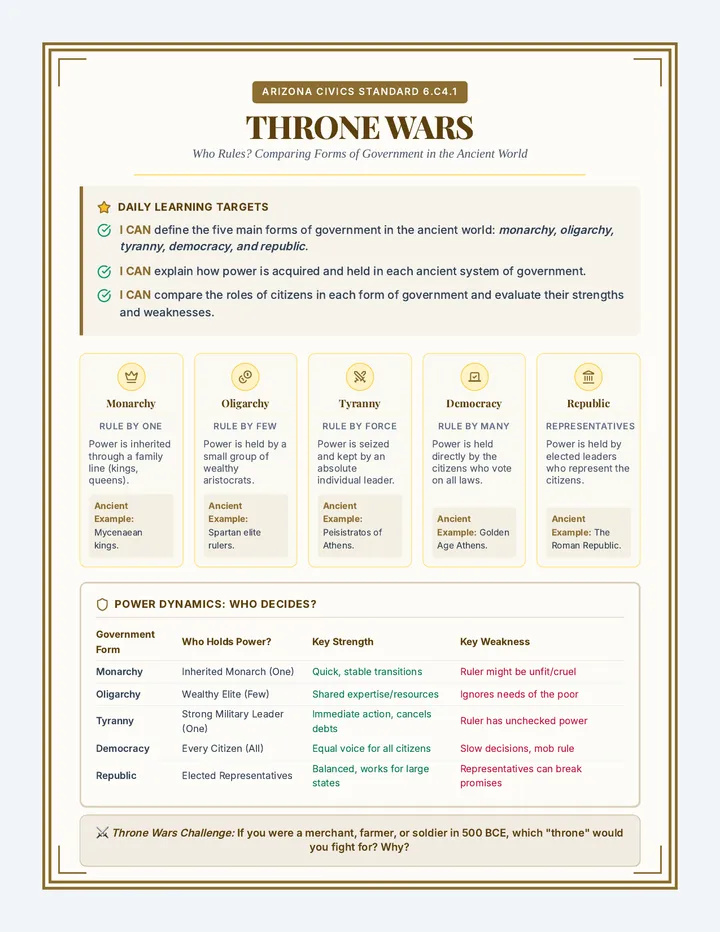
Throne Wars Anchor Chart

Rise of Civilization

A comprehensive 6th-grade social studies unit exploring the trajectory of human history, from nomadic hunter-gatherers and the cognitive evolution of early humans, to the agricultural revolution, and finally the development of structured ancient governments.

SZ

Sandy Zoerhoff

10
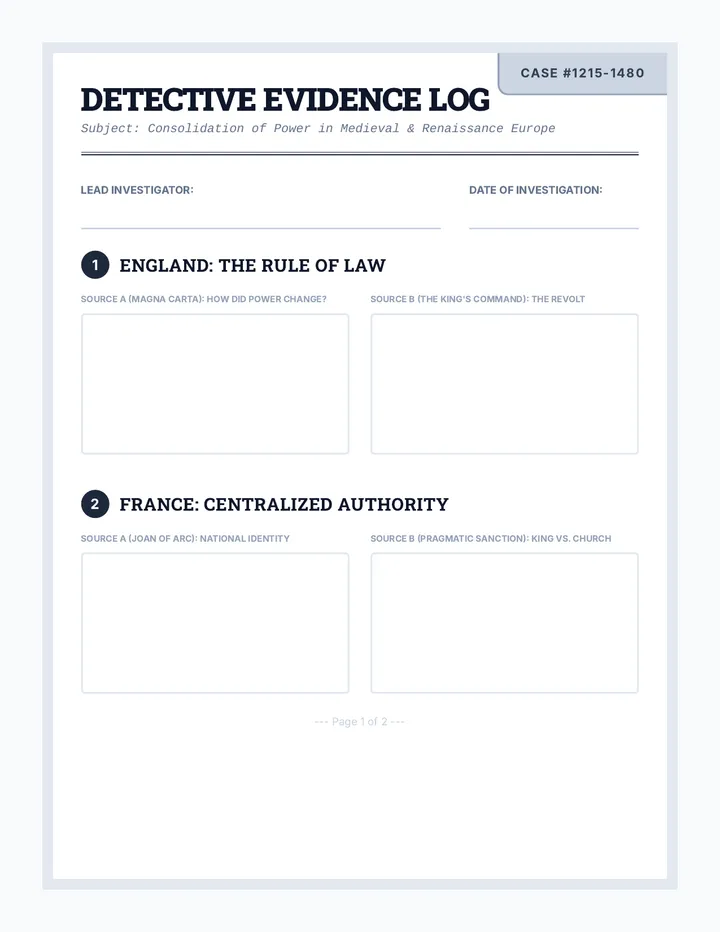
Detective Evidence Log Worksheet

Nation State Detectives

A comprehensive middle school history unit where students act as 'history detectives' to investigate the rise of nation-states in England, France, Spain, and Russia through primary source analysis.

HO

Helen O'Keefe

11
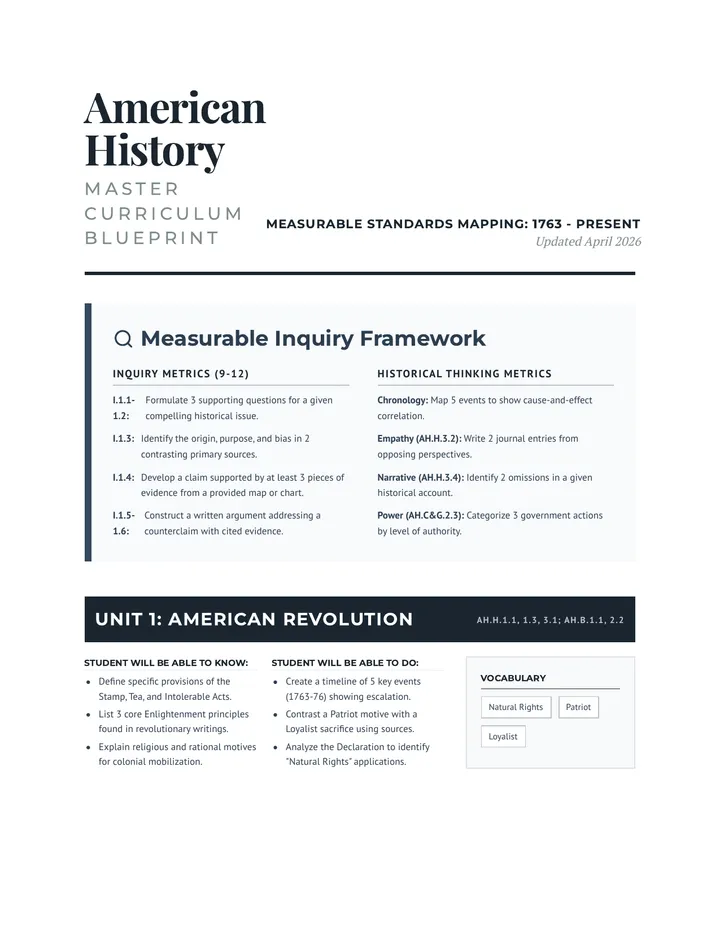
Curriculum Blueprint Document v2

History Horizon Sequence

A comprehensive high school curriculum plan for American History, covering 13 units from the American Revolution to the modern era, aligned with North Carolina Social Studies standards.

AK

Amity Kea

21
Empire Autopsy Slides

Empire Autopsy

An analytical deep-dive into the collapse of the Western Roman Empire, treating history as a forensic investigation into why great powers fail.

SW

Shelley Wright

3
Day 1 American Republic Reader

Global Governance Remediation

A comprehensive 7-day remediation unit covering various forms of government, comparing the U.S. constitutional republic to historical and contemporary systems, and analyzing executive structures.

CE

Chelsea Elliott

16
Ancient Foundations Worksheet

Europe Explorer Remediation

A comprehensive week-long remediation packet covering Europe's history, culture, economics, and the European Union through reading passages and high-level analysis.

KB

Kenneth Brown

8

Lessons

Explorer Epochs Wall Chart

Early World Explorers

A comprehensive lesson on early world exploration from 300 BCE to 1500 CE, focusing on the geographical, cultural, and religious impacts of key explorers across different continents.

J

jcasey

14
Silk Road Slides

Desert Caravans

A comprehensive exploration of the Silk Road's geography, challenging terrain, and the vital role of trade routes connecting East and West. Students will analyze physical barriers and key trading hubs.

WM

Wilberto Mejias

7
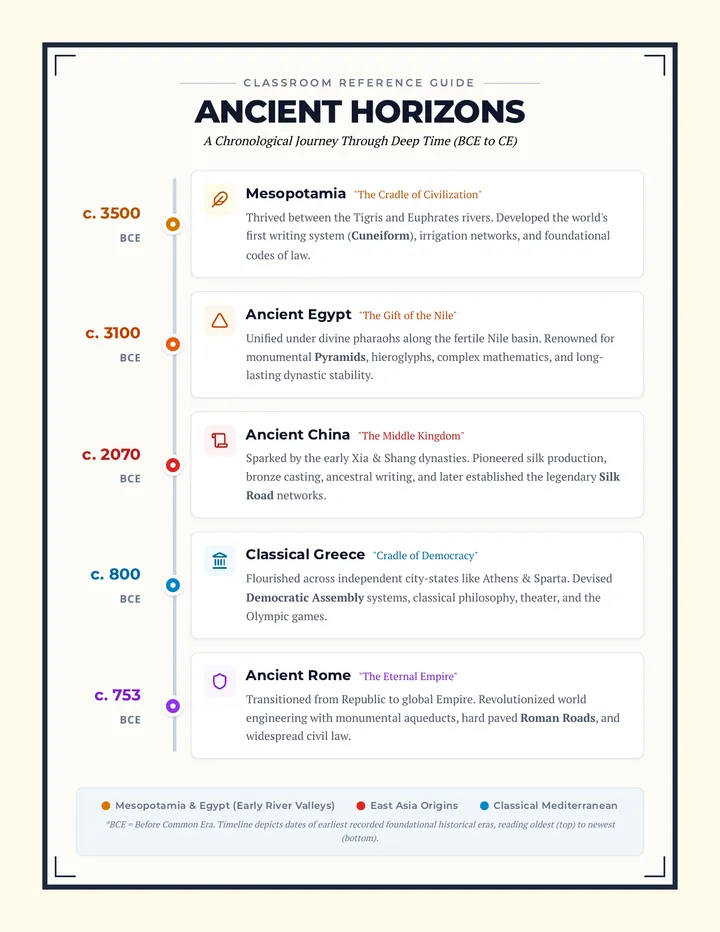
Ancient Horizons Timeline Poster

Ancient Civilizations Timeline

A lesson package designed to introduce the chronology of five fundamental ancient civilizations. It includes a high-impact master reference poster and printable large-scale timeline cards for classroom display.

SZ

Sandra Zoerhoff

2
Law of the Land Organizer

Eternal City

An introductory lesson on Ancient Rome covering its founding, social structure, daily life, engineering feats, and the transition from Republic to Empire. Students explore Roman law through the Twelve Tables and analyze the factors that led to Rome's rise.

D

destiny.lanier

6
Caesar Conspiracy Investigation

Caesar Tribunal

A comprehensive classroom simulation and analysis lesson about the assassination of Julius Caesar. Students examine historical perspectives, engage with primary sources, and debate civic duty through a mock trial and a three-page investigative document.

TH

Thomas Harris

3
L'Héritage Gaulois Worksheet

Secrets des Gaulois

Une leçon complète sur la civilisation gauloise basée sur un document d'archive, explorant leur société, leurs inventions, leur langue et leur héritage culturel.

SK

Stéphanie Krommenacker

4