Lenny.com
Explore
Create
ActivitiesNewMathEnglish Language ArtsScience & EngineeringSocial StudiesGlobal LanguagesHealth & Physical EducationSpecial EducationCounseling & Life SkillsArts & CreativityESL
Lenny.com
Lenny.com
Explore
Create
ActivitiesNewMathEnglish Language ArtsScience & EngineeringSocial StudiesGlobal LanguagesHealth & Physical EducationSpecial EducationCounseling & Life SkillsArts & CreativityESL
Lenny.com
Lenny.com

Solutions

Lenny for EducatorsLenny for SchoolsLenny for Districts

Product

ExploreSign inCreateSupportAbout

Resources

Getting startedMTSS Acceleration Program

Newsletters

School Funding Newsletter

© 2026 Lenny Learning Inc.

TermsPrivacyAccessibility
LinkedInInstagramX
Lenny

World War I

Geopolitical tensions, trench warfare strategies, and the global impact of the Great War. Examines the Treaty of Versailles and the subsequent redrawing of international borders.

Social StudiesSocial Studies PracticesLocation WordsMapsOrder EventsChronology and CausationEvaluating SourcesHistorical ThinkingGeography, Humans, & the EnvironmentAmerican Symbols and LandmarksCitiesStatesState CapitalsRegions of the United StatesGeographic SkillsPhysical GeographyHuman GeographyRegional GeographyGeography of AfricaGeography of AsiaGeography of EuropeGeography of OceaniaGeography of the AmericasSociety and Environment of EuropeSociety and Environment of AsiaSociety and Environment of The AmericasSociety and Environment of the Middle EastSociety and Environment of AfricaHistoryPrehistoryComparing Ancient River CivilizationsAncient MesopotamiaAncient Egypt and KushAncient South AsiaEarly ChinaGreeceRome and the Byzantine EmpireAncient World HistoryNative Peoples of North AmericaNative Peoples of Mesoamerica and South AmericaAfrican EmpiresMedieval AsiaMedieval EuropeThe Silk RoadMedieval HistoryIslamic EmpiresWorld ReligionsRenaissance PeriodAge of ExplorationThe Thirteen ColoniesThe American RevolutionUS History Early RepublicFounding of the United StatesUS History AntebellumUS Civil WarReconstruction PeriodThe Gilded AgeUS ImperialismWorld ImperialismWorld War IUS History 1920sGreat DepressionWorld War IIThe Cold WarUS History 1950-60sUS History 1960s-70sWorld History 20th CenturyContemporary US HistoryContemporary World HistoryHolidaysCivics and GovernmentCitizenshipGovernment FoundationsThe ConstitutionUS ConstitutionExecutive BranchLegislative BranchJudicial BranchState and LocalPolitical ParticipationPublic PolicyPolitical SystemsPower and AuthoritySocial MovementsDefining DevianceTheories of DevianceCrime and Criminal JusticeEconomicsBasic Economic PrinciplesSupply and DemandWhat is MoneyEconomic FundamentalsMicroeconomicsMacroeconomicsBanking and FinanceEconomic SystemsGlobal EconomicsCorporations and PowerThe Changing WorkplaceUnemployment and LaborClass and InequalitySocial MobilityGlobal InequalityPsychologyHistory of PsychologyPsychology as a ScienceBrain and Nervous SystemNeuroscience and BehaviorGenetics and BehaviorSleep and ConsciousnessSensory ProcessesPerceptual OrganizationClassical ConditioningOperant ConditioningObservational LearningCognitive LearningMemory ProcessesThinking and Problem SolvingLanguage and CognitionTheories of MotivationStress and CopingPrenatal and Infant DevelopmentChildhood DevelopmentAdolescent DevelopmentAdulthood and AgingSelf and IdentitySocial CognitionSocial InfluenceAttraction and RelationshipsGroup BehaviorPrejudice and DiscriminationAnxiety and Mood DisordersClinical PsychologyForensic PsychologyPhilosophy & EthicsIntroduction to PhilosophyMajor Philosophers & IdeasMind and Body ProblemFree Will vs DeterminismEthics & MoralityReligion & PhilosophyPolitical Philosophy

Videos

Exploring the Origins and Geography of Central and Southwest Asia

Exploring the Origins and Geography of Central and Southwest Asia

This educational video provides a comprehensive overview of the geography, history, and modern geopolitical landscape of Central and Southwest Asia. Hosted by Brian, the lesson begins by establishing the region's historical significance as the "birthplace of civilization" and the origin of three major world religions: Judaism, Christianity, and Islam. It traces the transition from the Agricultural Revolution to the rise of empires like the Ottomans, and explains how World War I and the subsequent protectorate system shaped modern national borders.

Miacademy & MiaPrep Learning ChannelMiacademy & MiaPrep Learning Channel

8mins 30s

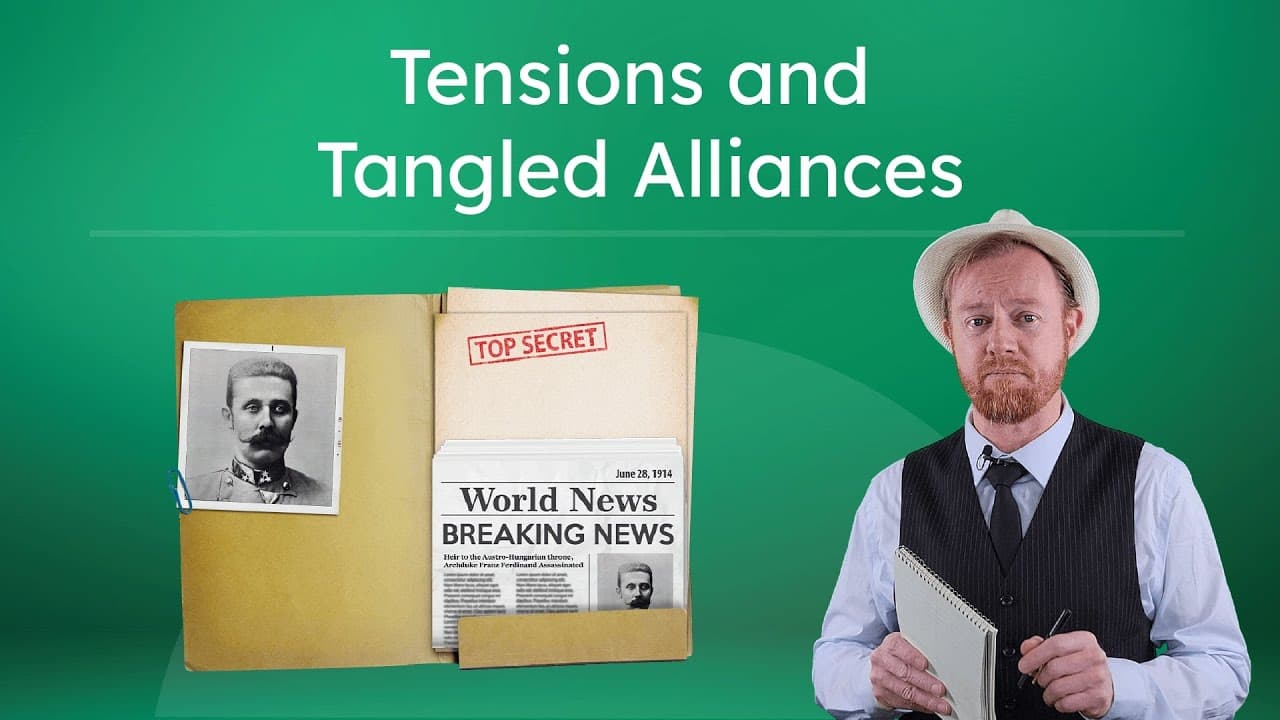
Investigating the Causes of World War I

Investigating the Causes of World War I

This engaging educational video adopts a creative "detective" persona to investigate the complex origins of World War I. Framed as a murder mystery solving the assassination of Archduke Franz Ferdinand, the video breaks down the long-term geopolitical tensions that turned a single event into a global conflict. It systematically explores the "facts," the "scene," and the "murder" to help students understand the causality of history. Key themes include the four main causes of the war: Nationalism, Imperialism, Militarism, and Alliances. The video provides detailed explanations of specific historical contexts, such as the Franco-Prussian War, the decline of the Ottoman Empire, the "Powder Keg" of the Balkans, and the web of secret treaties between European powers like Germany, Austria-Hungary, Russia, France, and Britain. It also profiles key figures like Otto von Bismarck, Kaiser Wilhelm II, and Gavrilo Princip. For educators, this video serves as an excellent anchor for a unit on WWI. Its unique narrative structure keeps students engaged while simplifying complex political concepts through clear definitions and map visualizations. The video includes built-in pause points for checking understanding and encourages critical thinking about how regional disputes can escalate into world-altering events.

Miacademy & MiaPrep Learning ChannelMiacademy & MiaPrep Learning Channel

10mins 9s

Evolution of US Foreign Policy: From Isolation to Superpower

Evolution of US Foreign Policy: From Isolation to Superpower

This educational video provides a comprehensive overview of United States foreign policy, tracing its evolution from the nation's founding to the modern era. It begins by establishing the Constitutional roles of the Executive, Legislative, and Judicial branches in crafting foreign policy, clarifying the balance of power between the President and Congress. The narrative then moves chronologically, highlighting George Washington's initial advice of isolationism and the shift toward interventionism through the Monroe Doctrine, territorial expansion, and the World Wars. The video explores the US's transition into a global superpower during the 20th century, covering the Cold War, the containment of communism, and post-9/11 military engagements. It also addresses contemporary issues such as foreign aid, trade deficits with nations like China, the rise of new economic powers like India, and global challenges like climate change and nuclear proliferation. The content emphasizes how historical events have shaped current diplomatic relationships and military presence worldwide. Designed for civics and history classrooms, this resource helps students connect historical precedents to current events. It concludes with a strong message about civic engagement, encouraging students to understand these complex issues so they can participate effectively in the democratic process through voting and debate. The video is an excellent tool for teaching the practical application of checks and balances and the history of America's role on the world stage.

Miacademy & MiaPrep Learning ChannelMiacademy & MiaPrep Learning Channel

9mins 54s

How World War I Innovations Created Modern Consumer Culture

How World War I Innovations Created Modern Consumer Culture

This educational video explores the profound cultural and economic shifts that occurred in Western society following World War I, specifically focusing on the transition into the "Roaring Twenties." It connects the technological innovations and propaganda techniques developed during the war to the rise of modern consumer culture, mass marketing, and changing social norms. The narrator explains how wartime advancements in infrastructure, such as electricity and transportation, laid the groundwork for a boom in consumer goods, while psychological tactics used to sell the war were repurposed by figures like Edward Bernays to sell products.

Miacademy & MiaPrep Learning ChannelMiacademy & MiaPrep Learning Channel

11mins 1s

Why We Study History: The Early Modern Era Explained

Why We Study History: The Early Modern Era Explained

This engaging educational video serves as a comprehensive introduction to an Early Modern World History course, covering the pivotal period from 1750 to 1950. The host begins by establishing the personal relevance of history, connecting students' current identities to the struggles, triumphs, and decisions of their ancestors. It moves beyond dates and facts to emphasize history as a tool for empathy, understanding societal changes, and learning from past mistakes to shape a better future. The video outlines the course structure in three distinct parts: (1) Absolutism to Revolution, exploring the Enlightenment and the shift from monarchies to democracies; (2) Industrialism to Imperialism, detailing how technological shifts led to global competition for resources and colonization; and (3) The World at War, covering the devastation of World war I and II. It also introduces critical historical thinking skills, such as analyzing primary sources, understanding cause and effect, and evaluating credibility. For educators, this video is an excellent course opener or unit introduction. It provides a "historian's toolbox" framework that teachers can reference throughout the year, encouraging students to "zoom out" for the big picture and "zoom in" for multiple perspectives. The content addresses difficult topics like slavery, oppression, and war with sensitivity, making it a strong launchpad for discussions about historical empathy and the ethical responsibilities of global citizens.

Miacademy & MiaPrep Learning ChannelMiacademy & MiaPrep Learning Channel

11mins 23s

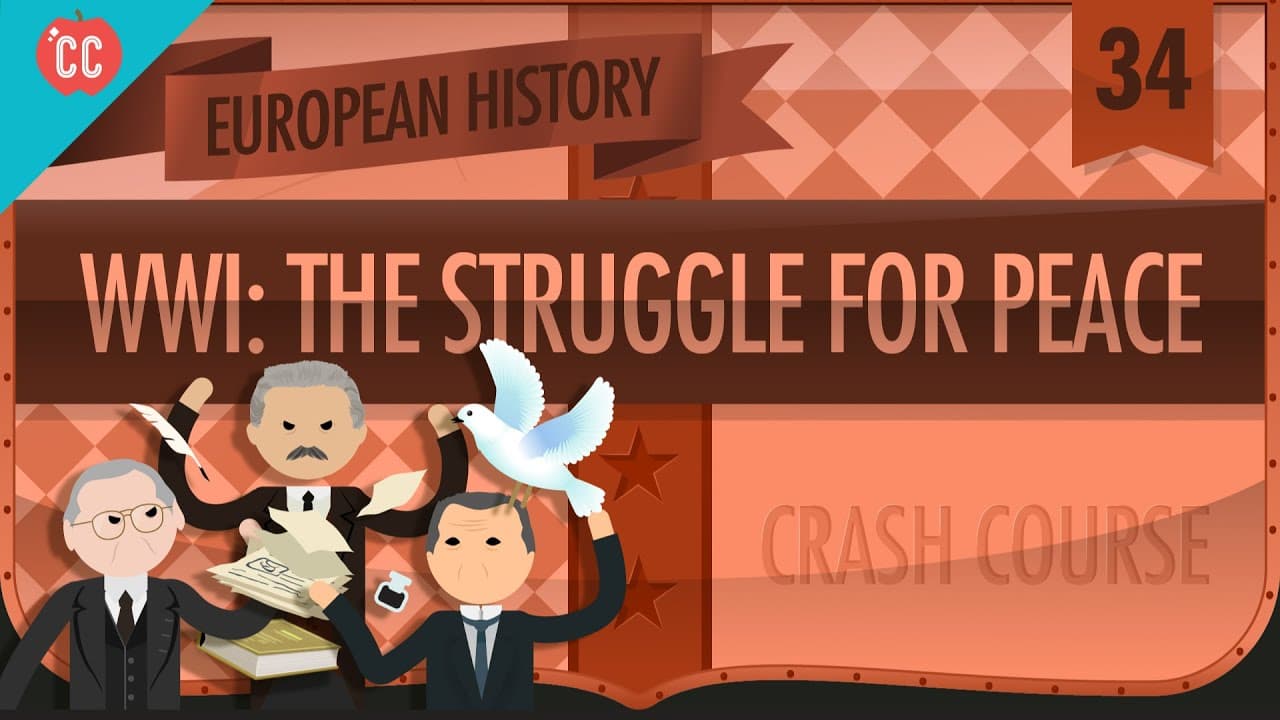
WWI Home Front: Total War and the Peace of Paris

WWI Home Front: Total War and the Peace of Paris

This episode of Crash Course European History explores the concept of "Total War" during World War I, shifting the focus from the trenches to the "Home Front." John Green explains how the war mobilized entire populations, transforming economies and social structures. The video details how civilians, including women and children, became integral to the war effort through factory work, farming, and enduring rationing, while also examining the social tensions that arose regarding gender roles, inflation, and class inequality. The narrative broadens to cover the devastation on the Eastern Front, the plight of refugees, and the collapse of empires. It discusses the political truces that initially united nations and how hunger and hardship eventually eroded that unity, leading to revolutions. The video also covers the 1919 Paris Peace Conference, contrasting Woodrow Wilson's idealism with the punitive desires of European leaders, resulting in the Treaty of Versailles and a redrawn map of Europe. For educators, this video is an excellent resource for teaching the social impact of war, beyond just military strategy. It connects economic forces like inflation to social unrest and provides a nuanced look at the "peace" that followed WWI, setting the stage for WWII. It is particularly useful for discussing the changing roles of women, the concept of nationalism vs. internationalism, and the geopolitical restructuring of the 20th century.
CrashCourseCrashCourse

14mins 7s

Materials

Backstabber Dossier Anchor Chart

Backstabber Dossier Anchor Chart

A comparative anchor chart analyzing the themes of broken trust and alliances in the historical Zimmermann Telegram and the Five Nights at Freddy's lore, featuring a confidential dossier aesthetic.

LM

Lauren Mulhern

Inquiry Guide IEP Document

Inquiry Guide IEP Document

An ultra-accessible inquiry guide for 9th-grade teachers featuring six extremely simplified, high-contrast essential questions about the end of WWI. Specifically designed for students with IEPs, it uses large text, high contrast, and minimal wording to ensure clarity and engagement.

B

bliddy

Sequences

Unity Roadmap Teacher Guide

Unity and Growth

A modified Modern US History curriculum (Founding to Present) for Tier 2 and 3 special education students, based on Grade 11 Social Studies standards. Focuses on government, industrialization, world wars, and civil rights.

D

dfleisch

26
Conflict Cards Activity

Century Crossroads

A comprehensive assessment sequence covering the pivotal moments of 20th-century US history, from the build-up to World War II through the height of the Cold War and the diverse Civil Rights movements.

AH

Ashley Hopf

16
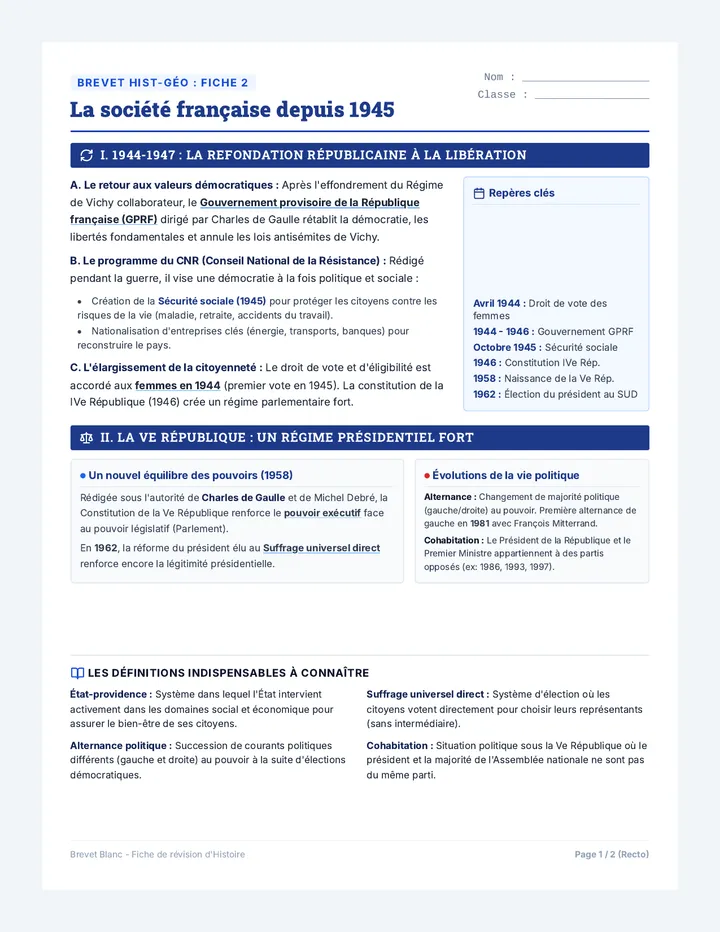
Societe Francaise Depuis 1945 Fiche

Brevet Fiches : Hist-Géo, EMC & Physique-Chimie

Une collection complète de fiches de révision classiques (recto-verso A4) très ciblées pour préparer les élèves de Troisième aux épreuves d'Histoire, de Géographie, d'EMC et de Physique-Chimie du DNB. Chaque fiche traite d'une leçon précise des programmes officiels.

MW

Myriam Wb

16
Reconstruction Reckoning Worksheet

Modern America

A comprehensive journey through United States history from the aftermath of the Civil War to the contemporary era, exploring the social, political, and economic shifts that shaped the modern nation.

DP

Darren Polamalu

18
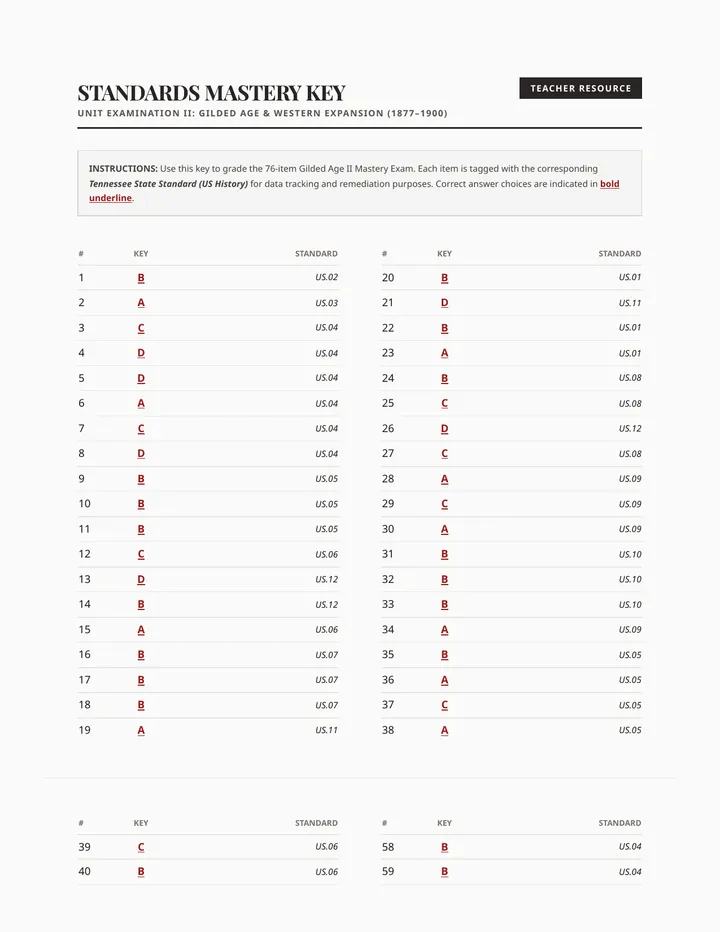
Gilded Age II Standards Key

Modern America Mastery

A comprehensive curriculum sequence covering late 19th and early 20th-century American history, focusing on economic transformation, Western expansion, global imperialism, and the impact of the Great War.

A

Andrew

29
Gilded Age WICOR Handout

History Hustle

A comprehensive US History EOC review sequence designed for AVID classrooms, utilizing WICOR strategies to master key eras from the Gilded Age through modern turning points.

ES

Erin Sims

15

Lessons

History Sprint Pacing Guide

STAAR History Sprint

A comprehensive pacing guide and activity resource designed to cover the remaining 11th Grade US History TEKS before the STAAR test on April 16th. This lesson provides a day-by-day calendar for A/B block schedules and high-engagement activities for each remaining historical era.

BB

Bridgette Burdick

51
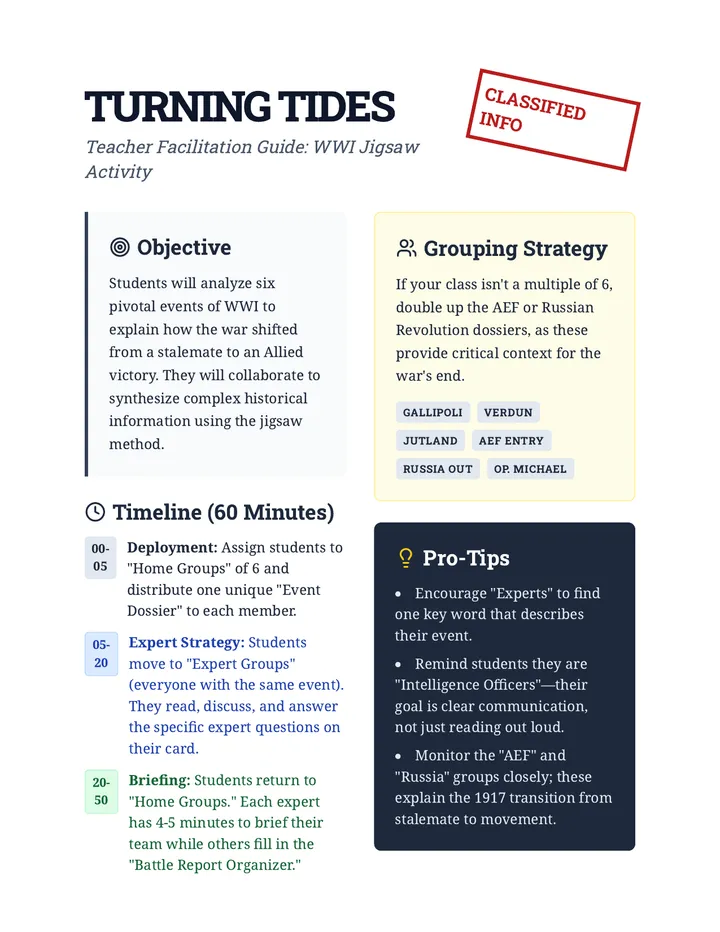
Turning Tides Teacher Guide

Turning Tides

A comprehensive jigsaw activity focusing on six pivotal events of World War I, designed for a 60-minute class session. Students act as intelligence officers to piece together the shifting dynamics of the Great War.

B

bliddy

34
Chronicle Study Guide Student

Modern Era Mastery

A comprehensive review and assessment package covering World History from the Enlightenment through the Cold War, aligned with state standards.

AH

Ashley Hopf

16
Era Review Challenge Practice Sheet

Era Review Challenge

A quick review lesson designed to prepare students for US History STAAR assessments, focusing on four key eras: Imperialism, the Roaring 20s, the Great Depression, and WWII.

BB

Bridgette Burdick

14
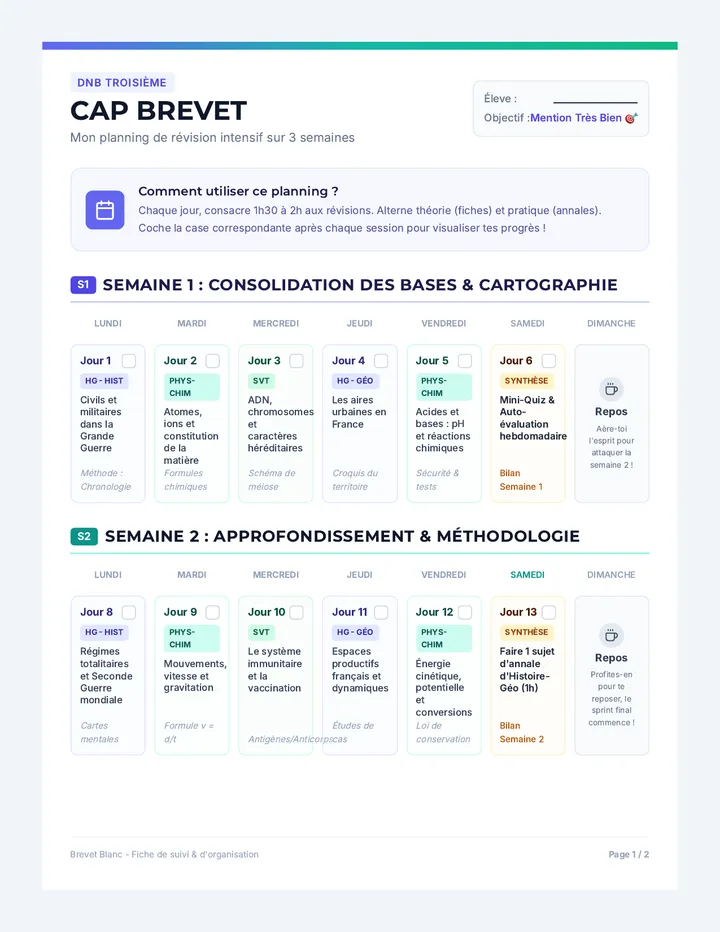
Planning Brevet Calendrier

Objectif Brevet

Un programme de révision intensif et structuré sur 3 semaines pour préparer sereinement les épreuves de SVT, Physique-Chimie et Histoire-Géographie du Diplôme National du Brevet.

MW

Myriam Wb

6
Suffrage Struggle Do Now

Suffrage Struggles and Strategies

A lesson exploring the interactions between key figures and events in the Women's Suffrage movement, specifically focusing on the shift to a federal amendment strategy.

DS

Dominque Sykes

2