Lenny.com
Explore
Create
ActivitiesNewMathEnglish Language ArtsScience & EngineeringSocial StudiesGlobal LanguagesHealth & Physical EducationSpecial EducationCounseling & Life SkillsArts & CreativityESL
Lenny.com
Lenny.com
Explore
Create
ActivitiesNewMathEnglish Language ArtsScience & EngineeringSocial StudiesGlobal LanguagesHealth & Physical EducationSpecial EducationCounseling & Life SkillsArts & CreativityESL
Lenny.com
Lenny.com

Solutions

Lenny for EducatorsLenny for SchoolsLenny for Districts

Product

ExploreSign inCreateSupportAbout

Resources

Getting startedMTSS Acceleration Program

Newsletters

School Funding Newsletter

© 2026 Lenny Learning Inc.

TermsPrivacyAccessibility
LinkedInInstagramX
Lenny

Founding of the United States

Examines the drafting of the Declaration of Independence, the Revolutionary War's impact, and the creation of the U.S. Constitution. Connects Enlightenment ideals to the development of early American democratic institutions and federalism.

Social StudiesSocial Studies PracticesLocation WordsMapsOrder EventsChronology and CausationEvaluating SourcesHistorical ThinkingGeography, Humans, & the EnvironmentAmerican Symbols and LandmarksCitiesStatesState CapitalsRegions of the United StatesGeographic SkillsPhysical GeographyHuman GeographyRegional GeographyGeography of AfricaGeography of AsiaGeography of EuropeGeography of OceaniaGeography of the AmericasSociety and Environment of EuropeSociety and Environment of AsiaSociety and Environment of The AmericasSociety and Environment of the Middle EastSociety and Environment of AfricaHistoryPrehistoryComparing Ancient River CivilizationsAncient MesopotamiaAncient Egypt and KushAncient South AsiaEarly ChinaGreeceRome and the Byzantine EmpireAncient World HistoryNative Peoples of North AmericaNative Peoples of Mesoamerica and South AmericaAfrican EmpiresMedieval AsiaMedieval EuropeThe Silk RoadMedieval HistoryIslamic EmpiresWorld ReligionsRenaissance PeriodAge of ExplorationThe Thirteen ColoniesThe American RevolutionUS History Early RepublicFounding of the United StatesUS History AntebellumUS Civil WarReconstruction PeriodThe Gilded AgeUS ImperialismWorld ImperialismWorld War IUS History 1920sGreat DepressionWorld War IIThe Cold WarUS History 1950-60sUS History 1960s-70sWorld History 20th CenturyContemporary US HistoryContemporary World HistoryHolidaysCivics and GovernmentCitizenshipGovernment FoundationsThe ConstitutionUS ConstitutionExecutive BranchLegislative BranchJudicial BranchState and LocalPolitical ParticipationPublic PolicyPolitical SystemsPower and AuthoritySocial MovementsDefining DevianceTheories of DevianceCrime and Criminal JusticeEconomicsBasic Economic PrinciplesSupply and DemandWhat is MoneyEconomic FundamentalsMicroeconomicsMacroeconomicsBanking and FinanceEconomic SystemsGlobal EconomicsCorporations and PowerThe Changing WorkplaceUnemployment and LaborClass and InequalitySocial MobilityGlobal InequalityPsychologyHistory of PsychologyPsychology as a ScienceBrain and Nervous SystemNeuroscience and BehaviorGenetics and BehaviorSleep and ConsciousnessSensory ProcessesPerceptual OrganizationClassical ConditioningOperant ConditioningObservational LearningCognitive LearningMemory ProcessesThinking and Problem SolvingLanguage and CognitionTheories of MotivationStress and CopingPrenatal and Infant DevelopmentChildhood DevelopmentAdolescent DevelopmentAdulthood and AgingSelf and IdentitySocial CognitionSocial InfluenceAttraction and RelationshipsGroup BehaviorPrejudice and DiscriminationAnxiety and Mood DisordersClinical PsychologyForensic PsychologyPhilosophy & EthicsIntroduction to PhilosophyMajor Philosophers & IdeasMind and Body ProblemFree Will vs DeterminismEthics & MoralityReligion & PhilosophyPolitical Philosophy

Videos

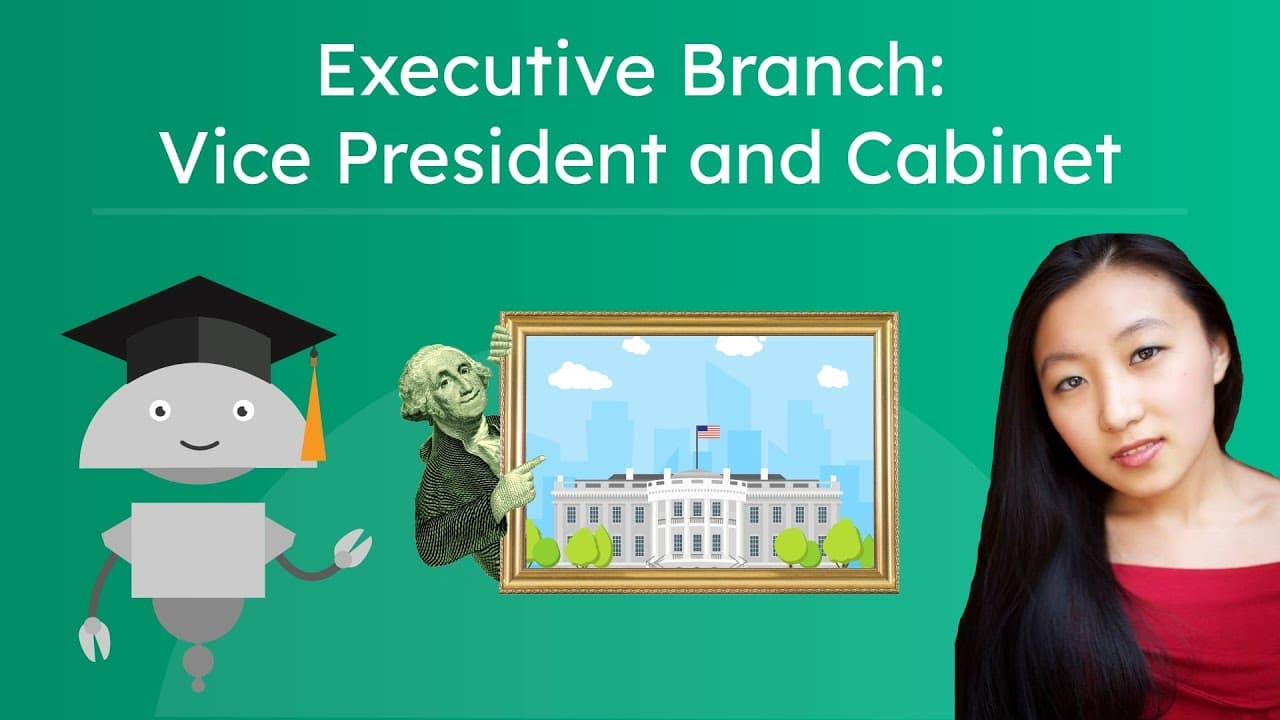
Beyond the President: The Vice President and Cabinet Explained

Beyond the President: The Vice President and Cabinet Explained

This educational video provides an in-depth look at the Executive Branch of the United States government, moving beyond the presidency to explore the critical roles of the Vice President and the Cabinet. It details the constitutional requirements, selection processes, and responsibilities associated with these positions, highlighting how the executive branch functions as a massive team rather than a one-person show. The video uses historical examples, such as George Washington's original cabinet and the relationship between early presidents and vice presidents, to illustrate how these roles have evolved over time. The content breaks down the specific duties of key Cabinet departments, including the \"Original Four\"—State, Treasury, Defense, and Justice—explaining how they support the President in managing national affairs. It also covers the Vice President's dual role as the President of the Senate and a key advisor, as well as the importance of other staff members like the Chief of Staff. The video clarifies the checks and balances involved, particularly the Senate's role in confirming appointments. For educators, this video serves as an excellent resource for Civics and U.S. History units. It transforms abstract government structures into concrete examples, making it easier for students to understand federal administration. The clear explanations of department functions and the visuals of historical figures help contextualize the scale of the executive branch, making it a perfect launchpad for lessons on government hierarchy, the separation of powers, and career exploration in public service.
Miacademy & MiaPrep Learning ChannelMiacademy & MiaPrep Learning Channel

9mins 26s

Slavery and the Constitution: America's Founding Paradox

Slavery and the Constitution: America's Founding Paradox

This video investigates the profound contradiction at the heart of the United States' founding: the coexistence of the institution of slavery within a nation declared to be the "land of the free." It examines why the Constitution specifically avoided using the word "slavery," analyzing the tension between the revolutionary ideals of equality asserted in the Declaration of Independence and the economic pragmatism that drove the Constitutional Convention. The narration guides students through the uncomfortable realities of the era, distinguishing between the idealistic "Founding Fathers" and the system-building "Framers." Key themes explored include the economic interdependence of Northern merchants and Southern planters on slave labor, the dehumanizing logic behind the Three-Fifths Compromise, and the geographic shift of the slave trade from the Old South to the Deep South. The video features significant historical analysis of Thomas Jefferson's famous "wolf by the ears" metaphor and explains how the framers' inability to resolve the slavery issue necessitated a Civil War decades later. For educators, this video serves as a powerful tool to teach the Constitution not as a static, perfect text, but as a "living document" designed to evolve with society. It provides crucial context for understanding the structural roots of American inequality and the mechanisms of compromise in government. By connecting the 1787 debates directly to the inevitable conflict of the 1860s, it helps students grasp cause-and-effect in history and the complexity of building a democracy.

Miacademy & MiaPrep Learning ChannelMiacademy & MiaPrep Learning Channel

8mins 38s

The Federalism Championship: States' Rights vs. Federal Power

The Federalism Championship: States' Rights vs. Federal Power

This engaging educational video introduces the complex concept of Federalism through a creative boxing match metaphor, pitting "States' Rights" against "Federal Power" in a battle for the direction of the nation. The host, Caroline, serves as the ring announcer and educator, guiding students through the definitions of strict versus loose interpretations of the U.S. Constitution and how these opposing views shape American governance. The video serves as both a review of foundational political principles and an introduction to the structure of the U.S. federal system. Key themes explored include the balance of power between national and state governments, the historical context of the Federalist vs. Anti-Federalist debates, and the structure of the three branches of government at both levels. The video emphasizes that conflict and debate are not negative side effects but intentional features of the system designed to limit government overreach and ensure liberty through checks and balances. For educators, this video is a high-utility resource for Civics and Government units. It simplifies abstract political science concepts using visual analogies and humor. The video is structurally designed for classroom use, featuring explicit "Show What You Know" pause points where questions appear on screen, allowing teachers to stop the video and facilitate immediate formative assessment without any extra preparation.

Miacademy & MiaPrep Learning ChannelMiacademy & MiaPrep Learning Channel

7mins 41s

Using Revolutionary Traditions to Create Social Change

Using Revolutionary Traditions to Create Social Change

This educational video explores how the core principles of the United States' founding documents—the Declaration of Independence and the Constitution—created a "revolutionary tradition" that has been utilized by marginalized groups to effect social change. It defines key concepts like popular sovereignty, natural rights, and the distinction between suffrage (voting) and mass democracy (participation outside the voting booth). The video argues that these founding ideals provide a "measuring stick" against which society can be judged and improved.

Miacademy & MiaPrep Learning ChannelMiacademy & MiaPrep Learning Channel

12mins 18s

Why We Study US History: Context, Perspectives, and Themes

Why We Study US History: Context, Perspectives, and Themes

This introductory video for a U.S. History course establishes the fundamental reasons for studying history: to better understand the present, to contextualize events through multiple perspectives, and to develop the skills necessary for civic engagement. Hosted by Anthony with assistance from an animated robot named Mia, the lesson uses relatable analogies and historical examples to demystify abstract concepts like 'contextualization' and 'historical perspective.' It moves beyond memorizing dates to emphasize critical thinking and the application of historical knowledge to modern life. The video introduces three core themes that will guide the course: Community & Belonging, People & The Environment, and the Role of Government. Through specific examples—such as George Washington's mandate for smallpox inoculations during the Revolutionary War—the narrator demonstrates how understanding the circumstances surrounding a decision changes our interpretation of it. The lesson also distinguishes between learning 'about' history versus learning 'from' it, positioning the student as an active participant in society. Educators can use this video to launch a history curriculum by setting expectations for critical inquiry. It provides a perfect framework for teaching students how to analyze primary sources, consider bias, and understand historical empathy. The segment featuring different personas reacting to a single public policy statement is an excellent tool for introducing debate and perspective-taking in the classroom.

Miacademy & MiaPrep Learning ChannelMiacademy & MiaPrep Learning Channel

10mins 51s

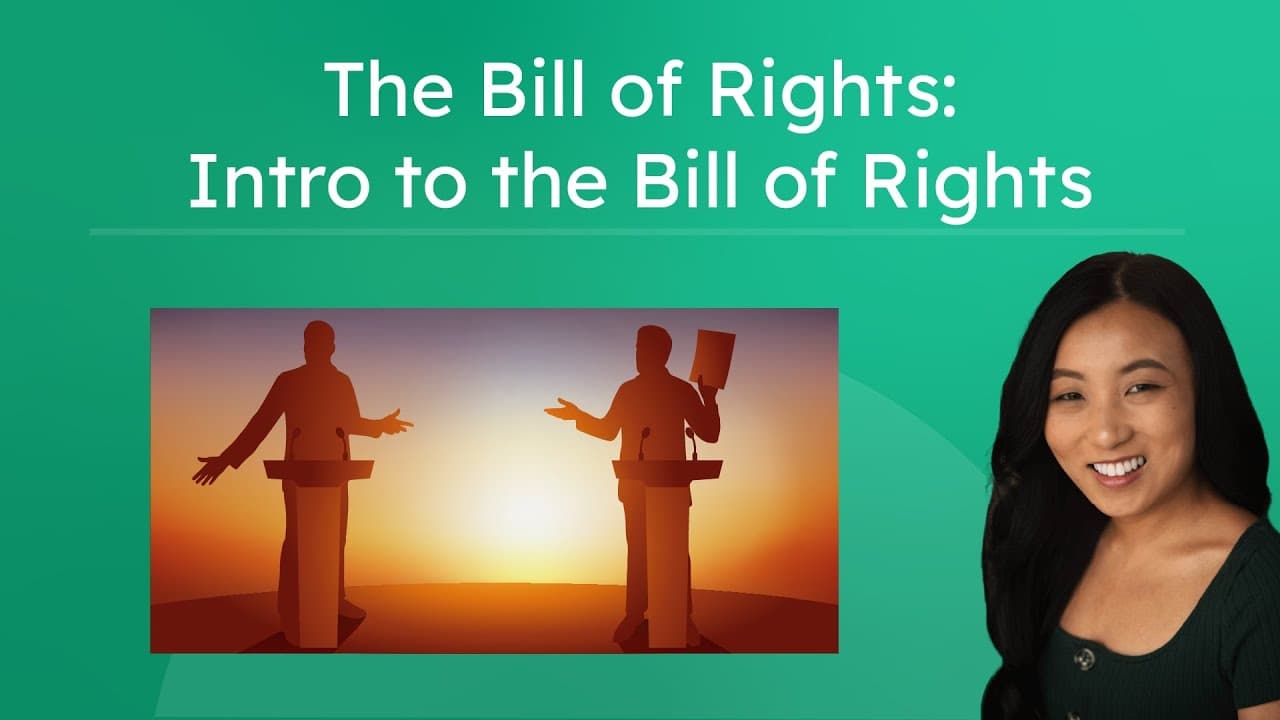
How Debates Created the Bill of Rights

How Debates Created the Bill of Rights

This educational video explores the historical origins and necessity of the Bill of Rights, framing it through the intense debates between Federalists and Anti-Federalists during the ratification of the U.S. Constitution. Using a relatable analogy of a school group project, the narrator explains how conflict and compromise were essential to finalizing the Constitution. The video details the specific fears Anti-Federalists held regarding vague clauses like the Supremacy Clause and their concern that a strong federal government could become tyrannical without explicit protections for individuals and states.

Miacademy & MiaPrep Learning ChannelMiacademy & MiaPrep Learning Channel

5mins 22s

Materials

Central American Freedom Reading Worksheet

Central American Freedom Reading Worksheet

A Grade 8-9 dual-language reading and multiple-choice worksheet covering Central American Independence Day (September 15, 1821). Features a 4-paragraph parallel English and Spanish text alongside 6 standards-aligned bilingual multiple choice questions assessing key historical concepts, leaders, and civic traditions.

GJ

Gerardo Jimenez Ramirez

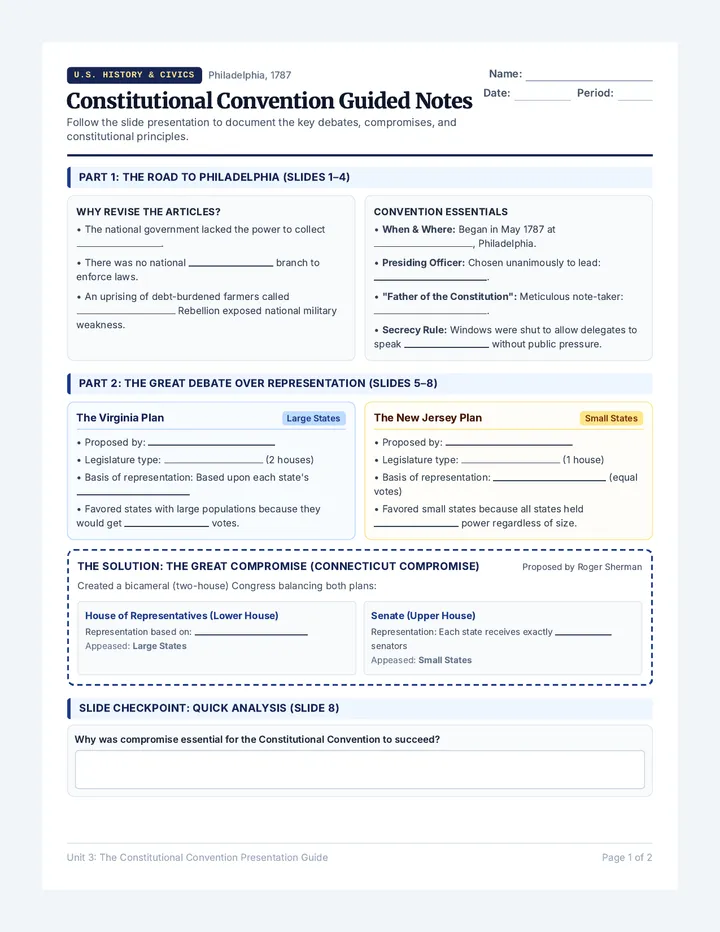
Constitutional Convention Guided Notes

Constitutional Convention Guided Notes

A comprehensive two-page guided note-taking worksheet on the 1787 Constitutional Convention, focusing on the road to Philadelphia, the Great Compromise, and slavery and economic compromises.

D

DOUGLAS.BODIE

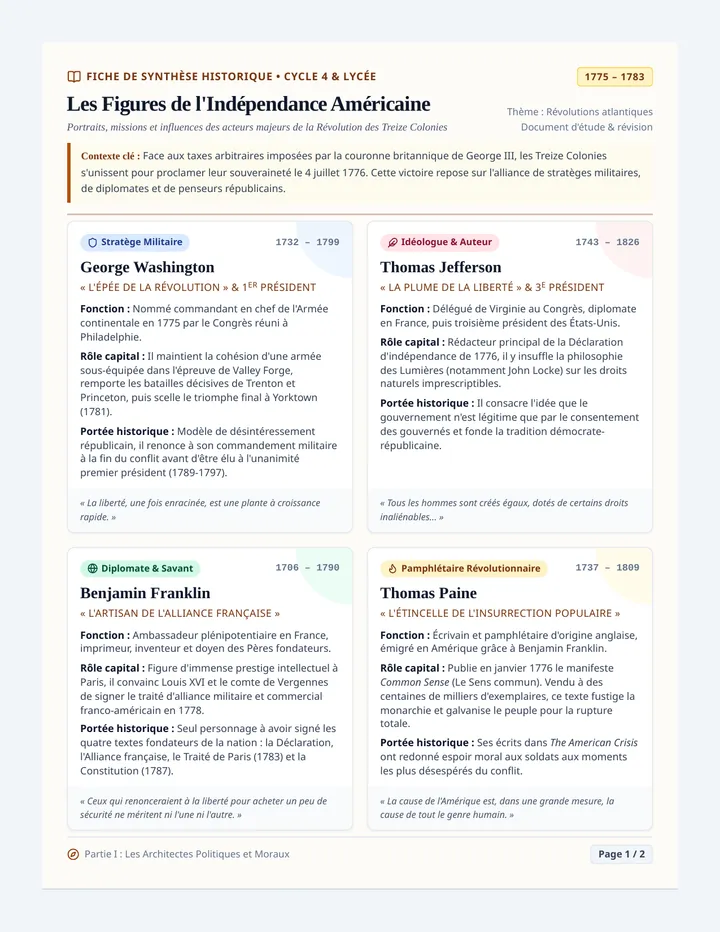
Figures Révolutionnaires Fiche Synthèse

Figures Révolutionnaires Fiche Synthèse

Fiche d'étude synthétique présentant les huit figures majeures de l'indépendance des États-Unis, leurs rôles politiques, militaires et diplomatiques, ainsi qu'une frise chronologique des repères clés.

CS

Carlos Santos

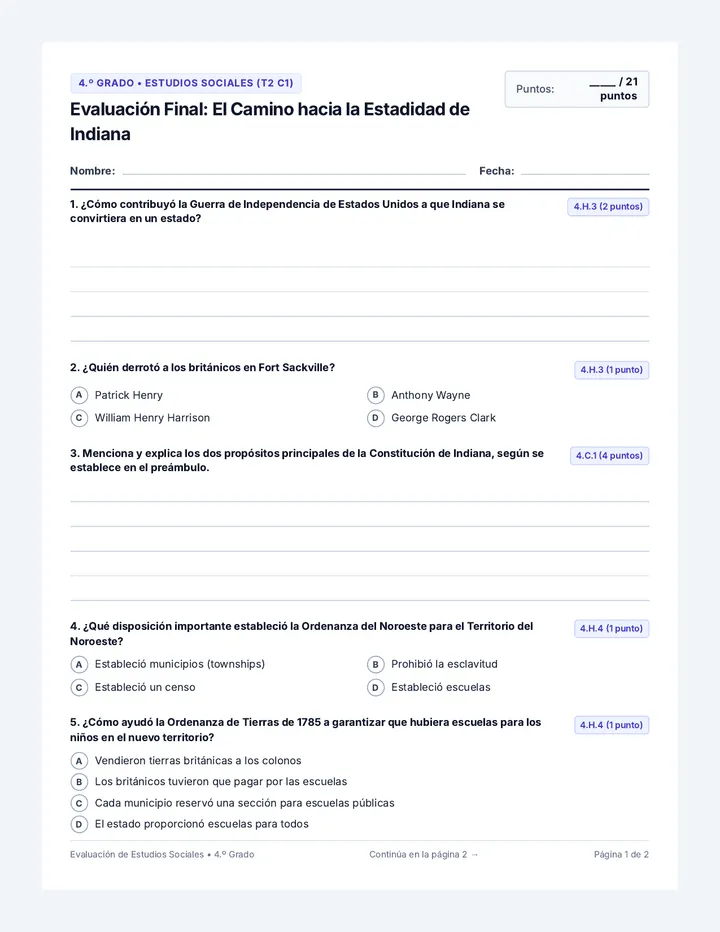
Indiana Statehood Spanish Test

Indiana Statehood Spanish Test

A Spanish translation of the 4th-grade social studies post-assessment on Indiana's journey to statehood, historical ordinances, and early governance. Includes 11 standards-aligned questions with designated response areas and clear multiple-choice options.

JS

Jennifer Swallow

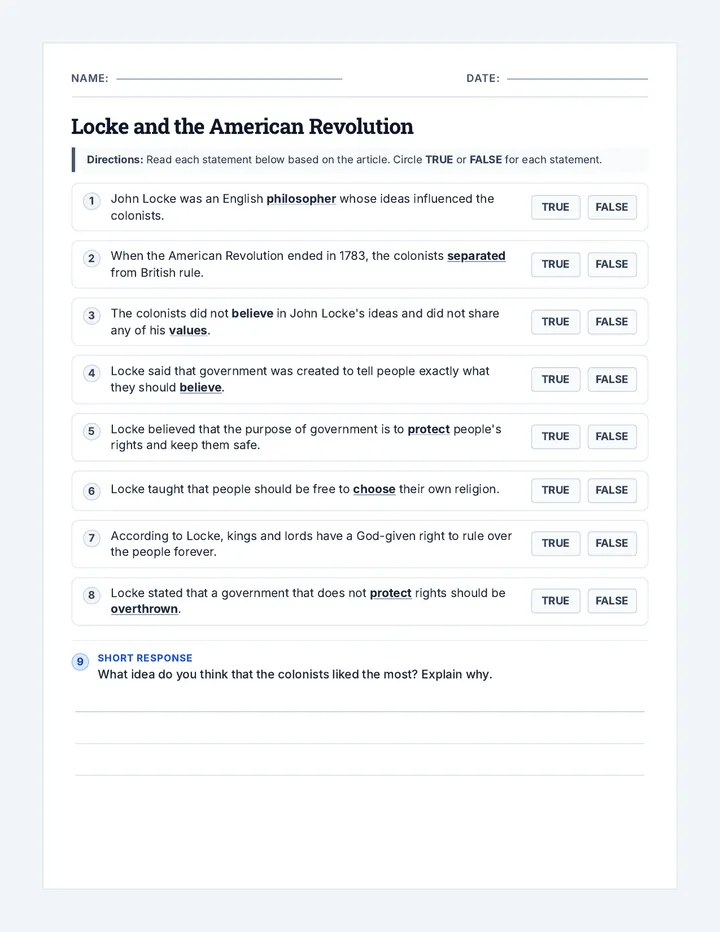
Revolutionary Ideas Worksheet

Revolutionary Ideas Worksheet

A foundational True or False reading comprehension worksheet on John Locke and the American Revolution, including an added short open-response question for student reflection.

CM

Christie Mercuri

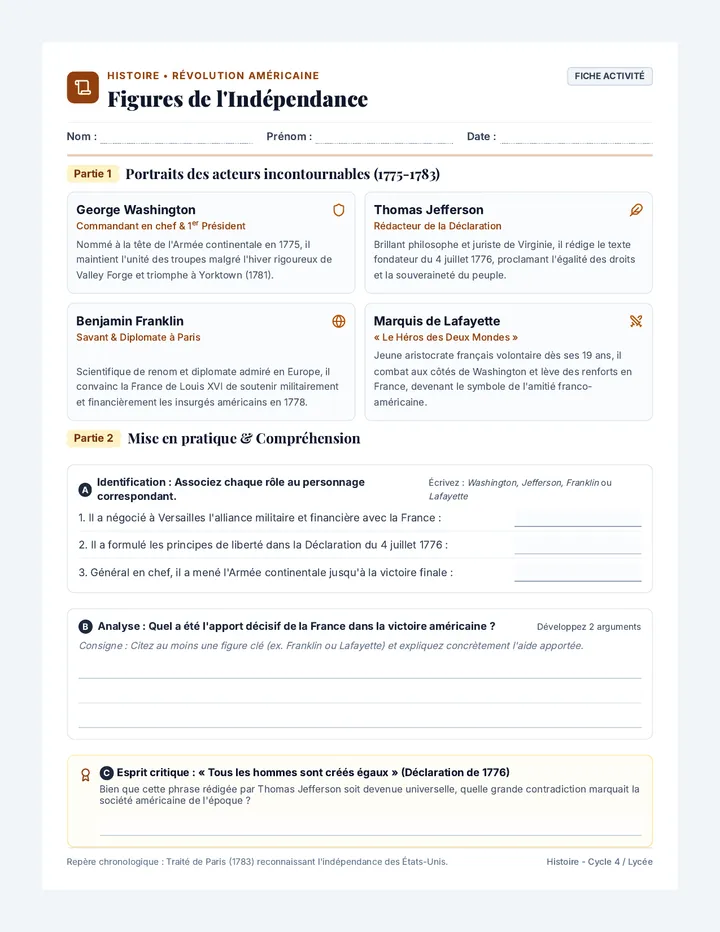
Figures de l'Indépendance Fiche

Figures de l'Indépendance Fiche

Fiche pédagogique recto combinant repères biographiques synthétiques et exercices d'application sur les figures majeures de la Révolution américaine : Washington, Jefferson, Franklin et Lafayette.

CS

Carlos Santos

Sequences

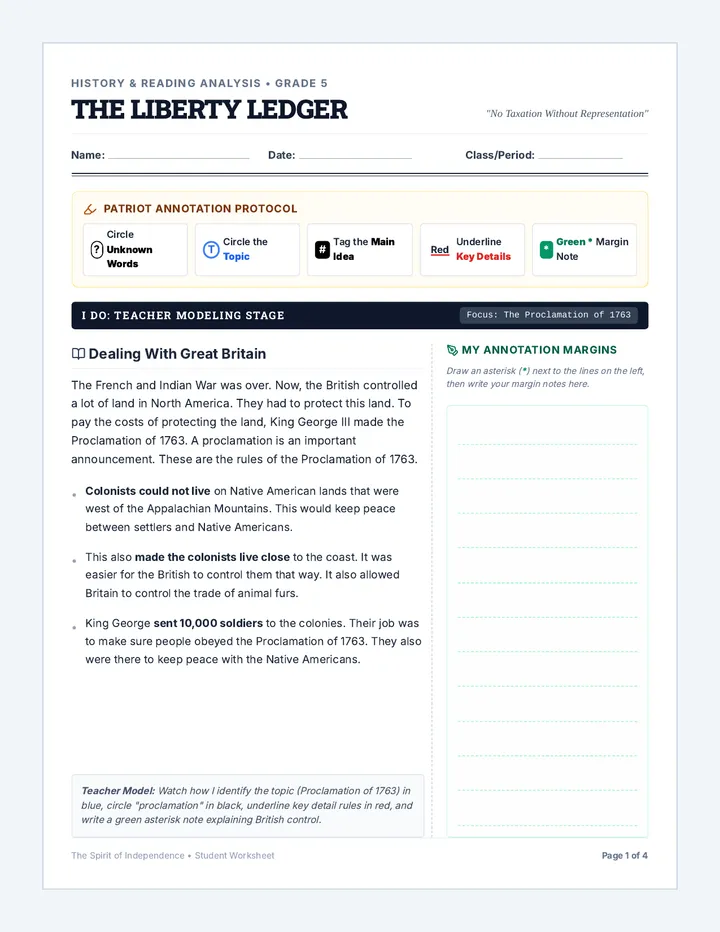
Liberty Ledger Annotation Worksheet

Spirit of Independence

A fifth-grade social studies and active reading unit exploring the growing friction between Great Britain and the American colonies, focusing on the causes, consequences, and motivated actions that led to the American Revolution.

MN

Monica Nava

7
Teacher Facilitation Guide

Revolutionary Dilemmas

A comprehensive book club unit for the historical fiction novel 'My Brother Sam is Dead', focusing on the moral complexities of the Revolutionary War, character transformation, and historical context.

KL

Kim Leary

8
Thirteen Friends Worksheet

Democratic Foundations

A series of lessons exploring the foundational documents and processes of the United States government, from the birth of the nation to the creation of modern laws.

SB

Stephanie Bizeur

40
Unity Roadmap Teacher Guide

Unity and Growth

A modified Modern US History curriculum (Founding to Present) for Tier 2 and 3 special education students, based on Grade 11 Social Studies standards. Focuses on government, industrialization, world wars, and civil rights.

D

dfleisch

26
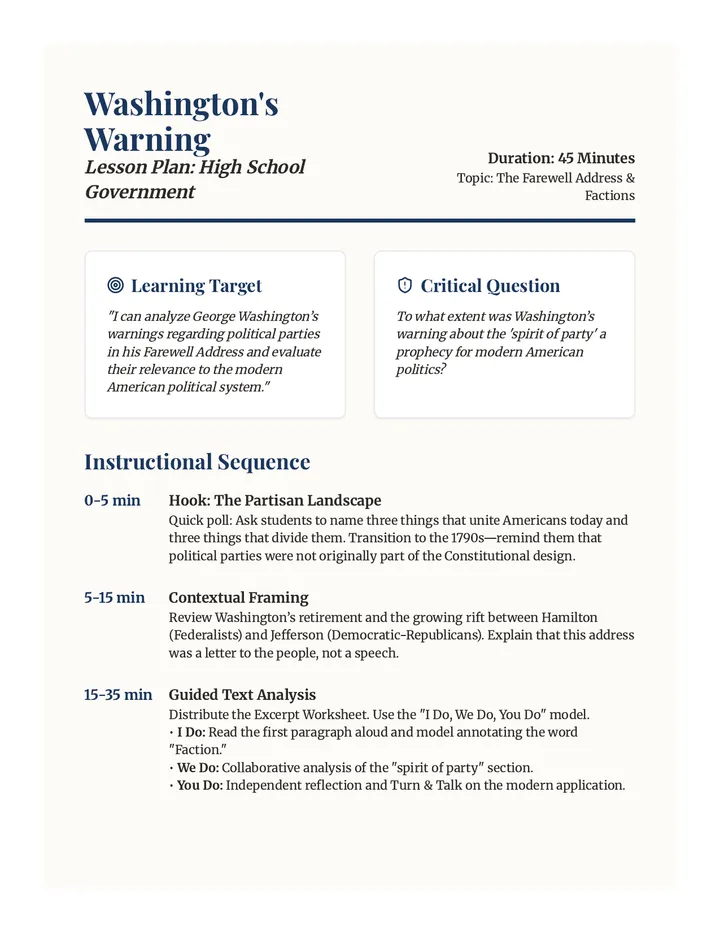
Washingtons Warning Lesson Plan

Washington's Farewell Legacy

A two-part sequence that takes students from a deep-dive analysis of George Washington's Farewell Address to a modern-day evaluation of his warnings regarding political parties, media bias, and national unity.

CE

Chelsea Elliott

24
Amendment Evolution Slides

Constitutional Crossroads

A deep dive into the foundations of American government, covering the evolution of constitutional amendments and the structure and power of the judicial system.

GM

Geneva Manus

11

Lessons

History Sprint Pacing Guide

STAAR History Sprint

A comprehensive pacing guide and activity resource designed to cover the remaining 11th Grade US History TEKS before the STAAR test on April 16th. This lesson provides a day-by-day calendar for A/B block schedules and high-engagement activities for each remaining historical era.

BB

Bridgette Burdick

51
Border Lines Activity

Harriet Tubman Escape

A lesson exploring Harriet Tubman's 1850 escape and the significance of the Mason-Dixon Line as a geographical and legal boundary in the pre-Civil War United States.

TL

Tanya Larson

46
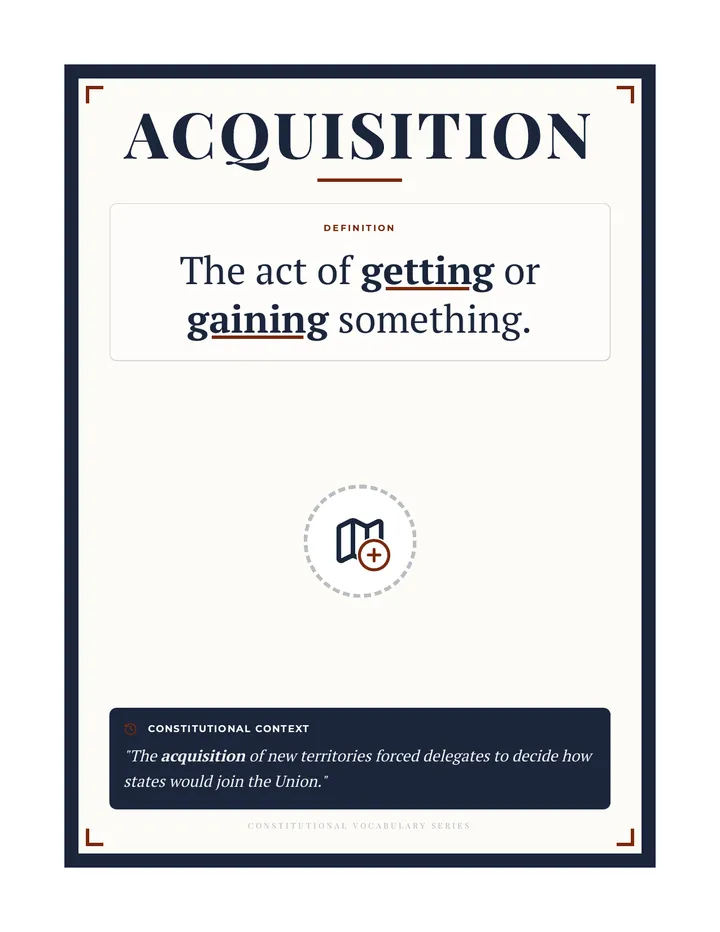
Constitutional Vocabulary Poster Set

Constitutional Vocabulary

A set of vocabulary posters focused on key terms from the Constitutional Convention, including government structures, legislative roles, and foundational principles like compromise and federalism.

SA

Senta Agnello-Shelton

21
Massachusetts Milestones Slideshow

New England Chronicles

An expansive journey through the history of New England, divided into state-by-state volumes. This series provides middle school students with 180 daily historical warm-ups, exploring major milestones from pre-colonial times to modern innovations.

SF

Steven Flint

6
Compromise Conundrum Activity Signs

Compromise Conundrum

A 45-minute stand-alone lesson centered on the Constitutional Convention's debate over representation and the Three-Fifths Compromise. It includes chunked reading for accessibility, a high-engagement 'Four Corners' activity, and a graphic organizer assessment designed for formal observation alignment with the Danielson Framework.

SA

Senta Agnello-Shelton

11
Reason for Revolution Worksheet V4 Refined Final

Architects of Liberty

A lesson exploring how Enlightenment philosophers like Locke, Montesquieu, and Voltaire influenced the founding documents and structure of the United States government.

KB

Kenneth Brown

10