Law Launchpad Worksheet Law Launchpad
Exploring the U.S. Legislative Process
Name: __________________________
Date: ___________________________
Where Do Laws Start?
Every law in the United States starts as a simple idea. Anyone can have an idea for a law! You might think there should be more parks or that school lunches should be healthier. Citizens can share their ideas with their leaders in the government. These leaders are called representatives and senators . They work in a place called Congress in Washington, D.C.
1
The Bill is Born
When a leader likes an idea, they write it down. This written idea is called a bill . It is like a rough draft of a law.
2
The Committee Chat
A small group of leaders, called a committee, reads the bill. They talk about it and decide if it is a good idea. They might change some parts of it to make it better.
3
The Big Vote
If the committee likes the bill, it goes to the whole House of Representatives or the Senate. Everyone votes. If more than half of the people say "yes," the bill moves forward!
4
The President's Desk
Finally, the bill reaches the President. If the President signs the bill, it officially becomes a law . If the President says no, it is called a veto .
Check Your Knowledge
Circle the correct answer for each question below.
1. What is an idea for a law called before it is passed?
A. A constitution
B. A bill
C. A decree
D. A memo
2. Where do representatives and senators work?
A. The Supreme Court
B. The White House
C. Congress
D. The Library of Congress
3. What does a committee do with a bill?
A. They sign it into law immediately.
B. They hide it from the President.
C. They throw it away if they don't like the paper.
D. They talk about it and might make changes.
4. What happens if the President signs the bill?
A. It becomes a law.
B. It is sent back to the citizens.
C. It is deleted from the computers.
D. It gets a new name.
5. What is it called when the President says "no" to a bill?
A. A pass
B. A veto
C. A vote
D. A law
Law Launchpad Worksheet Legislative Journey
Capitol Circuit Worksheet Capitol Circuit
Intermediate Guide to the Legislative Process
Name: __________________________
Date: ___________________________
From Idea to Introduction
Every year, thousands of ideas for laws are brought to the attention of Congress. These ideas come from ordinary citizens, interest groups, or the President. However, only a sponsor —a member of Congress—can officially introduce a bill. In the House of Representatives, this happens by placing the written bill into a wooden box called the "hopper." In the Senate, a member usually introduces it from the floor.
The Committee Filter
Once a bill is introduced, it is sent to a standing committee . These are small groups of experts who focus on specific topics like agriculture, education, or defense. Most bills actually "die" in committee because they aren't viewed as necessary. If the committee approves the bill, they "report" it back to the full chamber for a debate and a vote.
The Floor Debate
On the chamber floor, members argue the pros and cons of the bill. They can suggest amendments , which are changes or additions to the text. For a bill to pass, a simple majority (more than 50%) must vote in favor. But there's a catch: the exact same version of the bill must pass in both the House and the Senate.
The Executive Action
After passing through both chambers, the bill lands on the President's desk. The President has 10 days to act. They can sign it, making it law immediately, or veto it. If they veto it, they send it back to Congress with their reasons why. Congress can try to override a veto, but they need a huge two-thirds majority to succeed.
Legislative Logic
Choose the best answer for each question based on the text.
1. Who is the only person allowed to officially introduce a bill to Congress?
A. The President of the United States
B. A member of Congress (a sponsor)
C. Any citizen with a good idea
D. The Supreme Court Justices
2. What is the "hopper" used for in the House of Representatives?
A. Storing signed laws for safe keeping
B. Holding votes during a debate
C. A box where new bills are placed when introduced
D. A special room where committees meet
3. Why do most bills "die" in the committee stage?
A. The President forgets to sign them
B. They aren't viewed as necessary or good ideas
C. The hopper gets too full to hold them
D. Citizens vote against them online
Legislative Labyrinth Worksheet Legislative Labyrinth
Navigating the Complexity of Federal Lawmaking
Name: __________________________
Date: ___________________________
The Origin of Legislation
The legislative process is designed to be slow and deliberate, ensuring that only thoroughly vetted ideas become the law of the land. While any citizen can propose a concept, only a sponsor within the House or Senate can formally introduce it. Once a bill is assigned a number (such as H.R. 1 or S. 1), it begins its journey through a series of procedural hurdles designed to test its viability and build consensus.
The Committee Crucible
Most bills face their demise in standing committees . These groups hold hearings to gather expert testimony and perform "markup" sessions where the bill's language is debated and revised. A committee can choose to report a bill favorably, table it (effectively killing it), or replace it with a "clean bill." In the House, the Rules Committee acts as a gatekeeper, setting the terms for floor debate and determining which amendments can be offered.
The House
Debate is strictly limited by time. The large number of representatives (435) requires rigid rules to maintain order and efficiency during the voting process.
The Senate
Tradition allows for unlimited debate, leading to the filibuster —a tactic used to delay or block a vote. Ending a filibuster requires a cloture vote supported by 60 senators.
Reconciliation and Vetoes
Because both chambers must pass an identical version of a bill, a conference committee —consisting of members from both the House and Senate—is often formed to resolve differences. Once reconciled, the final bill moves to the President. Beyond signing or vetoing, the President may also allow a "pocket veto" if Congress adjourns within 10 days of submitting the bill and the President takes no action.
Lex Et Justitia
Legislative Analysis
Select the most accurate response based on your reading of the text.
1. What is the primary function of the House Rules Committee?
A. To officially sponsor new legislation from citizens
B. To set the parameters for debate and amendments on the House floor
C. To resolve differences between House and Senate versions of a bill
D. To override presidential vetoes with a simple majority
2. How does the Senate's tradition of "unlimited debate" impact the lawmaking process?
A. It guarantees that every bill introduced will eventually become law
Bill to Law Slides How a Bill Becomes a Law
The Journey of an Idea through the U.S. Government
What is a Bill?
A bill is a written idea for a new law.
It is presented to Congress to be discussed, changed, and voted on.
The Big Three
Anyone can have an idea.
Only Congress can introduce it.
It must pass both chambers.
Step 1: Introduction
The Sponsor
A member of Congress (Representative or Senator) introduces the bill.
The Hopper
In the House, bills are placed in a wooden box called the hopper .
Step 2: Committee Action
Hearings
Experts talk about why the bill is good or bad.
Markup
The committee makes changes and edits the bill.
Report
If they like it, they send it to the full chamber.
Most bills die in committee!
Step 3: Floor Debate & Vote
1
Representatives or Senators debate the bill's merits.
2
Amendments (changes) may be added.
3
A simple majority (51%) is needed to pass.
Senate Twist
The Senate allows for filibusters —talking for a long time to delay a vote!
The Final Step
Signed
The President signs the bill. It is now a Law !
Vetoed
The President says "No." The bill is sent back to Congress.
Congress can override a veto with a 2/3 majority vote!
Legislative Journey Answer Key Teacher Answer Key
Legislative Journey Differentiated Unit
Master Key
Grade 4: Law Launchpad
B. A bill
C. Congress
D. They talk about it and might make changes.
A. It becomes a law.
B. A veto
Grade 5: Capitol Circuit
B. A member of Congress (a sponsor)
C. A box where new bills are placed when introduced
B. They aren't viewed as necessary or good ideas
C. The exact same version must pass in both the House and the Senate
C. By getting a two-thirds majority vote in both chambers
Grade 7: Legislative Labyrinth
B. To set the parameters for debate and amendments on the House floor
B. It allows for the use of filibusters to delay or block legislation
B. When Congress adjourns within 10 days of the President receiving a bill and they take no action
C. To resolve differences between House and Senate versions of the same bill
D. A cloture vote supported by a three-fifths majority (60 senators)
Teaching Notes
4th Grade Focus: Identifying basic terminology (bill, veto, Congress) and the sequence of major events.5th Grade Focus: Understanding the role of sponsorship, committees, and the specific requirement for identical bills.7th Grade Focus: Analyzing procedural tactics (filibuster/cloture), specific committees (Rules/Conference), and executive nuances (pocket veto).
End of Answer Key • Legislative Journey Unit
Thirteen Friends Worksheet Thirteen Friends
History Records
Name:
Date:
Read the story of how our first government was like a group of friends trying to work together.
A New Start
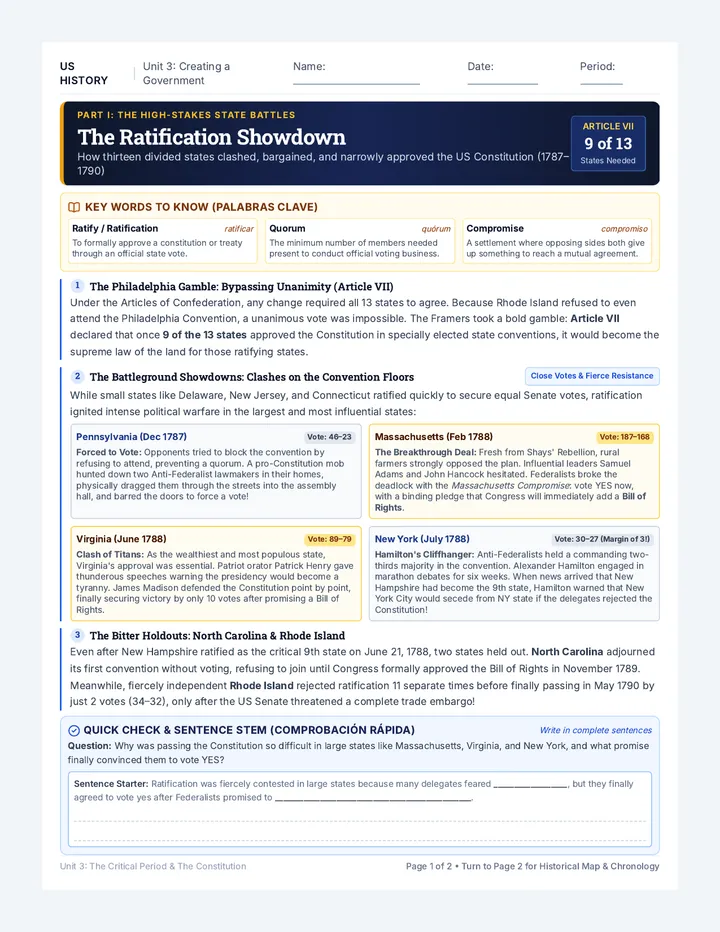
After the United States declared independence in 1776, the thirteen colonies became thirteen independent states. They knew they needed a way to work together, especially to win the war against Great Britain. In 1781, they agreed on a plan called the Articles of Confederation .
What They Wanted
The states wanted to keep most of their power. They were afraid of a strong central government that might act like a king. They called their group a "league of friendship."
The Big Problems
Under this plan, there was no President and no national courts. The national government couldn't force states to pay taxes or follow laws. It was like a club where nobody had to follow the rules!
Each state had its own money, its own army, and its own trade laws. If the national government needed money for the war, they had to ask the states for it. Most of the time, the states said "no." Because of these weaknesses, the new country had a very hard time paying its debts and keeping order.
While the Articles of Confederation helped the states stay united during the war, it soon became clear that "thirteen friends" needed a stronger plan to stay together as one nation.
Checking the Records
1. What did the states call their group under the Articles of Confederation?
The United Kingdom
A League of Friendship
The Royal Colonies
The President's Club
2. Why were the states afraid of a strong central government?
They wanted to move back to England.
They didn't want a government that acted like a king.
They wanted to have a different language for every state.
They were worried about too many national parks.
3. Which of these was NOT a part of the government under the Articles?
Thirteen independent states
A President and national courts
A group of state representatives
A plan for working together
Reflect: If you and your friends had a club where nobody had to follow the rules, what is one problem that might happen?
The Weak Link Worksheet The Weak Link
Documentary Analysis
Name: _________
Date: _________
Explore the structural flaws of America's first constitution and why it struggled to govern a new nation.
A "Firm League of Friendship"
In 1777, as the Revolutionary War raged on, the Continental Congress drafted the Articles of Confederation . This document served as the first constitution of the United States. However, the authors were deeply suspicious of central authority. Having just fought a war against the British monarchy, they wanted to ensure that no single person or group could ever have too much power again.
The result was a government that was intentionally weak. The national government consisted only of a unicameral (one-house) legislature. There was no Executive Branch to enforce laws and no Judicial Branch to interpret them. Each state, regardless of its size or population, had exactly one vote in Congress. To pass any major law, nine out of the thirteen states had to agree. To change the Articles themselves, all thirteen states had to agree.
Key Weaknesses:
No Power to Tax: Congress could only request money from the states; it could not force them to pay.No Trade Regulation: States placed tariffs on each other, causing economic confusion.No National Currency: Many states printed their own money, making commerce difficult.No National Army: The government relied on state militias for defense.
By the mid-1780s, the nation was in financial crisis. The central government couldn't pay its war debts, and states were arguing over borders and trade. It became clear that while the Articles had held the country together during the war, they were not strong enough to govern it during peace.
Comprehension Check
1. How many votes did each state receive in Congress under the Articles of Confederation?
Votes were based on the state's population.
Large states got two votes, small states got one.
Each state received exactly one vote.
Only the original thirteen colonies could vote.
2. Why did the authors of the Articles intentionally create a weak central government?
They wanted to save money on government buildings.
They were afraid of creating another tyrannical monarchy.
They believed that most people shouldn't be allowed to vote.
They wanted Great Britain to eventually take back the colonies.
3. What was required to make an amendment (change) to the Articles of Confederation?
A Rope of Sand Worksheet A Rope of Sand
Constitutional Origins
Name:
Date:
Sovereignty and Stagnation
George Washington once described the Articles of Confederation as a "rope of sand"—a structure that looked like a bond but possessed no actual strength. Ratified in 1781, the Articles established a confederacy , a political system in which the states retain the ultimate power, or sovereignty . The central government was merely a tool of the states, designed to be subservient to their interests.
The fundamental flaw was the lack of coercive power . Congress could pass resolutions and request funds, but it had no mechanism to compel state compliance. Consequently, the national government was paralyzed by debt. It could not pay the soldiers who had fought the Revolution, nor could it effectively negotiate with foreign powers who viewed the fragmented states as easy targets.
The Successes
Successful conclusion of the Revolutionary War.
Northwest Ordinance (1787): Established a process for admitting new states and banned slavery in the Northwest Territory.
The Catalysts
Economic instability led to Shays' Rebellion (1786), an uprising of farmers in Massachusetts.
The government's inability to raise an army to suppress the rebellion proved the system was failing.
The failure of the Articles demonstrated that while liberty requires limits on government, order requires authority to function. This tension between state sovereignty and national stability became the central debate of the 1787 Constitutional Convention.
Analytical Inquiry
1. In the context of the Articles of Confederation, what does "sovereignty" refer to?
The supreme power and authority of the national government.
The independent authority of each individual state to govern itself.
The power of the Judicial Branch to strike down unconstitutional laws.
The religious authority granted to the original thirteen colonies.
2. Why was Shays' Rebellion a significant turning point in American history?
It was the first time that slavery was officially abolished in a state.
It proved that the national government was too strong and needed to be limited.
It exposed the weakness of the central government to maintain order and security.
It led to the immediate signing of the Treaty of Paris with Great Britain.
3. What was one major success of the national government under the Articles?
The creation of a national bank and a single paper currency.
The First Draft Slides The First Draft
The Articles of Confederation
What is a Confederation?
A Confederation is a "firm league of friendship" where individual states keep most of their power.
States remain independent
Central government is weak
Focus on cooperation, not control
The Power Balance
The States COULD:
• Collect their own taxes
• Print their own money
• Decide on their own trade laws
• Manage their own militias
The Nation COULD NOT:
• Force states to pay taxes
• Settle disputes between states
• Enforce national laws
• Raise a national army
The Breaking Point
Shays' Rebellion (1786)
Farmers in Massachusetts were losing their land because they couldn't pay their debts. They rose up and shut down the courts.
"The government was too weak to stop them. There was no national army to call for help."
This event proved the Articles of Confederation were failing.
Time for a Revision
In May 1787, leaders from 12 states met in Philadelphia. Their original goal was to fix the Articles.
Instead, they started over and wrote the Constitution.
The First Draft Answer Key The First Draft Answer Key
Teacher Resource • Articles of Confederation Unit
Instructional Guidance
These materials are differentiated to meet varying reading levels. Thirteen Friends focuses on basic concepts. The Weak Link introduces academic vocabulary like "unicameral." A Rope of Sand addresses complex concepts like sovereignty.
Thirteen Friends (Level 1)
1. Group Name: A League of Friendship
2. Fear of Power: They didn't want a government that acted like a king.
3. Not Included: A President and national courts
The Weak Link (Level 2)
1. State Votes: Each state received exactly one vote.
2. Why Weak: They were afraid of creating another tyrannical monarchy.
3. Amendments: Unanimous approval from all thirteen states.
A Rope of Sand (Level 3)
1. Sovereignty: The independent authority of each individual state to govern itself.
2. Turning Point: It exposed the weakness of the central government to maintain order.
3. Major Success: The passage of the Northwest Ordinance to manage expansion.
Discussion & Synthesis:
The "One State, One Vote" Conflict: Why would Virginia (the most populous state) feel this system was inherently unfair?Economic Paralysis: If the national government cannot tax, how does it fund a navy to protect merchant ships from pirates?The Unanimous Consent Trap: In a room of 13 people with competing interests, is it ever possible to get 100% agreement on anything? How does this rule essentially ensure the status quo remains? Upside Down World Worksheet Upside Down World
Revolutionary Times
Name:
Date:
Read about the last big battle of the American Revolution and how the war finally came to an end.
The Trap at Yorktown
In 1781, after years of fighting, the American Revolution reached a turning point. General George Washington and his French allies saw a chance to end the war. The British army, led by Lord Cornwallis, was camped in a small town in Virginia called Yorktown .
Washington moved his troops quickly to surround the British on land. At the same time, French ships blocked the British by sea. Cornwallis was trapped! He had no way to escape and no way to get more supplies. After three weeks of fighting, the British finally gave up. Legend says that as the British marched out to surrender, their band played a song called "The World Turned Upside Down" because a group of colonies had defeated the most powerful empire in the world.
The Peace Treaty
The fighting at Yorktown ended the major battles, but the war wasn't officially over until both sides signed a paper called the Treaty of Paris in 1783. This paper said that Great Britain officially recognized the United States as an independent country.
The war had lasted eight long years. Many people had sacrificed a lot for freedom. Now, the American people had a new challenge: they weren't just colonies anymore; they were a brand-new nation.
Checking the History
1. Where was the last major battle of the American Revolution fought?
Philadelphia, Pennsylvania
Yorktown, Virginia
Boston, Massachusetts
London, England
2. Who helped General Washington surround the British army?
The Spanish Navy
The French allies
The British sailors
The Native Americans
3. What did the Treaty of Paris officially do?
It started a new war with France.
It gave the colonies back to Great Britain.
It recognized the U.S. as an independent nation.
It made George Washington the King.
Imagine you were a soldier at the end of the war. What is one thing you would be most excited about doing now that the war is over?
The Final Handshake Worksheet The Final Handshake
Documentary Record
Name:
Date:
Analyze the diplomatic end to the American Revolution and the specific terms of the 1783 Treaty of Paris.
Beyond the Battlefield
While the surrender of Lord Cornwallis at Yorktown in 1781 effectively ended the military conflict, the war was far from over on paper. It took two more years of intense negotiation in France to reach a final peace agreement. The American delegation—which included Benjamin Franklin, John Adams, and John Jay —faced the difficult task of convincing Great Britain to recognize American independence while also securing favorable borders.
In September 1783, the Treaty of Paris was finally signed. This historic document did more than just stop the fighting; it redrew the map of North America. Great Britain officially acknowledged the United States as "free, sovereign, and independent." The new nation's borders were expanded significantly, reaching from the Atlantic Ocean in the east to the Mississippi River in the west.
Key Terms of the Treaty:
Independence: Britain recognized the U.S. as a free nation.Boundaries: The U.S. gained all land east of the Mississippi River (except Florida).Fishing Rights: American sailors were allowed to fish off the coast of Canada.Debts: Both sides agreed to pay back money they owed to each other.
The signing of the treaty was a massive victory for American diplomacy. Without the bravery of the soldiers on the battlefield and the wisdom of the negotiators in Paris, the "Great Experiment" of American democracy might never have truly begun.
Evidence-Based Questions
1. Who were the three main American negotiators in Paris?
George Washington, Thomas Jefferson, and Alexander Hamilton
John Hancock, Samuel Adams, and Patrick Henry
Benjamin Franklin, John Adams, and John Jay
Lord Cornwallis, King George III, and Benedict Arnold
2. According to the text, what was the western border of the new United States?
The Appalachian Mountains
The Pacific Ocean
The Mississippi River
The Rocky Mountains
3. Why did the war not end immediately after the Battle of Yorktown?
The soldiers wanted to keep fighting for two more years.
It took two years of diplomatic negotiation to sign a formal peace treaty.
The French navy refused to leave Yorktown.
King George III ordered a new invasion of New York.
Paris Peace Accords Worksheet Treaty of Paris
Historical Inquiry
Name:
Date:
A Precarious Peace
The road from the trenches of Yorktown to the gilded halls of Paris was fraught with geopolitical complexity. While the American victory at Yorktown in October 1781 broke the British will to continue the military struggle, it triggered a collapse of the British government under Lord North. The succeeding administration was eager to end the costly war, yet the American negotiators—Franklin, Adams, and Jay —found themselves in a delicate three-way dance between Britain and their own ally, France.
France, having spent millions to support the Revolution, hoped to keep the United States weak and dependent, potentially limiting its expansion to keep it as a junior partner in the global struggle against Britain. Recognizing this, the American team made the bold, controversial decision to negotiate separately with the British, in violation of their instructions from Congress. This diplomatic gamble paid off handsomely in the 1783 Treaty of Paris .
Geopolitical Gains
The treaty secured massive territorial concessions, doubling the size of the nation overnight. The British ceding of the Trans-Appalachian west was a stunning diplomatic coup that paved the way for future westward expansion.
Lingering Tensions
Despite the treaty, seeds of future conflict remained. Issues regarding the treatment of Loyalists and the continued British presence in frontier forts would plague Anglo-American relations for decades, eventually contributing to the War of 1812.
The 1783 Treaty of Paris was more than a conclusion; it was a birth certificate. It demanded that the world's most powerful empire treat its former subjects as equals on the global stage. However, as the ink dried, the internal weaknesses of the Articles of Confederation began to loom, raising the question of whether a nation born of such sophisticated diplomacy could survive its own lack of centralized power.
Critical Inquiry
1. Why did the American negotiators decide to negotiate with the British separately from the French?
They were worried that the French were planning to invade the United States.
They suspected the French wanted to limit American expansion and keep the U.S. dependent.
They had run out of money to stay in Paris and needed a quick solution.
The British promised to pay the Americans if they left the French alliance.
2. What was the "stunning diplomatic coup" mentioned in the text regarding territorial gains?
The acquisition of Florida from the Spanish.
The inclusion of Canadian fishing rights for all American citizens.
Liberty's Victory Slides Liberty's Victory
The End of the American Revolution
The Yorktown Trap
October 1781: The victory that forced Great Britain to the peace table.
Land Siege: Washington surrounds Cornwallis's 8,000 troops.Sea Blockade: French Navy cuts off British escape routes.
Lord Cornwallis Trapped
Story Spotlight
A World Turned Upside Down
After three weeks of fighting at Yorktown, the British army had no way to escape. They were trapped by Washington on land and the French at sea. When they surrendered, the world was shocked. A group of colonies had defeated the most powerful empire on Earth!
Check Question:
Who helped Washington trap the British at sea?
Documentary Spotlight
The 1783 Treaty of Paris
The war didn't officially end until the Treaty of Paris was signed. This document forced Great Britain to recognize the U.S. as an independent nation. It also moved our western border all the way to the Mississippi River, doubling the size of our country.
Check Question:
What was the new western border of the United States?
Diplomacy Spotlight
A Geopolitical Gamble
American negotiators Franklin, Adams, and Jay made a bold choice. Fearing that their French allies wanted to keep the U.S. weak and small, they negotiated separately with the British. This secret diplomacy secured massive land gains in the Trans-Appalachian West and formal recognition of U.S. sovereignty.
Critical Thinking:
Why was "recognition" more important than just ending the fighting?
Winning is only Half the Battle
Independence was won. But can the new nation govern itself?
Next: The Articles of Confederation
Our First Attempt at Union
Liberty's Victory Answer Key Liberty's Victory Answer Key
Teacher Resource • American Revolution Unit
Instructional Guidance
These materials explore the transition from war to formal independence. Upside Down World (Level 1) focuses on the military victory at Yorktown. The Final Handshake (Level 2) details the specific terms of the Treaty of Paris. Treaty of Paris (Level 3) examines the complex diplomacy and secret negotiations involved.
Upside Down World (Level 1)
1. Location of Battle: Yorktown, Virginia
2. Washington's Allies: The French allies
3. Treaty Function: It recognized the U.S. as an independent nation.
The Final Handshake (Level 2)
1. Negotiators: Benjamin Franklin, John Adams, and John Jay
2. Western Border: The Mississippi River
3. Delay in Peace: It took two years of diplomatic negotiation to sign a formal peace treaty.
Treaty of Paris (Level 3)
1. Secret Negotiation: They suspected the French wanted to limit American expansion and keep the U.S. dependent.
2. Diplomatic Coup: The British ceding the land between the Appalachians and the Mississippi River.
3. Internal Challenge: The structural weaknesses of the Articles of Confederation.
Discussion & Synthesis:
Diplomatic Gamble: Was it ethical for American negotiators to go behind their French allies' backs? Does the successful outcome justify the broken promise?The Native American Perspective: The treaty gave the U.S. land west of the Appalachians, but didn't mention the Indigenous nations living there. How might this lead to future conflict?Birth Certificate: Why is formal "recognition" from other countries so vital for a new nation's economy and security? The Protective Shield Worksheet The Protective Shield
Liberty Guard
Name:
Date:
Learn about the first ten additions to our Constitution that protect your freedom every day.
Adding to the Plan
In 1787, when the leaders of the United States finished writing the Constitution, not everyone was happy. Some people were worried. They asked, "What if the government becomes too strong? What if it tries to take away our basic freedoms?"
To fix this, they decided to add a list of protections. They called these additions "amendments." In 1791, the first ten amendments were added. Together, they are known as the Bill of Rights . Think of them like a giant shield that stands between you and the government.
The First Amendment
This is one of the most important! It protects your right to speak your mind, practice your religion, and gather with your friends to ask the government for changes.
Fair Treatment
Other amendments make sure that if someone is accused of a crime, they are treated fairly. This includes the right to a trial with a jury of regular people.
Because of the Bill of Rights, Americans have freedoms that many other people in history did not have. It reminds the government that it is there to serve the people, not the other way around.
Checking for Protection
1. What is the official name for the first ten additions to the Constitution?
The Declaration of Freedom
The Bill of Rights
The President's Rules
The Treaty of Paris
2. Why were some leaders worried about the original Constitution?
They were worried the government might become too strong.
They wanted to move the capital to a different state.
They thought the paper it was written on was too small.
They wanted to invite Great Britain back to help.
3. Which of these is protected by the First Amendment?
The right to own a gold mine
The right to speak your mind
The right to skip school
The right to choose your own President
Why do you think it is helpful for rights to be written down in a list like the Bill of Rights?
Ten Essential Rules Worksheet Ten Essential Rules
Constitutional Guard
Name: _________
Date: _________
Examine the history and purpose of the Bill of Rights and how it defines the relationship between the government and the people.
The Great Compromise
After the Constitutional Convention in 1787, the new plan for government faced a tough fight for ratification (approval). Many states were split between two groups: the Federalists, who supported the new Constitution, and the Antifederalists, who feared it gave the central government too much power. The Antifederalists refused to support the Constitution unless it included a specific list of individual rights.
James Madison, often called the "Father of the Constitution," took the lead in drafting these rights. He reviewed hundreds of suggestions from different states and narrowed them down. In 1791, ten of these amendments were officially ratified and became known as the Bill of Rights .
Key Protections:
Amendment 1: Freedoms of religion, speech, press, assembly, and petition.Amendment 4: Protection against unreasonable searches and seizures of property.Amendments 5-8: Rights of the accused, including fair trials and protection against "cruel and unusual punishment."Amendments 9-10: Limits on federal power, stating that any power not given to the U.S. belongs to the states or the people.
The Bill of Rights was a turning point in history. It shifted the focus of the Constitution from the power of the government to the liberty of the individual . Today, these ten amendments remain the cornerstone of American democracy.
Comprehension Check
1. Which group refused to support the Constitution without a Bill of Rights?
The Federalists
The Antifederalists
The British Parliament
The French Monarchy
2. What was James Madison's role in creating the Bill of Rights?
He voted against adding any amendments.
He drafted the amendments and presented them to Congress.
He was the first judge to use the Bill of Rights in a trial.
He wrote the suggestions for the British government.
3. According to the 10th Amendment, who holds powers not given to the federal government?
The President and the Vice President
The Supreme Court
The states or the people
The United Nations
Critical Thinking: Why do you think the 4th Amendment protects against "unreasonable" searches rather than "all" searches?
Safeguarding Liberty Worksheet Safeguarding Liberty
Legal Foundations
Name:
Date:
The Price of Ratification
The Bill of Rights was not merely a list of noble ideas; it was a political necessity. During the ratification debates of 1787-1788, the Antifederalists —led by figures like George Mason and Patrick Henry—argued that the Constitution created a centralized "tyranny" that lacked a check on government overreach. They pointed to the lack of a "Declaration of Rights" as a fatal flaw that would inevitably lead to the erosion of individual liberty.
James Madison, initially skeptical of the need for a Bill of Rights, eventually conceded that adding amendments was the only way to secure the Constitution's survival. He famously transitioned from a Federalist architect to the primary drafter of the first ten amendments. These amendments were rooted in the English Bill of Rights (1689) and Enlightenment philosophy, particularly the concept of natural rights .
Philosophical Tensions
The Bill of Rights represents a tension between order and liberty . While the main body of the Constitution creates the mechanics of order, the amendments define the boundaries of liberty that the government may not cross.
The "Forgotten" Amendments
The 9th and 10th Amendments are critical but often overlooked. They serve as "catch-all" protections, ensuring that the listing of certain rights does not imply that others do not exist, and reaffirming the principle of federalism .
Ultimately, the Bill of Rights fulfilled the promise made during the ratification struggle. It transformed the Constitution from a blueprint for power into a covenant for freedom. It serves as a reminder that in a true democracy, the majority must respect the fundamental rights of the minority, protected by the "parchment barrier" of the law.
In-Depth Inquiry
1. According to the text, what was the primary Antifederalist critique of the original Constitution?
It did not give enough power to the Executive Branch.
It failed to include a formal list of individual protections against government tyranny.
It allowed for too much freedom of religion in the southern states.
It was too similar to the Articles of Confederation.
2. How did James Madison's perspective on the Bill of Rights evolve over time?
He was always the strongest supporter of adding rights immediately.
He initially supported it but later tried to repeal the amendments.
He was initially skeptical but realized amendments were necessary for ratification.
He only agreed to write them if the President would pay him for his work.
Shield of Rights Slides Shield of Rights
The First Ten Amendments
The Core Problem
The Constitution set up the government, but it didn't list the rights of the people.
Antifederalists asked:
"What stops the government from taking our freedom?"
"Why isn't there a list of protections?"
Securing Individual
Story Spotlight
A Protective Shield
Think of the Bill of Rights like a giant shield. In 1791, these ten rules were added to the Constitution to stand between you and the government. They make sure you can speak your mind and practice your religion without fear.
Check Question:
A) 5 Amendments
B) 10 Amendments
C) 13 Amendments
D) 50 Amendments
Documentary Spotlight
The Ratification Compromise
The Antifederalists refused to approve the Constitution unless it had a Bill of Rights. James Madison drafted the amendments to protect individuals from a "strong" central government. It shifted the focus from federal power to individual liberty.
Check Question:
A) The Federalists
B) The British Parliament
C) The Antifederalists
D) The French Navy
Philosophical Spotlight
Safeguarding the Minority
The Bill of Rights addresses the tension between order and liberty. The 9th and 10th Amendments are "forgotten" protections that ensure non-listed rights belong to the people and states. They transform the Constitution into a covenant for freedom.
What do these protect?
A) Only the President
B) Just the large states
C) Unlisted rights & State powers
D) Taxes and military pay
What's Next?
The rules are set. The rights are protected. Now, how does the government actually work on a day-to-day basis?
Next: The Legislative Journey
From Ideas to Laws
Shield of Rights Answer Key Shield of Rights Answer Key
Teacher Resource • Bill of Rights Unit
Instructional Guidance
This unit provides three differentiated reading levels to support diverse classroom needs. The Protective Shield is calibrated for 4th Grade (basic concepts/metaphor). Ten Essential Rules is calibrated for 5th Grade (academic vocabulary/historical context). Safeguarding Liberty is calibrated for 7th Grade (philosophical analysis/federalism).
4th Grade: The Protective Shield
1. Official Name: The Bill of Rights
2. Why worried? They were worried the government might become too strong.
3. 1st Amendment Protection: The right to speak your mind
5th Grade: Ten Essential Rules
1. Demanding group: The Antifederalists
2. Madison's role: He drafted the amendments and presented them to Congress.
3. Power holder: The states or the people
7th Grade: Safeguarding Liberty
1. Primary critique: It failed to include a formal list of individual protections against government tyranny.
2. Madison's evolution: He was initially skeptical but realized amendments were necessary for ratification.
3. 9th/10th purpose: They protect unlisted rights and reserve non-federal powers for the states or people.
Discussion & Analysis:
The "Unreasonable" Search: Why does the 4th Amendment allow for "reasonable" searches? How does this balance individual privacy with community safety?The Federalist Logic: Some Federalists argued that listing rights was dangerous because if you forgot to list one, the government would think you didn't have it. How does the 9th Amendment solve this?Modern Application: Which of the ten amendments do you think is the most frequently discussed in the news today? Why? The Big Breakup Worksheet The Big Breakup
The Story of the Declaration of Independence
Name: __________________________
Date: ___________________________
Time to Say Goodbye
A long time ago, the 13 colonies in America were ruled by Great Britain. The king of Britain, King George III, lived far away across the ocean. At first, the colonies were happy to be part of Britain. But as time went on, they felt like they weren't being treated fairly.
The King made the colonists pay high taxes (money for the government). He also wouldn't let them have a say in the laws. The colonists started to say, "No taxation without representation!" This meant they didn't want to pay taxes if they couldn't help make the rules.
Writing it Down
In 1776, leaders from all the colonies met in Philadelphia. They decided it was time to break away from Britain. They asked a young man named Thomas Jefferson to write a letter to the King. This letter was called the Declaration of Independence . It told the world that the colonies were now a free and independent country.
What it Said
The letter said that everyone has certain rights that cannot be taken away. These include the right to life, the right to be free, and the right to try and be happy.
On July 4, 1776 , the leaders voted to approve the Declaration. That is why we celebrate Independence Day on the 4th of July every year!
Think and Choose
Circle the correct answer for each question based on the reading.
1. Who was the king of Great Britain that ruled the colonies?
A. King George III
B. King Henry VIII
C. King James I
D. King Edward II
2. What did the colonists mean by "No taxation without representation"?
A. They didn't want to pay any taxes at all.
B. They wanted to move back to Britain.
C. They didn't want to pay taxes if they couldn't help make the laws.
D. They wanted the King to pay them for living in America.
3. Who was the main person who wrote the Declaration of Independence?
A. George Washington
B. Thomas Jefferson
C. Benjamin Franklin
D. John Adams
4. Which of these is a "right" mentioned in the reading?
A. The right to free candy
B. The right to live and be free
C. The right to rule other people
D. The right to not have any rules
5. Why do we celebrate the 4th of July?
Liberty's Letter Worksheet Liberty's Letter
Declaring Independence for the 13 Colonies
Name: __________________________
Date: ___________________________
Trouble in the Colonies
By the 1770s, many Americans were furious with the British government. King George III and the British Parliament had passed several laws that the colonists believed were unfair. They were particularly angry about being taxed to pay for British wars and soldiers without having any members in the British Parliament to speak for them.
This lack of representation led to protests like the Boston Tea Party. The colonists wanted their rights as British citizens, but the King refused to listen. Instead, he sent more soldiers to control the colonies.
The Committee of Five
In June 1776, the Continental Congress met in Philadelphia. They formed a "Committee of Five"—including Thomas Jefferson, Benjamin Franklin, and John Adams —to explain why the colonies should be free. Jefferson was the primary author, spending days carefully choosing his words to express the colonies' frustrations.
A Three-Part Document
The Declaration of Independence had three main sections:
Natural Rights: Jefferson wrote that all people are "created equal" and have rights to life, liberty, and the pursuit of happiness.Grievances: This was a list of 27 complaints against the King, explaining exactly how he had broken the law and mistreated the colonies.Independence: The final section officially declared that the colonies were now free and independent states.
Declaration Details
Analyze the reading passage and choose the best answer for each question.
1. Why were the colonists specifically angry about British taxes?
A. They didn't have any money left to pay them.
B. They didn't want to pay for soldiers who were in the colonies.
C. They were being taxed without having representatives in the British Parliament.
D. The British government was charging them in the wrong kind of currency.
2. Who was the primary author of the Declaration of Independence?
A. Benjamin Franklin
B. John Adams
C. George Washington
D. Thomas Jefferson
3. What was the purpose of the "Grievances" section of the document?
A. To list complaints against the King and explain his mistreatment.
B. To ask for more British soldiers to be sent to America.
C. To explain how to build a new government in Philadelphia.
Grievances and Grand Ideas Worksheet Grievances and Grand Ideas
Philosophy and the Declaration of Independence
Name: __________________________
Date: ___________________________
The Enlightenment Influence
The Declaration of Independence was not merely a list of complaints; it was a profound philosophical statement. Thomas Jefferson was heavily influenced by Enlightenment thinkers, particularly John Locke . Locke argued that government exists only with the consent of the governed . This means a government's authority comes from the people, and its primary purpose is to protect their natural rights.
If a government fails in this duty and becomes tyrannical, Locke argued that the people have the right—and the duty—to alter or abolish it. Jefferson mirrored this in the famous line: "whenever any Form of Government becomes destructive of these ends, it is the Right of the People to alter or to abolish it."
Anatomy of a Declaration
The Preamble: Explains why the Continental Congress felt it was necessary to explain their motives to the world. It frames the separation as a matter of universal law.
Declaration of Rights: States that all men possess unalienable rights —rights that cannot be taken away or surrendered. This established the moral ground for the American experiment.
List of Grievances: Evidence of King George III's "repeated injuries and usurpations." Complaints included suspending local laws, imposing taxes without consent, and depriving colonists of trial by jury.
Conclusion of Independence
The document concludes with a formal declaration of statehood. By signing it, the delegates committed an act of treason against the British Crown. They famously pledged to each other "our Lives, our Fortunes and our sacred Honor," knowing that failure meant death.
A more perfect union
Critical Analysis
Select the answer that best reflects a sophisticated understanding of the text.
1. How did John Locke's "Social Contract" theory influence the Declaration?
A. It suggested that a King's power is divine and cannot be questioned.
B. It established that government authority must come from the consent of the people.
C. It argued that taxes are necessary to keep a society from falling into chaos.
D. It provided a specific list of 27 laws that the King had broken.
2. According to the text, what is the primary duty of the people if their government becomes destructive of their rights?
A. To pay their taxes and wait for the government to fix itself.
Birth of a Nation Slides Birth of a Nation
The Declaration of Independence & The American Revolution
Why Break Up?
The 13 colonies were tired of being controlled by Great Britain .
They wanted freedom and the right to make their own laws.
Main Complaints
High Taxes
No Representation
British Soldiers in Homes
The Mastermind
Thomas Jefferson
He was a 33-year-old lawyer from Virginia with a gift for writing.
The Committee
He worked with Benjamin Franklin and John Adams to perfect the letter.
Unforgettable Words
"We hold these truths to be self-evident, that all men are created equal , that they are endowed by their Creator with certain unalienable Rights ..."
Life
Liberty
Pursuit of Happiness
July 4, 1776
The 56 delegates to the Continental Congress knew they were taking a huge risk.
By signing the Declaration, they were committing treason against Britain.
"We must all hang together, or assuredly we shall all hang separately."
— Benjamin Franklin
Birth of Independence
Birth of a Nation Answer Key Teacher Answer Key
Birth of a Nation Differentiated Unit
Master Key
Grade 4: The Big Breakup
A. King George III
C. They didn't want to pay taxes if they couldn't help make the laws.
B. Thomas Jefferson
B. The right to live and be free
C. It was the day the Declaration of Independence was approved.
Grade 5: Liberty's Letter
C. They were being taxed without having representatives in the British Parliament.
D. Thomas Jefferson
A. To list complaints against the King and explain his mistreatment.
B. Rights that everyone is born with, such as life and liberty.
C. To officially break away and become an independent nation.
Grade 7: Grievances and Grand Ideas
B. It established that government authority must come from the consent of the people.
C. To alter or abolish the government and establish a new one.
C. They are fundamental rights that belong to everyone and cannot be surrendered.
C. The Preamble
B. Because the delegates were officially breaking away from and rebelling against their sovereign ruler.
Teaching Notes
Contextualizing "Taxation without Representation": Discuss with students that the colonists considered themselves British citizens and expected the same rights as those living in Britain.The Risk of Treason: Emphasize to older students (7th Grade) that the Declaration was a death warrant if the Revolution had failed.Unalienable Rights: Use the 5th and 7th grade readings to debate what qualifies as a "natural right" versus a "legal right."
End of Answer Key • Birth of a Nation Unit
The Power of One Worksheet The Power of One
Your Voice in a Democracy
Name: __________________________
Date: ___________________________
What is Voting?
In the United States, we live in a democracy . This means that the power belongs to the people. But how do millions of people make decisions together? They do it by voting ! When people vote, they are choosing the leaders who will represent them and make rules for everyone.
How We Vote
In a major election, citizens go to a place called a polling station . Inside, they get a piece of paper called a ballot . The ballot lists the names of the people running for office. The voter marks who they want to win and puts their ballot into a secure machine.
Today, any U.S. citizen who is 18 years old or older has the right to vote. It doesn't matter if you are a man or a woman, or what color your skin is.
Why Does it Matter?
Some people think that one single vote doesn't matter because there are so many people. But that's not true! Many elections have been won or lost by just a few votes. When you vote, you are helping to decide the future of your neighborhood, your state, and your country.
Voting is a way to make sure your voice is heard. It is one of the most important responsibilities of being a citizen.
Voting Review
Choose the correct answer for each question below.
1. What is a democracy?
A. A government ruled by a single king.
B. A government where the power belongs to the people.
C. A country with no laws or rules.
D. A school with only one teacher.
2. What is the piece of paper called that voters use to choose leaders?
A. A receipt
B. A ticket
C. A ballot
D. A flyer
3. How old must a U.S. citizen be to vote in an election?
A. 16 years old
B. 21 years old
C. 18 years old
D. 25 years old
4. Where do people go to cast their votes?
A. A polling station
B. A fire station
C. The supermarket
D. The park
5. Why is voting an important responsibility?
A. Because you get a free sticker for doing it.
B. Because it is the only way to meet your neighbors.
C. Because it allows your voice to be heard in the government.
D. Because it is required by law for everyone to vote.
The Power of One Worksheet Power of the Polls
Voice for All Worksheet Voice for All
The Expansion of American Voting Rights
Name: __________________________
Date: ___________________________
A Restricted Start
When the United States was first founded, the right to vote was very limited. In most states, only white men who owned land were allowed to vote. This meant that millions of Americans—including women, African Americans, and many others—had no say in their own government.
Constitutional Changes
Over time, the U.S. Constitution was changed through amendments to allow more people to vote. This process was not easy; it took decades of protests and hard work.
15th
Passed in 1870, this amendment stated that the right to vote could not be denied because of someone's race.
19th
Passed in 1920, this amendment gave women the right to vote after years of the suffrage movement .
26th
Passed in 1971, this amendment lowered the voting age from 21 to 18.
The Work Continues
Even after these amendments passed, some states created unfair rules to stop certain people from voting. They used literacy tests and other obstacles. This led to the Civil Rights Movement of the 1960s. In 1965, the Voting Rights Act was signed, making these unfair obstacles illegal and protecting the rights of all citizens to cast their ballots.
Voting Rights Review
Choose the best answer for each question based on the passage.
1. In the early days of the United States, who was most likely allowed to vote?
A. All citizens over the age of 21
B. Only white men who owned land
C. Anyone who lived in a major city
D. Women who had finished high school
2. Which amendment granted women the right to vote in 1920?
A. The 13th Amendment
B. The 15th Amendment
C. The 19th Amendment
D. The 26th Amendment
3. What is the main purpose of the 26th Amendment?
A. To allow citizens of all races to vote
B. To ensure women have a say in the government
C. To lower the voting age to 18
D. To stop the use of literacy tests
4. What were "literacy tests" used for in some states?
A. To help new voters learn how to read the ballot
B. To choose the best leaders for the community
C. To stop certain people from being able to vote
D. To measure how many people were going to school
The Ballot Box Struggle Worksheet The Ballot Box Struggle
Defining the American Electorate
Name: __________________________
Date: ___________________________
The Evolution of the Franchise
The history of voting in the United States—the franchise —is a story of gradual expansion met with significant resistance. While the 15th and 19th Amendments established that voting rights could not be denied based on race or sex, many states, particularly in the South, used extra-legal tactics and local laws to maintain white supremacy and disenfranchise minority voters.
Structural Barriers to the Polls
During the era of Jim Crow, several methods were used to prevent African Americans from exercising their constitutional rights:
Poll Taxes: A fee required for voting, which was specifically designed to exclude poor citizens. This was eventually abolished by the 24th Amendment in 1964.
Literacy Tests: Exams that were administered unfairly; African Americans were often given impossibly difficult questions to ensure failure.
Intimidation: Violence and threats from groups like the KKK were used to frighten potential voters away from the polls.
The 1965 Catalyst
The 1965 march from Selma to Montgomery, Alabama, led by activists like John Lewis and Dr. Martin Luther King Jr. , was a pivotal moment. The brutal response of state troopers, known as "Bloody Sunday," shocked the nation. In response, President Lyndon B. Johnson signed the Voting Rights Act of 1965 . This landmark legislation outlawed discriminatory practices and authorized federal oversight of elections in states with a history of voter suppression.
Safeguarding the Vote
Legislative Impact
Select the answer that best reflects the historical significance described in the passage.
1. What does the term "franchise" refer to in the context of government?
A. A business that is owned by a large company.
B. The right to vote in public elections.
C. A specific type of law created by a King.
D. The process of becoming a U.S. citizen.
2. How did the 24th Amendment impact American voting rights?
A. It lowered the voting age to 18 for all citizens.
B. It granted women the right to vote in national elections.
C. It abolished the use of poll taxes in federal elections.
D. It required all citizens to register at a polling station.
3. What was the direct response of the federal government to the events of "Bloody Sunday" in Selma?
Voting Rights Slides Power of the Polls
The History & Expansion of Voting Rights
What is Voting?
Voting is how citizens in a democracy make decisions together.
It is the primary way we choose the people who represent us in government.
Election Basics
Happens at Polling Stations
Uses a Ballot
Must be 18+ to vote
The "Limited" Democracy
In 1789, only white, land-owning men could vote in most states.
This meant about 90% of the population was excluded from voting.
Exclusion by Design
Expanding the Franchise
15th
1870
Right to vote cannot be denied based on race .
19th
1920
Right to vote cannot be denied based on sex (Women's Suffrage).
26th
1971
Lowers the voting age from 21 down to 18 years old .
1965: A Turning Point
The Voting Rights Act of 1965 finally made unfair obstacles like literacy tests illegal.
"The vote is precious. It is the most powerful non-violent tool we have in a democratic society."
— John Lewis
Bloody Sunday
The march in Selma that forced the government to act.
Federal Oversight
National government protecting voters from local suppression.
Every Single Vote Matters
In some elections, a few hundred votes can change the entire direction of a country.
Your Voice
Your Values
Your Future
Register. Research. Vote.
Voting Rights Answer Key Teacher Answer Key
Power of the Polls Differentiated Unit
Master Key
The Power of One (Grade 4)
B. A government where the power belongs to the people.
C. A ballot
C. 18 years old
A. A polling station
C. Because it allows your voice to be heard in the government.
Voice for All (Grade 5)
B. Only white men who owned land
C. The 19th Amendment
C. To lower the voting age to 18
C. To stop certain people from being able to vote
B. It made unfair obstacles like literacy tests illegal.
The Ballot Box Struggle (Grade 7)
B. The right to vote in public elections.
C. It abolished the use of poll taxes in federal elections.
B. The signing of the Voting Rights Act of 1965.
C. They were administered unfairly and designed specifically to fail minority voters.
B. It authorized federal officials to oversee elections in states with a history of voter suppression.
Instructional Guidance
Defining Franchise: Introduce this academic term early to younger students to build their vocabulary of civic concepts.Voting Age Debate: For the 5th and 7th grade students, discuss why the voting age was lowered during the Vietnam War (26th Amendment).Legacy of the Civil Rights Movement: Emphasize that the Voting Rights Act of 1965 was the first time the federal government took an active role in enforcing the voting rights of minority citizens on a large scale.
End of Answer Key • Power of the Polls Unit
Power Trio Worksheet Power Trio
Exploring the Three Branches of Government
Name: __________________________
Date: ___________________________
Dividing the Power
The leaders who wrote the U.S. Constitution wanted to make sure that no single person or group had too much power. To do this, they divided the government into three branches . Each branch has its own special job to do, and they all work together like a team to run the country fairly.
1
Legislative Branch (Congress)
This branch makes the laws . It is made up of the House of Representatives and the Senate. They meet in the U.S. Capitol building in Washington, D.C.
2
Executive Branch (The President)
This branch carries out the laws . The President is the leader of this branch. The President works in the White House and leads our country's military.
3
Judicial Branch (The Courts)
This branch explains the laws . The Supreme Court is the highest court in the land. They decide if laws follow the rules of the Constitution.
The Balancing Act
The branches use a system called checks and balances . This means each branch can "check" on the others. For example, the President can veto a law made by Congress. This helps keep everyone's power equal.
Branch Review
Circle the correct answer for each multiple-choice question.
1. Why did the writers of the Constitution divide the government into three branches?
A. Because they wanted to make the government more complicated.
B. To make sure no single person or group had too much power.
C. Because there were only three people who wanted to be leaders.
D. To help the King of Great Britain rule the country.
2. Which branch of government has the job of making the laws?
A. The Executive Branch
B. The Judicial Branch
C. The Legislative Branch
D. The Military Branch
3. Who is the leader of the Executive Branch?
A. The Chief Justice
B. The President
C. The Governor
D. The Mayor
4. Which branch explains the laws and includes the Supreme Court?
A. The Judicial Branch
B. The Legislative Branch
C. The Congress Branch
D. The State Branch
5. What is the system called that allows branches to check on each other?
A. Separation of Powers
Branching Out Worksheet Branching Out
Roles and Responsibilities of the Three Branches
Name: __________________________
Date: ___________________________
Separation of Powers
The United States government is based on a principle called the separation of powers . This means that the various duties of governing are divided among three distinct groups. By separating these powers, the Framers of the Constitution ensured that the government would remain stable and that no single branch could act like a king or a dictator.
The Legislative Branch
Composed of the House of Representatives and the Senate , this branch is responsible for creating laws, declaring war, and regulating commerce. Members are elected by the citizens of their respective states and districts.
The Executive Branch
Led by the President , this branch includes the Vice President and the Cabinet. Their role is to enforce and carry out the laws passed by Congress. The President also serves as the Commander-in-Chief of the armed forces.
The Judicial Branch
Consisting of the Supreme Court and other federal courts, this branch interprets the meaning of laws. They ensure that laws are constitutional and resolve legal disputes involving federal matters.
Maintaining Equilibrium
To keep these branches in balance, the Constitution includes a system of checks and balances . For instance, while Congress makes the laws, the President can veto them. However, Congress can override that veto with enough votes. Additionally, the Supreme Court can declare a law unconstitutional , effectively "checking" both the President and Congress.
Constitutional Competence
Select the best answer for each question based on the passage.
1. What is the main goal of the "separation of powers"?
A. To make sure the President has more power than Congress.
B. To ensure that no single branch of government becomes too powerful.
C. To allow the Supreme Court to make all the laws.
D. To give the states the same power as the federal government.
2. Which branch has the power to declare war and regulate commerce?
A. The Executive Branch
B. The Judicial Branch
C. The Legislative Branch
D. The Cabinet
3. What is one way the Executive Branch can "check" the Legislative Branch?
A. By declaring a law unconstitutional
B. By vetoing a bill passed by Congress
Checks and Balances Worksheet The Balancing Act
Separation of Powers and Constitutional Friction
Name: __________________________
Date: ___________________________
Intentional Friction
The Framers of the U.S. Constitution, inspired by the Enlightenment philosopher Montesquieu , designed the federal government to be intentionally inefficient. By dividing power into three distinct branches—the Legislative, Executive, and Judicial—they created a system where each branch would naturally compete for influence, thereby preventing any single entity from consolidating absolute power.
The Legislative Counterweight
Congress serves as the primary "checker" of the Executive. It possesses the power of the purse (budget), the power to impeach federal officials, and the Senate's unique authority to provide "advice and consent" on presidential appointments and treaties.
The Executive Veto
The President can restrain Congress through the use of the veto . Furthermore, the Executive branch influences the Judicial branch by nominating federal judges, ensuring that the President's judicial philosophy has a long-lasting impact on the legal system.
Judicial Review
Established in the landmark case Marbury v. Madison , judicial review allows the Supreme Court to strike down acts of Congress or the President as unconstitutional, serving as the ultimate arbiter of the Constitution's meaning.
A Dynamic Tension
This system creates a dynamic tension where the branches are constantly monitoring one another. While this often leads to political gridlock, it ensures that major changes to national policy require significant consensus across different parts of the government, safeguarding the individual liberties of the citizenry from government overreach.
Separated but Equal
Analytical Assessment
Select the most accurate response based on a critical reading of the text.
1. Why did the Framers intend for the government to be "intentionally inefficient"?
A. To save money by preventing the government from starting new programs.
B. To ensure that the British King could not easily regain control of the colonies.
C. To prevent any single entity from consolidating absolute power through competition.
D. To force the Judicial branch to make most of the major decisions.
2. Which of the following is a unique power of the Senate that serves as a "check" on the President?
A. The power of judicial review to strike down executive orders.
Branches of Government Slides The Balancing Act
Understanding the Three Branches of Government
Why Separate Power?
The Framers wanted to prevent tyranny (absolute power by one person).
They created three independent but equal branches.
Separation of Powers
The Legislative Branch
The Job: Make Laws
It consists of the House of Representatives and the Senate (Congress).
The Location
They meet at the U.S. Capitol building.
The Executive Branch
The Job: Enforce Laws
Led by the President , Vice President, and the Cabinet.
The Location
The President lives and works in the White House .
The Judicial Branch
The Job: Interpret Laws
Led by the Supreme Court , the highest court in the U.S.
The Decision
They decide if laws are Constitutional .
Checks and Balances
Veto
The President can refuse to sign a bill from Congress.
Override
Congress can pass a law even after a veto with a 2/3 vote.
Unconstitutional
The Supreme Court can cancel any law that breaks the Constitution.
No branch is above the others!
The Balancing Act Answer Key Teacher Answer Key
The Balancing Act Differentiated Unit
Master Key
Power Trio (Grade 4)
B. To make sure no single person or group had too much power.
C. The Legislative Branch
B. The President
A. The Judicial Branch
B. Checks and Balances
Branching Out (Grade 5)
B. To ensure that no single branch of government becomes too powerful.
C. The Legislative Branch
B. By vetoing a bill passed by Congress
C. Interpreting the meaning of laws
C. By overriding the veto with enough votes
Checks and Balances (Grade 7)
C. To prevent any single entity from consolidating absolute power through competition.
B. The authority to provide "advice and consent" on nominations and treaties.
C. It was established through the landmark Supreme Court case Marbury v. Madison .
B. It ensures that major policies require significant consensus, protecting liberty.
B. By nominating federal judges who share the President's philosophy.
Teaching Perspectives
Simplicity vs. Complexity: For 4th grade, focus on the buildings and the general roles. For 7th grade, pivot to the "intentional friction" and the philosophy of power.Checks and Balances Examples: Use current events or school-based analogies (Principal, Teacher, Student Council) to illustrate how checks work in real life.Judicial Review: Note that this power isn't explicit in the Constitution; it's an implied power established later. This is a key distinction for older students.
End of Answer Key • The Balancing Act Unit
Election Express Worksheet Election Express
The Path to the Presidency
Name: __________________________
Date: ___________________________
A Big Decision
Every four years, the people of the United States choose a new President. Being the President is a very important job. It’s like a giant job interview that lasts a whole year! To win, a person has to follow several steps before they can move into the White House.
1
Step 1: The Primaries
Before the main election, people in the same political party (like Democrats or Republicans) must choose one person to run. This is called a primary . It’s like a team picking its best player for the big game.
2
Step 2: The Convention
After the primaries, each party holds a big party called a National Convention . They officially announce their candidate. This person also chooses a running mate to be the Vice President.
3
Step 3: The General Election
Finally, on the first Tuesday in November, people across the country vote. They are choosing between the different party candidates. Everyone waits to see who will win the most votes!
Moving In
The winner is inaugurated on January 20th . During Inauguration Day , the new President takes an oath to follow the rules of the country. They give a speech and then officially start their four-year term in the White House.
Election Check-Up
Circle the correct answer for each multiple-choice question.
1. How often does the United States hold a presidential election?
A. Every year
B. Every two years
C. Every four years
D. Every ten years
2. What is the goal of a primary election?
A. To choose the winner of the White House
B. To let political parties pick their best candidate
C. To count all the votes from every state
D. To help the President write new laws
3. When do most people across the country go to vote for President?
A. On January 20th
B. On July 4th
C. On the first Tuesday in November
D. On the first Monday in December
4. What is a "running mate"?
A. A person who runs a race with the President
B. The person chosen to be Vice President
C. A leader in the Judicial Branch
D. Any citizen who is older than 18
5. What happens on Inauguration Day?
Race to the Residence Worksheet Race to the Residence
Understanding the Two-Party System and the General Election
Name: __________________________
Date: ___________________________
Choosing the Nominees
In the United States, most people who run for President belong to a political party . The two biggest parties are the Democrats and the Republicans . Early in an election year, each party holds primaries and caucuses to decide which one person will represent them. By the summer, each party has one main candidate.
Winning Over the Voters
Once the candidates are chosen, the "general election" season begins. Candidates travel across the country to share their ideas on how to fix problems like the economy or education. They participate in debates on television so voters can compare their answers. They also spend millions of dollars on advertisements to tell people why they should be the next President.
The Final Count
Voting for President is a bit unique. While citizens mark their ballots, the winner isn't just decided by the total number of people who vote. Instead, we use a system called the Electoral College . Each state has a certain number of points (called "electors") based on its population. In most states, whichever candidate wins the most votes in that state gets all of that state’s electors. The first person to reach 270 electoral votes becomes the winner!
Road to 270
Election Essentials
Select the best answer for each question based on the passage.
1. What are the two major political parties in the United States?
A. The Liberals and the Conservatives
B. The Democrats and the Republicans
C. The Federalists and the Nationalists
D. The House and the Senate
2. Why do candidates participate in television debates?
A. To help choose the Vice President running mate
B. To give voters a way to compare their ideas side-by-side
C. To officially count the votes from the primaries
D. To take the oath of office before January
3. What is the name of the system used to elect the President?
A. The Primary System
B. The Popular Vote Assembly
C. The Electoral College
D. The Congressional Committee
4. How is the number of "electors" for each state determined?
A. Based on the size of the state's land
B. Based on how many years the state has been part of the U.S.
Presidential Pursuit Worksheet Presidential Pursuit
Mechanics of the Executive Election Process
Name: __________________________
Date: ___________________________
Constitutional Foundations
The election of the President is governed by Article II of the Constitution and various federal laws. To serve as President, a person must be a "natural born citizen," at least 35 years old, and a resident of the U.S. for at least 14 years. While the process has evolved to include popular voting, the Framers originally envisioned a more indirect method of selection.
Primaries
Most states hold secret-ballot elections where voters choose their preferred party candidate. These can be "open" (any voter) or "closed" (party members only).
Caucuses
In a few states, party members meet in person to discuss candidates and vote through group consensus. This is a more interactive, public process.
The Electoral College Mechanics
The general election culminates in the Electoral College . There are a total of 538 electors : one for each member of the House (435), two for each Senator (100), and three for the District of Columbia. To secure the presidency, a candidate must achieve an absolute majority of 270 votes . This system emphasizes the role of states, forcing candidates to focus on diverse regions rather than just high-population urban centers.
Commander in Chief
Electoral Analysis
Select the best answer for each question based on the passage.
1. Which of the following is NOT a constitutional requirement to be President?
A. Must be a natural born citizen
B. Must be at least 35 years old
C. Must have served in the military
D. Must be a resident of the U.S. for at least 14 years
2. How does a "caucus" differ from a "primary"?
A. A caucus uses secret ballots while a primary does not.
B. A caucus involves an in-person meeting and public discussion.
C. A caucus is only for electing the Vice President.
D. A primary is held on January 20th of the election year.
3. What is the total number of electors in the Electoral College?
A. 435
B. 100
C. 270
D. 538
4. Why is the number 270 significant in a presidential election?
A. It is the number of days in the general election campaign.
B. It is the maximum number of electors a single state can have.
C. It is the minimum number of electoral votes needed to win the presidency.
Election Slides Oval Office Odyssey
The Path to the United States Presidency
Election Timeline
Winter/Spring
Primaries and Caucuses
Summer
National Conventions
November
General Election
January
Inauguration Day
The Party Pick
Primaries
Secret ballot elections used by most states to choose a candidate.
Caucuses
In-person meetings where party members discuss and vote publicly.
Winning the White House
After candidates are nominated, they campaign to win Electoral Votes .
What happens?
Television Debates
Ad Campaigns
Swing State Visits
270
The Magic Number to Win
The Electoral College
538
Total Electors in the system.
Population
State electoral votes are based on population.
Winner-Take-All
The winner of the state's popular vote gets ALL the electors.
January 20th
"I do solemnly swear that I will faithfully execute the Office of President of the United States..."
Inauguration Day
Oval Office Odyssey Answer Key Teacher Answer Key
Oval Office Odyssey Differentiated Unit
Master Key
Election Express (Grade 4)
C. Every four years
B. To let political parties pick their best candidate
C. On the first Tuesday in November
B. The person chosen to be Vice President
B. The new President takes an oath and starts their job.
Race to the Residence (Grade 5)
B. The Democrats and the Republicans
B. To give voters a way to compare their ideas side-by-side
C. The Electoral College
C. Based on the population of the state
C. 270 votes
Presidential Pursuit (Grade 7)
C. Must have served in the military
B. A caucus involves an in-person meeting and public discussion.
D. 538
C. It is the minimum number of electoral votes needed to win the presidency.
C. It forces candidates to build consensus across diverse regions and states.
Teaching Pointers
Electoral College Rationale: Explain to older students that the system was a compromise to balance the interests of high-population and low-population states.Primary vs. General: Use the "Team Selection" vs. "Championship Game" analogy to help younger students distinguish between the two phases.Inauguration Oath: Highlight the specific date (Jan 20) and the peaceful transfer of power as a hallmark of U.S. democracy.
End of Answer Key • Oval Office Odyssey Unit