Lenny.com
Explore
Create
ActivitiesNewMathEnglish Language ArtsScience & EngineeringSocial StudiesGlobal LanguagesHealth & Physical EducationSpecial EducationCounseling & Life SkillsArts & CreativityESL
Lenny.com
Lenny.com
Explore
Create
ActivitiesNewMathEnglish Language ArtsScience & EngineeringSocial StudiesGlobal LanguagesHealth & Physical EducationSpecial EducationCounseling & Life SkillsArts & CreativityESL
Lenny.com
Lenny.com

Solutions

Lenny for EducatorsLenny for SchoolsLenny for Districts

Product

ExploreSign inCreateSupportAbout

Resources

Getting startedMTSS Acceleration Program

Newsletters

School Funding Newsletter

© 2026 Lenny Learning Inc.

TermsPrivacyAccessibility
LinkedInInstagramX
Lenny

Global Inequality

Disparities in wealth distribution, GDP per capita, and standards of living across different nations and regions. Analyzes systemic causes like historical legacies, trade policies, and unequal access to infrastructure.

Social StudiesSocial Studies PracticesLocation WordsMapsOrder EventsChronology and CausationEvaluating SourcesHistorical ThinkingGeography, Humans, & the EnvironmentAmerican Symbols and LandmarksCitiesStatesState CapitalsRegions of the United StatesGeographic SkillsPhysical GeographyHuman GeographyRegional GeographyGeography of AfricaGeography of AsiaGeography of EuropeGeography of OceaniaGeography of the AmericasSociety and Environment of EuropeSociety and Environment of AsiaSociety and Environment of The AmericasSociety and Environment of the Middle EastSociety and Environment of AfricaHistoryPrehistoryComparing Ancient River CivilizationsAncient MesopotamiaAncient Egypt and KushAncient South AsiaEarly ChinaGreeceRome and the Byzantine EmpireAncient World HistoryNative Peoples of North AmericaNative Peoples of Mesoamerica and South AmericaAfrican EmpiresMedieval AsiaMedieval EuropeThe Silk RoadMedieval HistoryIslamic EmpiresWorld ReligionsRenaissance PeriodAge of ExplorationThe Thirteen ColoniesThe American RevolutionUS History Early RepublicFounding of the United StatesUS History AntebellumUS Civil WarReconstruction PeriodThe Gilded AgeUS ImperialismWorld ImperialismWorld War IUS History 1920sGreat DepressionWorld War IIThe Cold WarUS History 1950-60sUS History 1960s-70sWorld History 20th CenturyContemporary US HistoryContemporary World HistoryHolidaysCivics and GovernmentCitizenshipGovernment FoundationsThe ConstitutionUS ConstitutionExecutive BranchLegislative BranchJudicial BranchState and LocalPolitical ParticipationPublic PolicyPolitical SystemsPower and AuthoritySocial MovementsDefining DevianceTheories of DevianceCrime and Criminal JusticeEconomicsBasic Economic PrinciplesSupply and DemandWhat is MoneyEconomic FundamentalsMicroeconomicsMacroeconomicsBanking and FinanceEconomic SystemsGlobal EconomicsCorporations and PowerThe Changing WorkplaceUnemployment and LaborClass and InequalitySocial MobilityGlobal InequalityPsychologyHistory of PsychologyPsychology as a ScienceBrain and Nervous SystemNeuroscience and BehaviorGenetics and BehaviorSleep and ConsciousnessSensory ProcessesPerceptual OrganizationClassical ConditioningOperant ConditioningObservational LearningCognitive LearningMemory ProcessesThinking and Problem SolvingLanguage and CognitionTheories of MotivationStress and CopingPrenatal and Infant DevelopmentChildhood DevelopmentAdolescent DevelopmentAdulthood and AgingSelf and IdentitySocial CognitionSocial InfluenceAttraction and RelationshipsGroup BehaviorPrejudice and DiscriminationAnxiety and Mood DisordersClinical PsychologyForensic PsychologyPhilosophy & EthicsIntroduction to PhilosophyMajor Philosophers & IdeasMind and Body ProblemFree Will vs DeterminismEthics & MoralityReligion & PhilosophyPolitical Philosophy

Videos

Exploring New Zealand: Geography, History, and Culture

Exploring New Zealand: Geography, History, and Culture

This educational video provides a comprehensive overview of New Zealand, known to the indigenous Maori as Aotearoa or "The Land of the Long White Cloud." The lesson begins with a fascinating analysis of human migration patterns, highlighting New Zealand's status as the last major landmass on Earth to be settled by humans—occurring roughly 50,000 years after neighboring Australia. The host guides viewers through the country's unique geography, situated on the Ring of Fire, and compares the distinct climates and topographies of the populous North Island versus the rugged South Island.

Miacademy & MiaPrep Learning ChannelMiacademy & MiaPrep Learning Channel

12mins 10s

How the Cold War Began: From Allies to Enemies

How the Cold War Began: From Allies to Enemies

This educational video from Crash Course European History explores the origins and early years of the Cold War, detailing the transition from the uneasy alliance of World War II to a bipolar world divided between the United States and the Soviet Union. Host John Green explains how diplomatic conferences at Yalta and Potsdam set the stage for post-war tensions, leading to the division of Germany and the erecting of the "Iron Curtain." The video covers the ideological, economic, and military escalations that defined the era, including the Marshall Plan, the Berlin Airlift, and the nuclear arms race. The content delves into key themes such as the geopolitical restructuring of Europe, the role of propaganda and fear in daily life, and the globalization of the conflict through proxy wars like the Korean War. It examines the contrasting post-war realities of a wealthy United States versus a devastated Soviet Union and how these disparities influenced international relations. The video also highlights cultural impacts, referencing literature like George Orwell's *1984* and the rise of spy fiction, illustrating how the Cold War permeated popular culture and individual psychology. For educators, this video serves as an excellent primer for units on 20th-century history, international relations, or government. It helps students understand complex concepts like containment, spheres of influence, and mutual assured destruction without getting bogged down in military tactics. The Thought Bubble segment offers a valuable comparison of daily life in the East and West, providing a springboard for discussions on media literacy, propaganda, and the human cost of ideological conflict.

CrashCourseCrashCourse

14mins 46s

How Decolonization Reshaped the World After WWII

How Decolonization Reshaped the World After WWII

This educational video explores the complex and often violent process of decolonization that reshaped the world following World War II. It examines how European powers lost control of their empires in Asia and Africa, highlighting the distinct paths to independence taken by nations such as India, China, Kenya, and Algeria. The narrative contrasts negotiated transfers of power with brutal wars of liberation, providing specific historical examples of the human cost involved in these transitions. Key themes include the impact of the Cold War on emerging nations, the concept of neo-imperialism, and the psychological dimensions of colonization as articulated by thinkers like Frantz Fanon. The video also discusses the phenomenon of reverse migration, where colonized peoples moved to Europe to rebuild war-torn infrastructure, facing racism and discrimination in the process. It connects these historical events to cultural shifts, such as the rejection of Western dress codes and the influence of immigrant musicians on Western pop culture. For educators, this video serves as a powerful resource for teaching 20th-century World or European History. It moves beyond simple dates and maps to address the nuances of post-colonial infrastructure, the economic dependence created by foreign aid systems, and the lasting legacy of partition violence. The video provides graphic primary source quotes that can spark deep classroom discussions about human rights, the ethics of war, and the ongoing challenges faced by the Global South.

CrashCourseCrashCourse

13mins 23s

Exploring the Geography and Culture of Turkey, Iran, and Cyprus

Exploring the Geography and Culture of Turkey, Iran, and Cyprus

This educational video takes students on a comprehensive journey through three key nations in Southwest Asia: Turkey, Iran, and Cyprus. Hosted by an engaging narrator, the lesson explores the physical geography, government structures, economic drivers, and rich cultural traditions of these countries. It highlights how they are geographically linked to the Fertile Crescent and explores their unique positions as bridges between Europe and Asia.

Miacademy & MiaPrep Learning ChannelMiacademy & MiaPrep Learning Channel

11mins 24s

Thinking Critically About Economic News and Policy

Thinking Critically About Economic News and Policy

This educational video adopts a game-show format titled "Adulting Adventures: Economics Edition" to teach students how to critically analyze economic news and policy. Hosted by a character named Bea with a contestant named Alex, the video guides viewers through three distinct rounds: "Navigating the News," "Economic Citizenship," and "Global Citizenship." Through these scenarios, students learn to look beyond headlines, evaluate public infrastructure proposals, and weigh the pros and cons of globalization in their local communities.

Miacademy & MiaPrep Learning ChannelMiacademy & MiaPrep Learning Channel

11mins 18s

Why the 1848 Revolutions Swept Europe and Failed

Why the 1848 Revolutions Swept Europe and Failed

This educational video from Crash Course European History explores the tumultuous year of 1848, a time when a wave of revolutions swept across Europe. Narrated by John Green, the video dissects the complex web of causes behind these uprisings, ranging from the devastation of the Irish Potato Famine and the "Hungry Forties" to the social and economic dislocations caused by the Industrial Revolution. It explains how traditional agrarian systems were failing and how new political ideologies like liberalism, nationalism, and socialism began to challenge the established monarchical order. The video provides a detailed tour of the specific revolutionary movements in France, the German states, the Austrian Empire, Italy, and Poland. It introduces key historical figures such as Louis Napoleon, Klemens von Metternich, and Karl Marx, while explaining pivotal concepts like the "springtime of Nations" and the friction between different revolutionary classes. The narrative highlights how the initial successes of these revolutions were often undone by internal disunity between middle-class liberals and working-class radicals, allowing conservative forces to reassert control. For educators, this resource serves as an excellent synthesis of 19th-century European political history. It helps students understand the connection between economic hardship and political action, the difficulty of coalition-building in politics, and the origins of modern political spectrums. The video concludes by asking critical historical questions about the value of revolution, noting that while many political goals failed, the revolutions successfully ended serfdom in Austria, changing the lives of millions.

CrashCourseCrashCourse

16mins 25s

Materials

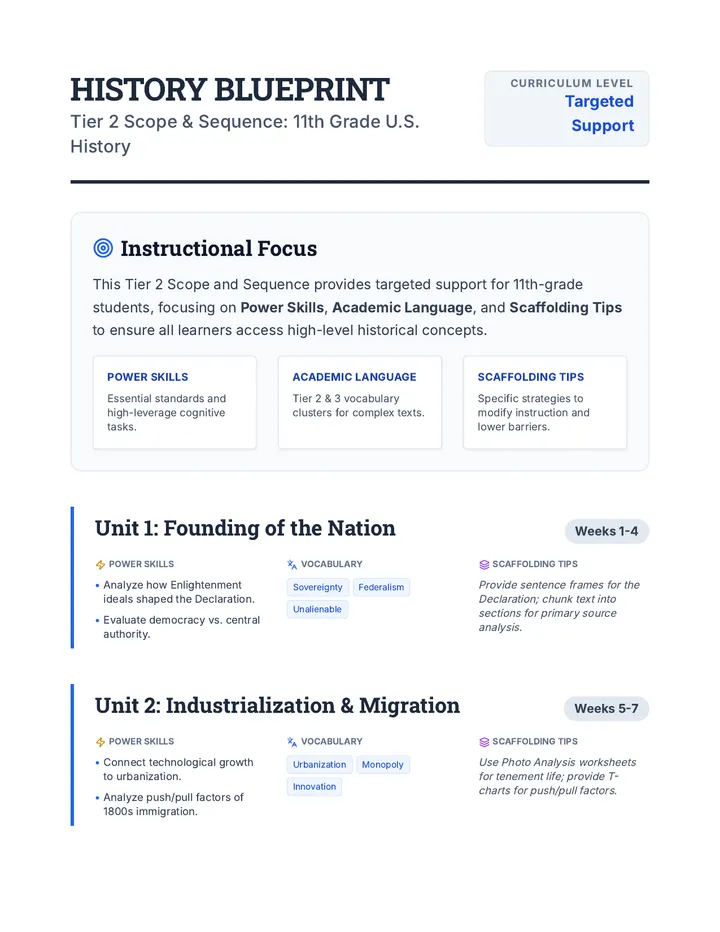
History Blueprint Scope and Sequence

History Blueprint Scope and Sequence

An updated Tier 2 Scope and Sequence for 11th Grade U.S. History, now including specific scaffolding tips for each unit alongside power skills and academic vocabulary. The layout is optimized for teacher reference with instructional strategies tailored for targeted support.

D

dfleisch

Small Steps Poster

Small Steps Poster

A classroom poster featuring a stylized graphic of a BIPOC student presenting on sustainable fashion and community impact. The poster includes educational tips on avoiding over-consumerism and the benefits of reusing items.

FB

Faith Bain-Lucey

Sequences

Reconstruction Reckoning Worksheet

Modern America

A comprehensive journey through United States history from the aftermath of the Civil War to the contemporary era, exploring the social, political, and economic shifts that shaped the modern nation.

DP

Darren Polamalu

18
Mobilization Intro Slides

Global Conflict WWII

A comprehensive 2-day unit covering World War II for 11th Grade US History, aligned with TEKS. It focuses on the transition from isolationism to total war, the home front experience, major turning points in both the European and Pacific theaters, and the strategic decisions that ended the conflict.

BB

Bridgette Burdick

17
Era of Crisis Study Guide

Superpowers and Scandals

A comprehensive unit covering United States history from 1960 to 1980, focusing on the Cold War, domestic policy, and political scandals.

AH

Ashley Hopf

5
Blueprint Curriculum Syllabus

Social Brain Blueprint

A comprehensive 5-part curriculum exploring social neuroscience through a macro social work lens, focusing on systemic change, practitioner wellbeing, and collective action.

DE

Dr. Erick Clinton Lear

16
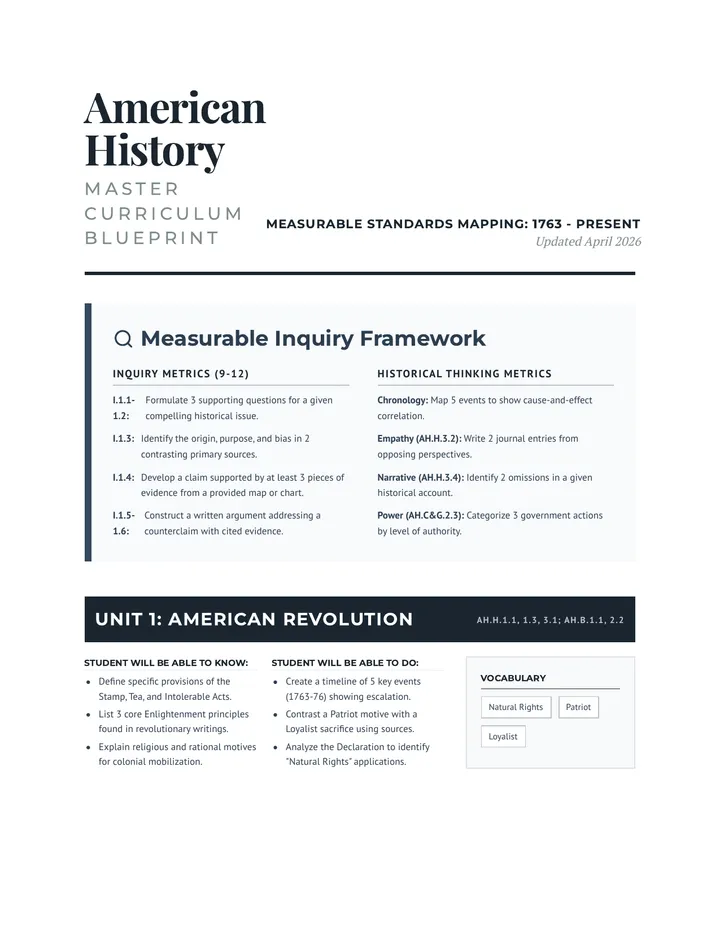
Curriculum Blueprint Document v2

History Horizon Sequence

A comprehensive high school curriculum plan for American History, covering 13 units from the American Revolution to the modern era, aligned with North Carolina Social Studies standards.

AK

Amity Kea

21
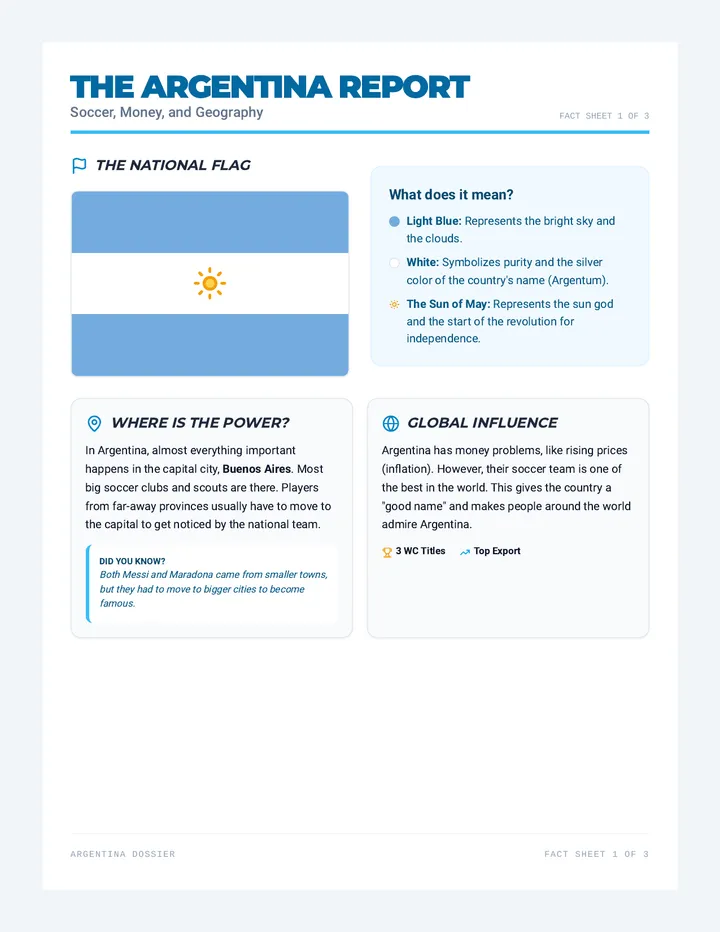
Albiceleste Dossier Packet

Pitch Power World Tour

A comparative study series exploring the geopolitics and economics of different nations through their national soccer teams.

AA

Adam Amster

25

Lessons

History Sprint Pacing Guide

STAAR History Sprint

A comprehensive pacing guide and activity resource designed to cover the remaining 11th Grade US History TEKS before the STAAR test on April 16th. This lesson provides a day-by-day calendar for A/B block schedules and high-engagement activities for each remaining historical era.

BB

Bridgette Burdick

51
Modern Era Reader Part 1

The Modern Ledger

A comprehensive exploration of the 1990s through the modern day, covering technological shifts, political milestones, military conflicts, and cultural evolution in the United States.

CE

Chelsea Elliott

20
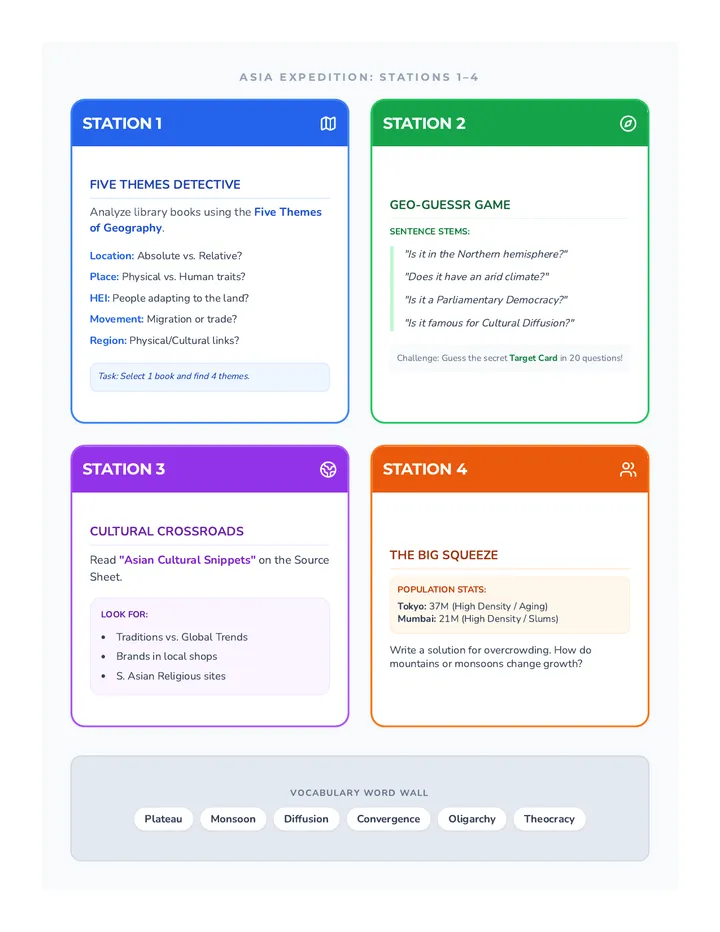
Asia Expedition Task Cards Resource

Asia Expedition Stations

A set of five interactive learning stations focused on the physical and cultural geography of Asia, including population challenges, globalization, and natural disasters. Students practice reading, writing, listening, and speaking skills while analyzing the five themes of geography.

JR

Jessica Ross

4
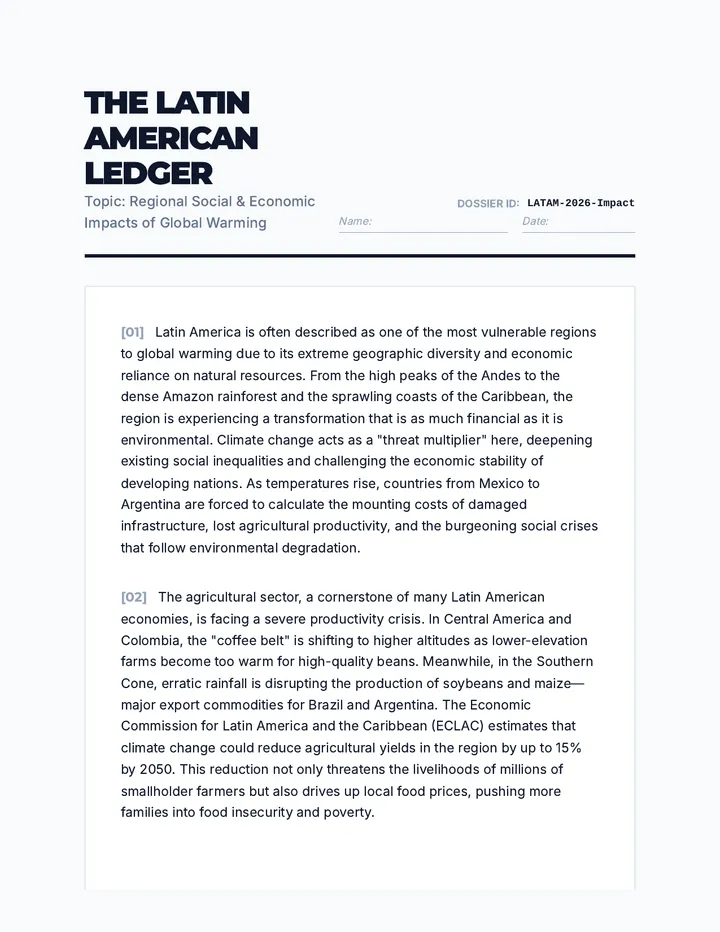
Latin American Ledger Reading

The Latin American Ledger Project

A regional investigation into the social and economic consequences of global warming in Latin America, focusing on human displacement, glacial melt in the Andes, and agricultural shifts. Students analyze a detailed text and construct a Claim-Evidence-Reasoning (CER) argument.

GJ

Gerardo Jimenez Ramirez

10
Iran Today Lesson Plan

Iran Today Current Events

A single 30-minute lesson introducing 8th-grade students to current events in Iran while developing media literacy skills. Students analyze diverse news sources to understand regional developments and global impacts.

J

jlangberg

5
Chronicle Study Guide Student

Modern Era Mastery

A comprehensive review and assessment package covering World History from the Enlightenment through the Cold War, aligned with state standards.

AH

Ashley Hopf

16