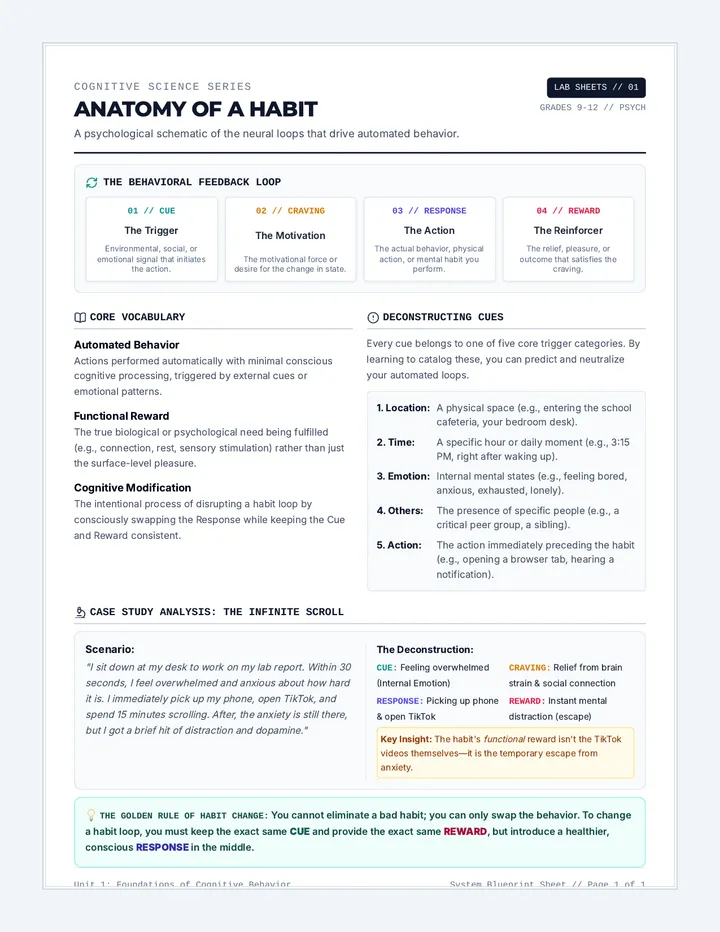
Reinforcement and punishment strategies used to modify behavior through consequences. Distinguishes between positive and negative stimuli while examining various reinforcement schedules and their effects on learning.
A comprehensive introductory psychology sequence for university students, exploring the biological, cognitive, and social foundations of human behavior through a lens of scientific inquiry and critical analysis.
A foundational university-level psychology curriculum covering biological bases, cognitive processes, behavioral theories, and social dynamics. This sequence provides a rigorous introduction to the scientific study of the human mind and behavior.
A comprehensive introduction to objective behavioral assessment for undergraduate students, focusing on operationalizing behavior, ABC recording, quantitative measurement, setting events, and data visualization.
A critical exploration of behavioral psychology, focusing on the tension between intrinsic and extrinsic motivation. Students analyze the ethical implications of reward systems in education, technology, and society.
A comprehensive exploration of operant conditioning for 10th-grade students, focusing on the mechanics of positive reinforcement, schedules of reinforcement, and the biological basis of reward. Students will learn to analyze behavior through the ABC model and design effective reinforcement strategies for real-world scenarios.
This sequence provides a rigorous introduction to operant conditioning for undergraduate students, focusing on the technical application of positive reinforcement. It covers the Three-Term Contingency, discrimination between consequences, operational definitions, motivational operations, and theoretical critiques.
This sequence examines the psychological and ethical limits of positive reinforcement. Students analyze the 'Overjustification Effect', the impact of rewards on creativity, and the ethics of behavioral nudging, concluding with a critical audit of real-world incentive systems.
This sequence explores the psychological mechanics of operant conditioning, specifically focusing on positive reinforcement. Students will move from defining basic behavioral loops to analyzing complex schedules of reinforcement and designing their own behavior modification plans based on B.F. Skinner's principles.
A clinical workshop sequence for undergraduate students focusing on the technical design of exposure hierarchies, SUDS ratings, and behavioral analysis for anxiety treatment.
This sequence introduces 11th-grade students to the principles of systematic desensitization and exposure therapy. Students will move from understanding the behavioral mechanics of anxiety (the cycle of avoidance) to technically designing and evaluating exposure hierarchies for therapeutic use.
This sequence explores the rapid cognitive, physical, and social-emotional changes during an infant's first year, covering motor milestones, Piaget's sensorimotor stage, language acquisition, and attachment theory. Students analyze the interplay between biological maturation and environmental interaction to understand early human development.
This sequence introduces 12th-grade students to Applied Behavior Analysis (ABA) and the four functions of behavior (SEAT: Sensory, Escape, Attention, Tangible). Students will learn that behavior is communication and develop skills to identify the 'why' behind actions through observation and case study analysis.
The teacher's answer key for the Conditioning Challenge Worksheet, providing clear, bolded answers and brief explanations for behavioral principles to facilitate quick grading and class discussion.
A comprehensive review worksheet for 10th-grade psychology students. It features vocabulary matching, fill-in-the-blank theory questions, multiple-choice scenarios, and detailed case studies to analyze classical and operant conditioning.
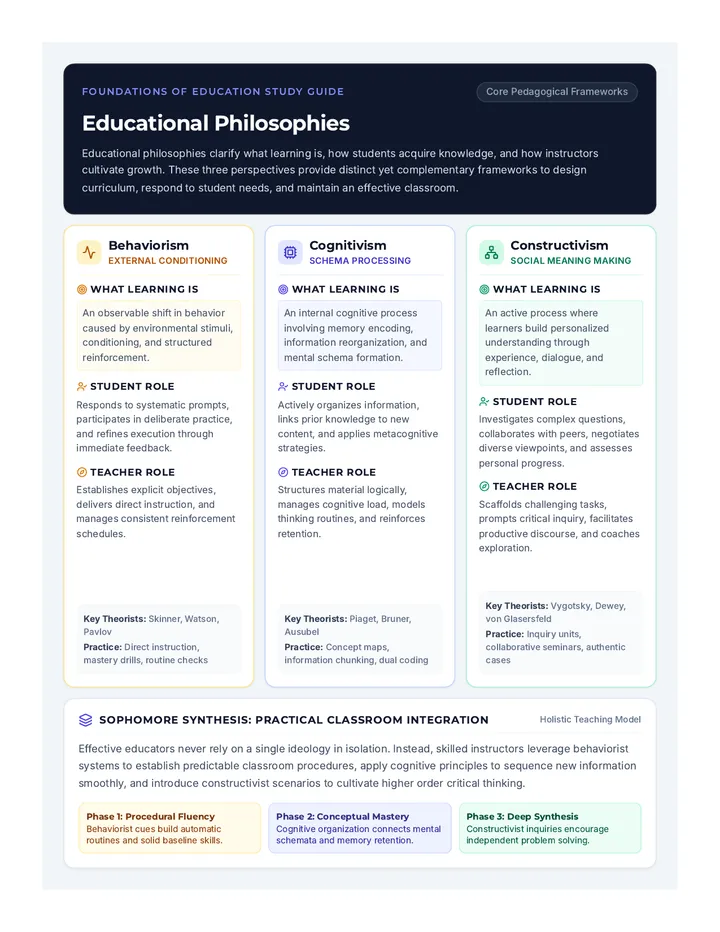
A visual review presentation for 10th-grade psychology covering the fundamentals of classical, operant, and observational learning. It includes key term definitions, visual breakdowns of reinforcement/punishment, and an overview of Bandura's research.
A detailed teacher's answer key for the Growth Roadmap Unit Test, providing correct answers for matching, fill-in-the-blank, and Parten's play scenarios with reasoning. Optimized for a single-page quick reference.
A comprehensive unit test for ECE guidance students, updated with fill-in-the-blank questions and a more rigorous play scenario section requiring both identification and reasoning. Optimized for a 2-page layout with clear student work areas.
A concise reference guide comparing major therapeutic approaches, their goals, techniques, and ethical considerations.
A diagnostic exercise for university students to analyze psychological case studies and apply the DSM-5 framework.
A university-level presentation on the complexities of psychological disorders, diagnostic frameworks, and the evolution of therapeutic interventions.
A concise reference guide for university students on group dynamics, social influence, and the psychological mechanisms of interaction.
A detailed lab planning worksheet for university students to design a social psychology experiment, focusing on variables, hypotheses, and ethics.
A university-level presentation on the power of social influence, covering attribution theory, conformity (Asch), obedience (Milgram), and group dynamics.
A quick-reference guide for university students comparing classical and operant conditioning, including the contingency matrix and reinforcement schedules.
A comprehensive review session covering the three primary modes of learning in psychology: classical conditioning, operant conditioning, and observational learning. This lesson uses varied activities to solidify student understanding of behavioral principles.
A comprehensive assessment covering developmental domains, brain growth, major ECE theorists, and strategies for supporting young children's self-concept and identity.
Navigate the complexities of psychological disorders, diagnostic frameworks, and the evolution of therapeutic interventions from a clinical perspective.
Analyze the power of social influence, group dynamics, and interpersonal relationships in shaping individual thought and action.
Investigate the fundamental principles of learning, including classical and operant conditioning, and how these mechanisms shape behavior in everyday life.
Examine how humans translate physical stimuli into psychological experiences through sensation and perception, exploring the limitations and wonders of our sensory systems.
Explore the biological underpinnings of behavior, focusing on neuroanatomy, the structure and function of neurons, and the chemical messengers that drive the human experience.
An examination of how individuals are influenced by others, covering obedience, conformity, group dynamics, and social cognition.
An exploration of human memory systems, including encoding, storage, and retrieval, as well as the fallibility of memory and forgetting.
A study of classical and operant conditioning, examining how organisms learn from their environment through associations and consequences.
An investigation into how the brain interprets sensory information, exploring the limits of sensation and the constructive nature of perception.
An exploration of the physiological underpinnings of behavior, focusing on the structure and function of neurons, the nervous system, and brain anatomy.