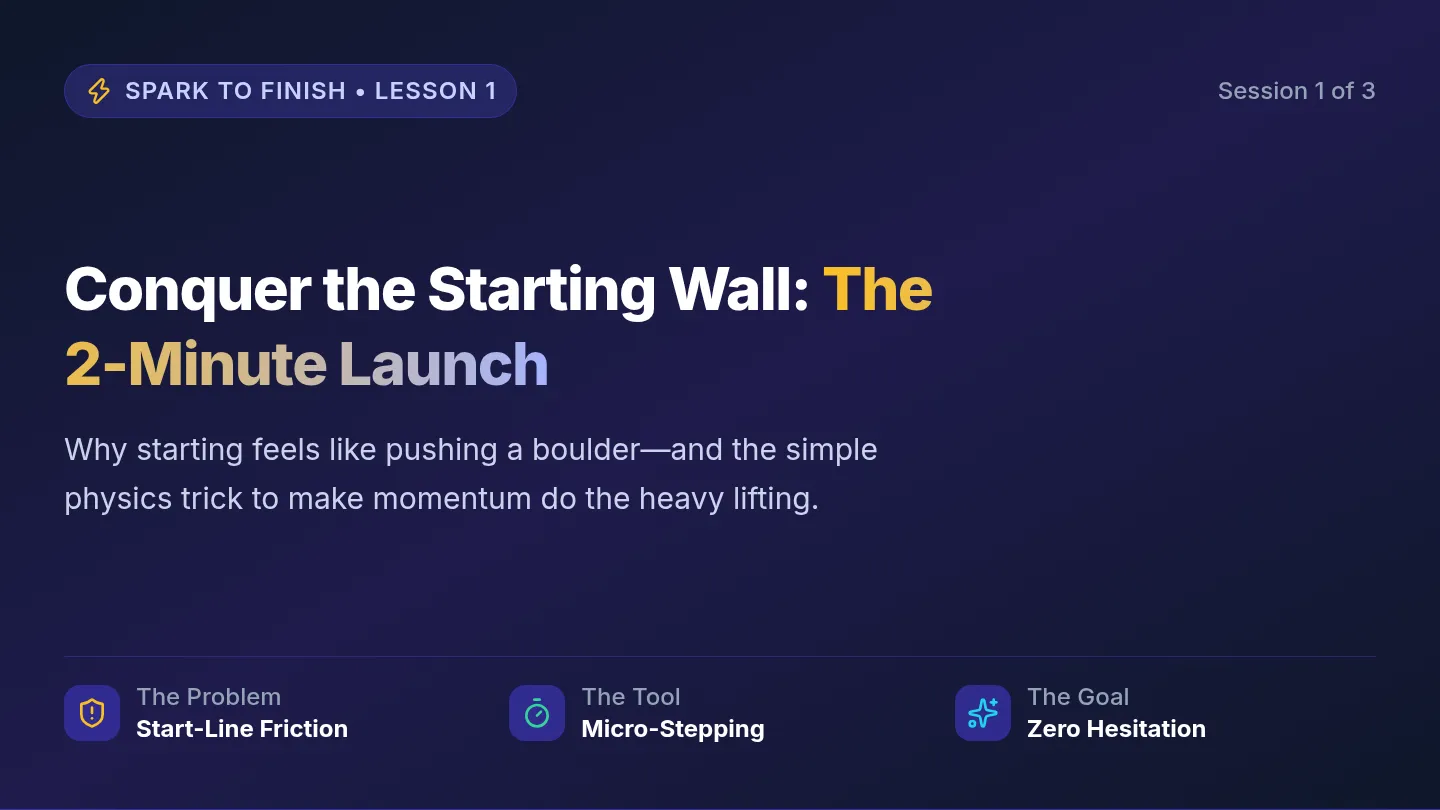
A three-part cognitive psychology series designed for Grades 9-12. Students learn the science of automation, explore how to isolate triggers and cravings, redesign unhelpful routines, and restructure their environments to make habit modification effortless.
[ DIAGRAM RUNROOM // SLIDE 06 ] DECONSTRUCTING IN REAL-TIME
Anatomy of an Everyday Routine
Let's look at how a common unhelpful student routine behaves when viewed under the cognitive microscope:
"I sit down at my desk to study. Within 30 seconds, I feel overwhelmed and anxious about how hard it is. I pick up my phone, open TikTok, and spend 15 minutes scrolling. After, the anxiety is still there, but I got a brief hit of distraction."
1. CUE Overwhelm (Internal Emotion)
2. CRAVING Temporary Escape & Rest
3. RESPONSE Check TikTok on phone
4. REWARD Dopamine Hit of Escape
Estimated Pacing: 4 Minutes Interactive Analysis
[ LAB INSTRUCTIONS // SLIDE 07 ] YOUR WORKSTATION TASK
Map Your Own Habit Loop
Now it is your turn. We are handing out The Habit Loop Diagram Worksheet. Here are your instructions:
STEP 01
Isolate a Routine
Choose a daily unhelpful habit you want to change (e.g., late-night snacking, putting off work, social media scrolling).
STEP 02
Deconstruct Cues
Think backward: What triggers the crave? Identify the specific time, place, emotion, or event immediately preceding it.
STEP 03
Identify the Reward
Be honest: What functional, sensory, or social need are you satisfying? Write it on your sheet.
Estimated Pacing: 10 Minutes Transition to Worksheet
Burlington Portrait of a Graduate: Deep-Dive Integration
Collaborative Citizen
Through partner-interviews, group feedback audits, and deconstructing social networks (Lesson 7), students gain high-level interpersonal agency, encouraging others to establish proactive, stress-reducing automated behavior patterns within the Burlington peer ecosystem.
Resilient, Adaptable Thinker
Behavioral science teaches that relapse into old habits is a natural feedback symptom, not a personal failure. In Lessons 6 and 8, students practice diagnostic resets, auditing environmental cues and adjusting stacking layers to handle transitions with grace and resilience.
Unit Assessment and Graduation Metrics
Curriculum Capstone Portfolio: Students aggregate their mapping schemas (Lesson 1), replacement profiles (Lesson 2), spatial redesigns (Lesson 3), friction sheets (Lesson 4), and sequential tracking flowcharts (Lesson 5-8) into a cohesive "Personal System Portfolio." This portfolio serves as a concrete artifacts folder confirming student competence in Burlington's core graduate metrics.
Habit Architects 8-Lesson Scope & Sequence Page 3 of 3
Does the new response solve the same core craving? Doing pushups when you crave quiet isolation won't work.
REQUIREMENT 02
Action Friction
Is the new behavior easy to execute in the moment? If it requires too much cognitive energy, your brain will reject it.
REQUIREMENT 03
Physical Availability
Can you perform it in the exact context of the cue? (e.g., You cannot go for a jog while in the middle of history class).
In Lesson 2, we introduce the simplest rule of behavior mechanics: make desired actions simple and undesired actions hard.
Softening (Reduce Friction)
Make your new response require fewer than 2 steps to execute:
Place your book open on your pillow before leaving for school.
Fill your water bottle and put it on your desk before bed.
Hardening (Increase Friction)
Make the old response require at least 5 steps to execute:
Log out of social media apps and put your phone in another room.
Put the video game controller inside a box in the attic.
Estimated Pacing: 5 Minutes Friction & Choice
[ WORK TASK // SLIDE 07 ] YOUR WORKSTATION TASK
Complete: The Habit Swap Planner
We are handing out **The Habit Substitution Planner**. Work individually to engineer your behavioral swap:
STEP 01
Establish the Anchors
Rewrite your target habit's exact Cue and Cue type from Lesson 1. Next, outline the exact underlying craving.
STEP 02
Draft Alternatives
Brainstorm three alternative behaviors. Calculate if they fulfill the craving and match your physical context.
STEP 03
Determine Friction
Choose the best option and write down exactly how you will decrease its friction while increasing the old habit's friction.
Estimated Pacing: 10 Minutes Transition to Worksheet
Practice Prime
Put your guitar stand in the exact middle of the living room. Do not leave your instruments hidden in their closet boxes.
Wellness Prime
Place your gym bag on top of your shoes next to the doorway. It serves as a strong external visual anchor.
Estimated Pacing: 5 Minutes Priming Strategies
[ DIGITAL ENVIRONMENT // SLIDE 06 ] THE MOBILE SCREEN
Hacking Your Digital Architecture
We spend hours in digital spaces. You must apply choice architecture to your phone's design to reclaim your attention loops:
1. OUT OF SIGHT Hide distraction apps inside nested home folder categories on Page 3.
2. SILENCE LOOP Turn off all non-human notification alerts. Keep control of when you check.
3. PRIME FOCUS Place kindle, notes, or planner utilities in your screen dock layout defaults.
Estimated Pacing: 4 Minutes Digital Restructuring
[ ACTIVE TASK // SLIDE 07 ] YOUR WORKSTATION TASK
Redesign Your Workstation Space
We are handing out **The Choice Architecture Design Worksheet**. Your task is to act as a workspace designer:
TASK 01
Audit Cues
Identify all distracting, automatic visual cues in your workspace (desktop, bedroom, phone layout).
TASK 02
Engineer Roadblocks
Sketch how you will physically hide or displace those triggers, building entry barrier friction.
TASK 03
Set Positive Primers
Prime the environment with clear visual indicators that nudge your new engineered replacement response.
Estimated Pacing: 10 Minutes Transition to Worksheet
Make the initial step so incredibly simple that rejection is impossible (e.g., "Open textbook to Page 1" rather than "Study 2 hours").
Estimated Pacing: 5 Minutes Softening Principles
[ CASE STUDY // SLIDE 05 ] FRICTION IN REAL TIME
Defeating the Mindless Screen Scroll
Here is how a high schooler engineered a **Friction Grid** to stop automatic afternoon phone-checking loops:
The 5-Step Roadblock System
STEP 1
Log out of TikTok/IG accounts.
STEP 2
Turn off the smartphone.
STEP 3
Place phone inside closet case.
STEP 4
Put closet case on high shelf.
STEP 5
Leave passkey with sibling.
"By the time I walk to the closet and look up, my conscious brain has woken up and intercepted the impulse."
Estimated Pacing: 5 Minutes Friction Architecture
[ LAB SCALES // SLIDE 06 ] MEASURING ROADBLOCKS
The Friction Severity Scale
Not all habits require maximum blocks. When engineering your life, scale your barriers based on habit strength:
LEVEL 1 // LIGHT
Displacement
Simply keeping items out of direct eye-level sight. Perfect for mild habits (e.g., closing browser tabs when study is in focus).
LEVEL 2 // MODERATE
Double-Step
Requires walking, logging out, or opening. Ideal for distracting routines (e.g., storing cookies in the basement cabinet).
LEVEL 3 // CRITICAL
Deep Barrier
Timed locks, physical blockades, or parental limits. Essential for addictive dopamine loops (e.g., video games or doomscroll routines).
Estimated Pacing: 5 Minutes Engineering Scale
[ WORK TASK // SLIDE 07 ] YOUR WORKSTATION TASK
Construct Your Friction Grid
We are handing out **The Friction Grid Design Worksheet**. Work individually to engineer your roadblock systems:
STEP 01
Select Target Habits
Isolate one unhelpful habit to harden (block), and one positive behavior to soften (ease).
STEP 02
Map the Roadblock
Write down a step-by-step physical block (at least 5 distinct physical movements) to prevent the bad habit.
STEP 03
Simplify the Slide-Way
List exactly how you will stage materials to make the replacement routine require under 2 seconds to perform.
Estimated Pacing: 10 Minutes Transition to Worksheet
Building a Morning Stacking Cascade
Once you master single stacks, you can chain multiple automated routines together to build an effortless morning cascade:
ANCHOR
Wake up & sit up
NEW HABIT A
Drink water bottle
NEW HABIT B
Write daily goals
REWARD
Open window blinds
"Each completed behavior acts as the physical, myelinated trigger for the next action in the series."
Estimated Pacing: 5 Minutes Sequential Cascades
[ DIAGNOSTIC SYSTEMS // Slide 06 ] PREVENTING BREAKAGE
Recovering from Stack Breakage
Sometimes schedules change and stacks break. This is a system adjustment point, not a personal failure:
The "Never Miss Twice" Rule
Missing a habit loop once is an accident. Missing it twice is the beginning of a **new, unhelpful default loop**. Recover instantly the next day.
Debugging the Anchor
If a stack keeps breaking, ask: Is the anchor too vague? Is the friction too high? Modify your anchor or decrease friction.
Estimated Pacing: 5 Minutes Cognitive Resilience
[ ACTIVE TASK // SLIDE 07 ] YOUR WORKSTATION TASK
Engineer Your Habit Stack
We are handing out **The Habit Stacking Flowchart Planner**. Work individually to design your sequential loops:
STEP 01
Audit Daily Anchors
Identify five automatic, myelinated behaviors you perform daily without conscious thought.
STEP 02
Anchor New Routines
Select high-priority positive habits and anchor them explicitly using the BJ Fogg formula.
STEP 03
Draft Your Cascade
Build a consecutive 3-tier stacking flowchart, checking that energy levels and physical tools align.
Estimated Pacing: 10 Minutes Transition to Worksheet
Specify the type of person you admire. Focus on character traits (e.g., "An organized study leader", "A healthy athlete", "A supportive friend").
Step 2: Prove It to Yourself
Do not demand perfection. Accumulate a series of **small micro-wins** (micro-votes) to build undeniable evidence of your identity.
Estimated Pacing: 5 Minutes Behavioral Adaptation
[ HIGH SCHOOL MODEL // SLIDE 06 ] IDENTITY REFRAMINGS
Case Study: Becoming an "Adaptive Scholar"
Here is how a high schooler reframed their morning and evening behaviors to construct a new identity:
GOAL-BASED MOTIVATION
"I must finish this assignment tonight so I don't get an F." If the student gets stuck or tired, they shut down immediately.
IDENTITY-BASED INTEGRATION
"I am an organized, proactive thinker. I study because it represents who I am." Even if they make mistakes, they return to the behavior with resilience.
Estimated Pacing: 4 Minutes Analysis & Reframing
[ WORK TASK // SLIDE 07 ] YOUR WORKSTATION TASK
Complete the Identity Behavior Profile
We are handing out **The Identity Behavior Profile Worksheet**. Complete your self-image audit:
STEP 01
Audit Beliefs
Reflect on the automatic habits you perform and write down what identity traits they are currently voting for.
STEP 02
Reconstruct Identity
Define three ideal character traits you want to nurture (e.g., active, resilient, curious).
STEP 03
Design Micro-Votes
Draft incredibly simple daily micro-behaviors that cast immediate, undeniable votes for your new self-image.
Estimated Pacing: 10 Minutes Transition to Worksheet
Designing Collective Habit Systems
You can build a small, high-functioning team by establishing 3 simple collective rules with a study partner or close peers:
TACTIC 01 // CUES
Shared Visual Prompts
Establish a clear starting cue: e.g., "When we sit down at the desk, we both close all non-study browser windows simultaneously."
TACTIC 02 // FRICTION
Mutual Roadblocks
Add double-step friction to devices: e.g. placing both smartphones in an opaque zipped pouch in the center of the table.
TACTIC 03 // REWARDS
Shared Micro-Rewards
Celebrate together: After 45 minutes of focus, open the pouch together and enjoy a 5-minute chat break (Reward).
Two high school track runners struggled with physical conditioning consistency until they designed a social loop:
INDIVIDUAL PRACTICE
Each runner planned to go for a run after school. Both frequently skipped due to homework fatigue and distraction.
COLLECTIVE LOOP
They agreed: "I will text a running-shoe emoji at 3:10 PM (Cue). We meet at the track at 3:30 PM (Response). If one skips, they buy the other a recovery snack (Friction)." Conditioning compliance rose to 95%.
Estimated Pacing: 4 Minutes Sociological Synergy
[ LAB TASK // SLIDE 07 ] YOUR WORKSTATION TASK
Engineer a Collective Blueprint
We are handing out **The Collective Habit Blueprint**. Find a study partner and design your shared systems:
STEP 01
Define Shared Goals
Identify one academic or fitness habit you both wish to perform daily with higher consistency.
STEP 02
Set Mutual Cues
Design an explicit digital or physical trigger that kicks off the session (e.g., shared reminder text).
STEP 03
Engineer Friction
Set group default rules and accountability triggers to prevent distraction loops and support focus.
Estimated Pacing: 10 Minutes Transition to Worksheet
[ REWARD DESIGNS // SLIDE 05 ] REINFORCING LOOPS
Designing Micro-Rewards
If a new routine doesn't deliver immediate satisfaction, your brain will struggle to myelinate the pathway. Engineer tiny, immediate rewards:
Immediate Sensory Rewards
Pouring a warm cup of herbal tea immediately after sitting at your desk. Playing your favorite high-energy song immediately during warmup stretching.
Mental Validation (The Cheer)
Consistently telling yourself: *"That was a vote for being an organized student"* immediately after closing your book. Celebrate micro-wins.
During a stressful midterm week, a student's daily exercise stacking cascade broke completely for four days straight:
WILLPOWER GUILT
"I have zero willpower. I blew my routine, so there is no point in exercising until next semester." They surrender completely, forming an unhelpful fallback default.
DIAGNOSTIC SYSTEM AUDIT
"Midterm week increased my cognitive stress limits. My exercise stack broke because I lacked energy at 4:00 PM. I will decrease entry friction by packing shoes in my bag and run for just 5 minutes today." They recover instantly.
Estimated Pacing: 4 Minutes Diagnostic Evaluation
[ LAB TASK // SLIDE 07 ] YOUR WORKSTATION TASK
Establish Your Feedback Diagnostic Tracker
We are handing out **The Habit Loop Diagnostic Tracker**. Work individually to design your tracking metrics and micro-rewards:
STEP 01
Design Micro Rewards
Identify concrete, immediate sensory rewards to deliver immediately after completing your new replacement routines.
STEP 02
Map the Audit Log
Setup your 7-day tracking calendar. Remember, logging actions serves as dopamine proof, not a perfection target.
STEP 03
Plan System Diagnostics
Draft your system audit parameters, detailing exactly how you will adjust environmental friction if a stack breaks.
Estimated Pacing: 10 Minutes Transition to Worksheet