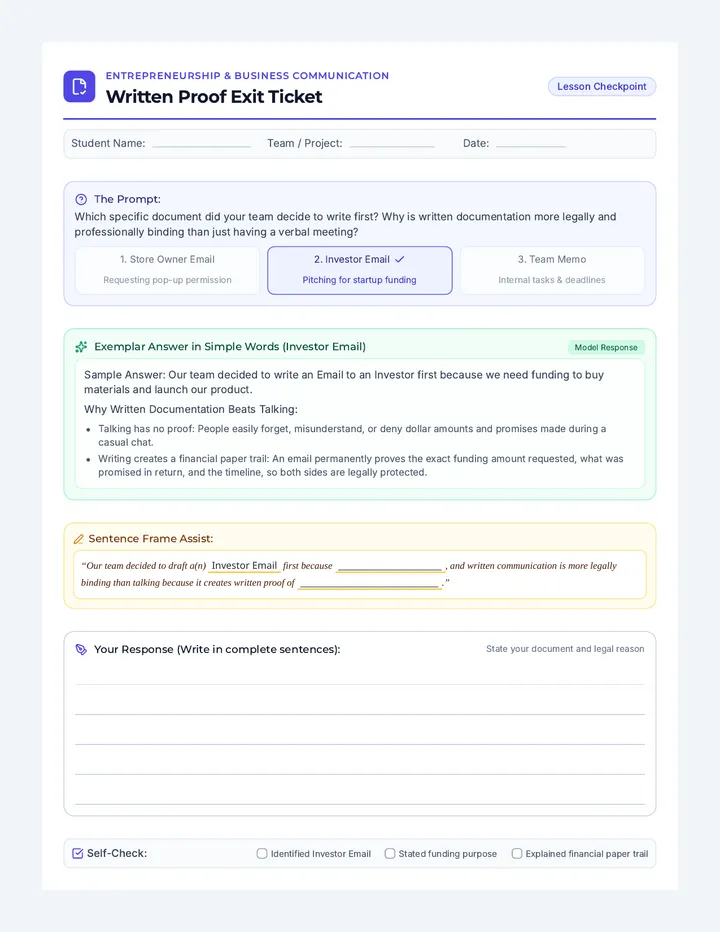
Research each target fleet's specific fuel expenses, route corridors, and current telematics vendor contracts.
Deliver a customized live demo demonstrating how route optimization reduces annual fleet fuel costs by 14%.
Present a risk-free 60-day pilot contract with guaranteed hardware installation dates to secure executive sign-off.
Conduct weekly dispatcher onboarding check-ins and deliver a 30-day executive fuel savings audit report.
Question 1 (Sales Quotas & Metrics):
Exemplar Answer: Explicit, measurable quotas allow corporate management to accurately forecast inventory needs, project cash flow, benchmark individual sales rep performance, and diagnose pipeline conversion bottlenecks. Telling representatives to "sell as much as possible" provides zero operational accountability, produces erratic revenue forecasting, and makes it impossible to identify whether deal drop-offs occur during lead generation or closing.
Question 2 (B2B Buying Complexity):
Exemplar Answer: B2B enterprise sales involve cross-functional buying committees with conflicting organizational priorities. The CFO evaluates decisions based on financial return on investment (ROI), payback schedules, and contractual capital expenditure limits. In contrast, the IT Operations Supervisor evaluates daily workflow usability, API software integration, security vulnerability management, and reducing technical support tickets.
EXIT TICKET EVALUATION RUBRIC (WEEKLY TRACKER) Weekly Tracker Check
Target Evaluation: Accept either position if supported by sound business reasoning.
Scoring: Full Credit (2 pts) if the student selects one stance and provides two distinct business justifications explaining financial impacts. Partial Credit (1 pt) if only one vague reason is given.
Principles of Business, Management, and Finance 1a • Teacher Key Unit 4 Lesson 1 Handout Complete
Principles of Business, Management, and Finance 1A • Instructor Key Unit 4 Lesson 2 • Customer Interaction
Complete Exemplars & Scoring Guidance for Handout Activities
Teacher Edition
DO NOW KEY: TWO TRUTHS AND A LIE Weekly Tracker Check
CORRECT LIE: Statement A
Explanation: Statement A is false because consultative sales follows the 80/20 Rule: sales reps listen 80% of the time and speak only 20%. Talking excessively alienates prospects and prevents the salesperson from diagnosing the client's actual pain points, budget constraints, and core buying motivations.
Reinforce the golden rule of consultative selling: "Features tell, but benefits sell." Push students past product specifications (gigabytes, horsepower, fabric weaves) to the emotional or financial outcome experienced by the customer (time saved, status gained, risk eliminated). Highlight how active listening questions uncover hidden buyer resistance.
4 Points (1 pt per row)
| Sales Interaction Scenario | Interaction Competency | Customer Buying Stage |
|---|---|---|
| 1. A cloud sales engineer asks: "What specific operational delays occurred during your company's server crash last quarter?" | Diagnostic 5W+H Questioning | Research & Discovery |
| 2. A smartphone rep explains that aerospace-grade titanium casing means a field contractor will never crack screens on active construction job sites. | Feature-to-Benefit Translation | Consideration & Comparison |
| 3. An automotive sales advisor pauses completely for 45 seconds while a family explains their daily safety concerns and budget boundaries. | 80/20 Active Listening | Awareness / Needs Assessment |
| 4. A specialty subscription retailer delivers personalized replacement cartridges and complimentary brew guides two weeks post-purchase. | Loyalty Retention Strategy | Repurchase & Retention |
Unit 4 Lesson 2 Teacher Key • Principles of Business, Management, and Finance 1a Page 1 of 2
Principles of Business, Management, and Finance 1A • Instructor Key Unit 4 Lesson 2 • Independent Work & Exit Ticket
Guarantees zero client data leaks, protecting field engineers from regulatory compliance fines and client lawsuits.
Empowers teams to complete double work shifts in remote areas without risking sudden device shutdowns or searching for wall outlets.
Prevents lost project logs in cellular dead zones; files automatically update the central database once back in Wi-Fi range.
Eliminates costly screen repairs and prevents project delays caused by accidental drops onto concrete job sites.
Immediate troubleshooting assistance at 3 AM so emergency midnight infrastructure repairs never stall.
Question 1 (Questioning Strategy):
Exemplar Answer: Asking "Do you like your supplier?" is a closed question that yields a polite, unhelpful "yes" or "they're fine," effectively ending discovery. In contrast, asking "What challenges is your current logistics vendor creating?" invites the client to vent about specific operational pain points (e.g., late deliveries, damaged inventory, billing errors), giving the salesperson explicit leverage to present their solution as a high-value fix.
Question 2 (Buying Process Friction):
Exemplar Answer: The greatest friction between Consideration and Purchase is "decision paralysis" driven by financial fear of buyer's remorse or choosing the wrong vendor. Consultative reps resolve this friction by offering risk-reversal guarantees (e.g., 30-day money-back trials, pilot programs), transparent pricing comparisons, and third-party customer case studies that provide psychological safety.
EXIT TICKET EVALUATION RUBRIC (WEEKLY TRACKER) Weekly Tracker Check
Target Evaluation: Look for strict adherence to benefits over features.
Sample Exemplar (Noise-Canceling Headphones): "Reclaim 3 hours of uninterrupted focus every workday, even in bustling coffee shops or loud open offices. Eliminate ambient travel exhaustion during long cross-country flights and protect your hearing during high-stress calls. Enjoy total professional calm and razor-sharp mental clarity anywhere you work."
Scoring: Full Credit (2 pts) if the student selects a product and pitches 2 distinct personal/professional benefits without listing raw technical specs. Deduct 1 pt if pitch relies on feature specs (e.g., decibels, battery size).
Principles of Business, Management, and Finance 1a • Teacher Key Unit 4 Lesson 2 Handout Complete
Principles of Business, Management, and Finance 1A • Instructor Key Unit 4 Lesson 3 • Advancing Sales
Complete Exemplars & Scoring Guidance for Handout Activities
Teacher Edition
DO NOW KEY: TWO TRUTHS AND A LIE Weekly Tracker Check
CORRECT LIE: Statement A
Explanation: Statement A is false because reflexively offering a price discount in response to an objection erodes gross margins, devalues the brand, and signals to the customer that initial quotes were inflated. Professional salespeople acknowledge the concern, isolate the root objection, and reframe the return on investment (ROI).
Frame objections as buying signals rather than rejections: a customer raising an objection is actively considering the purchase and seeking psychological reassurance. Emphasize the distinct roles of Upselling (encouraging an upgrade to a higher-tier model for superior capability) versus Cross-Selling (adding complementary accessories to ensure full customer satisfaction).
4 Points (1 pt per row)
| Customer Conversation Scenario | Primary Objection Category | Strategic Sales Technique |
|---|---|---|
| 1. "We love your automated inventory software, but our capital expenditures budget is completely locked until Q3." | Price/Budget Barrier (Timing) | Flexible Financing / ROI Proof |
| 2. A camera retail associate suggests an ultra-fast SD card, extra battery pack, and protective travel sling bag to a new mirrorless camera buyer. | Product Fit Uncertainty | Cross-Selling / Add-On |
| 3. "Our team suffered severe downtime with our prior cloud vendor, and we cannot afford another painful technical migration." | Vendor Trust/Support Concern | Service Guarantees / Onboarding SLA |
| 4. A commercial dealer recommends a construction company step up to the heavy-duty engine package to handle harsh mountain terrain. | Product Fit Uncertainty | Upselling / Premium Upgrade |
Unit 4 Lesson 3 Teacher Key • Principles of Business, Management, and Finance 1a Page 1 of 2
Principles of Business, Management, and Finance 1A • Instructor Key Unit 4 Lesson 3 • Independent Work & Exit Ticket
Remain quiet, take notes, and let the director thoroughly express budgetary worries without defensive interruption.
"I completely understand. A $45,000 investment is a serious expenditure that must deliver provable club revenue."
"Is the main concern the upfront capital outlay, or are you unsure if the smart screens will increase member retention?"
Share data showing interactive smart treadmills reduce gym membership cancellations by 15%, paying for themselves in 8 months.
"If our flexible monthly equipment lease costs less than the dues of the members it retains, does that address your budget concern?"
Question 1 (The Discounting Trap):
Exemplar Answer: Immediate discounting destroys profitability and permanently trains customers to never pay full retail price. Furthermore, it undermines trust: the buyer realizes the original quote contained an excessive markup. In B2B relationships, frequent discounting also degrades perceived brand authority, causing clients to view the offering as a cheap commodity rather than a premium solution.
Question 2 (Suggestive Selling Ethics):
Exemplar Answer: Ethical suggestive selling is customer-centric: it ensures the buyer has everything needed to enjoy a safe, complete, and functional experience (e.g., safety glasses, necessary power cables, or protective cases). In contrast, predatory sales tactics prioritize short-term salesperson commissions, using guilt, deceptive fine print, or high-pressure scare tactics to unload unwanted warranties and obsolete inventory.
EXIT TICKET EVALUATION RUBRIC (WEEKLY TRACKER) Weekly Tracker Check
Target Evaluation: Accept either strategic choice when justified with sound reasoning:
Scoring: Full Credit (2 pts) if the student names a strategy and provides two distinct, coherent business justifications.
Principles of Business, Management, and Finance 1a • Teacher Key Unit 4 Lesson 3 Handout Complete
Principles of Business, Management, and Finance 1A • Instructor Key Unit 4 Lesson 4 • Mastering the Close
Complete Exemplars & Scoring Guidance for Handout Activities
Teacher Edition
DO NOW KEY: TWO TRUTHS AND A LIE Weekly Tracker Check
CORRECT LIE: Statement A
Explanation: Statement A is false because failing to directly ask for the sale is the single most common cause of lost revenue. Customers expect the salesperson to lead them across the finish line with a clear, confident closing call to action. Passive waiting invites competitor intervention and buyer procrastination.
Demystify closing: it is not a high-pressure climax, but the natural culmination of a well-executed discovery process. Have students role-play the Assumptive Close and Summary Close to build confidence. Connect post-sale follow-up to customer lifetime value (LTV) and the Sephora case study on community loyalty.
4 Points (1 pt per row)
| Sales Dialogue Scenario | Closing Style Deployed | Strategic Pipeline Goal |
|---|---|---|
| 1. "Would you prefer our logistics team deliver the modular office desks on Tuesday morning or Friday afternoon?" | Assumptive Close | Finalizing Implementation Logistics |
| 2. "Our vendor factory rebates expire today at 5:00 PM; locking in the order right now saves your dealership $3,200." | Urgency / Now-or-Never Close | Overcoming Buyer Hesitation |
| 3. "We verified that our software automates your payroll, cuts errors by 40%, and trains your staff in two days. Shall we finalize the contract?" | Summary Recap Close | Securing Immediate Agreement |
| 4. An enterprise software director schedules a 30-day post-launch check-in and invites the client's operations manager to a VIP user advisory council. | Retention Onboarding Strategy | Driving Long-Term Retention |
Unit 4 Lesson 4 Teacher Key • Principles of Business, Management, and Finance 1a Page 1 of 2
Principles of Business, Management, and Finance 1A • Instructor Key Unit 4 Lesson 4 • Independent Work & Exit Ticket
"Our Grand Ballroom accommodates your 500 guests with full A/V. May I prepare the booking contract for your signature today?"
"Would your event committee prefer our banquet team to set up registration in the atrium at 7:00 AM or 8:00 AM?"
"We have another medical association inquiring about that same weekend; locking in your deposit by 5 PM guarantees the space."
"We've locked your discounted room block, customized catering menu, and included free Wi-Fi. Shall we finalize the agreement?"
"If you confirm the event today, I will include complimentary executive suite upgrades for your two keynote speakers."
Question 1 (The Onboarding Churn Threat):
Exemplar Answer: When sales reps disappear immediately after closing, clients experience steep workflow friction, lack employee user adoption, and feel abandoned. This triggers severe buyer's remorse and leads to contract cancellation (churn) at renewal. A structured post-sale onboarding process guarantees that the client realizes early operational victories, masters the software, and protects the recurring subscription revenue.
Question 2 (Loyalty Program Psychology):
Exemplar Answer: Tiered loyalty programs (such as Sephora Rouge or airline elite tiers) leverage the psychological principles of gamification and social status. Reaching an elite tier produces emotional belonging and exclusive pride (e.g., free makeovers, VIP lines, early access). This psychological reward drives consumers to deliberately consolidate all their purchases with that one brand rather than shopping with cheaper competitors.
EXIT TICKET EVALUATION RUBRIC (WEEKLY TRACKER) Weekly Tracker Check
Target Answer: The Summary Close is generally far superior for B2B contracts because it focuses on objective business value, recaps proven ROI milestones, and builds long-term executive trust without manipulative pressure.
Alternative: The Urgency Close can receive full credit if the student specifies that the urgency is grounded in authentic business realities (e.g., expiring tax incentives, factory retooling deadlines, or scheduled quarterly price increases).
Scoring: Full Credit (2 pts) if the student chooses a technique and defends it with two distinct business justifications relating to client trust and brand reputation.
Principles of Business, Management, and Finance 1a • Teacher Key Unit 4 Lesson 4 Handout Complete
Principles of Business, Management, and Finance 1A • Instructor Key Unit 4 Lesson 5 • Pricing Strategies
Complete Exemplars & Scoring Guidance for Handout Activities
Teacher Edition
DO NOW KEY: TWO TRUTHS AND A LIE Weekly Tracker Check
CORRECT LIE: Statement A
Explanation: Statement A is false because competing purely on lowest price initiates destructive price wars, evaporates profit margins, and attracts disloyal bargain shoppers. Premium brands succeed by competing on superior quality, perceived luxury, elite customer experience, and proprietary design.
Help students see that price is a signal of perceived value. Review the five strategic pricing models using recognizable brands (Louis Vuitton vs. Walmart vs. McDonald's Value Meals). Deepen understanding of indirect competition: Netflix competes not just with Disney+, but with TikTok, sleep, and video gaming for leisure attention.
4 Points (1 pt per row)
| Marketplace Pricing Scenario | Strategic Pricing Model | Underlying Competitive Dynamic |
|---|---|---|
| 1. A ride-share service increases fare prices by 50% on New Year's Eve as thousands of passengers request rides simultaneously in rain. | Dynamic / Surge Pricing | Demand Scarcity / Elasticity |
| 2. A music streaming startup offers premium unlimited ad-free access for $0.99 for the first 3 months to take users from Spotify. | Market Penetration Pricing | Direct Rivalry / Acquisition |
| 3. A gaming console manufacturer packages a console, wireless headset, and two popular games together at a 20% savings over individual items. | Bundle Pricing | Perceived Value Bundle |
| 4. A luxury Swiss horology brand sells hand-crafted watches for $15,000, purposefully restricting inventory to maintain elite status. | Luxury / Premium Pricing | Brand Equity & Status Status |
Unit 4 Lesson 5 Teacher Key • Principles of Business, Management, and Finance 1a Page 1 of 2
Principles of Business, Management, and Finance 1A • Instructor Key Unit 4 Lesson 5 • Independent Work & Exit Ticket
Handcrafted mountaineering shells made of recycled titanium-woven gore-tex, priced at $780 with lifetime free repairs.
Everyday synthetic moisture-wicking base layers sold in a multi-pack for $24.99 targeting mass high-volume retail buyers.
"Weekend Explorer Kit": Backpack, rain shell, and thermal beanie bundled at $165 (25% cheaper than buying separately).
Launch a new ultra-light trail running shoe at $49 (at cost) for the first 45 days to capture trail runner market share.
Automated algorithm discounts heavy winter parkas by 35% in late February, while increasing rain gear prices during rainy April.
Question 1 (Indirect Competition Dynamics):
Exemplar Answer: Indirect competitors satisfy the exact same underlying consumer need—entertainment and leisure diversion—even though their product format differs. If consumers spend their Friday evening watching Netflix or gaming on Discord, the local cinema loses ticket sales and lucrative concession revenues. Businesses must monitor all alternatives competing for consumer time and discretionary spending.
Question 2 (The Amazon Effect Defense):
Exemplar Answer: Independent brick-and-mortar stores cannot win a pure price war against automated e-commerce titans. Instead, they thrive by differentiating on high-touch experiential value: hosting in-person community events, offering specialized product curation, providing immediate tactile product demonstrations, and establishing genuine personal relationships that online algorithms cannot duplicate.
EXIT TICKET EVALUATION RUBRIC (WEEKLY TRACKER) Weekly Tracker Check
Target Evaluation: Both strategies are valid if supported by strategic rationale:
Scoring: Full Credit (2 pts) if the student chooses a strategy and articulates two distinct business justifications explaining revenue or competitive impacts.
Principles of Business, Management, and Finance 1a • Teacher Key Unit 4 Lesson 5 Handout Complete