A comprehensive 45-60 minute sixth-grade lesson exploring European economic systems, voluntary trade barriers, and factors driving economic growth across the United Kingdom, Germany, and Russia. Students analyze the three fundamental economic questions, plot nations on the economic continuum, evaluate trade policies, and connect investments in capital to gross domestic product.
Quota
A Strict Limit on Quantity
Caps the exact number of specific foreign goods allowed into the country each year.
Embargo
A Complete Trade Ban
Zero trade permitted with a specific nation, usually enforced for political or safety reasons.
Currency Exchange: International trade requires converting currencies (British Pound £, Euro €, Russian Ruble ₽).
Exchange Rates Apply
Economic Drivers
The European Union & Growth Engines
Standard SS6E8.d & SS6E9
The European Union (EU) Solution
Eliminates tariffs between member nations and created the common Euro (€) currency.
Frictionless Trade
Human Capital
Investment in education, job training, and health care.
Boosts Literacy & Skills
Physical Capital
Investment in factories, machinery, roads, and computers.
Increases Production
Natural Resources
Gifts of nature: arable land, timber, coal, oil, and gas.
Russia leads in energy
Entrepreneurship
Creative risk-takers who launch new businesses.
Spurs Innovation & Jobs
The Growth Formula: Higher Literacy Rate + Higher Capital Investment = Higher GDP per Capita & Standard of Living!
Classroom Mission
Economy Detective Challenge
Student Mission
1
Plot Continuum
Place Russia, Germany, and the UK on your worksheet line and record two pieces of evidence for each.
2
Crack Barriers
Analyze real-world scenarios to identify tariffs, quotas, embargoes, and currency exchange needs.
3
Fuel The GDP
Determine how investing in human and physical capital elevates the standard of living for everyday citizens.
Final Synthesis Question
Why do all modern European countries choose a mixed economy?
Complete Part 7 on your handout Ready for Teacher Check!
European Economic Quest • Investigation Continued
Currencies, the European Union, Capital Investment & Living Standards
Part 4 – 7
4 Part 4: Currency Exchange & The European Union Advantage
A. Why do nations need a currency exchange system?
Explain in your own words what happens when a UK buyer (British Pounds £) buys goods from a Russian seller (Rubles ₽):
B. How does the European Union (EU) encourage trade?
Identify two major trade benefits shared by European Union member nations:
5 Part 5: The Four Growth Engines & Gross Domestic Product (GDP)
Classify each investment as Human Capital, Physical Capital, Natural Resource, or Entrepreneurship:
Real-World European Scenario
Factor of Growth
Impact on GDP per Capita
A German automaker purchases robotic welding arms for its factory.
________________________
Increases output speed & volume
The UK government funds digital coding academies to train engineers.
________________________
Workers become more skilled & productive
Russia extracts massive reserves of natural gas in western Siberia.
________________________
Valuable raw exports bring in national revenue
A British tech inventor risks savings to build a green battery startup.
________________________
Creates new employment and market innovation
6 Part 6: Literacy Rate & Standard of Living Analysis
Data Snapshot (Estimated Averages):
• United Kingdom: 99% Literacy Rate | ~$46,000 GDP per capita
• Germany: 99% Literacy Rate | ~$51,000 GDP per capita
• Russia: 99.7% Literacy Rate | ~$12,500 GDP per capita
Analytical Question:
Why does a high literacy rate usually lead to a higher standard of living for citizens?
7 Part 7: Exit Ticket Synthesis Mission
Independent Mastery
Prompt: Explain why no European country is a pure command or pure market economy. Use the United Kingdom, Germany, or Russia as evidence in your response.
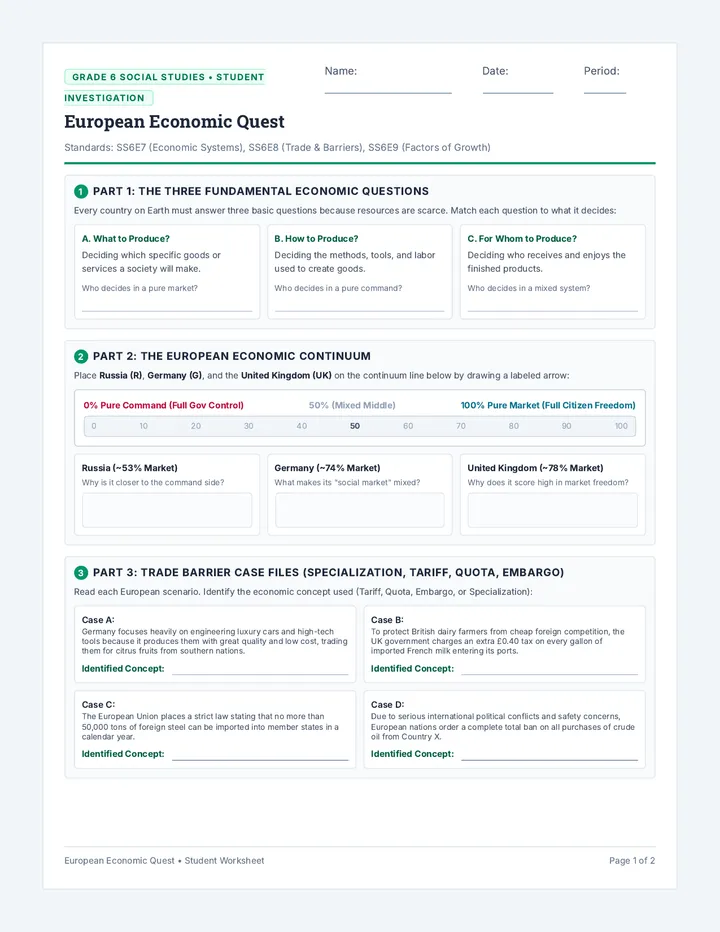
European Economic Quest • Student Worksheet Page 2 of 2
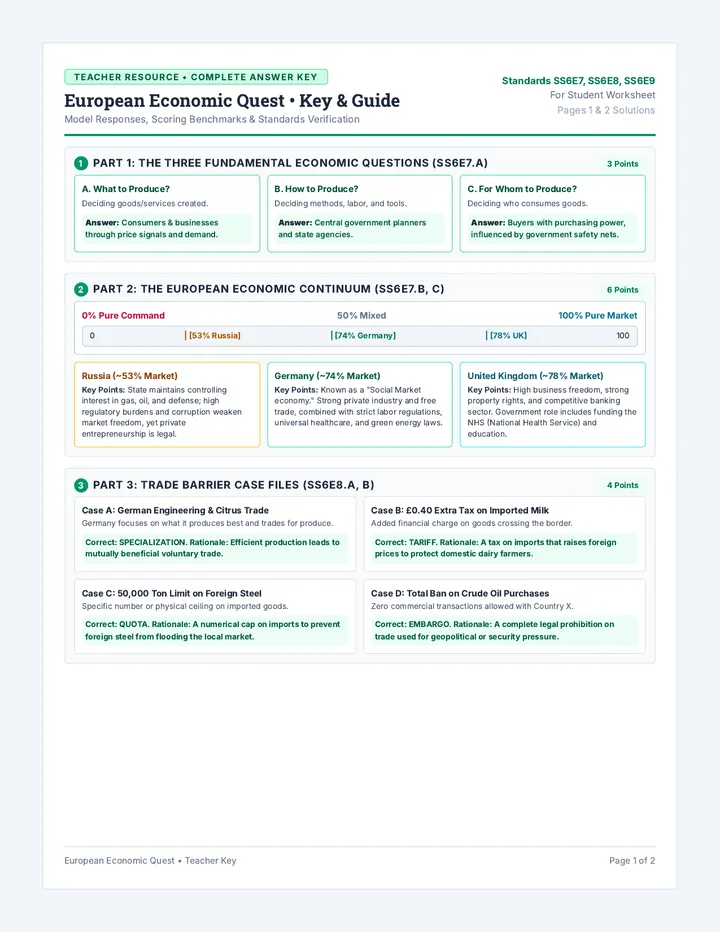
Correct: EMBARGO. Rationale: A complete legal prohibition on trade used for geopolitical or security pressure.
European Economic Quest • Teacher Key Page 1 of 2
Teacher Scoring Key & Exemplars • Page 2
Currency, EU Integration, Factors of Production & Exit Ticket Rubric
Part 4 – 7 Solutions
4 Part 4: Currency Exchange & The European Union (SS6E8.c, d)
4 Points
A. Currency Exchange System Need
Model Answer: Because nations use different legal tender (UK uses Pounds £, Russia uses Rubles ₽), traders must exchange currencies based on floating exchange rates. Without a reliable exchange system, international buyers and sellers cannot agree on payment value.
B. European Union Trade Advantages
Model Answer: 1) Eliminates internal tariffs/quotas, establishing free trade among member states; 2) Established a single shared currency (the Euro €) that removes currency exchange fees for Eurozone nations.
5 Part 5: Factors of Economic Growth Table (SS6E9.a–e)
4 Points
Scenario
Correct Factor
Economic Link
German automaker buys robotic welding arms.
Physical Capital
Upgraded tools produce more cars in less time.
UK funds digital coding academies for workers.
Human Capital
Trained labor commands higher wages and productivity.
Russia extracts Siberian natural gas reserves.
Natural Resource
Exporting raw energy fuels national GDP revenue.
British tech inventor starts green battery venture.
Entrepreneurship
Risk-taker organizes resources to create new jobs.
6 Part 6: Literacy Rate & Living Standards (SS6E9.a)
2 Points
Model Analytical Response:
A high literacy rate means workers can read, operate complex technology, and master specialized professions. Educated workers earn higher wages, produce higher-value goods, and drive up GDP per capita, which provides families with better housing, healthcare, nutrition, and quality of life (higher standard of living).
7 Part 7: Exit Ticket Exemplar & Rubric (SS6E7.b, c)
5 Points
Exemplar Student Response (Full Credit):
"No European nation is a pure command economy because governments cannot efficiently set every price or know every citizen's needs without causing shortages. No nation is a pure market economy because without government rules, there would be no safety laws, public schools, or roads. For example, the United Kingdom allows businesses to choose what to produce and compete freely, but the UK government funds national healthcare (NHS) and enforces consumer safety laws. This makes it mixed with a strong market lean."
Full Credit (5 pts) Addresses both sides (why neither pure system works); provides specific government vs market evidence from UK, Germany, or Russia.
Partial Credit (3-4 pts) States that economies are mixed, but only describes one country vaguely or forgets to explain why pure command/pure market fails.
Minimal Credit (1-2 pts) Merely names a country without explaining mixed traits, or confuses command with market.