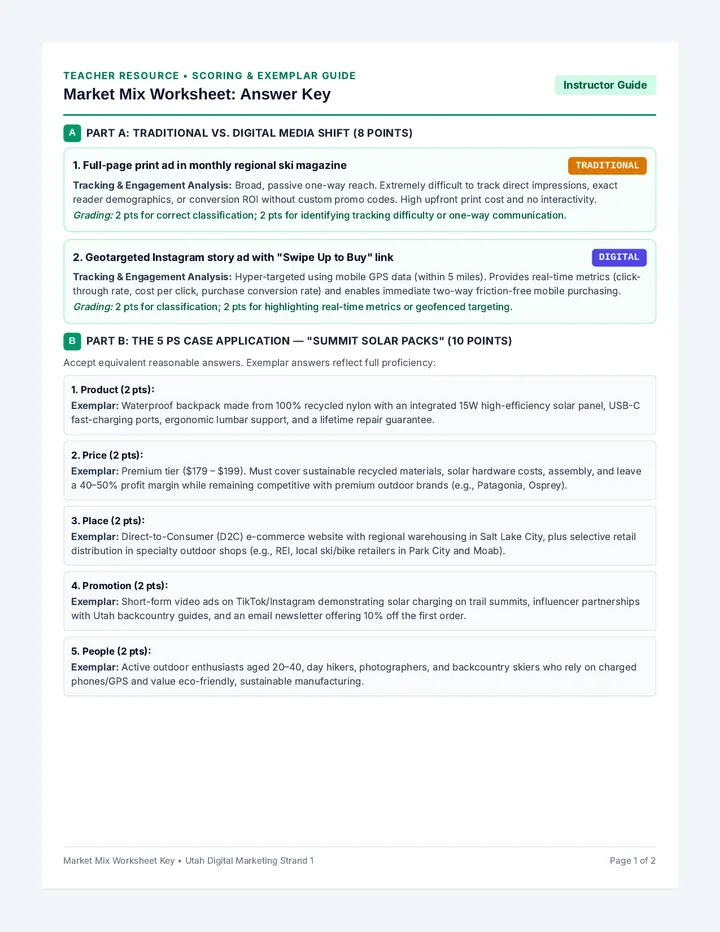
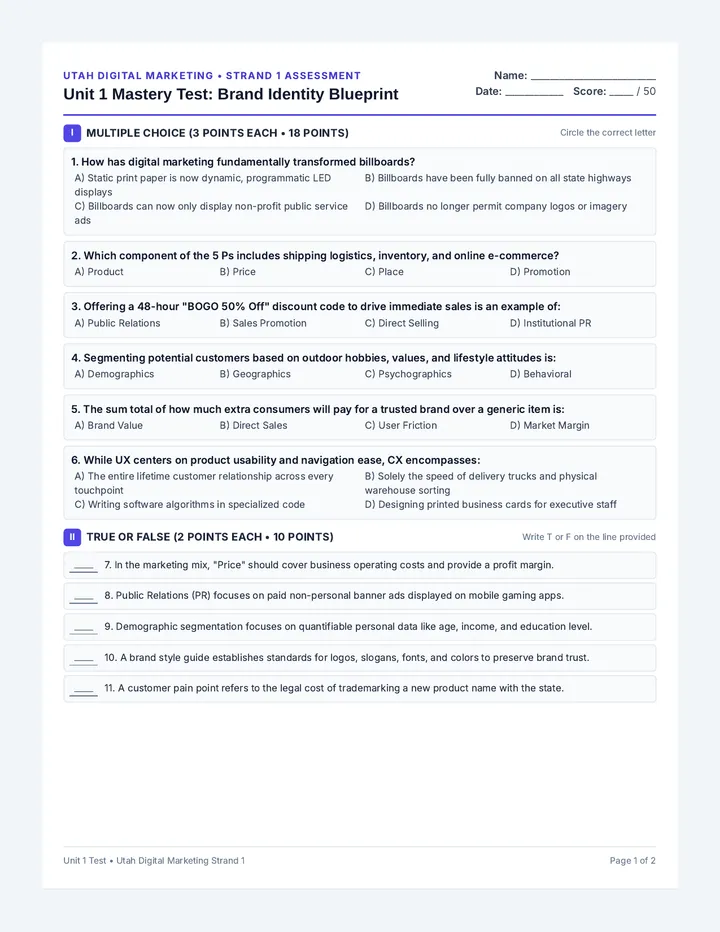
A comprehensive high school unit covering Utah Digital Marketing Strand 1: the marketing mix, market segmentation, buyer personas, branding identity, and style guides.
Market Segmentation is the process of dividing a total market into distinct groups based on common characteristics. Fill in each pillar below:
1. Demographics (Question: ________?)
Personal characteristics including: age, gender, ___________ level, education level, and ethnicity.
2. Geographics (Question: ________?)
Based on where people live, such as natural boundaries, local __________, urban/rural density, and cultural customs.
3. Psychographics (Question: ________?)
Groups people by shared __________, core values, personality traits, hobbies, and social attitudes.
4. Behavioral (Question: ________?)
Focuses on consumer actions such as shopping patterns, usage rate, and desired ___________.
5
Buyer Personas & Customer Pain Points
• Buyer Persona: A semi-fictional representation of your ideal customer based on ___________ and market research.
• Customer Pain Point: A specific ___________ or roadblock that prospective customers are currently experiencing that your business can solve.
6
Branding, Style Guides, CX & UX
• Branding: A company name, logo, design, or combination used to identify and ___________ itself from competition, connecting emotionally with buyers.
• Brand Value: The sum total of how much extra people will pay for the reputation, memories, and expectations of a brand over ___________ alternatives (e.g., Kleenex vs. store brand facial tissues).
• Brand Loyalty: When consumers repeatedly buy the ___________ brand instead of switching to competitors.
The 4 Key Elements of a Brand Style Guide:
1. L_____
2. S_____ / Tagline
3. C_____ Palette
4. F_____ / Typography
CX (Customer Experience):
Brand-related service and emotional perception across a customer's entire __________.
UX (User Experience):
Product-related experience focusing on usability, functionality, speed, and visual __________.
Touchpoint: Any ___________ where customers and businesses engage to exchange info, receive service, or conduct transactions.
A. Segmenting by natural boundaries, climate, or region.
B. When buyers repeatedly buy a brand over competing alternatives.
C. Product usability, speed, and digital interface functionality.
D. Product, Price, Place, Promotion, and People.
E. A specific frustration prospective buyers face in daily routines.
F. Segmenting based on usage rate, shopping habits, and benefits.
G. Official rules governing logos, slogans, fonts, and colors.
H. Personal persuasion process guiding buyers to take action.
IV
Scenario Analysis & Application (10 points)
Answer clearly in the boxes provided
20. Generics vs. Brand Names (3 pts):
Why will consumers consistently pay $3.50 for a name-brand tissue box like "Kleenex" over an identical store generic at $1.25? Explain using the concept of Brand Value.
21. Customer Pain Points in Action (3 pts):
A company invents an insulated water bottle that cleans itself using UV light. What specific customer pain point does this solve for gym-goers, and why is highlighting pain points more persuasive than listing technical specs?
22. Brand Style Guide Integrity (4 pts):
An employee publishes social media posts with random neon fonts and a distorted company logo to "make it look fun." Explain two specific business consequences of failing to adhere to brand style guides.
Unit 1 Test • Utah Digital Marketing Strand 1 Page 2 of 2
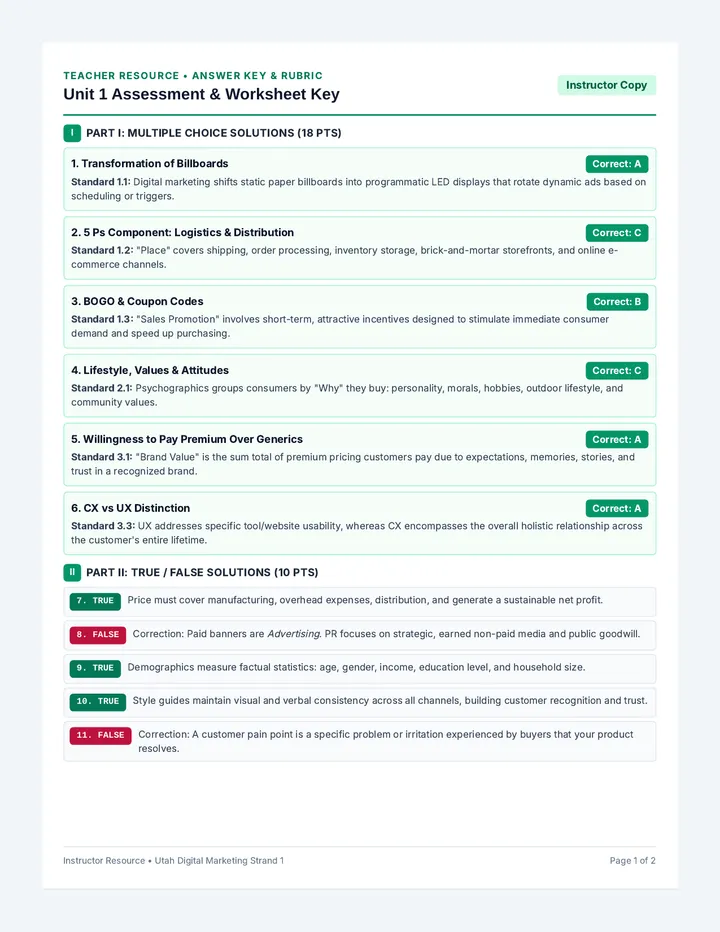
13. Behavioral Segmentation F
14. Customer Pain Point E
15. Brand Style Guide G
16. User Experience (UX) C
17. Direct Selling H
18. Geographic Segmentation A
19. Brand Loyalty B
IV
Part IV: Scenario Scoring Guide & Exemplars (10 pts)
20. Generics vs. Brand Names (Brand Value) [3 pts] Standard 3.1
Exemplar Answer: Consumers pay a premium for Kleenex because brand value represents built-in trust, guaranteed softness/quality expectations, and decades of familiarity. Buyers perceive generic tissues as higher risk (roughness or tearing), so they willingly pay extra for the established brand guarantee.
21. Customer Pain Points in Action [3 pts] Standard 2.2
Exemplar Answer: Gym-goers hate smelly, moldy, or hard-to-clean water bottles (pain point: bacteria & unpleasant taste). Focusing marketing copy on "no more funky gym bottle odor" triggers an emotional relief response, whereas talking only about "280nm UV-C diode wavelengths" feels abstract and unpersuasive.
22. Consequences of Violating Style Guides [4 pts] Standard 3.2
Exemplar Answer: 1) Erosion of Consumer Trust: Inconsistent logos and jarring neon colors look unprofessional or even fraudulent (like a phishing scam), confusing customers. 2) Loss of Recognition & Equity: Brands rely on repetitive visual cues; random aesthetics break immediate brand recall across digital touchpoints.