Lenny.com
Explore
Create
ActivitiesNewMathEnglish Language ArtsScience & EngineeringSocial StudiesGlobal LanguagesHealth & Physical EducationSpecial EducationCounseling & Life SkillsArts & CreativityESL
Lenny.com
Lenny.com
Explore
Create
ActivitiesNewMathEnglish Language ArtsScience & EngineeringSocial StudiesGlobal LanguagesHealth & Physical EducationSpecial EducationCounseling & Life SkillsArts & CreativityESL
Lenny.com
Lenny.com

Solutions

Lenny for EducatorsLenny for SchoolsLenny for Districts

Product

ExploreSign inCreateSupportAbout

Resources

Getting startedMTSS Acceleration Program

Newsletters

School Funding Newsletter

© 2026 Lenny Learning Inc.

TermsPrivacyAccessibility
LinkedInInstagramX
Lenny

Evaluating Sources

Criteria for assessing credibility, authority, and bias in digital and print media. Strengthens critical thinking skills needed to identify misinformation and verify evidence.

Social StudiesSocial Studies PracticesLocation WordsMapsOrder EventsChronology and CausationEvaluating SourcesHistorical ThinkingGeography, Humans, & the EnvironmentAmerican Symbols and LandmarksCitiesStatesState CapitalsRegions of the United StatesGeographic SkillsPhysical GeographyHuman GeographyRegional GeographyGeography of AfricaGeography of AsiaGeography of EuropeGeography of OceaniaGeography of the AmericasSociety and Environment of EuropeSociety and Environment of AsiaSociety and Environment of The AmericasSociety and Environment of the Middle EastSociety and Environment of AfricaHistoryPrehistoryComparing Ancient River CivilizationsAncient MesopotamiaAncient Egypt and KushAncient South AsiaEarly ChinaGreeceRome and the Byzantine EmpireAncient World HistoryNative Peoples of North AmericaNative Peoples of Mesoamerica and South AmericaAfrican EmpiresMedieval AsiaMedieval EuropeThe Silk RoadMedieval HistoryIslamic EmpiresWorld ReligionsRenaissance PeriodAge of ExplorationThe Thirteen ColoniesThe American RevolutionUS History Early RepublicFounding of the United StatesUS History AntebellumUS Civil WarReconstruction PeriodThe Gilded AgeUS ImperialismWorld ImperialismWorld War IUS History 1920sGreat DepressionWorld War IIThe Cold WarUS History 1950-60sUS History 1960s-70sWorld History 20th CenturyContemporary US HistoryContemporary World HistoryHolidaysCivics and GovernmentCitizenshipGovernment FoundationsThe ConstitutionUS ConstitutionExecutive BranchLegislative BranchJudicial BranchState and LocalPolitical ParticipationPublic PolicyPolitical SystemsPower and AuthoritySocial MovementsDefining DevianceTheories of DevianceCrime and Criminal JusticeEconomicsBasic Economic PrinciplesSupply and DemandWhat is MoneyEconomic FundamentalsMicroeconomicsMacroeconomicsBanking and FinanceEconomic SystemsGlobal EconomicsCorporations and PowerThe Changing WorkplaceUnemployment and LaborClass and InequalitySocial MobilityGlobal InequalityPsychologyHistory of PsychologyPsychology as a ScienceBrain and Nervous SystemNeuroscience and BehaviorGenetics and BehaviorSleep and ConsciousnessSensory ProcessesPerceptual OrganizationClassical ConditioningOperant ConditioningObservational LearningCognitive LearningMemory ProcessesThinking and Problem SolvingLanguage and CognitionTheories of MotivationStress and CopingPrenatal and Infant DevelopmentChildhood DevelopmentAdolescent DevelopmentAdulthood and AgingSelf and IdentitySocial CognitionSocial InfluenceAttraction and RelationshipsGroup BehaviorPrejudice and DiscriminationAnxiety and Mood DisordersClinical PsychologyForensic PsychologyPhilosophy & EthicsIntroduction to PhilosophyMajor Philosophers & IdeasMind and Body ProblemFree Will vs DeterminismEthics & MoralityReligion & PhilosophyPolitical Philosophy

Videos

Comparing Primary and Secondary Historical Sources

Comparing Primary and Secondary Historical Sources

This educational video uses the 1893 Chicago World's Fair as a case study to explain the critical difference between primary and secondary sources in historical analysis. The narrator breaks down definitions of each source type before presenting concrete examples: a first-hand letter written by a fair attendee in 1893 (primary) and a modern National Park Service article about the fair (secondary). Through this comparison, viewers learn how to distinguish between direct observation and retrospective analysis. The video explores key themes of historical perspective, bias, and the construction of historical narratives. It specifically highlights how primary sources capture immediate, subjective experiences (like the spectacle of the Egyptian exhibit), while secondary sources provide broader context and critical analysis that may be unavailable to contemporary witnesses (such as the structural sexism faced by women organizers). The video uses a Venn diagram to visually map out where these accounts overlap and diverge. For educators, this resource is an excellent tool for teaching historical thinking skills and source evaluation. It moves beyond simple definitions to demonstrate *how* historians use different sources to build a complete picture of the past. The video includes a built-in pause for student reflection and concludes with a powerful metaphor about history being a "conversation between the past and the present," helping students understand that history is an evolving interpretation rather than a static set of facts.

Khan AcademyKhan Academy

5mins 1s

How to Critically Evaluate News Media

How to Critically Evaluate News Media

This educational video introduces students to the essential skill of media literacy, focusing on how to distinguish between trustworthy and untrustworthy news sources. Through a narrative set in "Media Metropolis," the host explains that while responsible citizens should stay informed, they must also consume news thoughtfully. The video uses relatable analogies—like a fibbing cousin versus an honest aunt—to explain the concepts of source credibility and content reliability before diving into more complex analysis techniques.

Miacademy & MiaPrep Learning ChannelMiacademy & MiaPrep Learning Channel

10mins 33s

Whose Independence? Diverse Responses to the Declaration

Whose Independence? Diverse Responses to the Declaration

This video provides a critical examination of the immediate aftermath of the signing of the Declaration of Independence, focusing specifically on the populations excluded from its promises. While popular narratives often depict a universal celebration, this lesson explores how the ideals of "life, liberty, and the pursuit of happiness" contrasted sharply with the reality for women, Native Americans, and enslaved and free Black people in the colonies. It highlights how these marginalized communities interpreted and utilized the language of the Declaration to advocate for their own rights, introducing key figures like Abigail Adams, Prince Hall, and Elizabeth Freeman. The content further expands the narrative scope by analyzing the reactions of the British Crown and American Loyalists. It details King George III's furious response, viewing the Declaration as treason, and the intellectual counter-arguments posed by Loyalists like John Lind. The video also touches upon the internal contradictions of the Founding Fathers, discussing the removal of the slavery clause to appease Southern colonies and the economic motivations of the wealthy signers. For educators, this resource serves as an excellent tool for teaching historical perspective and critical thinking. It moves beyond the "textbook" version of the Fourth of July to reveal a complex tapestry of reactions. Teachers can use this video to launch discussions about the gap between American ideals and historical realities, the agency of marginalized groups in early America, and the global ripple effects of the Declaration in places like France and Haiti.

Miacademy & MiaPrep Learning ChannelMiacademy & MiaPrep Learning Channel

11mins 28s

The History of Money: Debt, Barter, and War

The History of Money: Debt, Barter, and War

Hosted by John Green, this episode of Crash Course World History challenges the traditional economic narrative that money evolved naturally from barter systems to solve logistical problems. Instead, it presents anthropologist David Graeber's theory that complex credit and debt systems existed long before coinage, and that physical money (coins) emerged primarily as a tool for states to fund wars and professional armies.

CrashCourseCrashCourse

14mins 4s

How the Indus Valley Civilization Rose and Fell

How the Indus Valley Civilization Rose and Fell

This engaging episode of Crash Course World History explores the Indus Valley Civilization, one of the largest and most mysterious ancient societies in human history. Host John Green guides viewers through the rise and fall of this Bronze Age culture, examining its sophisticated urban planning, extensive trade networks, and the puzzling lack of weapons or evidence of warfare. The video also tackles the broader historical concept of what defines a "civilization" and the inherent biases in how historians classify different human societies. Key themes include the relationship between geography and settlement, specifically the importance of reliable river flooding for agriculture; the role of archaeology in reconstructing history without decipherable written records; and the comparison of social structures across different ancient cultures. The video highlights specific artifacts like the famous animal seals and architectural marvels like the Great Bath of Mohenjo-Daro to illustrate the uniqueness of the Indus Valley people. For the classroom, this video is an excellent resource for introducing Ancient River Valley Civilizations or units on archaeology and historical inquiry. It models critical thinking by questioning established historical narratives—such as the definition of "barbarian"—and demonstrating how historians form theories based on physical evidence. The fast-paced, humorous delivery helps make complex anthropological concepts accessible and relevant to high school students.

CrashCourseCrashCourse

9mins 35s

Understanding Economic Cycles: Boom, Bust, and Recessions

Understanding Economic Cycles: Boom, Bust, and Recessions

This educational video provides a clear and accessible introduction to the complex topic of economic cycles and how we measure the health of an economy. It breaks down the natural ebb and flow of market economies, defining key phases such as expansion, peak, contraction, and trough, and explains the technical definition of a recession. The host uses relatable examples, such as the contrast between the Roaring Twenties and the Great Depression, to illustrate these concepts concretely. Beyond basic definitions, the video explores why economic news can often feel contradictory or disconnected from personal reality. It highlights how different industries, geographic regions, and income levels experience economic changes differently—explaining why a booming national economy might not feel that way to everyone. This nuance introduces students to the importance of perspective when analyzing social data. For educators, this resource serves as an excellent primer for units on economics, financial literacy, or civics. It encourages critical thinking by providing specific questions students can ask to evaluate economic claims, rather than just accepting headlines. The video fosters data literacy by introducing indicators like GDP, employment rates, and inflation, making it a valuable tool for teaching students how to interpret real-world information.
Miacademy & MiaPrep Learning ChannelMiacademy & MiaPrep Learning Channel

9mins 43s

Materials

History Inquiry Guided Worksheet

History Inquiry Guided Worksheet

3-page scaffolded student inquiry packet fully aligned to lesson objectives (why learn history, classroom procedures, and historical thinking skills) streamlined for native English students with clear procedural guides, stacked-traits analogies, and IDCV graphic organizers.

SP

Sheridan Pickett

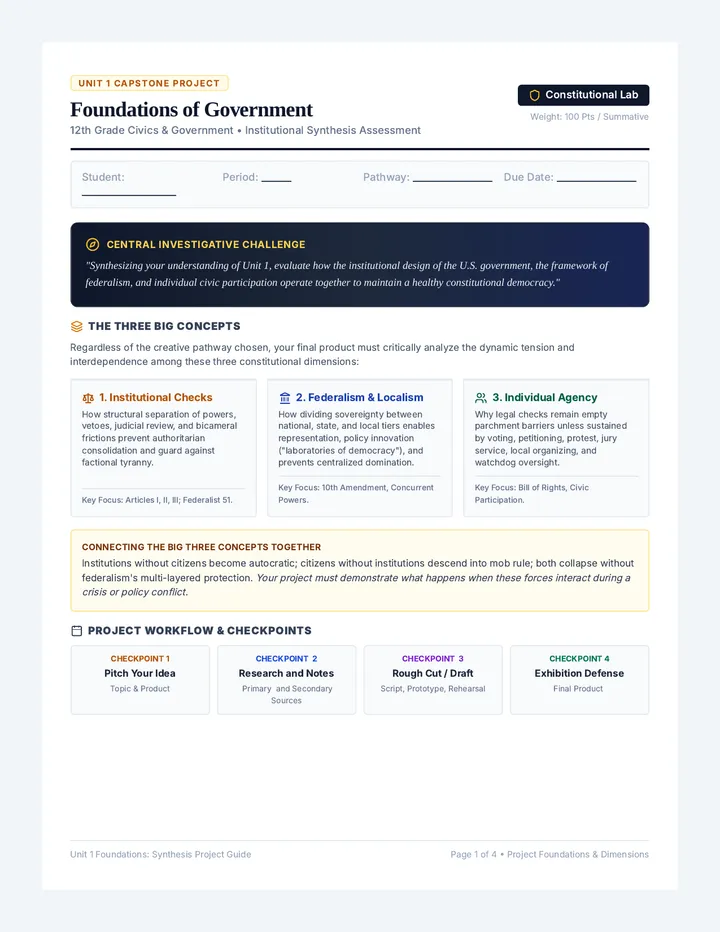
Democracy Design Project Guide

Democracy Design Project Guide

A comprehensive 4-page student project assignment guide for 12th-grade Civics and Government, detailing 5 creative project pathways (podcast, documentary, interview simulation, reader's theater drama, and board/card game), an analytical rubric across the three core constitutional dimensions, and a student planning blueprint.

JG

Joshua Griffith

US History Welcome Slide

US History Welcome Slide

A comprehensive Back to School Night slide for 7th Grade US History taught by Austin Nowak. Features classroom policies, course scope from Pre-Columbian societies through Reconstruction with New York State integration, and core historical thinking skills in a rich Americana visual theme.

AN

Austin Nowak

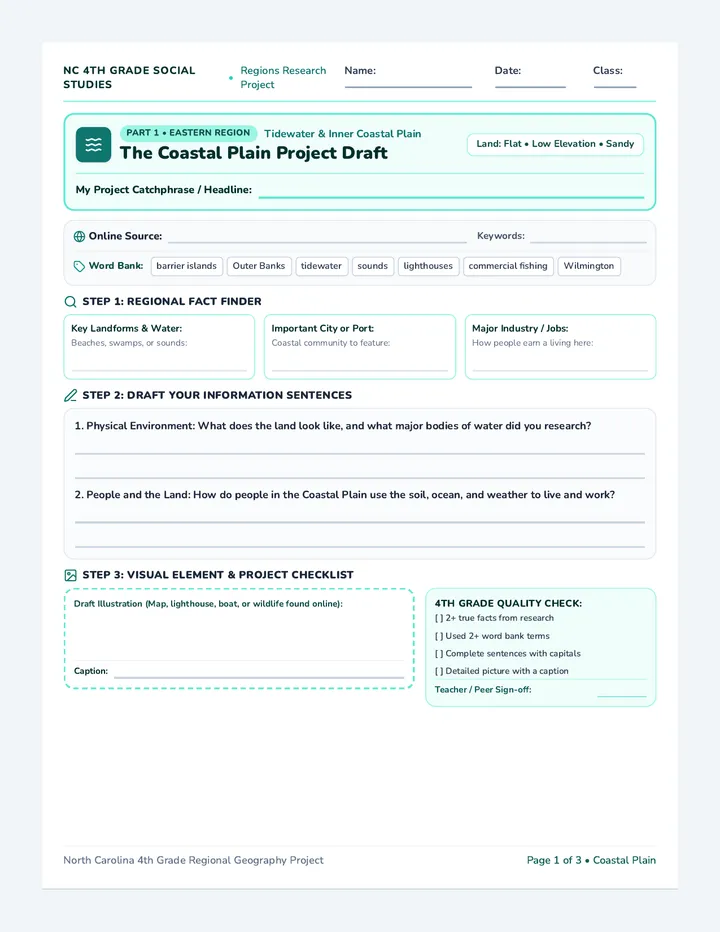
Carolina Regions Draft Sheet

Carolina Regions Draft Sheet

A three-page printable project draft sheet for 4th grade students researching North Carolina's regions. Includes both an online research source tracker and regional academic word banks, structured fast-fact cards, guided drafting lines, an illustration workspace with captions, and a 4th grade quality check.

TG

Tolisha Goldston

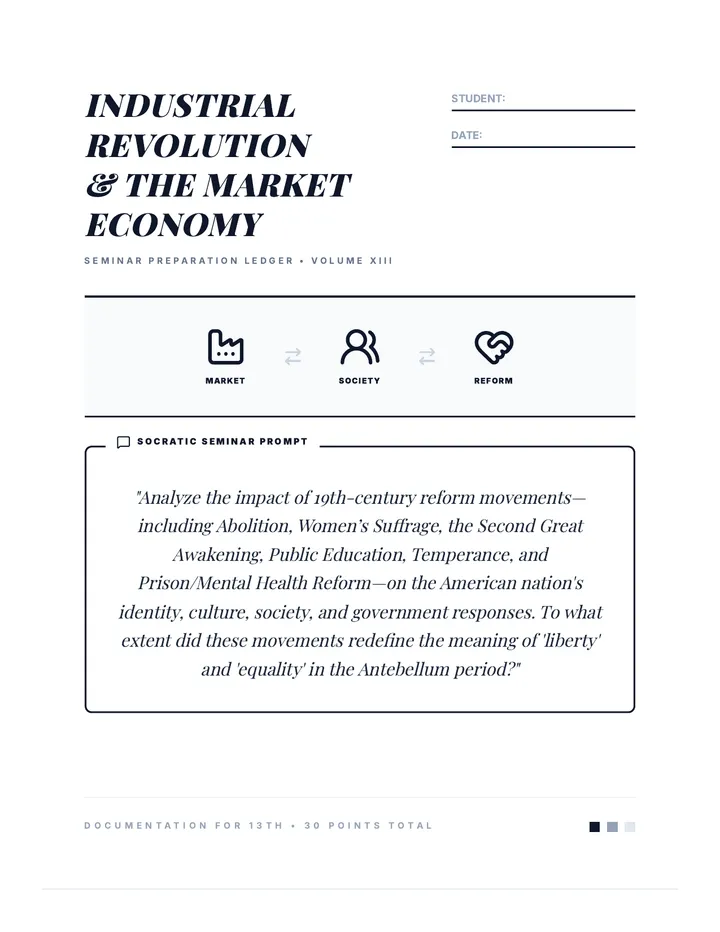
Market Economy Seminar Ledger

Market Economy Seminar Ledger

A detailed 5-page seminar preparation ledger for the Industrial Revolution and Market Economy lesson. Features a dedicated cover page with relevant historical icons and a prominent Socratic prompt, three separate article analysis pages, and a final synthesis evaluation. Writing lines are darkened for optimal print quality.

JG

Joshua Griffith

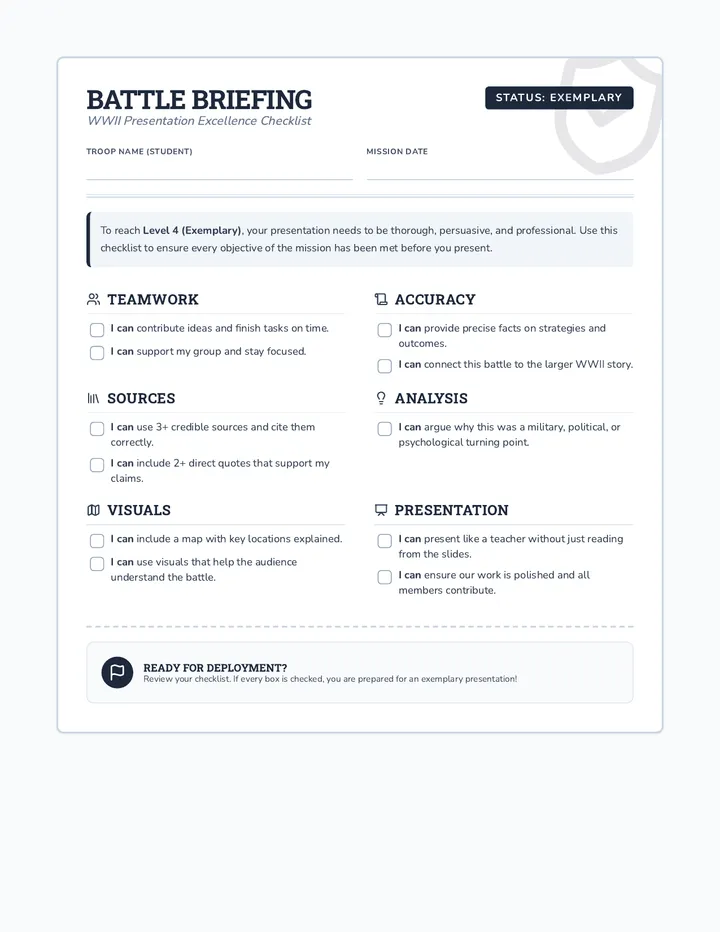
Battle Briefing Checklist

Battle Briefing Checklist

A student-friendly presentation checklist based on Level 4 criteria of a WWII Battles Project rubric, featuring 'I can' statements and visual icons. Revised to fit on a single page.

NP

Nicole Palmiotto

Sequences

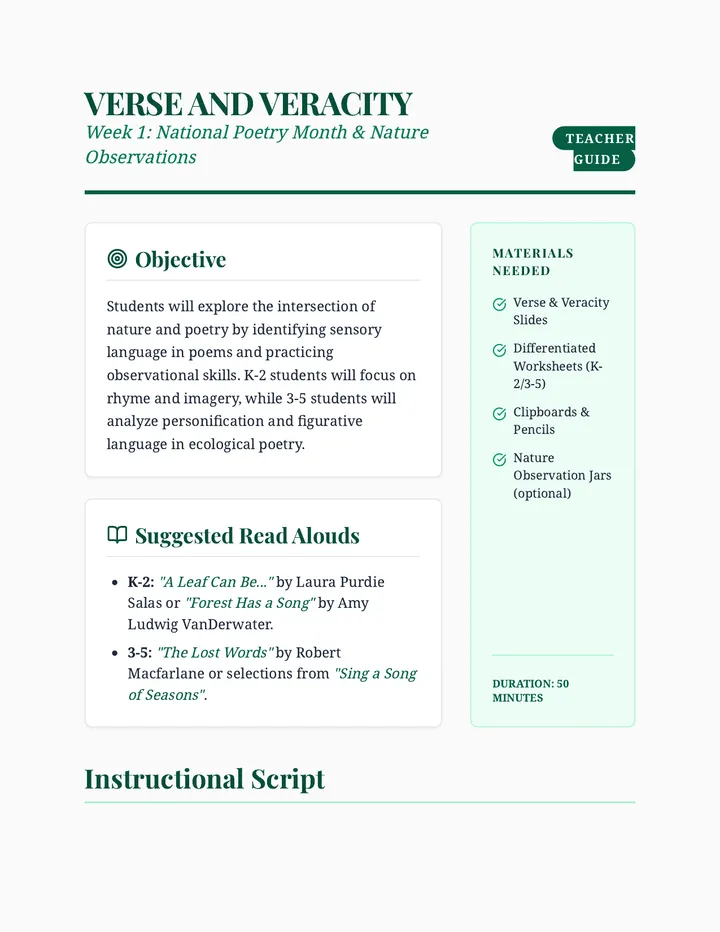
Verse and Veracity Teacher Guide

Media Center Year Curriculum

A comprehensive K-5 Media Center curriculum spanning August to May. Each month features a thematic unit integrating library skills (Dewey Decimal System, research, digital citizenship), literacy (poetry, biographies, informational texts), and STEM/Maker Space challenges. Resources are differentiated for K-2 and 3-5.

B

bethany.nied

50
The Imaginer Teacher Guide

The Imaginer Plato Logic

A four-day introductory logic and philosophy sequence for middle schoolers focusing on Plato's 'Thinking Style.' Students explore the Allegory of the Cave, perception vs. reality, and the Theory of Forms through the lens of 'The Imaginer,' culminating in a visual analysis game.

DB

Danielle Burham

12
Mission Message Guide Enseignant

Expertise Formation Premier Degré

Une série de modules de formation destinés aux conseillers pédagogiques pour renforcer leur expertise en ingénierie de formation continue, spécifiquement appliquée à l'enseignement du français à l'école primaire.

VD

Val Désirée

27
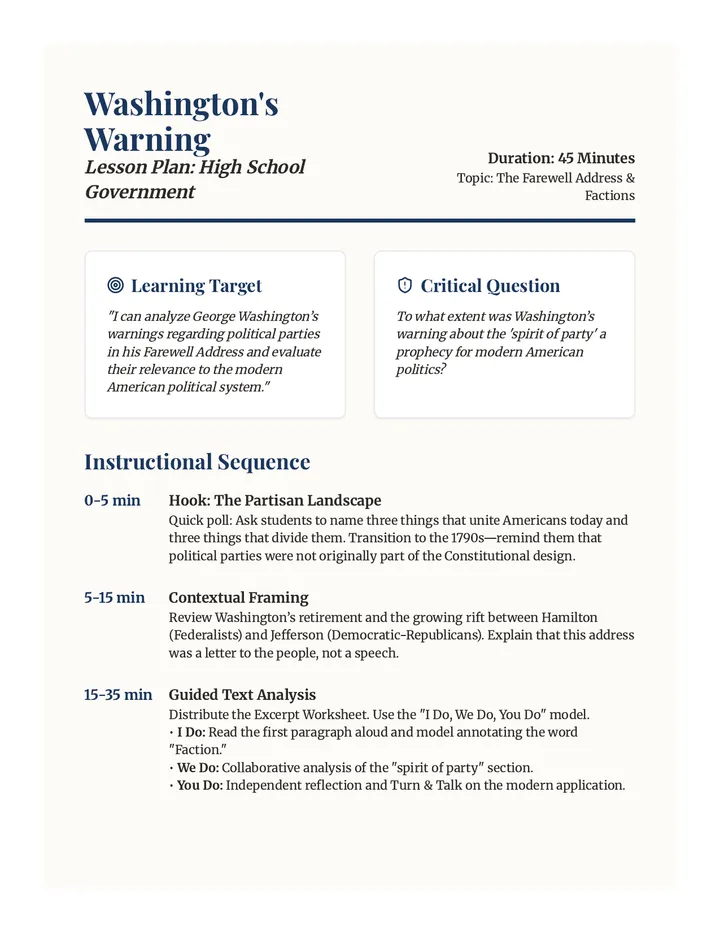
Washingtons Warning Lesson Plan

Washington's Farewell Legacy

A two-part sequence that takes students from a deep-dive analysis of George Washington's Farewell Address to a modern-day evaluation of his warnings regarding political parties, media bias, and national unity.

CE

Chelsea Elliott

24
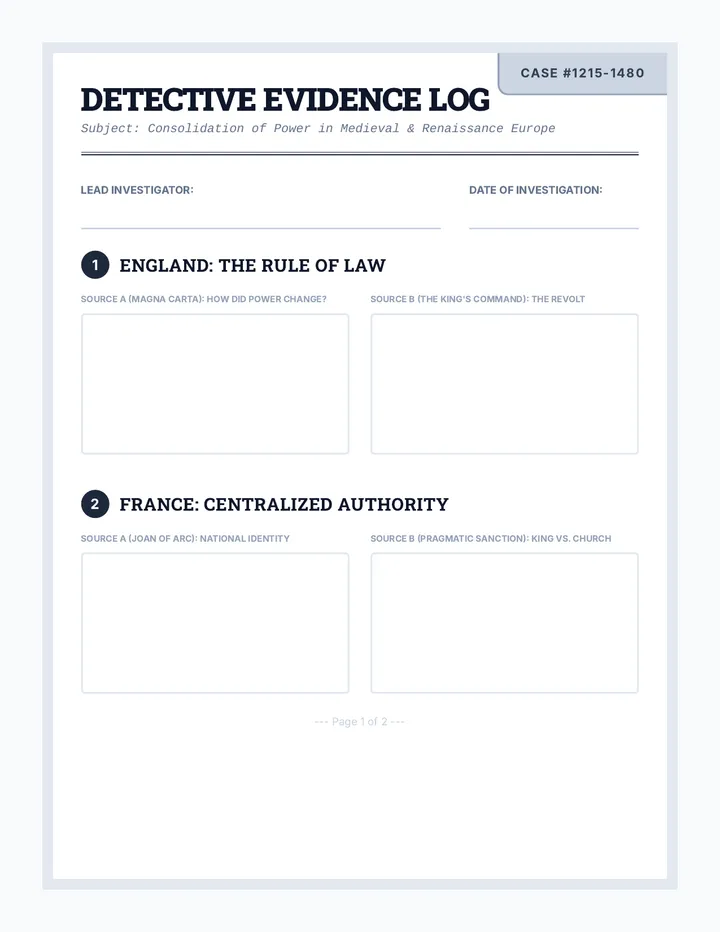
Detective Evidence Log Worksheet

Nation State Detectives

A comprehensive middle school history unit where students act as 'history detectives' to investigate the rise of nation-states in England, France, Spain, and Russia through primary source analysis.

HO

Helen O'Keefe

11
Conflict Cards Activity

Century Crossroads

A comprehensive assessment sequence covering the pivotal moments of 20th-century US history, from the build-up to World War II through the height of the Cold War and the diverse Civil Rights movements.

AH

Ashley Hopf

16

Lessons

History Sprint Pacing Guide

STAAR History Sprint

A comprehensive pacing guide and activity resource designed to cover the remaining 11th Grade US History TEKS before the STAAR test on April 16th. This lesson provides a day-by-day calendar for A/B block schedules and high-engagement activities for each remaining historical era.

BB

Bridgette Burdick

51
Modern Era Reader Part 1

The Modern Ledger

A comprehensive exploration of the 1990s through the modern day, covering technological shifts, political milestones, military conflicts, and cultural evolution in the United States.

CE

Chelsea Elliott

20
Liberty Blueprints Posters

Liberty Blueprints

A 10th-grade social studies stations activity investigating the Constitutions of 1791, 1793, and 1795. Students analyze how France repeatedly drafted and revised its foundational laws in a turbulent quest for a more democratic society.

KT

Kyle Trocolla

14
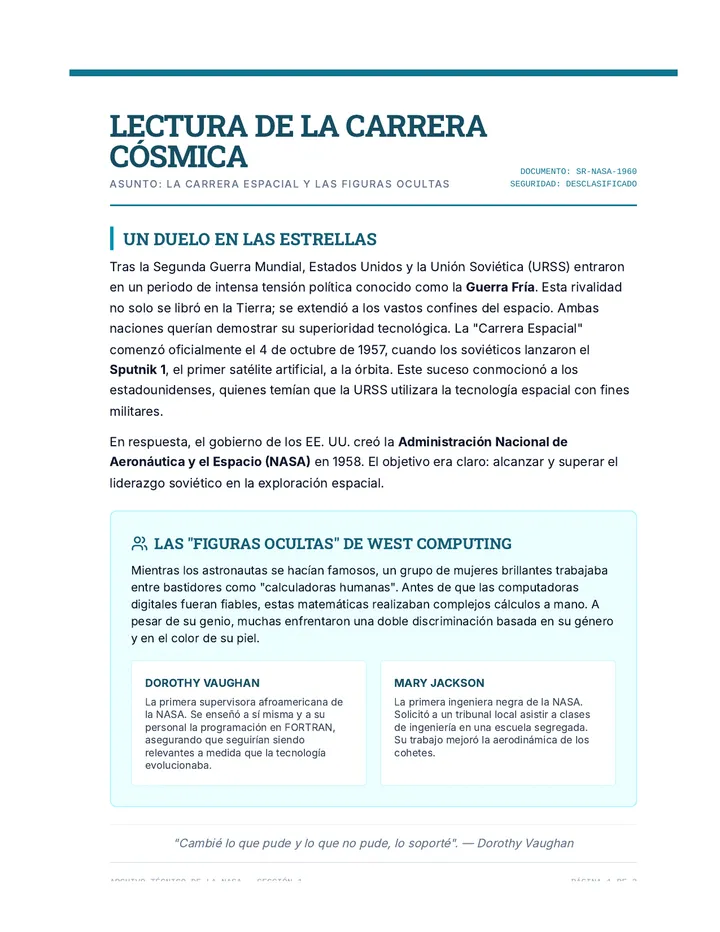
Cosmic Race Reading Text

Stellar Rivalry

A comprehensive exploration of the Space Race, highlighting the technological competition between the US and USSR, the essential contributions of African American women at NASA, and the international agreements that keep space a peaceful frontier.

RM

Robyn MacDonald

16
Compromise Conundrum Activity Signs

Compromise Conundrum

A 45-minute stand-alone lesson centered on the Constitutional Convention's debate over representation and the Three-Fifths Compromise. It includes chunked reading for accessibility, a high-engagement 'Four Corners' activity, and a graphic organizer assessment designed for formal observation alignment with the Danielson Framework.

SA

Senta Agnello-Shelton

11
Crown and Covenant Teacher Guide

Crown and Covenant

A pre-reading lesson on the Divine Right of Kings and European Absolutism, preparing 10th-grade students with crucial background knowledge through a close reading of King James I and Louis XIV.

T

timothy.nixon

8