Lenny.com
Explore
Create
ActivitiesNewMathEnglish Language ArtsScience & EngineeringSocial StudiesGlobal LanguagesHealth & Physical EducationSpecial EducationCounseling & Life SkillsArts & CreativityESL
Lenny.com
Lenny.com
Explore
Create
ActivitiesNewMathEnglish Language ArtsScience & EngineeringSocial StudiesGlobal LanguagesHealth & Physical EducationSpecial EducationCounseling & Life SkillsArts & CreativityESL
Lenny.com
Lenny.com

Solutions

Lenny for EducatorsLenny for SchoolsLenny for Districts

Product

ExploreSign inCreateSupportAbout

Resources

Getting startedMTSS Acceleration Program

Newsletters

School Funding Newsletter

© 2026 Lenny Learning Inc.

TermsPrivacyAccessibility
LinkedInInstagramX
Lenny

Introduction to Philosophy

Fundamental questions regarding existence, knowledge, and ethics through the analysis of major philosophical traditions. Builds critical thinking skills by evaluating logical arguments from classical to modern theorists.

Social StudiesSocial Studies PracticesLocation WordsMapsOrder EventsChronology and CausationEvaluating SourcesHistorical ThinkingGeography, Humans, & the EnvironmentAmerican Symbols and LandmarksCitiesStatesState CapitalsRegions of the United StatesGeographic SkillsPhysical GeographyHuman GeographyRegional GeographyGeography of AfricaGeography of AsiaGeography of EuropeGeography of OceaniaGeography of the AmericasSociety and Environment of EuropeSociety and Environment of AsiaSociety and Environment of The AmericasSociety and Environment of the Middle EastSociety and Environment of AfricaHistoryPrehistoryComparing Ancient River CivilizationsAncient MesopotamiaAncient Egypt and KushAncient South AsiaEarly ChinaGreeceRome and the Byzantine EmpireAncient World HistoryNative Peoples of North AmericaNative Peoples of Mesoamerica and South AmericaAfrican EmpiresMedieval AsiaMedieval EuropeThe Silk RoadMedieval HistoryIslamic EmpiresWorld ReligionsRenaissance PeriodAge of ExplorationThe Thirteen ColoniesThe American RevolutionUS History Early RepublicFounding of the United StatesUS History AntebellumUS Civil WarReconstruction PeriodThe Gilded AgeUS ImperialismWorld ImperialismWorld War IUS History 1920sGreat DepressionWorld War IIThe Cold WarUS History 1950-60sUS History 1960s-70sWorld History 20th CenturyContemporary US HistoryContemporary World HistoryHolidaysCivics and GovernmentCitizenshipGovernment FoundationsThe ConstitutionUS ConstitutionExecutive BranchLegislative BranchJudicial BranchState and LocalPolitical ParticipationPublic PolicyPolitical SystemsPower and AuthoritySocial MovementsDefining DevianceTheories of DevianceCrime and Criminal JusticeEconomicsBasic Economic PrinciplesSupply and DemandWhat is MoneyEconomic FundamentalsMicroeconomicsMacroeconomicsBanking and FinanceEconomic SystemsGlobal EconomicsCorporations and PowerThe Changing WorkplaceUnemployment and LaborClass and InequalitySocial MobilityGlobal InequalityPsychologyHistory of PsychologyPsychology as a ScienceBrain and Nervous SystemNeuroscience and BehaviorGenetics and BehaviorSleep and ConsciousnessSensory ProcessesPerceptual OrganizationClassical ConditioningOperant ConditioningObservational LearningCognitive LearningMemory ProcessesThinking and Problem SolvingLanguage and CognitionTheories of MotivationStress and CopingPrenatal and Infant DevelopmentChildhood DevelopmentAdolescent DevelopmentAdulthood and AgingSelf and IdentitySocial CognitionSocial InfluenceAttraction and RelationshipsGroup BehaviorPrejudice and DiscriminationAnxiety and Mood DisordersClinical PsychologyForensic PsychologyPhilosophy & EthicsIntroduction to PhilosophyMajor Philosophers & IdeasMind and Body ProblemFree Will vs DeterminismEthics & MoralityReligion & PhilosophyPolitical Philosophy

Videos

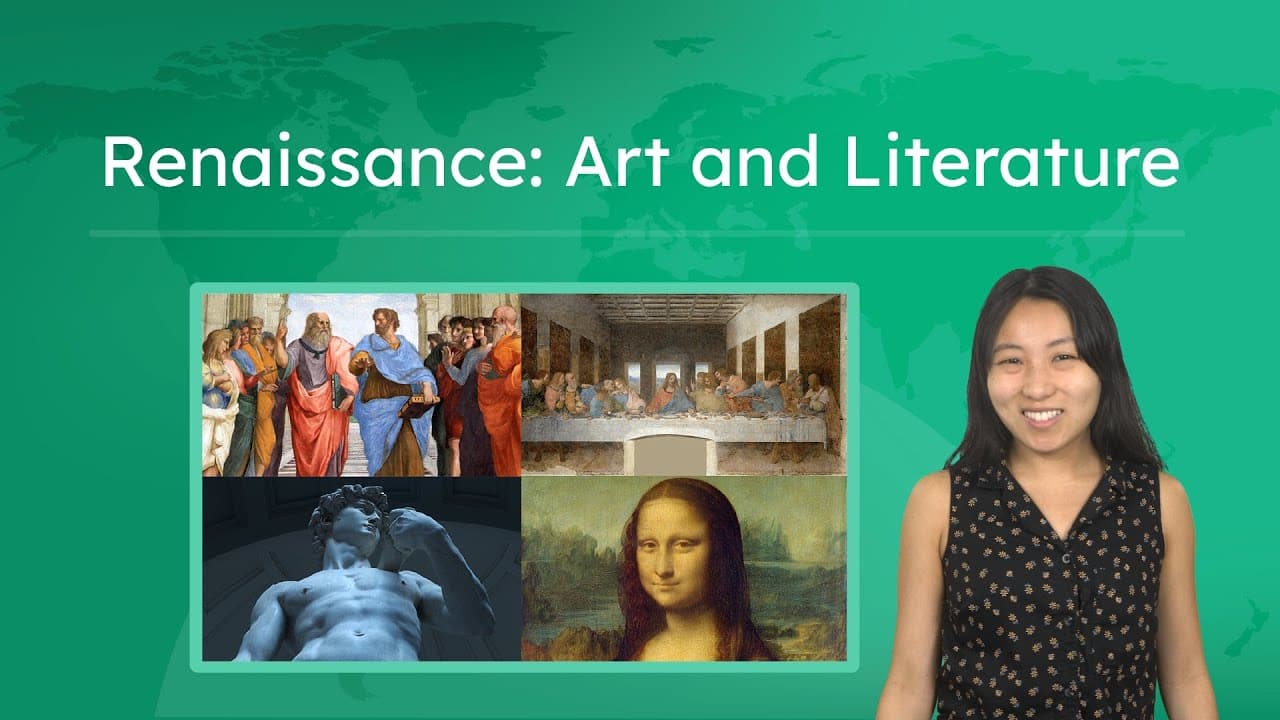
How Renaissance Art and Literature Changed the World

How Renaissance Art and Literature Changed the World

This educational video takes students on a journey through a virtual museum to explore the profound cultural shifts of the Renaissance. It contrasts the art and literature of the Middle Ages—characterized by religious themes and flat, stylized figures—with the explosion of Realism, Humanism, and Individualism during the Renaissance. Through detailed analyses of masterpieces by Leonardo da Vinci, Michelangelo, and Raphael, the video demonstrates how artists used techniques like linear perspective and shading to celebrate the human form and experience. The video also examines the literary revolution led by figures like Dante Alighieri and William Shakespeare. It highlights the shift from Latin to vernacular languages, making literature accessible to the common person, and the move toward exploring complex human emotions and everyday experiences rather than just religious doctrine. Key concepts such as Secularism—the separation of institutions from religious beliefs—are defined and applied to show how society began questioning authority and valuing individual potential. Ideal for World History and Art History classes, this video serves as an engaging multimedia text. It helps students visualize abstract historical concepts through famous works of art. Teachers can use this video to anchor discussions on how cultural values are reflected in art, the importance of the printing press and vernacular language in spreading ideas, and the lasting impact of Renaissance thinking on modern views of human potential and individuality.

Miacademy & MiaPrep Learning ChannelMiacademy & MiaPrep Learning Channel

12mins

Restoring Order After Napoleon: The Congress of Vienna

Restoring Order After Napoleon: The Congress of Vienna

This educational video from Crash Course European History explores the aftermath of the French Revolution and the Napoleonic Wars, focusing on the Congress of Vienna in 1815. Host John Green explains how major European powers—Britain, Prussia, Russia, Austria, and a defeated France—convened to redraw the map of Europe and restore the "old order" of monarchy and aristocracy. The video details the political maneuvering of key figures like Klemens von Metternich and Charles Maurice de Talleyrand, illustrating how they established a "Balance of Power" intended to prevent future massive conflicts and check the expansion of nations like Russia. The video also delves deeply into the ideological and cultural shifts of the time. It contrasts the conservative political backlash, championed by thinkers like Edmund Burke who valued tradition and stability, against the lingering revolutionary spirit. Significant attention is given to the rise of Romanticism as a cultural reaction against Enlightenment rationality. Through examples in literature (Mary Shelley, Alexander Pushkin) and art, the video highlights how the era began to prioritize emotion, nature, and the past over reason and industrialization. For educators, this video serves as an excellent bridge between the age of revolutions and the modern era. It provides crucial context for understanding 19th-century geopolitics, the concept of the "Concert of Europe," and the tension between conservative institutions and rising liberal/nationalist movements. The juxtaposition of political history with art and literature offers interdisciplinary opportunities to discuss how cultural movements reflect and react to political realities, making it highly valuable for World History, European History, and Humanities curriculums.

CrashCourseCrashCourse

14mins 1s

The Northern Renaissance: Books, Politics, and Radical Ideas

The Northern Renaissance: Books, Politics, and Radical Ideas

This educational video explores the spread of Renaissance ideas from Italy to Northern Europe, examining how the movement transformed as it crossed the Alps. It begins by identifying the printing press as the technological catalyst that democratized knowledge, allowing ideas to travel faster and reach wider audiences than ever before. The narrative then delves into how Northern Humanists adapted Italian concepts to fit their own cultural and religious contexts, often focusing more on religious reform and social ethics than the aesthetic glorification of the individual seen in Italy. The content profiles four pivotal thinkers who shaped Western political and social thought: Desiderius Erasmus, the "Prince of the Humanists" who advocated for a middle path of religious reform; Niccolò Machiavelli, whose treatise "The Prince" established modern political realism; Thomas More, whose "Utopia" imagined an idealistic communal society; and Christine de Pizan, an early feminist who challenged the misogyny of her time. Through these figures, the video illustrates the tension between idealism and realism that defined the era. For the classroom, this video serves as an excellent bridge between the artistic Renaissance and the political/religious upheavals of the Reformation. It provides rich opportunities to discuss the impact of media technology on society, debate the ethics of political power (is it better to be loved or feared?), and analyze how historical context shapes philosophical outlooks. The video effectively demonstrates how the Renaissance was not a monolith but a diverse movement with conflicting values and visions for the future.

CrashCourseCrashCourse

14mins 2s

How Authoritarian Socialism Controls Truth and Economies

How Authoritarian Socialism Controls Truth and Economies

This educational video provides a deep dive into the mechanisms of authoritarian socialism, exploring how these regimes control both information and economies. The narrator, Justin, begins by examining the psychological tools used by authoritarian systems, specifically propaganda and cognitive dissonance, to manipulate citizens' perception of reality. The video explains how truth is often subverted to maintain the status quo and the authority of the state, using the famous "2+2=5" analogy to illustrate how political pressure can force individuals to accept falsehoods.

Miacademy & MiaPrep Learning ChannelMiacademy & MiaPrep Learning Channel

12mins 18s

What Anarchism Actually Means: Beyond Chaos and Disorder

What Anarchism Actually Means: Beyond Chaos and Disorder

This episode of Crash Course Political Theory provides a comprehensive introduction to anarchism, moving beyond the common stereotype of chaos and disorder to explore it as a serious political philosophy. The video examines the core belief that society can organize itself without a centralized state, arguing that human nature is inherently cooperative rather than competitive. It contrasts anarchist views with those of thinkers like Thomas Hobbes, who believed life without government would be "nasty, brutish, and short." The video traces the historical development of anarchist thought through key figures such as Emma Goldman, Pierre-Joseph Proudhon, Mikhail Bakunin, and Peter Kropotkin. It distinguishes between different strands of the ideology, including mutualism, collectivist anarchism, and anarchist communism. The narrative connects these historical theories to modern movements, analyzing the Occupy Wall Street protests, the concept of "everyday anarchism" in daily life, and even the divergence of right-wing anti-state movements like crypto-anarchism. For educators, this resource is an excellent tool for high school Civics, Government, and Philosophy classes. It helps students understand the spectrum of political ideologies beyond the standard liberal-conservative binary. By presenting anarchism as a theory of mutual aid and voluntary association, it prompts deep discussions about the necessity of the state, the nature of hierarchy, and how communities handle crisis. The video also addresses the complex relationship between anarchism and violence, offering a nuanced look at political radicalism.
CrashCourseCrashCourse

11mins 42s

Understanding Liberalism: Liberty, Rights, and the Social Contract

Understanding Liberalism: Liberty, Rights, and the Social Contract

This educational video from the Crash Course Political Theory series explores the complex philosophy of Liberalism, moving beyond the common political usage of the term to its roots as a philosophy centered on liberty and individual rights. Hosted by Ellie Anderson, the video traces the evolution of liberal thought from the 1600s social contract theories of Thomas Hobbes and John Locke to modern interpretations by John Rawls and Isaiah Berlin. It tackles difficult questions about what happens when individual rights conflict and how a democratic society balances freedom with equality. The content dives deep into key political concepts including the State of Nature, the Social Contract, the Veil of Ignorance, and the crucial distinction between Negative Liberty (freedom from interference) and Positive Liberty (the capacity for self-determination). It also addresses historical contradictions within classical liberalism, such as its coexistence with slavery and colonialism, and introduces contemporary debates regarding multiculturalism and group rights versus individual rights. For educators, this video serves as an excellent anchor for units on political philosophy, civics, or government. It provides a structured framework for students to understand abstract concepts like justice and fairness. The video offers concrete metaphors—like the ride-sharing app for the social contract or the job applicant for positive/negative liberty—that make complex theories accessible. It naturally prompts critical thinking and classroom debate regarding current events, social justice, and the role of government.

CrashCourseCrashCourse

12mins 24s

Materials

Metaphysics Architecture Reference Sheet

Metaphysics Architecture Reference Sheet

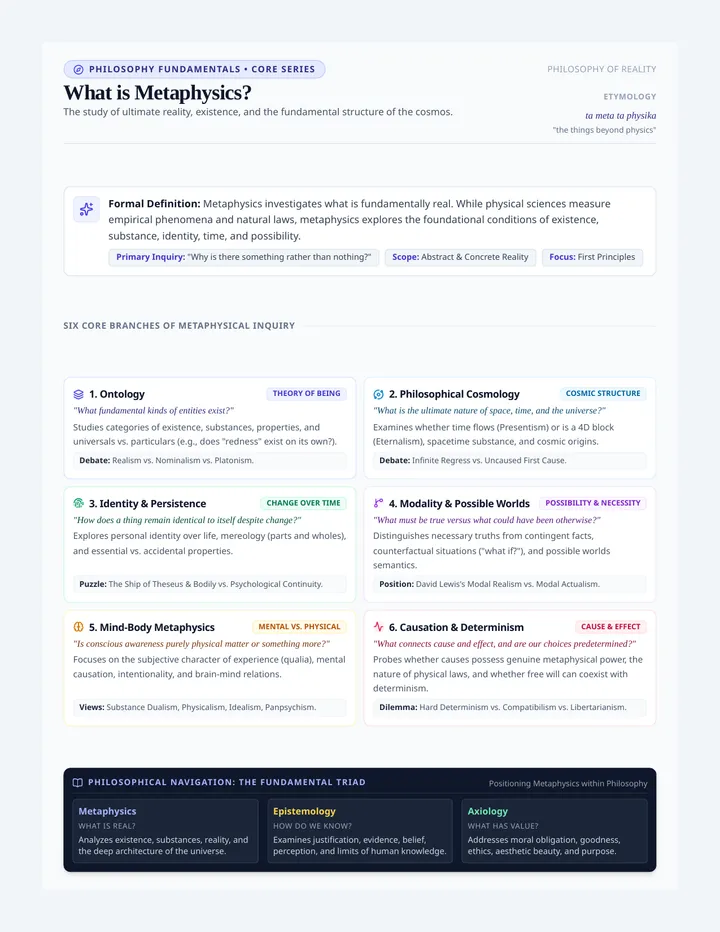
A concise, print-ready reference guide outlining the definition of metaphysics, its etymology, and its six primary branches—Ontology, Cosmology, Identity, Modality, Mind, and Causation—with key debates and philosophical distinctions.

ES

Eslem Serdar

Modern World Fall Inquiry Benchmark

Modern World Fall Inquiry Benchmark

A seven-slide model inquiry presentation demonstrating an exemplary project response for the Fall Inquiry Benchmark, featuring the user's provided composite image of Plato, Socrates, and Aristotle as the sole image on the mentorship connection slide (Slide 3).

KT

Kyle Trocolla

Renaissance Genius Worksheet

Renaissance Genius Worksheet

A comprehensive two-page Renaissance review worksheet covering key historical figures, influential patrons, humanist philosophy, artistic innovations, and cultural achievements with matching, vocabulary application, and analytical short answers.

MM

Michele Magee

Mythes Philosophiques Guide Pédagogique

Mythes Philosophiques Guide Pédagogique

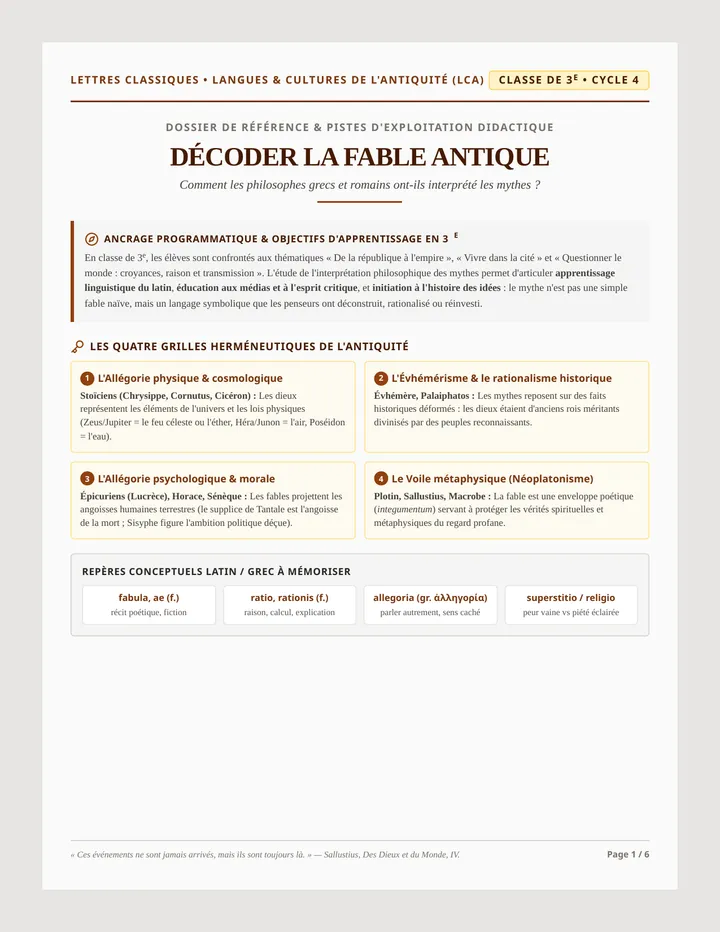
Guide pédagogique complet pour professeurs de lettres classiques en 3e : corpus de 18 extraits antiques analysant et interprétant les mythes, présentation détaillée de chaque auteur et de chaque œuvre, et propositions d'activités didactiques pour latinistes.

DS

Da Silva Annabelle

Judgment Call Handout

Judgment Call Handout

A two-page historical fiction handout styled as an aged parchment document. It features a personal account from 'Hans' with a dedicated 'Impression' sidebar and profile icon area, followed by reflective questions regarding moral accountability. This version optimizes the second page layout to ensure all questions fit comfortably within the print margins.

LN

Leah Nickols

Modern Philosophy Study Guide

Modern Philosophy Study Guide

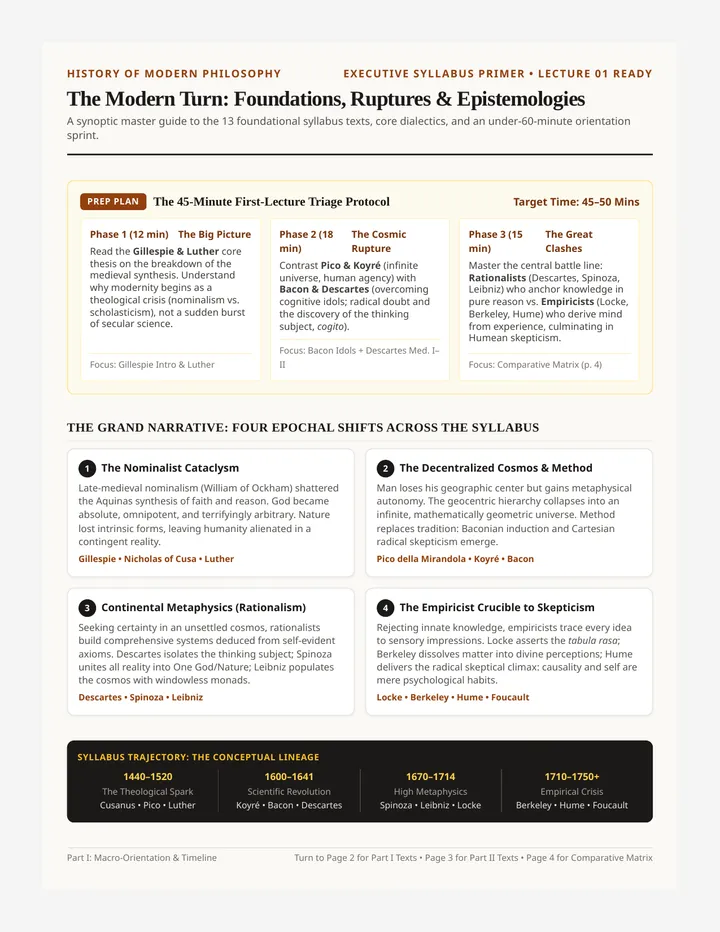
A comprehensive 4-page reading study guide and under-one-hour preparation sprint for a History of Modern Philosophy course. Covers the entire syllabus trajectory from late-medieval theological origins (Gillespie, Cusanus, Luther) and the scientific revolution (Pico, Koyré, Bacon, Foucault) to the great rationalist-empiricist epistemological debates (Descartes, Spinoza, Leibniz, Locke, Berkeley, Hume), complete with a rapid study schedule, core theses, seminar questions, and a comparative matrix.

ES

Eslem Serdar

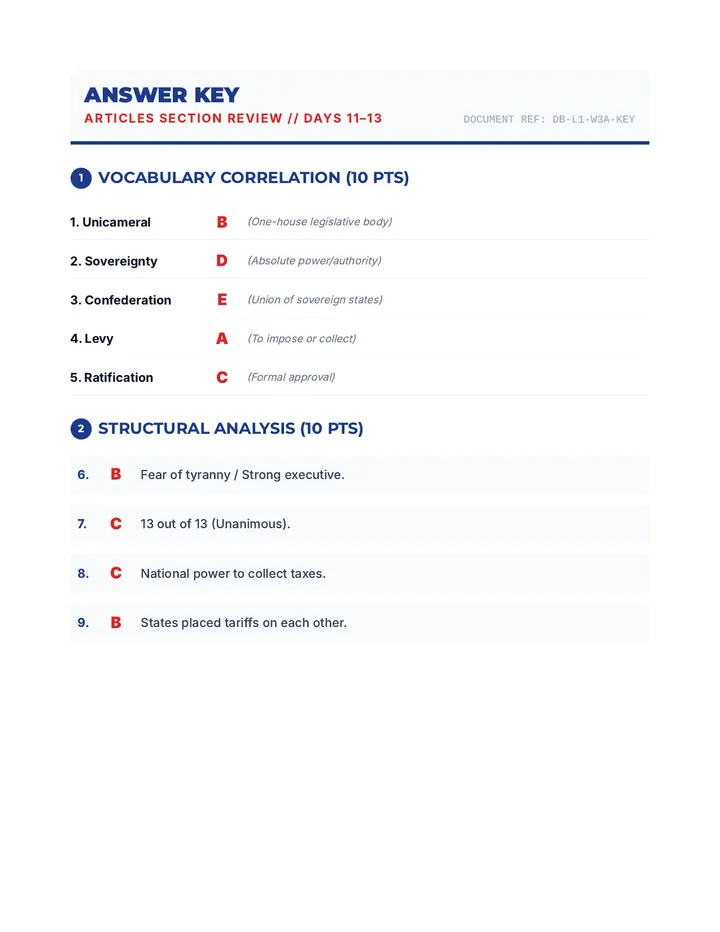
Sequences

Articles Section Review Key

Democracy Blueprint

A comprehensive 90-day independent study program for high school government, covering everything from philosophical foundations to modern policy and civic participation.

LF

Lindsey Foulks

35
Roots of Republicanism Reader

Foundations of Freedom Remediation Packet

A 7-day comprehensive remediation sequence focused on the philosophical, historical, and individual foundations of American government. Designed for students needing mastery of TEKS 1 and 12B, the unit features structured readers, skill-building worksheets, and a cumulative assessment.

CE

Chelsea Elliott

16
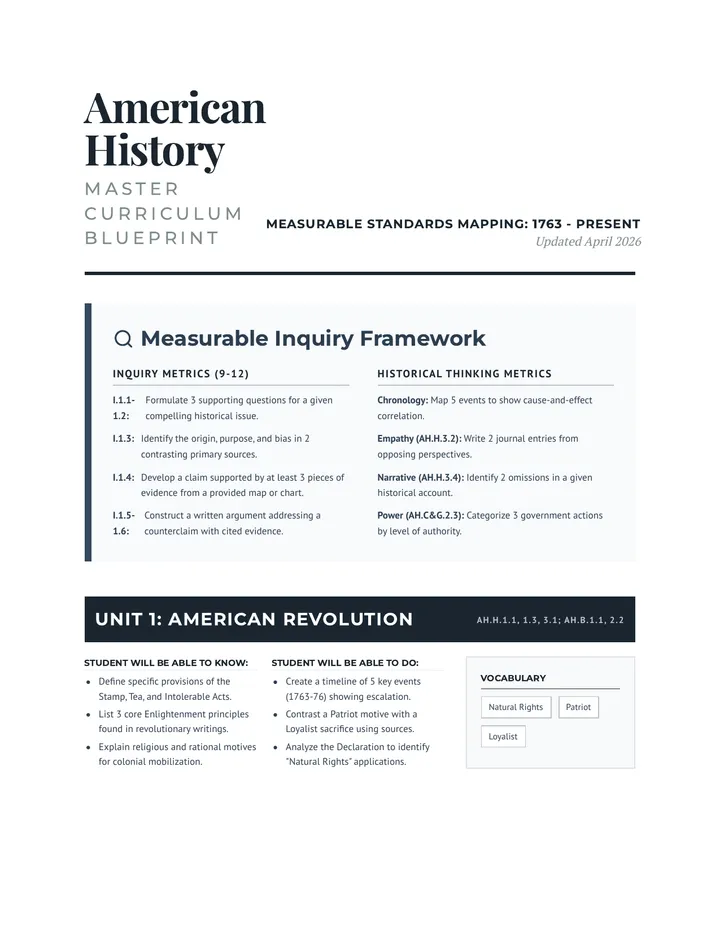
Curriculum Blueprint Document v2

History Horizon Sequence

A comprehensive high school curriculum plan for American History, covering 13 units from the American Revolution to the modern era, aligned with North Carolina Social Studies standards.

AK

Amity Kea

21
Tax and Tea Teacher Guide

Road to Revolution

A 5-day history and English Language Arts sequence exploring the accelerating events and intellectual currents that led to the American Revolution. Students scaffold their summative assessment—an open letter from a Second Continental Congress delegate—by documenting crown abuses, analyzing Enlightenment concepts, and drafting arguments daily.

AN

Ashleigh Nash

10
Foundations Comprehension Quiz

The American Ledger USH Remediation

A 25-day intensive remediation program for 11th Grade US History students, focusing on the Cold War, Civil Rights, Vietnam, the Reagan Era, and contemporary history. Each day features a 'Ledger' reader with embedded annotations and a review worksheet, aligned with Texas TEKS standards.

CE

Chelsea Elliott

62
Miranda Mockery Worksheet

Constitutional Crises and Political Realignment

This sequence explores the constitutional revolution of the Warren Court during the 1950s and 60s. Students analyze landmark cases involving rights of the accused, free speech, and privacy, culminating in an examination of the resulting political realignment and a moot court simulation.

11

Lessons

Crown and Covenant Teacher Guide

Crown and Covenant

A pre-reading lesson on the Divine Right of Kings and European Absolutism, preparing 10th-grade students with crucial background knowledge through a close reading of King James I and Louis XIV.

T

timothy.nixon

8
Reason for Revolution Worksheet V4 Refined Final

Architects of Liberty

A lesson exploring how Enlightenment philosophers like Locke, Montesquieu, and Voltaire influenced the founding documents and structure of the United States government.

KB

Kenneth Brown

10
Chronicle Study Guide Student

Modern Era Mastery

A comprehensive review and assessment package covering World History from the Enlightenment through the Cold War, aligned with state standards.

AH

Ashley Hopf

16
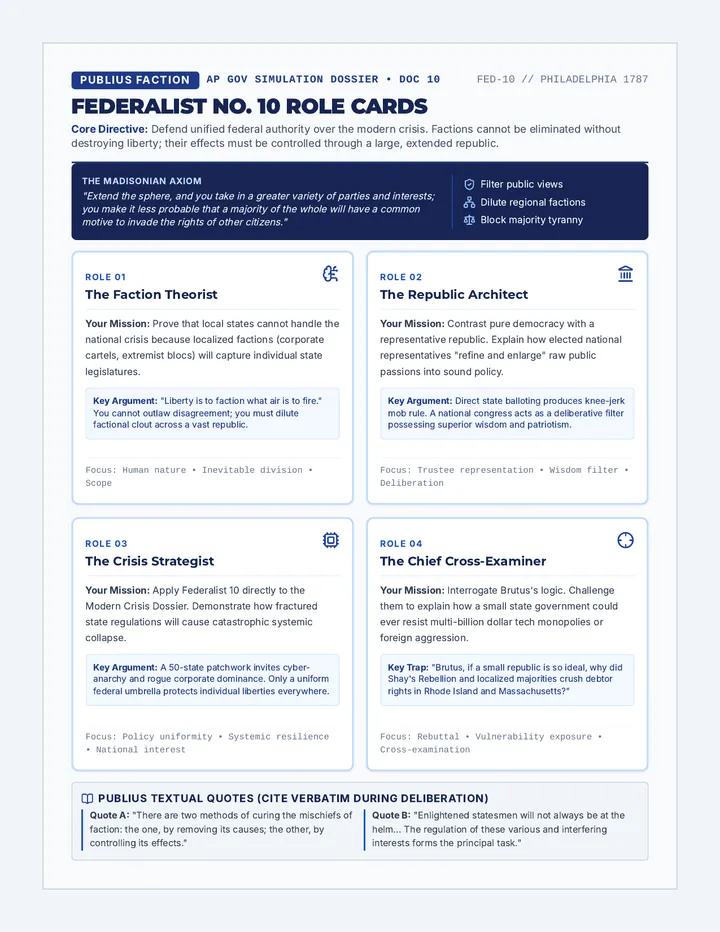
Faction Showdown Role Cards

Faction Showdown

A high-stakes AP Government classroom simulation that pits Madisonian Federalists against Anti-Federalist Brutus factions over a modern national crisis. Students deploy foundational constitutional arguments to deliberate federal power, faction control, and state sovereignty.

K

kpitcher

5
Power Play Lesson Plan

The Power Play

A deep dive into the social psychology of power, exploring how leadership styles, social influence, and ethical frameworks shape historical and modern societies. Students analyze case studies of authority and resistance to understand the mechanics of influence.

CL

Chrissy Longley

6
Meaning Makers Slides

The Design of Meaning

A deep dive into the search for meaning through the lenses of Plato and C.S. Lewis, exploring how beauty, nature, and universal design challenge existentialist perspectives. Students will analyze primary source excerpts to understand the relationship between objective reality and human longing.

AM

Acacia McCombs

4