Meaning Makers Slides
The Meaning Makers
Plato, Lewis, and the Blueprint of Reality
The Great Debate
Existentialism
"Existence precedes essence."
We are born first, and then we must define our own meaning in an indifferent universe.
Essentialism / Universal Design
"Essence precedes existence."
There is a blueprint. Meaning is something we *discover*, not something we *invent*.
Is the universe a blank canvas or a pre-written story?
Plato: The World of Forms
The Architecture of Truth
"The shadows on the wall are not reality, but merely a reflection of a higher truth."
— Plato, The Republic
The Sun of Beauty
To Plato, Beauty isn't just "in the eye of the beholder." It is an objective reality that draws us toward the Truth.
Universal Design
Everything in nature (a tree, a river, a human) is a "copy" of a perfect, divine Idea or "Form."
C.S. Lewis: The Great Longing
Nature as a Signpost
"If I find in myself a desire which no experience in this world can satisfy, the most probable explanation is that I was made for another world."
Desire
Our hunger for meaning is a "clue" to reality.
Nature
Nature is beautiful but "hints" at something more.
Art
Art is the "echo" of a original beauty.
The Architecture of Meaning
Synthesizing the Perspectives
Key Themes
- Beauty is a bridge to truth.
- Nature is a "signpost" pointing upward.
- Purpose is built into the design.
- Existential dread is actually "longing."
Discussion Point
If beauty is an objective part of "universal design," how does that change the way we experience a sunset or a painting? Does it give art a "responsibility" that existentialists might deny?
Meaning Map Reading Handout
The Meaning Map
Primary Source Reader: Plato & C.S. Lewis
Name: __________________________
Date: ___________________________
The Context
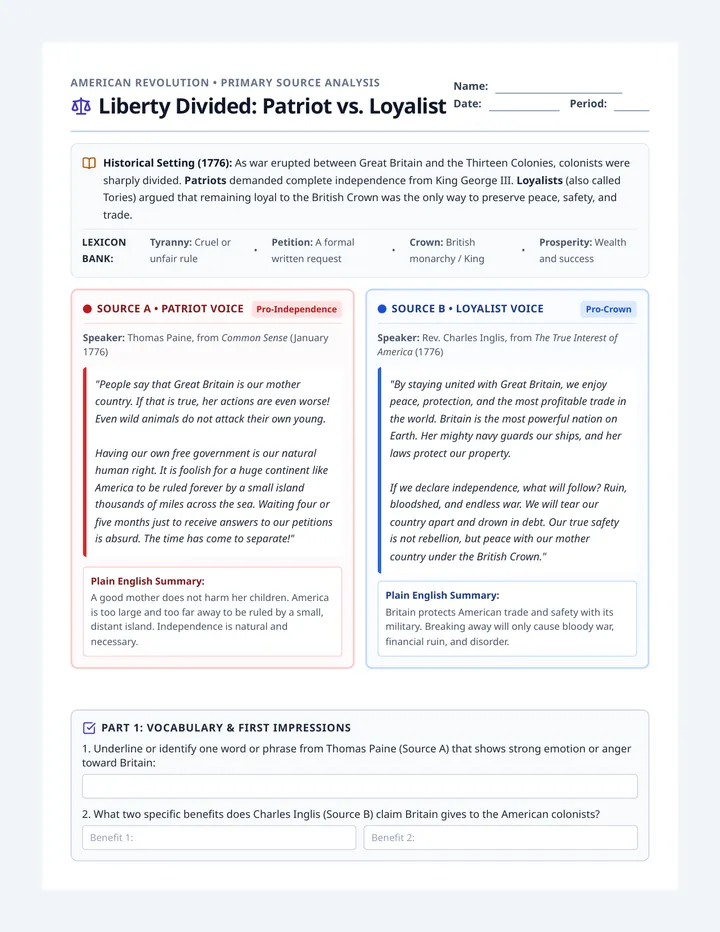
Traditional existentialism suggests that the universe is "absurd" and meaning is entirely subjective. However, many philosophers and thinkers argue that the structure of reality itself points toward an objective purpose. These excerpts explore the "Universal Design" perspective through the lenses of ancient Greek philosophy and modern theological thought.
Source A
The Allegory of the Forms
— Excerpted from The Republic by Plato (c. 375 BCE)
"Behold! human beings living in an underground den... they see only their own shadows, or the shadows of one another, which the fire throws on the opposite wall of the cave... To them, I said, the truth would be literally nothing but the shadows of the images."
"And now look again, and see what will naturally follow if the prisoners are released and disabused of their error... When any of them is liberated, and compelled suddenly to stand up and turn his neck round and walk and look towards the light, he will suffer sharp pains; the glare will distress him, and he will be unable to see the realities of which in his former state he had seen the shadows."
"My opinion is that in the world of knowledge the Idea of Good appears last of all, and is seen only with an effort; and, when seen, is also inferred to be the universal author of all things beautiful and right... and the immediate source of reason and truth in the intellectual; and that this is the power upon which he who would act rationally either in public or private life must have his eye fixed."
Comprehension Questions:
1. According to Plato, what is the relationship between the "shadows" on the wall and the "Idea of Good"?
2. Why does the prisoner suffer "sharp pains" when turning toward the light? What might this represent in the search for meaning?
Source B
The Weight of Glory
— Excerpted from The Weight of Glory by C.S. Lewis (1941)
"We do not want merely to see beauty, though, God knows, even that is bounty enough. We want something else which can hardly be put into words—to be united with the beauty we see, to pass into it, to receive it into ourselves, to bathe in it, to become part of it."
"The books or the music in which we thought the beauty was located will betray us if we trust to them; it was not in them, it only came through them, and what came through them was longing... These things—the beauty, the memory of our own past—are good images of what we really desire; but if they are mistaken for the thing itself they turn into dumb idols, breaking the hearts of their worshippers. For they are not the thing itself; they are only the scent of a flower we have not found, the echo of a tune we have not heard, news from a country we have never yet visited."
"If I find in myself a desire which no experience in this world can satisfy, the most probable explanation is that I was made for another world. If none of my earthly pleasures satisfy it, that does not prove that the universe is a fraud. Probably earthly pleasures were never meant to satisfy it, but only to arouse it, to suggest the real thing."
Comprehension Questions:
3. How does Lewis define "beauty" in relation to the objects we enjoy (books, music, nature)?
4. Explain the metaphor of the "scent of a flower we have not found." How does this challenge the existentialist view that we must create our own meaning?
Synthesizing the Truth
5. Based on both readings, what role does nature play in the discovery of meaning? Is it an end in itself, or a signpost for something else? Explain using evidence from both texts.
Meaning Makers Teacher Guide
Meaning Makers Teacher Guide
Lesson Facilitation & Answer Key
Lesson Objectives
- Analyze how Plato and Lewis use metaphor to describe reality.
- Contrast existentialist subjectivity with the theory of objective universal design.
- Identify the role of beauty and desire in philosophical arguments.
Discussion Hook
"Is a sunset beautiful because we say it is, or is its beauty a fact of nature that we simply notice?"
Answer Key: Reading Handout
1. Relationship between "shadows" and the "Idea of Good":
Shadows are mere reflections or imperfect copies of the higher reality (The Forms). The Idea of Good is the source ("universal author") of all truth and beauty.
2. Significance of "sharp pains":
The transition from comfort (illusion) to truth (reality) is difficult and disorienting. It suggests that discovering meaning requires effort and a "turning" of the soul.
3. Lewis's definition of beauty:
Beauty is not *in* the object itself, but *comes through* it. Objects are "signposts" or "echoes" of a higher, original beauty.
4. The metaphor of the "scent of a flower":
It suggests that our longing for meaning is a response to a real destination we haven't reached yet. It challenges existentialism by suggesting meaning is an external discovery, not an internal creation.
Graphic Organizer Exemplar
| Key Concept | Plato | C.S. Lewis |
|---|
| The "Shadow" World | The cave; sensory reality is just a shadow of the perfect Forms. | "Dumb idols" or "images" that are mistaken for the thing itself. |
| Function of Beauty | A bridge that leads the soul out of the cave toward the "Idea of Good." | A "signpost" that arouses longing for a "far country" or another world. |
| The Role of Nature | An imperfect copy of a divine blueprint (The Forms). | The "scent" or "echo" of a original reality that we were made for. |
| Source of Meaning | Objective Truth found in the "Idea of Good." | Relationship with the "source" of our deepest desires. |
Facilitation Tips
Connecting to Universal Design
Ask students: "If you find a watch in a desert, do you assume it happened by chance or that it has a maker?" Use this to frame the "Argument from Design."
Addressing Art
Discuss if modern art (which often prizes subjectivity) would agree or disagree with Lewis. Does art have to "point" to something to be good?