Provenance Sleuths Slides Curator Studio • Module 01
HS History & Museum Studies
Primary Source & Material Culture Investigation
Provenance Sleuths:
Unlocking the Biography of Artifacts
How professional museum curators authenticate objects, trace archival chains of custody, and uncover forgotten historical perspectives.
Investigation Phase • Artifact Discovery 01 / 05
Foundational Principles
02 / 05
Artifact or Prop? The Power of Material Evidence
An object in a museum is never just an object—it is an eyewitness to political, social, and economic realities.
Authenticity
Is the artifact genuine, an era-replica, or a deliberate forgery? Curators verify physical age, materials, and signatures.
Provenance
The unbroken paper trail documenting ownership from creation to the museum floor. Gaps demand critical historical skepticism.
Ethics & Voice
How was the item acquired? Was it looted, gifted, or commercialized? Who possesses the cultural right to tell its story?
Curator Standard: Uncorroborated artifacts without provenance remain claims, not historical evidence.
Analytical Methodology
03 / 05
The Four Pillars of Object Analysis
Every artifact in your exhibit must withstand systematic cross-examination across four dimensions:
01
Materiality & Construction
Examine tools, dyes, wear marks, repairs, and degradation. What does physical composition reveal about technology and class?
02
Archival Corroboration
Cross-reference against ledgers, diaries, patent filings, manifests, and photographs to substantiate timeline and context.
03
Historiographical Context
Situate the object within prevailing academic debates. Does it affirm conventional consensus or illuminate counter-narratives?
04
Historical Silences
Whose labor produced it? Who was excluded from its use? Identify the perspectives omitted by dominant record-keeping.
Framework derived from Smithsonian & British Museum Curatorial Practices Methodology Check
Case Application
04 / 05
Case Study: An 1892 Immigrant Trunk
Observe how a single mundane object shifts meaning depending on the curator's lens:
Lens A: The Relic
Treated as a Trophy
Label reads: "Steamer trunk carried across the Atlantic by European family, 1892."
Passive, superficial, lacks historical inquiry.
Lens B: Curatorial Probe
Physical & Archival Data
Chalk manifest marks reveal quarantine inspection; internal lining made of scrap Yiddish newspapers from Lodz.
Corroborated with Ellis Island shipping manifests.
Lens C: The Exhibition Core
Interpretive Thesis
The trunk becomes evidence of economic desperation, immigration bureaucracy, and cultural preservation under duress.
Dynamic, rigorous, provoking visitor inquiry.
Curatorial Rule: Your job is not to put relics in glass boxes; your job is to make artifacts speak truth.
Studio Challenge
05 / 05
Your Task: Build an Artifact Dossier
STEP 1
Select Anchor Artifact
Choose 1 physical object, document, or cultural artifact central to your chosen historical era or event.
STEP 2
Conduct Provenance Audit
Trace origins, date of creation, past owners, and pair it with at least two primary corroborating sources.
STEP 3
Draft Curatorial Stance
Identify the central question this artifact will provoke in your museum gallery visitors.
Ready your dossiers: Turn to the Artifact Dossier Worksheet to begin your museum investigation.
Curator Studio • Exhibition Project Sequence Next: Dossier Workshop
Artifact Dossier Worksheet Curator Studio • Historical Research Division
Primary Artifact Dossier & Provenance Audit
FORM HS-CUR-01
Page 1 of 2
Lead Curator:
Exhibit Title:
Historical Era:
Date Filed:
1 Artifact Tombstone & Material Analysis
Descriptive physical metadata
Object Common Name:
Approx. Date of Creation:
Geographic Origin / Culture:
Physical Materials & Wear Indicators:
e.g., forged iron, woven flax, hand-stitched leather, oxidation, tool marks
Original Function vs. Social Significance:
Practical utilitarian use contrasted with what it symbolized to its contemporaries
2 Provenance & Chain of Custody Audit
Historical authenticity verification
Known Ownership Timeline (From Creation → Current Repository): Cite records, bills of sale, estate records
Gaps or Discrepancies in Provenance:
Ethical Acquisition Assessment:
3 Corroborating Primary Sources
2 non-material sources required
Source A (Textual/Archival) Diary / Treaty / Ledger
Author / Date / Repository:
Corroborating Evidence / Direct Quote:
Source B (Visual/Contextual) Photo / Map / Period Print
Creator / Medium / Location:
Corroborating Evidence / Visual Clues:
Curator Studio • High School Curatorial Protocol Continue to Page 2: Interpretive Synthesis →
Curator Studio • Interpretive Synthesis
Historiographical Stance & Visitor Engagement
FORM HS-CUR-02
Page 2 of 2
4 Competing Historical Narratives & Silences
Moving past single-story history
Dominant / Traditional Historical Narrative:
How have textbook accounts or major institutions historically framed this artifact or event?
Silenced or Marginalized Perspective:
Whose voices, struggles, labor, or resistance are highlighted when looking closer at this artifact?
5 Curatorial Rationale & Visitor Provocation
Designing the gallery experience
The Provocative Inquiry Question (to appear on gallery label):
A question that halts visitors and triggers intense debate rather than a simple factual answer
Curator's Justification Statement:
Why is this specific artifact essential to your exhibition? What would visitors fail to understand without it?
6 Curator Viability & Source Quality Scorecard
Curatorial Narrative Slides Curator Studio • Module 02
Exhibition Narrative & Spatial Design
Curatorial Narrative Design
Storyline Architecture:
Crafting the Visitor Journey
How curators transform isolated historical artifacts into a cohesive, provocative physical storyline with an unmistakable interpretive argument.
Conceptualization Phase • Narrative Design 01 / 05
Thematic Clarification
02 / 05
Topic vs. Exhibition Thesis
A museum exhibition is not an encyclopedia entry on a wall. It is an argument supported by material evidence.
Passive Topic (Weak)
“Inventions of the Industrial Revolution”
Merely catalogs machines, dates, and inventors. Visitors look passively and ask, “So what?”
Curatorial Thesis (Strong)
“Progress at a Price: How Mechanization Redefined Human Worth and Divided Labor”
Takes a contested stance, reveals societal tension, and demands visitors evaluate human cost vs. technological gain.
Rule of Thumb: If your exhibit thesis cannot be debated or disagreed with by a serious historian, it is not yet a thesis.
Narrative Structure
03 / 05
The Three-Act Spatial Storyline
Organize your gallery into three progressive thematic zones that guide emotional and intellectual discovery:
ZONE 1
The Threshold
Context & Disruption: Establishes the baseline reality before the historical rupture occurs.
Hook Artifact + Big Question
ZONE 2
The Crucible
Conflict & Contradiction: Explores the peak struggle, competing ideologies, and human costs.
Contrasting Evidence Pairs
ZONE 3
The Reverberation
Legacy & Reckoning: Connects historical consequences to contemporary ethical realities.
Interactive Prompt + Synthesis
Curator Principle: Every room must prompt a specific intellectual shift in the visitor. Spatial Dramaturgy
Text Architecture
04 / 05
The Curatorial Text Pyramid
Museum visitors read in short, intense bursts. Structure your gallery text using the industry standard hierarchy:
Tier 1: Exhibition Wall Panel (120–150 words)
Introduces the master thesis, sets the historical stakes, and articulates the overarching visitor question.
Gallery Entrance
Curator Storyboard Template Curator Studio • Narrative Architecture Division
Exhibition Storyboard & Visitor Arc
FORM HS-CUR-03
Page 1 of 2
Lead Curator(s):
Working Title:
Gallery Space / Format:
Target Audience:
1 Exhibition Core Thesis & Curatorial Rationale
The central historical argument
Exhibition Master Thesis (1–2 concise, debatable sentences): Must take a bold interpretive stance
Primary Tension or Counter-Perspective:
What opposing viewpoint will the exhibit challenge?
Intended Visitor Revelation:
What will visitors realize when exiting that they did not know before?
2 Three-Act Visitor Progression Mapping
Spatial dramaturgy
Zone 1: Threshold Entry / Context
Zone Subtitle:
Inquiry Prompt:
Anchor Artifact:
Emotional Tone: Anticipation & Curiosity
Zone 2: Crucible Conflict / Climax
Zone Subtitle:
Inquiry Prompt:
Contrasting Evidence:
Emotional Tone: Tension & Complexity
Zone 3: Reverberation Legacy / Reflection
Zone Subtitle:
Inquiry Prompt:
Modern Artifact/Echo:
Emotional Tone: Reckoning & Agency
Curator Studio • Narrative Architecture Protocol Continue to Page 2: Wall Text & Interactivity →
Curator Studio • Text & Experience Studio
Wall Text Drafting & Interactive Station Blueprint
FORM HS-CUR-04
Page 2 of 2
3 Main Entrance Introductory Wall Panel (120–150 Words)
Tier 1 Curatorial Text
Exhibition Headline / Banner Title:
Word Count Check:
Target: 120–150 wds
Introductory Narrative Draft (Sets historical stakes, thesis, and tone):
Must avoid passive voice; provoke inquiry within the first 15 words.
4 Zone 2 Thematic Panel Draft (80–100 Words)
Tier 2 Curatorial Text
Zone 2 Sub-Title / Focus:
Word Count Check:
Target: 80–100 wds
Thematic Context & Conflict Narrative:
5 Participatory Visitor Engagement Touchpoint
Active visitor inquiry
Station Type & Physical Setup:
e.g., Voting token box, tactile reproduction handling, audio testimony listening booth, archival transcription desk
Visitor Reflection Prompt & Data Collected:
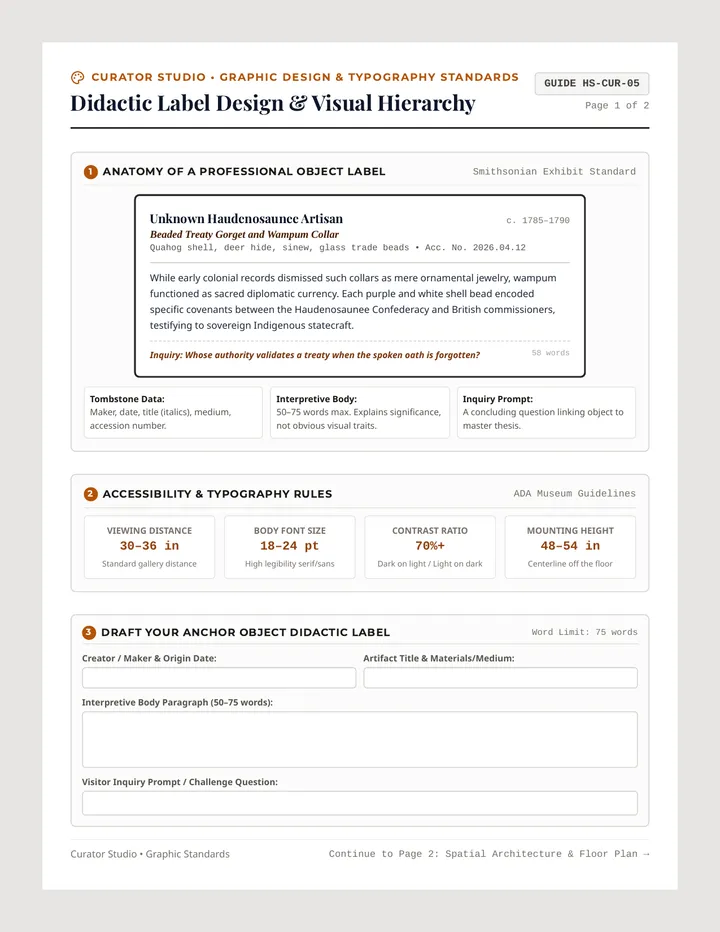
Didactic Design Guide Curator Studio • Graphic Design & Typography Standards
Didactic Label Design & Visual Hierarchy
GUIDE HS-CUR-05
Page 1 of 2
1 Anatomy of a Professional Object Label
Smithsonian Exhibit Standard
Unknown Haudenosaunee Artisan c. 1785–1790
Beaded Treaty Gorget and Wampum Collar
Quahog shell, deer hide, sinew, glass trade beads • Acc. No. 2026.04.12
While early colonial records dismissed such collars as mere ornamental jewelry, wampum functioned as sacred diplomatic currency. Each purple and white shell bead encoded specific covenants between the Haudenosaunee Confederacy and British commissioners, testifying to sovereign Indigenous statecraft.
Inquiry: Whose authority validates a treaty when the spoken oath is forgotten? 58 words
Tombstone Data: Maker, date, title (italics), medium, accession number.
Interpretive Body: 50–75 words max. Explains significance, not obvious visual traits.
Inquiry Prompt: A concluding question linking object to master thesis.
2 Accessibility & Typography Rules
ADA Museum Guidelines
Viewing Distance 30–36 in Standard gallery distance
Body Font Size 18–24 pt High legibility serif/sans
Contrast Ratio 70%+ Dark on light / Light on dark
Mounting Height 48–54 in Centerline off the floor
3 Draft Your Anchor Object Didactic Label
Word Limit: 75 words
Creator / Maker & Origin Date:
Artifact Title & Materials/Medium:
Interpretive Body Paragraph (50–75 words):
Visitor Inquiry Prompt / Challenge Question:
Curator Studio • Graphic Standards Continue to Page 2: Spatial Architecture & Floor Plan →
Curator Studio • Spatial Architecture & Exhibition Blueprint
Gallery Floor Plan & Spatial Ergonomics
GUIDE HS-CUR-06
Page 2 of 2
4 Ergonomic & Sightline Blueprint Principles
Physical visitor experience
Visual Sightline Anchor
Place your dramatic focal artifact directly visible through the entrance doorway to compel immediate visitor entry.
Traffic Circulation
Maintain minimum 48-inch pathways between vitrines to prevent bottlenecking and ensure universal wheelchair accessibility.
Lighting & Reflection
Angle directional spotlighting at 30° to prevent glare on protective vitrine glass and ensure labels are shadow-free.
5 Exhibition Floor Plan Schematic
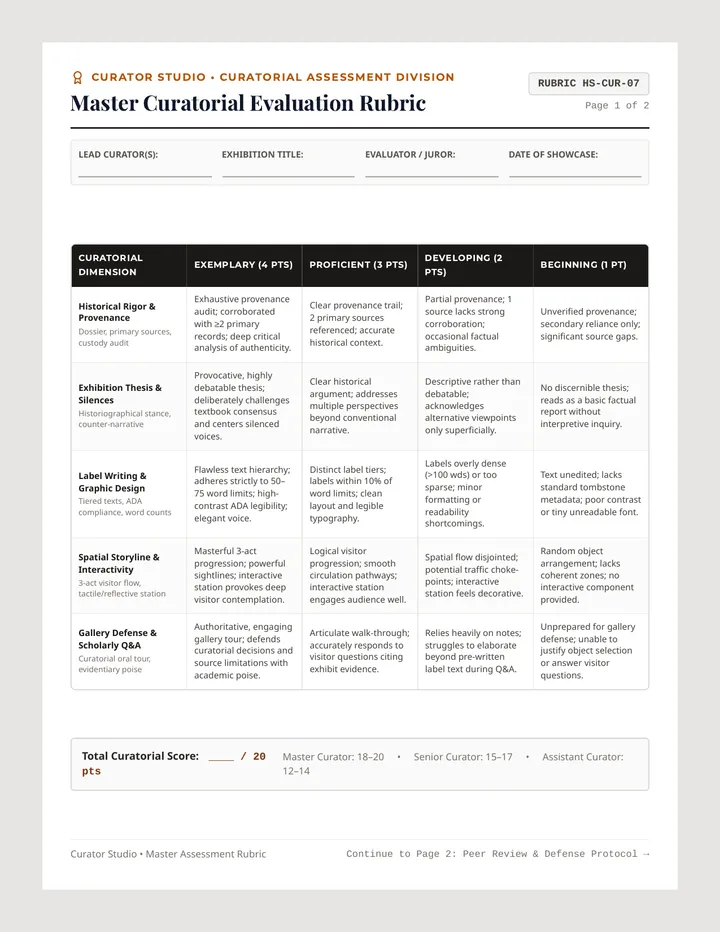
Exhibition Showcase Rubric Curator Studio • Curatorial Assessment Division
Master Curatorial Evaluation Rubric
RUBRIC HS-CUR-07
Page 1 of 2
Lead Curator(s):
Exhibition Title:
Evaluator / Juror:
Date of Showcase:
Curatorial Dimension Exemplary (4 pts) Proficient (3 pts) Developing (2 pts) Beginning (1 pt) Historical Rigor & Provenance Dossier, primary sources, custody audit Exhaustive provenance audit; corroborated with ≥2 primary records; deep critical analysis of authenticity. Clear provenance trail; 2 primary sources referenced; accurate historical context. Partial provenance; 1 source lacks strong corroboration; occasional factual ambiguities. Unverified provenance; secondary reliance only; significant source gaps. Exhibition Thesis & Silences Historiographical stance, counter-narrative Provocative, highly debatable thesis; deliberately challenges textbook consensus and centers silenced voices. Clear historical argument; addresses multiple perspectives beyond conventional narrative. Descriptive rather than debatable; acknowledges alternative viewpoints only superficially. No discernible thesis; reads as a basic factual report without interpretive inquiry. Label Writing & Graphic Design Tiered texts, ADA compliance, word counts Flawless text hierarchy; adheres strictly to 50–75 word limits; high-contrast ADA legibility; elegant voice. Distinct label tiers; labels within 10% of word limits; clean layout and legible typography. Labels overly dense (>100 wds) or too sparse; minor formatting or readability shortcomings. Text unedited; lacks standard tombstone metadata; poor contrast or tiny unreadable font. Spatial Storyline & Interactivity 3-act visitor flow, tactile/reflective station Masterful 3-act progression; powerful sightlines; interactive station provokes deep visitor contemplation. Logical visitor progression; smooth circulation pathways; interactive station engages audience well. Spatial flow disjointed; potential traffic choke-points; interactive station feels decorative. Random object arrangement; lacks coherent zones; no interactive component provided. Gallery Defense & Scholarly Q&A Curatorial oral tour, evidentiary poise Authoritative, engaging gallery tour; defends curatorial decisions and source limitations with academic poise.