Defiance at Sea Slides Echoes of Endurance • Lesson 1 Historical Inquiry
Centering Agency, Resistance & Survival
Defiance at Sea
Uncovering firsthand perspectives, shipboard rebellion, and cultural memory across the Middle Passage.
Focus: Reframing captive Africans as active historical agents
Session 1 of 2
Core Inquiry Frame 01 / Critical Lenses
Traditional Misconception
Passive Victims
Historical narratives often reduced captives to anonymous cargo tallies, erasing their human intentions, cultural knowledge, and continuous resistance.
Limits history to economic ledgers and colonial perspectives.
Historical Reality
Active Agents of Survival
Enslaved Africans waged relentless resistance: organized insurrections, hunger strikes, communication through songs, and preservation of spiritual traditions.
Affirms humanity, strategy, and enduring defiance.
Guiding Question: In what diverse ways did captive Africans resist inhumanity before reaching land?
Firsthand Testimonies 02 / Primary Accounts
Olaudah Equiano (1789)
Igbo writer and abolitionist
"I envied the inhabitants of the deep... I preferred death in any form to the dreadful condition I was in."
Equiano documents not only the physical horror, but captive solidarity and refusal to accept subjugation.
Ottobah Cugoano (1787)
Fante survivor and author
"There was nothing to be heard but the rattling of chains, smacking of whips, and the groans and cries of our fellow-men."
Cugoano explicitly recounts collective plotting among prisoners to blow up the ship rather than submit to slavery.
Key Insight: Suicide, hunger strikes, and armed conspiracy were deliberate political refusals of enslavement.
Rebellion on the Water 03 / Maritime Revolts
500+
Documented Revolts
Historical records confirm an insurrection occurred on approximately 1 out of every 10 voyages across the Atlantic.
Multi-Lingual
Cross-Ethnic Pacts
Captives from different ethnic groups overcame language divides by creating signals and rhythms to coordinate strikes.
Strategic
Calculated Timing
Rebellions most frequently erupted within sight of the African coast, where captives retained hope of swimming ashore.
Slave ships were built as fortified floating prisons solely because shipbuilders knew captives would fight to break free.
Synthesizing Survival 04 / Classroom Task
Intangible Defiance
Resistance was not only physical violence. Survival required psychological fortitude:
Singing laments and coded messages across the ship hold
Forming kinship bonds ("shipmates") that lasted across generations
Preserving sacred rituals, naming customs, and cosmologies
Activity Instructions
Middle Passage Voices Dossier
Transition to your primary source worksheet. Analyze the words of Equiano and Cugoano, identify categories of resistance, and draft your historical thesis.
Materials: Middle Passage Voices Worksheet
"They sought not merely to survive, but to remember who they were."
Middle Passage Voices Worksheet Echoes of Endurance • Lesson 1 Historical Inquiry Dossier
Middle Passage Voices Worksheet
Document Analysis
Name:
Date:
Class Period:
Investigation Focus: For centuries, colonial records documented captive Africans primarily as commercial cargo. In this dossier, you will interrogate firsthand testimonies written by African survivors to analyze how captives asserted their humanity, solidarity, and defiance during the transatlantic crossing.
Source A: Olaudah Equiano (The Interesting Narrative, 1789) Igbo survivor, kidnapped c. 1756
"The stench of the hold while we were on the coast was so intolerably loathsome... The shrieks of the women, and the groans of the dying, rendered the whole a scene of horror almost inconceivable... Two of my wearied countrymen who were chained together, preferring death to such a life of misery, somehow made through the nettings and jumped into the sea; immediately another followed their example."
1. How does Equiano interpret the captives' choice to leap into the ocean? Explain why this was an act of deliberate resistance rather than surrender:
Source B: Ottobah Cugoano (Thoughts and Sentiments, 1787) Fante author and abolitionist
"There was a conspiracy found out among us of the poor cargo to blow up the ship, in order to make our escape; and in fact they had nearly taken possession of the vessel, but were betrayed by a woman... Death was more desirable than life under such cruelty."
2. What does Cugoano's account reveal about the strategic planning, coordination, and risks taken by enslaved people aboard ship?
Echoes of Endurance • African Agency in the Transatlantic Era Page 1 of 2
Echoes of Endurance • Lesson 1 Analytical Synthesis Matrix
Typology of Shipboard Resistance
Categorize the multifaceted forms of defiance documented aboard slave vessels. For each category, describe a specific tactic and analyze its historical meaning.
Active Armed Revolt
Overpowering crew, seizing navigation, weaponizing tools, or coordinated mutiny.
Evidence & Significance:
Covert Refusal
Hunger strikes, refusing medicine, jumping overboard, and slowing forced labor.
Evidence & Significance:
Cultural & Spiritual
Laments, secret communication codes, mourning rituals, and kinship ("shipmate") bonds.
Evidence & Significance:
Summative Historical Essay Response Thesis & Evidence
Prompt: Based on the primary accounts and historical data studied today, explain why historians must reframe the Middle Passage from a story of mere victimhood to a history of continuous contestation and agency. Cite at least two specific pieces of evidence.
Shipboard Resistance Teacher Guide Echoes of Endurance • Lesson 1 Facilitation Teacher Instructional Guide
Shipboard Resistance Teacher Guide
Pacing: 50–60 Min
Pedagogical Stance: Agency Over Victimhood
When teaching the transatlantic slave trade, avoid graphic spectacle or simulations that re-enact trauma. Never simulate slave ship conditions. Frame enslaved Africans as political thinkers, strategists, and human beings navigating catastrophic violence with dignity, mutual aid, and active resistance.
Lesson Flow & Pacing Breakdown
10 MIN • HOOK Slide 1–2
Examine ledger vs. human narrative. Define agency vs. passivity.
15 MIN • DIRECT Slide 3–4
Analyze Equiano & Cugoano excerpts; review 500+ maritime revolts.
20 MIN • WORK Worksheet P1–2
Paired analysis of primary texts and completion of resistance matrix.
10 MIN • DEBRIEF Whole Class
Synthesis thesis share-out and preview of plantation resistance.
Socratic Inquiry & Teacher Prompts
Q1: Why did European captains fear mutiny near the African coast most of all?
Key Insight: Captives recognized landmarks, held geographic orientation, and knew swimming ashore meant potential reunion with land/allies. Once out at open sea, navigating European rigging became a secondary obstacle.
Q2: How did captives from different language groups communicate to stage revolts?
Key Insight: They utilized rhythmic clapping, drum-like beats against wood, melodic mourning songs with encrypted tonal shifts, and shared cosmological symbols to coordinate synchronized strikes.
Scaffolding & Support
Provide a glossary for 18th-century vocabulary ("cargo", "nettings", "conspiracy").
Offer sentence starters for the synthesis thesis ("By analyzing Equiano's testimony, historians can see that...").
Pair students for Source B analysis.
Extension & Deep Dive
Examine the Amistad (1839) or Meermin (1766) maritime revolt legal proceedings.
Compare Transatlantic Slave Trade Database (Voyages) revolt records with colonial logbooks.
Investigate how African maritime knowledge influenced revolt tactics.
Echoes of Endurance • Teacher Instructional Materials Page 1 of 1
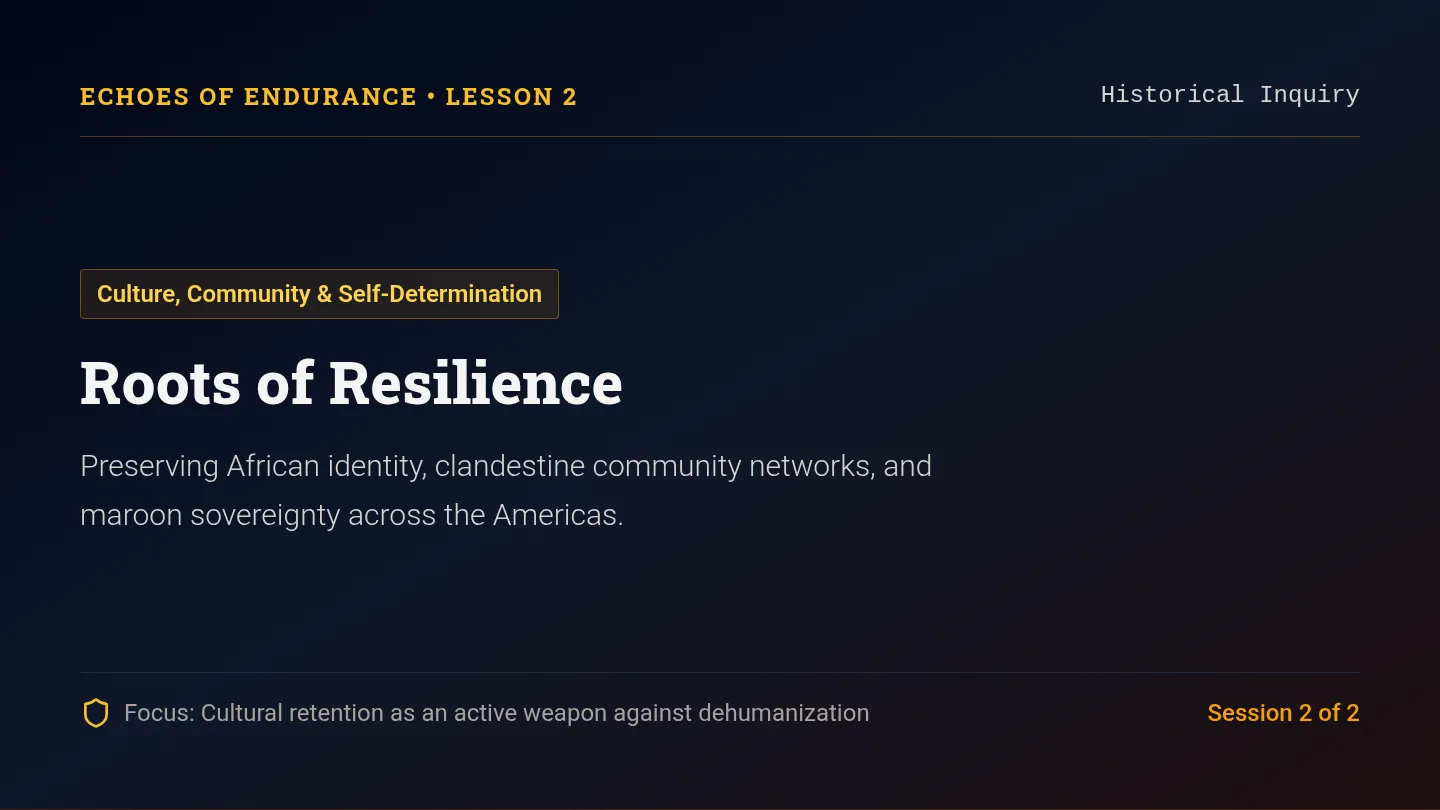
Roots of Resilience Slides Echoes of Endurance • Lesson 2 Historical Inquiry
Culture, Community & Self-Determination
Roots of Resilience
Preserving African identity, clandestine community networks, and maroon sovereignty across the Americas.
Focus: Cultural retention as an active weapon against dehumanization
Session 2 of 2
Conceptual Framework 01 / Forms of Struggle
Overt Resistance
Open Rebellion & Flight
Direct confrontations designed to dismantle slaveholder control:
• Armed rebellions (Haitian Revolution, Stono, Nat Turner)
• Marronage: Escaping to establish self-governing towns
• Destroying plantation equipment and burning crops
Covert Resistance
Daily Defiance & Culture
Subtle, daily actions safeguarding life, dignity, and heritage:
• Preserving maternal languages and naming traditions
• Clandestine literacy and nocturnal prayer meetings
• Work slow-downs and herbal healing remedies
Core Idea: Surviving with one's humanity intact was itself a victory against total subjugation.
Living Heritage 02 / Cultural Memory
Sacred Music & Code
Spirituals and ring shouts contained dual meanings: deep spiritual faith alongside escape routes and warnings.
Agrarian Wisdom
Enslaved women braided African rice, okra, and sesame seeds into their hair before forced voyages to sustain foodways.
Oral Literature
Folktales (such as Anansi the Spider) taught tactical subversion, moral resilience, and outsmarting powerful oppressors.
Key Truth: Enslaved people were not stripped of their culture; they transformed and adapted it into armor.
Sovereign Sanctuaries 03 / Marronage
Brazil • 1605–1694
Quilombo dos Palmares
A self-governing federation of over 20,000 free African and Indigenous people in northeastern Brazil that resisted Portuguese assaults for nearly a century under leaders Ganga Zumba and Zumbi.
Proved African political governance could thrive in the Americas.
Jamaica • 1720s–1739
Windward Maroons & Nanny
Led by the spiritual strategist Queen Nanny, Jamaican maroons used guerrilla mountain warfare so successfully that the British Empire was forced to sign peace treaties recognizing their sovereign land.
Defeated the world's most powerful colonial navy through asymmetric warfare.
Marronage was not just running away—it was the revolutionary construction of independent African states.
Cultural Resistance Dossier Worksheet Echoes of Endurance • Lesson 2 Cultural Resistance Dossier
Cultural Resistance Dossier Worksheet
Case Study Analysis
Name:
Date:
Class Period:
Inquiry Premise: Enslavement attempted to erase personal identity, family ties, and ancestral memory. In response, captive Africans engaged in sophisticated acts of cultural preservation that actively defied plantation regimes.
Case 1: Hair Braiding, Seed Keeping & Cartography Colombia, Suriname, Brazil
Oral histories in Palenque (Colombia) and Suriname document that enslaved women cornrowed detailed maps of escape routes, rivers, and mountains into their hair patterns. Furthermore, before crossing or fleeing into forests, mothers braided grains of African rice (Oryza glaberrima ), okra seeds, and cassava roots into their hair to ensure their communities could establish sustainable agriculture in autonomous maroon settlements.
Analysis: How did seed keeping and hair cornrowing combine technological knowledge, maternal care, and political defiance?
Case 2: The Double-Voiced Spiritual ("Steal Away") North America & Caribbean
Plantation overseers permitted enslaved people to sing religious hymns, assuming Christianity fostered obedience. However, songs like "Steal Away to Jesus" and "Wade in the Water" operated on dual registers: overtly religious to white listeners, but covertly alerting the enslaved community of secret midnight meetings in the woods or signaling an imminent escape flight.
Analysis: Why was "double-voiced" communication an effective survival strategy under constant surveillance?
Echoes of Endurance • Resistance & Cultural Sovereignty Page 1 of 2
Echoes of Endurance • Lesson 2 Comparative Strategy Matrix
Analyzing Dimensions of Resistance
Compare overt and covert methods of resistance. Analyze how both strategies worked synergistically to preserve human dignity and undermine chattel bondage.
Strategy Type
Historical Examples
Impact on Slave System
Overt Resistance (Armed revolt, marronage, flight)
Covert Resistance (Music, literacy, slowdowns, rituals)
Summative Historical Essay Core Assessment
Prompt: Historian Sterling Stuckey argued that enslaved Africans' culture was "the principal weapon with which they fought psychological death." Evaluate this claim. How did family bonds, artistic expression, and cultural retention serve as direct acts of political resistance?
Success Criteria: ☐ Analyzes at least 2 cultural forms ☐ Distinguishes overt vs. covert ☐ Connects culture to political agency
Cultural Resistance Answer Key Echoes of Endurance • Lesson 2 Assessment Key Teacher Reference & Rubric
Cultural Resistance Answer Key
Exemplars & Scoring Matrix
Part 1: Artifact Analysis Exemplar Responses
Case 1 (Braiding & Seeds) Exemplar:
Exemplar: Enslaved women transformed personal grooming into military reconnaissance and agricultural foresight. Braiding escape routes functioned as wearable maps that could not be confiscated. Concealing native seeds in their hair proved maternal forethought for communal survival, ensuring that if they escaped into maroon wilderness, they could cultivate ancestral crops and establish food sovereignty independent of the colonial plantation.
Case 2 (Coded Spirituals) Exemplar:
Exemplar: "Double-voiced" discourse exploited slaveholders' racist assumptions that enslaved people were simplistic or devoutly submissive. Under constant surveillance, overt planning was fatal. By layering geographic instructions ("wade in the water" to throw off bloodhounds) and meeting alerts onto familiar scripture, enslaved communities created an impenetrable communication network right in front of white overseers.
Part 2: Comparative Matrix Reference Points
Overt Resistance (Armed Revolt / Flight)
Examples: Stono Rebellion (1739), Nat Turner (1831), establishment of Palmares or Jamaican Maroon towns.
Systemic Impact: Created profound panic among white elites, disrupted plantation economies, and forced colonial armies to concede sovereignty or enact harsh security codes.
Covert Resistance (Cultural & Daily)
Examples: Feigning illness, tool breaking, clandestine nighttime praise houses, passing down Anansi stories and West African culinary traditions.
Systemic Impact: Denied owners maximum profit, prevented complete psychological domination, and maintained communal mental health and collective solidarity.
Part 3: Summative Essay Scoring Rubric (4-Point Scale)
4 • Advanced
Argues convincingly with nuanced historical evidence that cultural retention was a direct political assault on chattel slavery; analyzes both overt and covert dynamics.
3 • Proficient
Clear thesis connecting culture to resistance; cites at least two specific artifacts (e.g. spirituals, hair braiding) with accurate historical context.
2 • Developing
Describes cultural practices but struggles to connect how preservation functioned as active resistance rather than passive survival.
1 • Novice
Limited evidence; descriptive without thesis or understanding of how enslaved people exerted historical agency.