A reference to a well-known person, myth, place, or event. Instead of listing 10 traits, the author connects to a legendary figure!
Hercules
Legendary strength & heroic feats
Athena
Wisdom, tactical courage & defense
Zeus
Supreme power, thunder & authority
Achilles / Perseus
Bravery facing terrifying beasts
Model Passage
"The warrior, his courage as unyielding as the shield of Athena, stepped forward to face the dragon head-on, just like the legendary Perseus."
DOK 3 Question:
Why compare to Perseus instead of saying "he was very brave"?
Answer: Perseus conquered impossible monsters; the comparison elevates the battle to epic legend!
Mythological allusions instantly establish an epic, larger-than-life tone. Slide 4 of 7
Day 4
Investigate & Decode
1. Definition
The author defines the word directly in the sentence.
"devastation, or complete ruin"
2. Synonym
A word with a similar meaning appears nearby.
"his sorrow and deep sadness"
3. Antonym
An opposite word reveals the contrast.
"generous, not greedy or stingy"
4. Example
Examples clarify the category or meaning.
"generosity, like donating food"
5. Inference
Reader combines clues and background knowledge.
"stepped carefully on treacherous ice"
Practice Sentence:
"The mansion was a labyrinth of confusing corridors where she feared getting lost in the maze."
Clue Type: Synonym ("maze")
Labyrinth = complex maze
Always circle clues in the surrounding sentences to verify your inference. Slide 5 of 7
Day 5
EOG Standardized Format
Master Passage
"The warrior, as mighty as Hercules, swung his sword through the air. His strength was unparalleled, and the cold wind was relentless. Yet his fiery spirit carried him forward against the beast."
Allusion
Hercules
Metaphor
Fiery Spirit
Simile
Easy as Paper
Part A (DOK 2)
What does "unparalleled" most likely mean?
Answer: Matchless; having no equal in strength.
Part B (DOK 3 Evidence)
Which text detail proves this meaning?
Evidence: "even the gods themselves would have been in awe"
Overall Tone: Heroic, awe-inspiring, and resilient.
Part B questions always require you to pinpoint the exact clue that justifies Part A. Slide 6 of 7
Master Vault
Phonics, Morphology & Definitions
1. treacherous 7. muffled 2. glistening 8. withstand 3. foreboding 9. fiercely 4. relentless 10. unyielding 5. unparalleled 11. battered 6. labyrinth 12. serpent
Morphology Clues: Prefixes: un- (not), with- (against). Suffixes: -less (without), -ly (manner), -ing (ongoing).
treacherous: dangerously unsafe, hazardous, or deceptive.
foreboding: a strong gut feeling that trouble or evil is coming.
relentless: continuing harshly without ever stopping or easing up.
unparalleled: completely without equal; unmatched in excellence.
labyrinth: an intricate, complicated maze of paths or corridors.
Study Strategy: Connect each vocabulary word to the mentor characters we read this week!
Spelling Test & Vocabulary Quiz on Friday! Keep this master vault in your binder. Slide 7 of 7
Device:
Meaning:
Explain what character trait each mythological allusion suggests to the reader:
"Muscles like Hercules"
What trait does this show?
"Shield of Athena"
What trait does this show?
"Strength of Zeus"
What trait does this show?
"The ancient city stood battered but unbroken. Its towers rose toward the sky like giant guardians watching over the people below. Though many buildings had crumbled, hope still flickered in the hearts of the citizens."
Part A: What does the phrase hope still flickered suggest?
A. Hope was completely lost.
B. Hope remained despite great challenges.
C. Hope caused great danger for citizens.
D. Hope grew uncontrollably fast.
Part B: Which detail best supports the answer to Part A?
A. "battered but unbroken"
B. "rose toward the sky"
C. "people below"
D. "giant guardians"
How does the author's choice of words (such as battered, guardians, and flickered) establish an inspiring and resilient tone? Use evidence from the passage.
Standard RL.4.4 Student Practice Packet Page 2 of 2
Why did the author compare Maya to Perseus instead of just saying "Maya was brave"?
Thursday Night • Context Clues & EOG Prep Passage Estimated Time: 15 min
"The ancient castle walls were built to withstand even the harshest winter storms. Inside, the grand library was an endless labyrinth of winding staircases and bookshelves where scholars spent years exploring without ever reaching the outer edge."
Part A: In this passage, what does withstand mean?
A. To crumble rapidly
B. To resist and hold up against
C. To hide away safely
D. To surrender under force
Part B: Which phrase is the best clue for labyrinth?
A. "built to withstand"
B. "ancient castle walls"
C. "endless winding staircases"
D. "grand library"
Friday Assessment Readiness Checklist Review before tomorrow's quiz!
Practiced 12 spelling words
Reviewed 5 core definitions
Know Simile / Metaphor / Myth
Parent/Guardian Signature:
Date:
RL.4.4 Weekly Homework Packet Page 2 of 2
RL.4.4 Teacher Answer Key Guide Page 1 of 2
Teacher Evaluation Guide
Days 1 – 4 Solutions
a. re-lent-less: Suffix -less means "without" (without stopping/slackening).
b. un-par-al-leled: Prefix un- means "not" (not matched or equaled).
c. fore-bod-ing: Prefix fore- means "before/ahead" (sensing trouble beforehand).
d. un-yield-ing: Root word is yield (to give up/surrender).
Sentence Rubric (treacherous): Must describe a condition that causes imminent peril (e.g., icy cliff, thin ice, raging rapids).
a. "storm clouds chased": Personification (clouds given human action of chasing).
b. "shield was a wall": Metaphor (direct comparison without like/as).
c. "glistened like diamonds": Simile (uses "like" to compare snow and diamonds).
Tone Transformer Model: "Muffled footsteps crept down the shadowy hallway as the floorboards groaned under the intruder's weight."
a. Lifting crushed boulder: Hercules (Superhuman physical feat).
b. Strategy in debate: Athena (Tactical wisdom and intellect).
c. Commanding fleet: Zeus (Supreme ruler & authority).
Perseus Allusion Rationale: Comparing Maya to Perseus elevates her courage to mythic levels because Perseus faced the deadly Medusa; it prepares the reader for an epic conflict.
Part A: B • "To resist and hold up against."
Explanation: The fortress stood firm even during the harshest storms.
Part B: C • "endless winding staircases"
Explanation: Winding staircases where scholars lose their way directly provides the clue for a labyrinth.
12 Spelling Words (36 Pts)
3 points per word: 2 points for correct phonics/root, 1 point for affix accuracy.
5 Vocabulary Words (25 Pts)
5 points per word: 3 points for definition match, 2 points for correct context usage.
RL.4.4 Analysis (39 Pts)
Part A/B items (15 pts), device identification (12 pts), constructed response (12 pts).
Total Weekly Score: 100 Points • Mastery Benchmark: 80% (Grade 4 Proficient Standard)
RL.4.4 Teacher Answer Key Guide Page 2 of 2
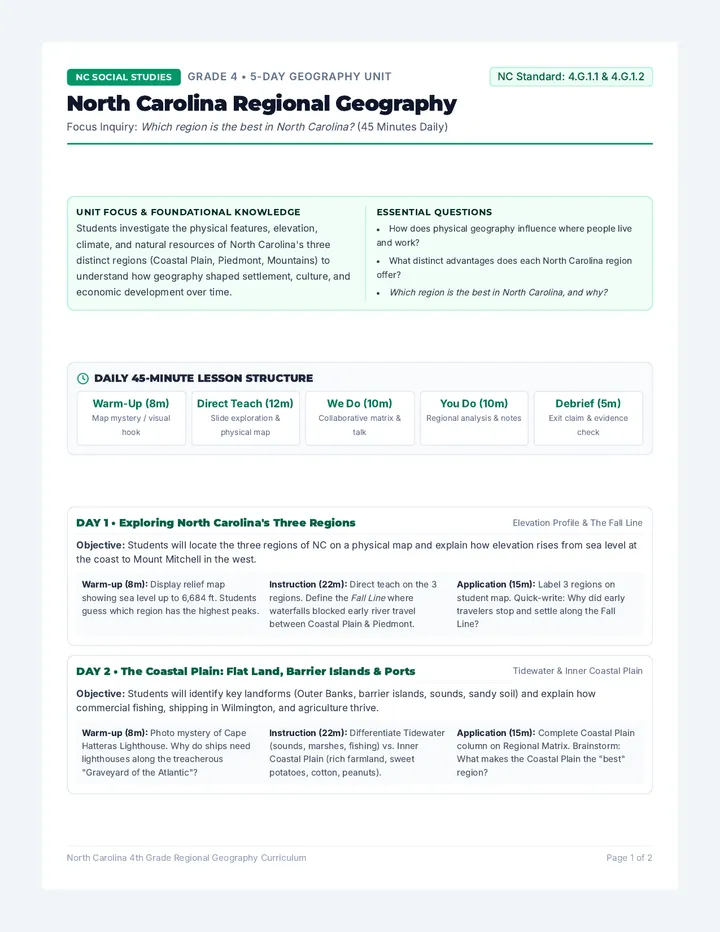
North Carolina 4th Grade Regional Geography Curriculum Page 1 of 2
Instructional Scope (Days 3 – 5)
NC SS Standards 4.G.1 & 4.E.1
DAY 3 • The Piedmont: Rolling Hills, Red Clay & Urban Engine Charlotte, Raleigh & Research Triangle
Objective: Students will analyze the physical features (rolling hills, red clay, waterfalls) of the Piedmont and explain why more than 60% of North Carolinians live in this economic hub.
Warm-up (8m): Analyze population chart: Why do Charlotte and Raleigh have more residents than all coastal or mountain towns combined?
Instruction (22m): Explore Piedmont Crescent. Discuss textile/tobacco history, shift to banking (Charlotte) and tech/universities (Research Triangle).
Application (15m): Add Piedmont details to matrix. Pair-share: What natural advantages powered factories and modern city growth?
DAY 4 • The Mountains: Peaks, Cool Climate & Cultural Heritage Appalachians, Blue Ridge & Cherokee
Objective: Students will describe the climate, high elevation, Mount Mitchell, forestry, tourism, and Cherokee Nation history in the Blue Ridge Mountains.
Warm-up (8m): Temperature comparison: Asheville vs. Wilmington on a summer day. How does elevation change temperature?
Instruction (22m): Teach Appalachian & Blue Ridge ranges, Mount Mitchell (6,684 ft), Cherokee traditions, timber, apple orchards, and tourism.
Application (15m): Finalize 3-region matrix. Students select which of the 3 regions they believe is the "best" to live, work, or visit.
DAY 5 • The Great Regional Debate & Friday Project Draft Research Sheet & Persuasive Showcase
Objective: Students will complete the attached Carolina Regions Draft Sheet (Step 1 Fact Finder, Step 2 Sentences, Step 3 Visual & Quality Check) and advocate for their chosen region in a structured debate.
Hook & Debate (15m): Four Corners debate: "Which region is the best in NC?" Students present evidence from their study matrices.
Project Work (25m): Students draft their chosen region on the Carolina Regions Draft Sheet utilizing the targeted word bank and rubric.
Closure (5m): Peer review and teacher sign-off on 4th Grade Quality Check criteria.
Differentiated Instruction & Accommodations
Support / ELL (Scaffolding)
Provide picture cards of landforms (barrier island, fall line, red clay, mountain ridge). Use sentence starters: "The ___ region is best because its physical land has ___."
On-Level (Core Mastery)
Complete all Step 1 Fact Finder categories independently and incorporate at least 3 vocabulary words into Step 2 information sentences.
Enrichment (Extension)
Research how climate change or modern transportation impacted regional industries (e.g., coastal erosion vs. mountain tourism vs. Piedmont tech corridor).
Summative Friday Project: Assessed using the 4th Grade Quality Check (2+ research facts, 2+ word bank terms, complete sentences, labeled illustration).
100 Pts Total
North Carolina 4th Grade Regional Geography Curriculum Page 2 of 2
"Warm maritime climate, abundant seafood, ocean access for world trade, and world-class beaches!"
Challenge: Hurricanes and coastal flooding risk.
Sub-regions: Tidewater (coastal marshes & sounds) and Inner Coastal Plain (rich farming belt). Slide 3 of 7
Day 3
Rolling Hills • Red Clay • Cities
"Piedmont" means "foot of the mountain." An elevated plateau of rolling hills.
• Soil: Famous iron-rich red clay
• Rivers: Catawba, Yadkin, Neuse
• Elevation: 300 to 1,500 feet
Central location connects ocean ports to western mountains.
Home to over 60% of North Carolina's population:
• Charlotte: 2nd largest US banking center
• Raleigh: State Capital & government
• Research Triangle: Tech & colleges
Shifted from old textile mills to modern medicine & tech.
The Piedmont advocacy pitch:
"The economic heartbeat! Best colleges, highest-paying career jobs, sports arenas, and vibrant city culture!"
Challenge: Heavy traffic congestion and rapid urban growth.
The Piedmont Crescent curves from Raleigh through Greensboro to Charlotte along rail corridors. Slide 4 of 7
Day 4
High Elevation • Peaks • Forests
Part of the ancient Appalachian Mountain chain:
• Blue Ridge & Great Smokies
• Mount Mitchell: 6,684 ft (highest peak)
• Climate: Cool summers, snowy winters
High elevation creates colder temperatures and dense spruce forests.
Deep traditions rooted in natural resources:
• Cherokee Heritage: Qualla Boundary
• Appalachian Crafts: Woodwork & music
• Forestry & Orchards: Apples & timber
Asheville is renowned for arts, crafts, and Biltmore Estate.
The Mountain advocacy pitch:
"Breathtaking scenic beauty, crisp mountain air, rich Cherokee history, hiking trails, and peaceful natural wonder!"
Challenge: Steep terrain makes roads and farming difficult.
Tourism flourishes year-round with autumn leaf-viewing, skiing, and national parks. Slide 5 of 7
Day 5
Evidence & Debate
Feature Coastal Plain The Piedmont The Mountains
Landforms Flat, sandy, barrier islands Rolling hills, waterfalls, red clay Steep peaks, ridges, valleys
Climate Mild, humid, coastal breezes Moderate, 4 distinct seasons Cool summers, cold snowy winters
Major Cities Wilmington, Greenville, New Bern Charlotte, Raleigh, Greensboro Asheville, Boone, Cherokee
Top Industries Farming, fishing, shipping Banking, universities, technology Forestry, tourism, apple orchards
Debate Rule: You must support your opinion with at least two physical facts from your research! Slide 6 of 7
Friday Project
Your Regional Showcase
Step 1: Fact Finder
Research and record verified data for your chosen region:
• Key landforms & water
• Important city or port
• Major industry / jobs
Select keywords from your project word bank.
Step 2: Draft Sentences
Write two detailed informative sentences:
• 1. Physical Environment: Describe the land & water.
• 2. People & Communities: Explain how people live & work.
Use capital letters and 2+ vocabulary words.
Step 3: Quality Check
Complete your draft visual element:
• Draw a map, landmark, or animal
• Write an informative caption
• Check all 4 checklist boxes
Get teacher or peer sign-off before publishing!
Turn your completed draft sheet into your final regional presentation poster or brochure! Slide 7 of 7
Caption:
4th Grade Quality Check:
2+ true facts from research
Used 2+ word bank terms
Complete sentences with capitals
Detailed picture with a caption
Teacher/Peer Sign-off:
North Carolina 4th Grade Regional Geography Project Page 2 of 3 • Piedmont
NC 4th Grade Social Studies • Regions Research Project
Name:
Date:
Class:
PART 3 • WESTERN REGION • Appalachians & Blue Ridge
Land: High Elevation • Peaks • Forests
My Project Catchphrase / Headline:
Online Source:
Keywords:
Word Bank:
Mount Mitchell elevation Blue Ridge Cherokee Appalachian forestry Asheville
Highest Point / Range: Famous peak or mountain trail:
Mountain Community: Town, city, or historic area:
Seasonal Climate / Trees: Weather patterns or timber/apples:
1. Physical Environment: How does high elevation change the climate, plants, and weather in the mountains?
2. People and Culture: Describe Cherokee heritage, Appalachian traditions, or why visitors travel to this region.
Draft Illustration (Mount Mitchell, hiking trail, cabin, or black bear):
Caption:
4th Grade Quality Check:
2+ true facts from research
Used 2+ word bank terms
Complete sentences with capitals
Detailed picture with a caption
Teacher/Peer Sign-off:
North Carolina 4th Grade Regional Geography Project Page 3 of 3 • Mountain Region
North Carolina 4th Grade Regional Geography Curriculum Page 2 of 2
North Carolina 4th Grade Regional Geography Curriculum Page 1 of 3
Evaluation & Facilitation
100-Point Assessment
Criterion Exemplary (25 Pts) Proficient (20 Pts) Developing (15 Pts)
1. Regional Geographic Accuracy
All Fact Finder boxes and sentences contain accurate, detailed facts about landforms, water, and elevation.
Contains at least 2 accurate facts; minor details missing in one category.
Contains inaccuracies or conflates features with a different NC region.
2. Domain Vocabulary Usage
Accurately uses 3+ terms from the regional word bank (e.g., tidewater, fall line, elevation).
Accurately uses 2 required word bank terms in proper context.
Uses fewer than 2 terms or uses terms incorrectly.
3. Sentence Craft & Mechanics
Both sentences are complete, informative, capitalize proper nouns (Outer Banks, Charlotte), and use correct punctuation.
Sentences are complete with minor capitalization or punctuation errors.
Fragments or run-ons that impede clear geographic explanation.
4. Visual Element & Quality Check
Detailed, relevant illustration with an informative caption; all 4 checklist boxes verified and signed off.
Illustration is relevant with a simple caption; checklist completed.
Drawing is incomplete, lacks a caption, or checklist is unchecked.
Friday Debate Facilitation Protocol: "Which Region is Best?" 15-Minute Protocol
1. Room Staging: Designate 3 areas of the room: Corner A (Coastal Plain), Corner B (Piedmont), Corner C (Mountain Region). Students take their completed Handout Page 2 to their corner.
2. Round 1 - Opening Pitch (2 min per group): One spokesperson from each region delivers their 30-second persuasive pitch highlighting their physical advantages.
3. Round 2 - Cross-Examination & Teacher Prompting (6 min): Teacher poses targeted comparative challenges:
4. Synthesis Debrief: Conclude by emphasizing that North Carolina is economically resilient precisely because each of the three regions supports and balances the others!
North Carolina 4th Grade Regional Geography Curriculum Page 2 of 3
Assessment Key
50-Point Scaled Evaluation
Region [ A ]: Mountain Region (or Mountains)
Region [ B ]: The Piedmont (or Piedmont Plateau)
Region [ C ]: The Coastal Plain
(1) Highest Peak: Mount Mitchell (6,684 ft)
(2) Boundary Line: The Fall Line (or Fall Zone)
(3) State Capital: Raleigh
(4) Major Seaport: Wilmington
(5) Barrier Islands: Outer Banks
1. Red clay soil & rolling hills: P (Piedmont)
2. Pamlico Sound & barrier islands: CP (Coastal Plain)
3. Cool summers, cold snow, timber: M (Mountains)
4. Banking in Charlotte & tech triangle: P (Piedmont)
5. Shrimp fishing & sweet potato farms: CP (Coastal Plain)
6. Cherokee Nation in Qualla Boundary: M (Mountains)
Question 1: B
Steadily rises from sea level at the coast to over 6,000 feet in the west.
Question 2: A
Waterfalls stopped ocean river boats and generated power for early mills.
Question 3: B
Barrier islands shield mainland sounds and shorelines from ocean storm waves.
"The Piedmont's physical geography directly enabled it to become North Carolina's economic and population hub. First, waterfalls along the Fall Line forced river traders to stop and build trading posts, and the rushing water provided mechanical energy to power early sawmills, gristmills, and textile factories. Second, its rolling hills and central location positioned it between the coast's shipping ports and the mountains' natural resources. This allowed railroads and highways to form the Piedmont Crescent, connecting Charlotte's banking center with government and technology in Raleigh."
4 Pts: 2+ specific physical features cited 4 Pts: Logical connection to industry/cities 2 Pts: Complete sentences & vocabulary
North Carolina 4th Grade Regional Geography Curriculum Page 3 of 3
D. They prevent ships from finding deepwater ports.
Prompt: Explain how physical geography (such as waterfalls along the Fall Line, central location, and rolling hills) helped the Piedmont become the most populated region in North Carolina.
Requirements: Include at least 2 specific geographical facts and explain how they helped industries grow.
Part 1: 20 Pts Part 2: 15 Pts Part 3: 15 Pts Part 4: 10 Pts
Total: 60 Pts Scaled
North Carolina 4th Grade Regional Geography Assessment Page 2 of 2