River Dynasties: Ancient China • Student Inquiry Packet Page 1 of 2
Collaborative Investigation (15–20 min)
Complete the comparative matrix below using your lesson notes, map packet, and primary source evidence to contrast how the two major river basins shaped ancient Chinese society.
Geographic Category
Huang He (Yellow River)
Chang Jiang (Yangtze River)
Climate & Region
Cold, dry northern plains; high winds
Warm, humid subtropical southern basin
Dominant Agricultural Crop
Key Environmental Challenge
Human Engineering Response
Political & Social Result
Write a structured 4-sentence claim evaluating whether the Huang He was primarily a blessing (cradle of life and farming) or a curse (sorrow and devastation) for early Chinese dynasties. Incorporate at least two historical terms (e.g., loess, siltation, flood control, agricultural surplus).
Score: ___ / 3
1. Define loess and explain why it was both an advantage and a hazard for farmers:
2. Name two geographic barriers and explain how they caused ancient China to develop in relative isolation:
River Dynasties: Ancient China • Student Inquiry Packet Page 2 of 2
Chang Jiang (Yangtze River)
Dominant Crops
Millet, wheat, barley (dry-field northern grains)
Wet rice (paddy cultivation), tea, silk/mulberry
Environmental Challenge
Volatile flooding, siltation raising riverbeds, course shifts
Seasonal monsoon floods, dense marshland requiring drainage
Human Engineering
Dredging riverbeds, constructing tall earthen dikes & levees
Paddy terracing, sluice gates, network of irrigation canals
Political & Social Result
Birth of earliest dynasties (Xia, Shang); centralized corvée labor
High agricultural surplus, population boom, southern trade artery
Exemplar Student Response:
"Although the Huang He brought terrible devastation that earned it the name 'China's Sorrow,' it was ultimately the vital cradle of early Chinese civilization. The annual deposition of fine, mineral-rich loess transformed the North China Plain into highly fertile soil that sustained abundant millet crops and supported surplus food production. While catastrophic floods regularly threatened farmers, the shared necessity of dredging channels and building protective levees forced local clans to unite under centralized leadership, directly fostering the creation of China's earliest dynastic states."
Claim (1 pt): Clear stance on cradle vs sorrow.
Evidence (2 pts): Cites loess fertility & flood adaptation.
Reasoning (1 pt): Connects geography to dynastic growth.
1. Define loess and explain its dual nature:
Key: Loess is fine, windblown, yellowish silt that is extremely fertile when deposited by the river. It was an advantage because it enabled bountiful crop harvests without heavy plows; however, it was a danger because it choked river channels, raised water levels above the plains, and triggered deadly flooding.
2. Name two geographic barriers and explain their impact:
Key: The Himalayan Mountains (southwest) and Gobi Desert (north) / Pacific Ocean (east) physically isolated China. This prevented early invasions, restricted cross-continental trade, and encouraged a distinct, continuous, self-sufficient culture centered on the "Middle Kingdom."
Evergreen Charter School • Teacher Instructional Reference • River Dynasties Page 2 of 2
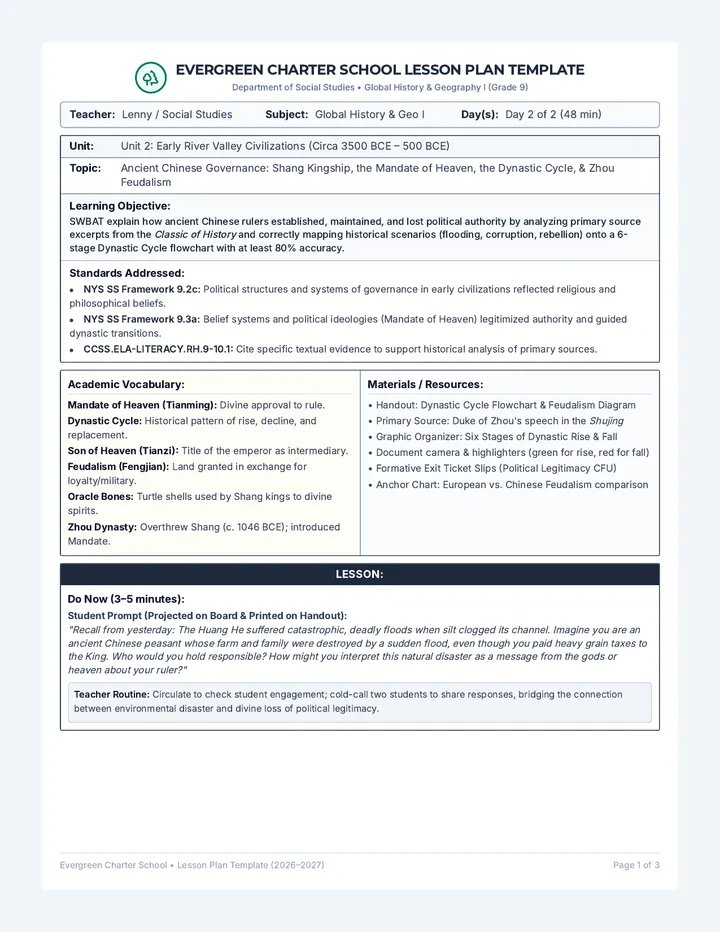
Teacher Routine: Circulate to check student engagement; cold-call two students to share responses, bridging the connection between environmental disaster and divine loss of political legitimacy.
Evergreen Charter School • Lesson Plan Template (2026–2027) Page 1 of 3
Gradual Release Model: I Do • We Do • You Do
I Do - Mini-Lesson (5–12 minutes): Direct Instruction on Governance & Legitimacy
1. Shang Theocracy to Zhou Conquest (4 min): Review how Shang kings based their rule on divination (oracle bones) and royal ancestral sacrifice. Explain that around 1046 BCE, King Wu of the Zhou dynasty overthrew the corrupt Shang king Di Xin. To justify rebelling against an established monarch, the Zhou formulated the revolutionary doctrine of the Mandate of Heaven (Tianming).
2. The Mechanics of the Mandate & Dynastic Cycle (4 min): Heaven grants supreme authority to rule only so long as the monarch governs justly and provides for the people. When a ruler becomes tyrannical or corrupt, Heaven expresses disapproval through famines, floods, and peasant riots. The mandate passes to a worthy new rebel leader who founds the next dynasty, creating the circular Dynastic Cycle.
3. Administering a Vast Realm: Zhou Feudalism (3 min): Because China was too vast for one monarch to rule directly without modern transport, the Zhou instituted Fengjian (feudalism): royal relatives and trusted nobles received regional land and peasants in return for tribute, loyalty, and military defense.
STUDENT WORK TIME (25–35 minutes)
WE Do - Class Modeling Activity:
Guided Document Analysis (The Duke of Zhou's Announcement in the Shujing): Teacher projects primary source text where the Duke explains why Shang lost power: "Heaven withdrew its mandate from Shang because their king indulged in drunken tyranny and oppressed the innocent."
Modeling Steps: Teacher highlights evidence of moral failure (corrupt taxes, neglect of dikes) in red and evidence of divine intervention (signs in nature, rebellion) in green.
Check for Understanding: Turn-and-Talk (60 sec): "How does the Mandate of Heaven make government accountable to the people in a way different from divine right absolute monarchy in other ancient cultures?"
YOU Do - Small Group/Independent Work and Learning Tasks:
Students work in collaborative pairs on the "Dynastic Cycle & Feudal Governance Activity Packet":
Task A: Dynastic Cycle Flowchart
Students sort 6 historical descriptions into their correct stage: New Dynasty → Peaceful Prosperity → Aging Dynasty → Corruption & Disaster → Loss of Mandate → Overthrow.
Task B: Zhou Feudalism Breakdown
Students analyze reciprocal obligations between King, Regional Nobles, and Peasants, identifying the fatal flaw (nobles grew militarily independent, leading to the Warring States Period).
Independent Argument Extension: Students write a 4-sentence claim evaluating: "Did the Mandate of Heaven promote political stability, or did it encourage constant rebellion?"
VERBAL CLOSING (1 minute):
Teacher brings room together: "Over these two days, we saw how China's unpredictable rivers forced society to unite, and how the Mandate of Heaven gave them a moral framework for government. Whenever rulers failed to tame floods or care for the people, the mandate fell!"
DAILY FORMATIVE: (1-2 minutes):
Exit Ticket Slip Collection: Students submit their 2-question formative check: 1. Explain how natural disasters (like floods) were linked to the Mandate of Heaven. 2. Identify one major weakness of the Zhou feudal system.
Evergreen Charter School • Lesson Plan Template (2026–2027) Page 2 of 3
Targeted Multi-Tiered Support
DIFFERENTIATION:
High Achievers: Tasked with comparing China's Mandate of Heaven to European "Divine Right of Kings." Prompt: Why did China allow for legitimate rebellion whereas European divine right forbade disobedience to the monarch?
Struggling Learners: Provided with visual step-by-step cycle diagrams with icon anchors (crown, flood wave, broken chain), sentence starters for document analysis, and word banks.
Dual-language terminology cards (English/Mandarin/Spanish) for terms like Mandate (approval/permission), Cycle (circle/repeating pattern), and Feudalism (land for protection). Graphic organizer with pictorial flowchart arrows.
Chunked reading passage with numbered lines; pre-filled graphic organizer sections (clues provided for 3 of the 6 stages); oral response option during partner share; strategic seating near peer model.
Homework:
"The Falling Dynasty" Historical Scenario Response (6–8 sentences):
Read a short scenario describing an emperor who triples peasant taxes to build a pleasure palace while river dikes collapse in flood season. Explain which stage of the Dynastic Cycle this represents, what will happen next according to the Mandate of Heaven, and why peasants feel justified in revolting.
Formative Assessment:
• Do Now CFU: Assess student understanding of environmental impacts on political trust.
• We Do Text Annotation Check: Circulate and stamp student document highlighting.
• You Do Flowchart Peer Review: Check stage ordering on Dynastic Cycle sheet.
• Daily Formative Exit Ticket: 2-question prompt scored on 0–2 point rubric.
Summative Assessment:
• Unit 2 Exam Stimulus Questions: 4 multiple-choice questions analyzing Dynastic Cycle diagrams and quotes from the Duke of Zhou.
• End of Unit DBQ: Focus on how religion and philosophy (ancestor veneration, Mandate of Heaven) structured ancient Chinese state power.
Teacher Anticipated Misconceptions & Facilitation Notes:
Evergreen Charter School • Lesson Plan Template (2026–2027) Page 3 of 3
Collaborative Activity (15–20 min)
Read the six historical scenarios in the bank below. Place each stage letter (A–F) into the correct chronological step in the cyclical diagram:
[A] Unchecked flooding on the Huang He drowns crops; bandits and peasant rebellions break out.
[B] Rebel leader captures capital, overthrows corrupt monarch, and claims the Mandate of Heaven.
[C] New ruler restores peace, repairs river dykes, redistributes land, and lowers peasant taxes.
[D] Dynasty is declared to have lost the Mandate of Heaven; rivals claim moral right to rule.
[E] Several generations pass; peace brings wealth, population growth, and architectural achievements.
[F] Later emperors raise taxes for luxury palaces; officials become corrupt; infrastructure decays.
Stage 1: Mandate Claimed Rebel claims authority
Stage 2: Golden Age Repairs, peace, growth
Stage 3: Peak Prosperity Generations of stability
Stage 4: Aging & Decay High taxes, corruption
Stage 5: Crises & Floods Disasters, peasant unrest
Stage 6: Loss of Mandate Dynasty overthrown
To rule large territories without modern roads or instant communication, the Zhou king granted control over large areas of land to royal family members and loyal noble lords. In return, the lords owed the king military troops and tribute grain.
Why did this feudal system eventually backfire and lead to civil war (The Warring States Period)?
Score: ___ / 2
1. Why was an environmental catastrophe (like a major flood) viewed as political proof that a ruler had lost the Mandate of Heaven?
2. How is the Mandate of Heaven different from an absolute monarchy where a king can never be lawfully overthrown?
Heavenly Mandate: Ancient Chinese Government • Student Inquiry Packet Page 2 of 2
Stage 4: [ F ] Later emperors raise taxes for luxury; corruption spreads.
Stage 5: [ A ] Floods destroy crops; dykes break; peasant revolts erupt.
Stage 6: [ D ] Dynasty loses Mandate; rivals claim moral right to rule.
Exemplar Answer:
"Over several generations, the local noble lords who held regional land became more wealthy, powerful, and militarily self-sufficient. As family ties to the Zhou royal court weakened, the regional lords stopped sending tribute grain or military forces to the Zhou king. Instead, they built private armies, minted their own coins, and began fighting each other for total dominion, plunging ancient China into centuries of brutal civil warfare known as the Warring States Period."
1. Floods as proof of losing the Mandate:
Key: The ruler was responsible for maintaining harmony between humans and the natural world, including dredging rivers and reinforcing dykes. An unchecked flood proved that the emperor was either too incompetent to maintain public works or too immoral to retain Heaven's favor.
2. Contrast with absolute monarchy:
Key: Absolute monarchy (such as European Divine Right) claims that royal authority is unconditional and rebellion is a mortal sin. By contrast, the Mandate of Heaven makes political authority conditional upon virtue, directly legitimizing rebellion against tyrannical rulers.
Evergreen Charter School • Teacher Instructional Reference • Heavenly Mandate Page 2 of 2