Lenny.com
Explore
Create
ActivitiesNewMathEnglish Language ArtsScience & EngineeringSocial StudiesGlobal LanguagesHealth & Physical EducationSpecial EducationCounseling & Life SkillsArts & CreativityESL
Lenny.com
Lenny.com
Explore
Create
ActivitiesNewMathEnglish Language ArtsScience & EngineeringSocial StudiesGlobal LanguagesHealth & Physical EducationSpecial EducationCounseling & Life SkillsArts & CreativityESL
Lenny.com
Lenny.com

Solutions

Lenny for EducatorsLenny for SchoolsLenny for Districts

Product

ExploreSign inCreateSupportAbout

Resources

Getting startedMTSS Acceleration Program

Newsletters

School Funding Newsletter

© 2026 Lenny Learning Inc.

TermsPrivacyAccessibility
LinkedInInstagramX
Lenny

Location Words

Prepositions of place and spatial awareness concepts for early learners. Identifies positional relationships using terms like in, on, under, beside, and between.

Social StudiesSocial Studies PracticesLocation WordsMapsOrder EventsChronology and CausationEvaluating SourcesHistorical ThinkingGeography, Humans, & the EnvironmentAmerican Symbols and LandmarksCitiesStatesState CapitalsRegions of the United StatesGeographic SkillsPhysical GeographyHuman GeographyRegional GeographyGeography of AfricaGeography of AsiaGeography of EuropeGeography of OceaniaGeography of the AmericasSociety and Environment of EuropeSociety and Environment of AsiaSociety and Environment of The AmericasSociety and Environment of the Middle EastSociety and Environment of AfricaHistoryPrehistoryComparing Ancient River CivilizationsAncient MesopotamiaAncient Egypt and KushAncient South AsiaEarly ChinaGreeceRome and the Byzantine EmpireAncient World HistoryNative Peoples of North AmericaNative Peoples of Mesoamerica and South AmericaAfrican EmpiresMedieval AsiaMedieval EuropeThe Silk RoadMedieval HistoryIslamic EmpiresWorld ReligionsRenaissance PeriodAge of ExplorationThe Thirteen ColoniesThe American RevolutionUS History Early RepublicFounding of the United StatesUS History AntebellumUS Civil WarReconstruction PeriodThe Gilded AgeUS ImperialismWorld ImperialismWorld War IUS History 1920sGreat DepressionWorld War IIThe Cold WarUS History 1950-60sUS History 1960s-70sWorld History 20th CenturyContemporary US HistoryContemporary World HistoryHolidaysCivics and GovernmentCitizenshipGovernment FoundationsThe ConstitutionUS ConstitutionExecutive BranchLegislative BranchJudicial BranchState and LocalPolitical ParticipationPublic PolicyPolitical SystemsPower and AuthoritySocial MovementsDefining DevianceTheories of DevianceCrime and Criminal JusticeEconomicsBasic Economic PrinciplesSupply and DemandWhat is MoneyEconomic FundamentalsMicroeconomicsMacroeconomicsBanking and FinanceEconomic SystemsGlobal EconomicsCorporations and PowerThe Changing WorkplaceUnemployment and LaborClass and InequalitySocial MobilityGlobal InequalityPsychologyHistory of PsychologyPsychology as a ScienceBrain and Nervous SystemNeuroscience and BehaviorGenetics and BehaviorSleep and ConsciousnessSensory ProcessesPerceptual OrganizationClassical ConditioningOperant ConditioningObservational LearningCognitive LearningMemory ProcessesThinking and Problem SolvingLanguage and CognitionTheories of MotivationStress and CopingPrenatal and Infant DevelopmentChildhood DevelopmentAdolescent DevelopmentAdulthood and AgingSelf and IdentitySocial CognitionSocial InfluenceAttraction and RelationshipsGroup BehaviorPrejudice and DiscriminationAnxiety and Mood DisordersClinical PsychologyForensic PsychologyPhilosophy & EthicsIntroduction to PhilosophyMajor Philosophers & IdeasMind and Body ProblemFree Will vs DeterminismEthics & MoralityReligion & PhilosophyPolitical Philosophy

Videos

Exploring Earth's Seven Continents and Five Oceans

Exploring Earth's Seven Continents and Five Oceans

Join Jessi and her feathered friends, Webb and Bill the ducks, for an exciting global expedition right from the classroom! This engaging video introduces young learners to the concept of a globe as a model of the Earth, distinguishing between the blue water that covers most of our planet and the colorful landmasses where people and animals live. Through clear animations and a physical globe demonstration, students will visualize the Earth as a sphere rather than a flat map. The video systematically breaks down the Earth's geography into its major components: the seven continents and the five oceans. It guides viewers through a tour of North America, South America, Africa, Europe, Asia, Australia, and Antarctica, highlighting their relative locations and sizes. Following the land tour, the lesson dives into the hydrosphere, explaining the difference between fresh and salt water and identifying the Pacific, Atlantic, Indian, Arctic, and Southern Oceans. Ideal for early elementary geography units, this resource simplifies complex spatial concepts into digestible facts. It addresses the difference between continents and countries, visualizes the vastness of the oceans compared to land, and helps students locate their own place on the planet. The use of puppets and high-contrast animations makes abstract geographical concepts concrete and memorable for young students.
SciShow KidsSciShow Kids

4mins 8s

Learning to Read a Map Key with Hide and Seek

Learning to Read a Map Key with Hide and Seek

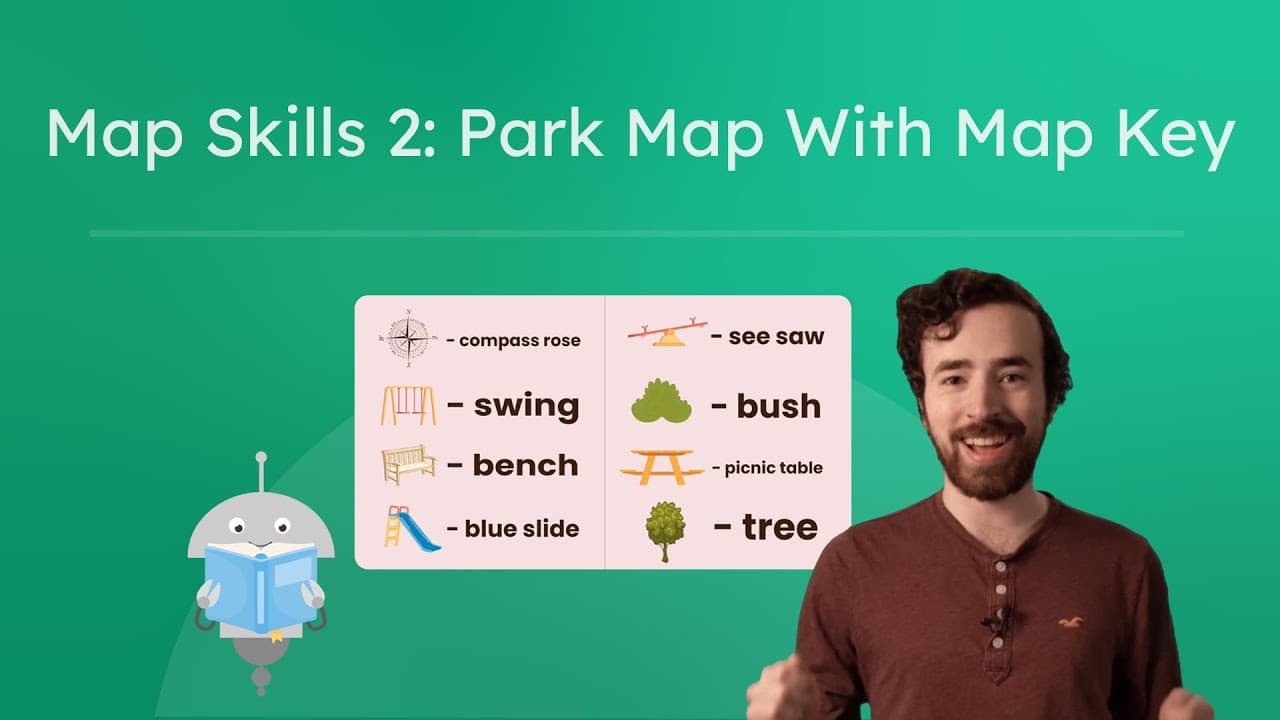
This engaging educational video introduces young learners to the concept of reading maps through the use of a map key. Using a relatable analogy, the host connects the familiar concept of emojis on a phone to symbols on a map, making abstract geographic concepts accessible to early elementary students. The video features a clear, step-by-step breakdown of a park map's key, identifying common symbols like slides, picnic tables, and trees. The core of the video is an interactive "Hide and Seek" game where students apply their new knowledge to find three missing puppies on a map of a park. The host provides riddle-like clues based on map symbols (e.g., "near something tall and blue"), encouraging viewers to actively scan the map and deduce locations. This segment reinforces spatial reasoning and symbol recognition in a fun, low-stakes environment. The lesson concludes with an animated rap music video that broadens the scope to include cardinal directions (North, South, East, West) and physical geographic features like mountains and rivers. Teachers can use this video to introduce a unit on geography, map skills, or spatial thinking. It effectively bridges the gap between concrete objects and their abstract representations, providing a solid foundation for more advanced social studies topics.

Miacademy & MiaPrep Learning ChannelMiacademy & MiaPrep Learning Channel

7mins 22s

Sequences

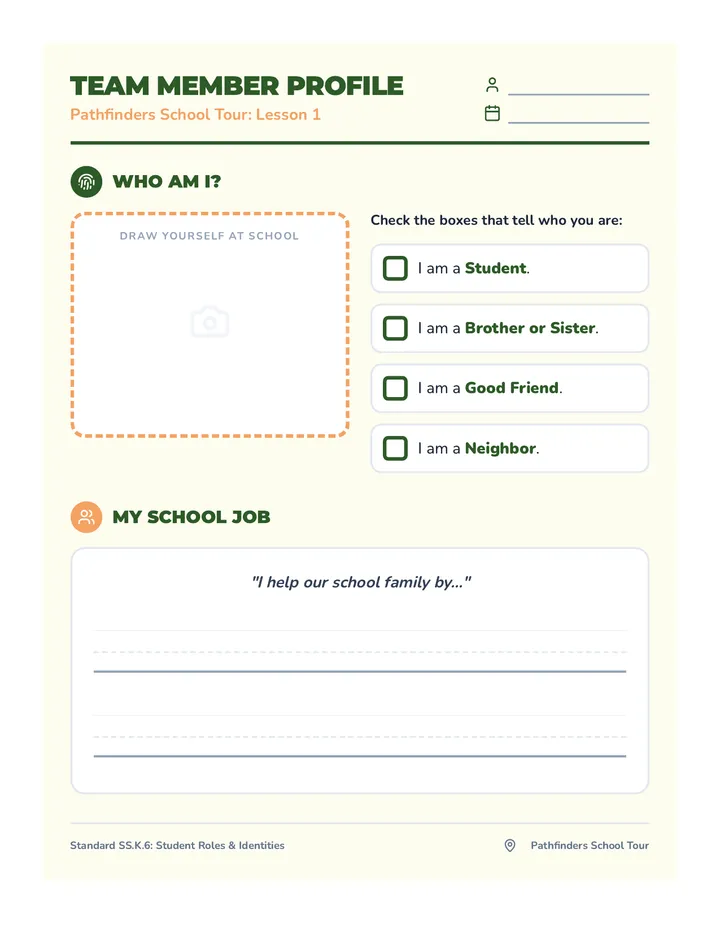
Team Member Profile Worksheet

Pathfinders School Tour

A 30-day PBL journey where kindergarteners become school experts, exploring roles, comparing spaces, and mapping routes to produce a professional video tour for new students.

S

schrauthb

7
Town Places Slides

Little Town Explorers

A foundational early childhood social studies sequence introducing young learners to neighborhood places, maps, and community helpers. Students explore where helpers work, the tools they use, and how simple maps help us navigate our world.

CG

Cidney Graham

1
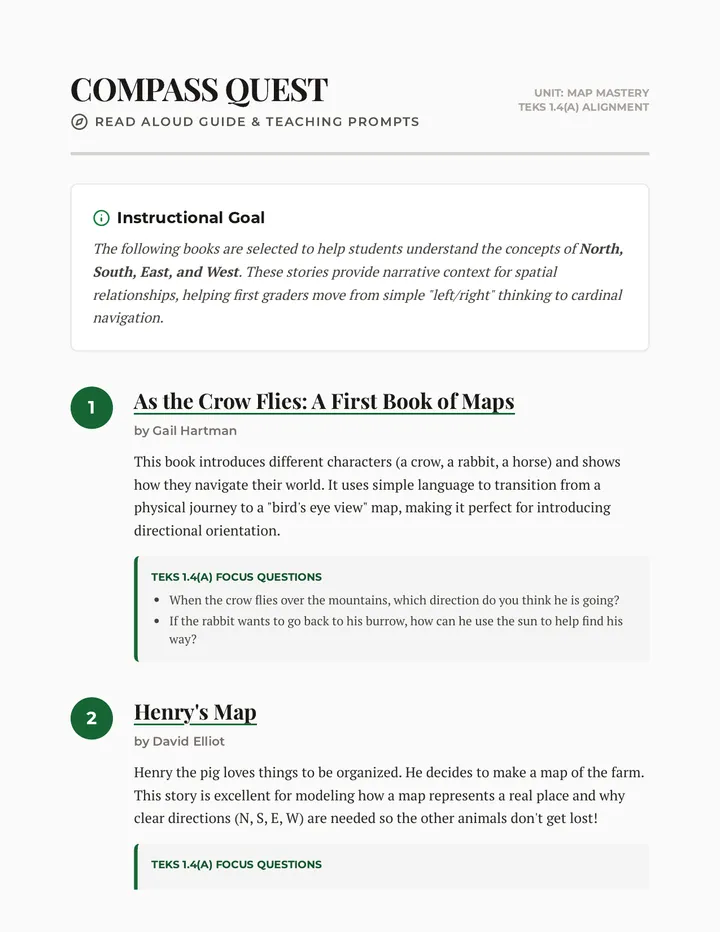
Compass Quest Read Aloud Guide

Map Mastery

A social studies unit designed to introduce primary students to basic geography skills, mapping, and spatial reasoning aligned with 1st grade standards.

SK

Shelley Kile

3
Center Spotters Slides

Locating Objects in the Classroom Environment

A Pre-K sequence introducing location words (on, under, next to, near, far) through classroom exploration, games, and modeling to build early geography skills.

11
Where I Live Teacher Guide

Little World Explorers

A 10-day integrated Kindergarten Social Studies and ELA unit exploring personal geography, addresses, neighborhood communities, maps, globes, and spatial thinking through oral language, shared reading, and hands-on experiments.

6
Blue Marble Slides

Landform Explorers

A Kindergarten sequence focused on identifying and distinguishing Earth's landforms and water bodies. Students progress from basic land/water distinction to creating physical models of mountains, hills, plains, valleys, rivers, and lakes.

11

Lessons

Compass Explorers Slides

Compass Explorers

A fun first-grade introduction to cardinal directions (North, South, East, West) and the compass rose. Students explore map navigation through catchy mnemonics, whole-body movement, treasure hunt maps, and hands-on crafts.

EB

Emily Brown

3
Map Adventures Slide Deck

Map Explorers

A foundational 1st-grade geography lesson introducing map distances, near versus far concepts, grid counting, and basic map scale using counting blocks and steps. Students learn that maps shrink the big real world into tiny drawings they can measure.

EB

Emily Brown

3
Map Masters Slides

Community Cartographers

Students will learn to navigate their local community by mastering map keys and symbols. This lesson includes instructional slides, a reading passage, and a hands-on mapping activity.

L

liagouret

4
Gods and Temples Reader Remake Final

Writing in Mesopotamia

A lesson exploring the development and importance of writing in ancient Mesopotamia, specifically cuneiform and the role of scribes.

S

sieva

59
Map Navigator Slides

Map Masters

An introductory lesson on United States geography, focusing on state identification, capital cities, and the practical use of a compass rose for navigation.

L

Lindsey

5
Big Map Slides

Big Place Small Place

A foundational geography lesson designed for early emergent learners to distinguish between their state (Texas) and their country (USA) using visual nesting and simple categorization.

S

sjcarr

4