Compass Quest Read Aloud Guide
Compass Quest
Read Aloud Guide & Teaching Prompts
UNIT: MAP MASTERY
TEKS 1.4(A) ALIGNMENT
Instructional Goal
The following books are selected to help students understand the concepts of North, South, East, and West. These stories provide narrative context for spatial relationships, helping first graders move from simple "left/right" thinking to cardinal navigation.
1
As the Crow Flies: A First Book of Maps
by Gail Hartman
This book introduces different characters (a crow, a rabbit, a horse) and shows how they navigate their world. It uses simple language to transition from a physical journey to a "bird's eye view" map, making it perfect for introducing directional orientation.
TEKS 1.4(A) Focus Questions
- When the crow flies over the mountains, which direction do you think he is going?
- If the rabbit wants to go back to his burrow, how can he use the sun to help find his way?
2
Henry's Map
by David Elliot
Henry the pig loves things to be organized. He decides to make a map of the farm. This story is excellent for modeling how a map represents a real place and why clear directions (N, S, E, W) are needed so the other animals don't get lost!
TEKS 1.4(A) Focus Questions
- Henry put the barn at the top of his map. In most maps, what direction is at the top?
- If Henry wants the sheep to go to the wool shed, which way should they walk?
3
North, South, East, and West
by Margaret Wise Brown
A little bird learns from its mother about the four directions before flying off to find its own home. The rhythmic text helps students memorize the four cardinal points and associate them with the changing seasons and travel.
TEKS 1.4(A) Focus Questions
- When the birds fly south for winter, what changes do they see?
- Point to the north wall of our classroom. If the bird flew that way, what would he see?
4
Follow That Map!
by Scot Ritchie
An interactive picture book that follows five friends as they search for a missing cat and dog. It introduces map symbols, legends, and specifically includes a compass rose on every page, encouraging students to track the characters' movement.
TEKS 1.4(A) Focus Questions
- Look at the compass rose on this page. If the friends go East, where will they land?
- Can you use your finger to trace a path West from the park to the school?
Anchor Chart Connection
While reading, create an anchor chart with a large Compass Rose. Have students come up and place a "character sticker" on the direction the book mentions.
NORTH = TOP (POLE)
SOUTH = BOTTOM (ICE)
EAST = SUNRISE
WEST = SUNSET
Navigator Notes Slides
Navigator Notes
Finding Our Way Around the World
What is a Direction?
A direction is the way you go to get to a place.
We use Cardinal Directions to talk about North, South, East, and West!
Meet the Compass Rose
This special tool on a map shows us which way is which!
Found in corners of maps
Points in 4 main directions
NORTH
SOUTH
EAST
WEST
North
Point to the North Pole!
South
Point to the South Pole!
The Sun's Path
EAST
The sun rises here!
WEST
The sun sets here!
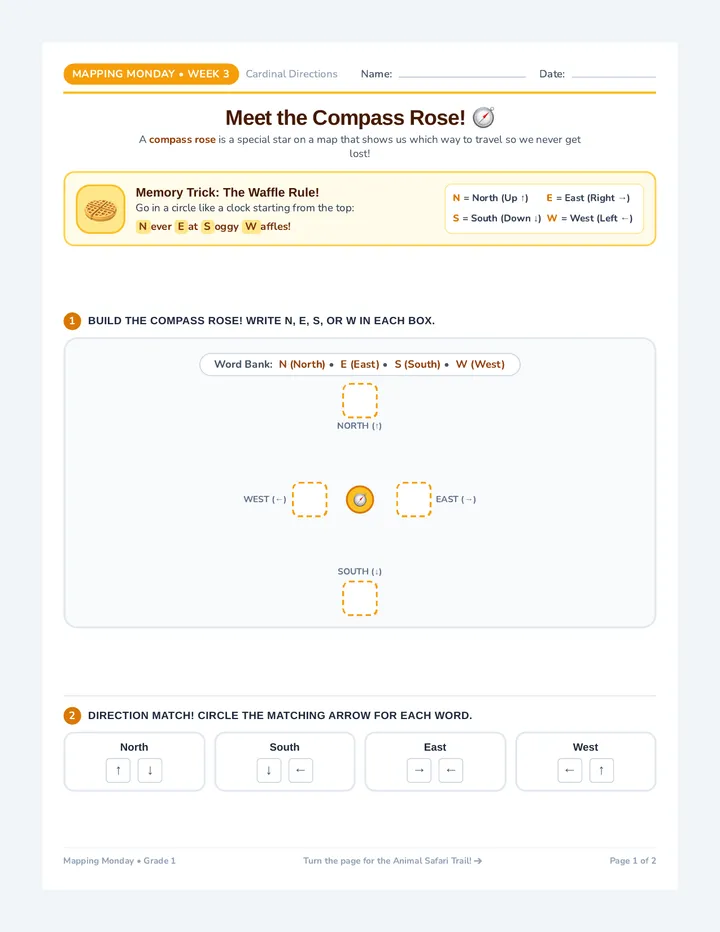
How to remember the order?
N
Never
E
Eat
S
Soggy
W
Waffles
Go clockwise from the top!
Backyard Scout Worksheet
Name:
Date:
Backyard Scout
Map Mastery Worksheet
1
Label Your Compass
Fill in the missing letters for North, South, East, and West!
N
___
___
___
Word Bank
2
The Hidden Garden
Look at the map and answer the questions using North, South, East, or West.
HOUSE
CAMP
FOREST
LAKE
1. To go from the House to the Lake, you must walk:
2. The Forest is ____________ of the compass rose.
3. If you are at the Camp and walk East, you reach the:
SCOUT CHALLENGE
Find one object in your classroom that is to the NORTH of your desk. Draw it in the space below!