Lenny.com
Explore
Create
ActivitiesNewMathEnglish Language ArtsScience & EngineeringSocial StudiesGlobal LanguagesHealth & Physical EducationSpecial EducationCounseling & Life SkillsArts & CreativityESL
Lenny.com
Lenny.com
Explore
Create
ActivitiesNewMathEnglish Language ArtsScience & EngineeringSocial StudiesGlobal LanguagesHealth & Physical EducationSpecial EducationCounseling & Life SkillsArts & CreativityESL
Lenny.com
Lenny.com

Solutions

Lenny for EducatorsLenny for SchoolsLenny for Districts

Product

ExploreSign inCreateSupportAbout

Resources

Getting startedMTSS Acceleration Program

© 2026 Lenny Learning Inc.

TermsPrivacyAccessibility
LinkedInInstagramX
Lenny

Ancient South Asia

Archaeological origins of the Indus Valley Civilization alongside the cultural shifts of the Vedic period. Examines the rise of early empires, the evolution of major world religions, and social structures across the subcontinent.

Social StudiesSocial Studies PracticesLocation WordsMapsOrder EventsChronology and CausationEvaluating SourcesHistorical ThinkingGeography, Humans, & the EnvironmentAmerican Symbols and LandmarksCitiesStatesState CapitalsRegions of the United StatesGeographic SkillsPhysical GeographyHuman GeographyRegional GeographyGeography of AfricaGeography of AsiaGeography of EuropeGeography of OceaniaGeography of the AmericasSociety and Environment of EuropeSociety and Environment of AsiaSociety and Environment of The AmericasSociety and Environment of the Middle EastSociety and Environment of AfricaHistoryPrehistoryComparing Ancient River CivilizationsAncient MesopotamiaAncient Egypt and KushAncient South AsiaEarly ChinaGreeceRome and the Byzantine EmpireAncient World HistoryNative Peoples of North AmericaNative Peoples of Mesoamerica and South AmericaAfrican EmpiresMedieval AsiaMedieval EuropeThe Silk RoadMedieval HistoryIslamic EmpiresWorld ReligionsRenaissance PeriodAge of ExplorationThe Thirteen ColoniesThe American RevolutionUS History Early RepublicFounding of the United StatesUS History AntebellumUS Civil WarReconstruction PeriodThe Gilded AgeUS ImperialismWorld ImperialismWorld War IUS History 1920sGreat DepressionWorld War IIThe Cold WarUS History 1950-60sUS History 1960s-70sWorld History 20th CenturyContemporary US HistoryContemporary World HistoryHolidaysCivics and GovernmentCitizenshipGovernment FoundationsThe ConstitutionUS ConstitutionExecutive BranchLegislative BranchJudicial BranchState and LocalPolitical ParticipationPublic PolicyPolitical SystemsPower and AuthoritySocial MovementsDefining DevianceTheories of DevianceCrime and Criminal JusticeEconomicsBasic Economic PrinciplesSupply and DemandWhat is MoneyEconomic FundamentalsMicroeconomicsMacroeconomicsBanking and FinanceEconomic SystemsGlobal EconomicsCorporations and PowerThe Changing WorkplaceUnemployment and LaborClass and InequalitySocial MobilityGlobal InequalityPsychologyHistory of PsychologyPsychology as a ScienceBrain and Nervous SystemNeuroscience and BehaviorGenetics and BehaviorSleep and ConsciousnessSensory ProcessesPerceptual OrganizationClassical ConditioningOperant ConditioningObservational LearningCognitive LearningMemory ProcessesThinking and Problem SolvingLanguage and CognitionTheories of MotivationStress and CopingPrenatal and Infant DevelopmentChildhood DevelopmentAdolescent DevelopmentAdulthood and AgingSelf and IdentitySocial CognitionSocial InfluenceAttraction and RelationshipsGroup BehaviorPrejudice and DiscriminationAnxiety and Mood DisordersClinical PsychologyForensic PsychologyPhilosophy & EthicsIntroduction to PhilosophyMajor Philosophers & IdeasMind and Body ProblemFree Will vs DeterminismEthics & MoralityReligion & PhilosophyPolitical Philosophy

Videos

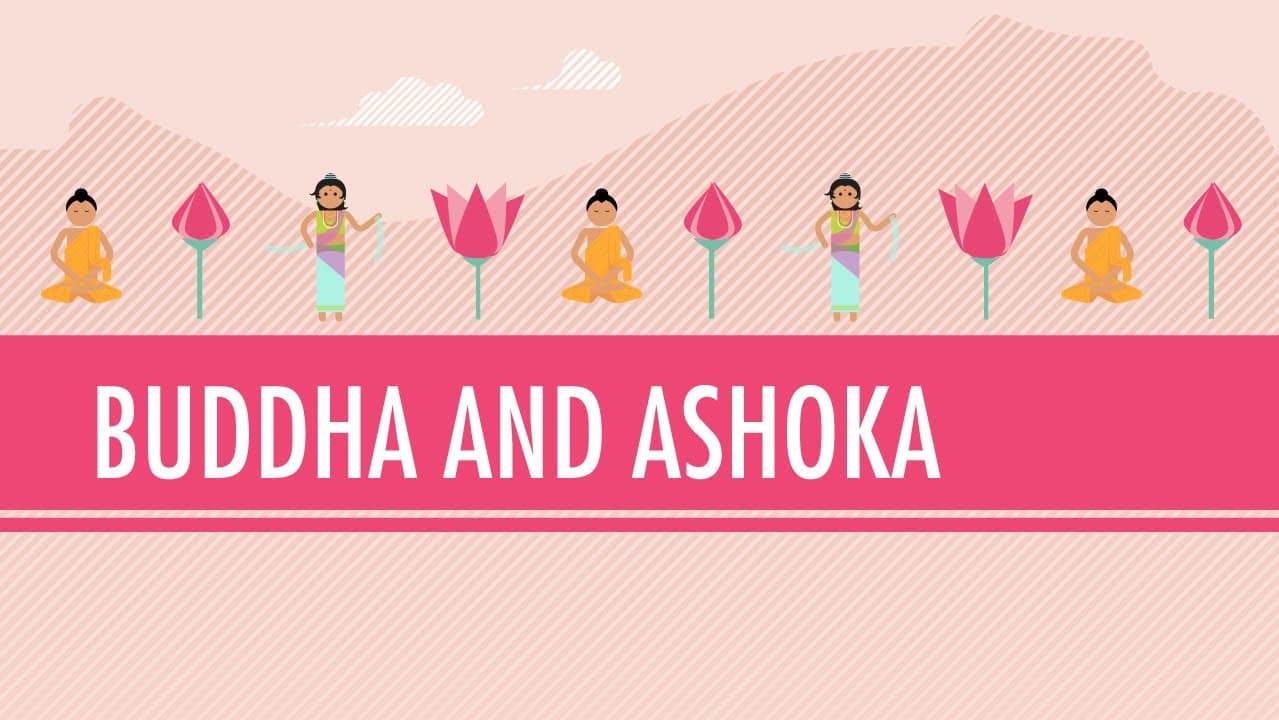
How Hinduism and Buddhism Shaped Ancient India

How Hinduism and Buddhism Shaped Ancient India

In this installment of Crash Course World History, John Green tackles the complex and vibrant history of India, focusing on the development of two major world religions: Hinduism and Buddhism. The video navigates the challenges of studying Indian history, such as the vast diversity of the subcontinent and the biases of British historians, before diving into the structural foundations of Indian society. Green explains the origins of the caste system through the Vedic myth of Purusha and connects it to the concepts of Dharma (duty), Karma (action/consequence), and Samsara (the cycle of rebirth), illustrating how these spiritual beliefs enforced social cohesion for millennia. The narrative then shifts to the story of Siddhartha Gautama and the birth of Buddhism as a reaction to the rigid social hierarchy of Hinduism. Green details the Four Noble Truths and the Eightfold Path, explaining Buddhism's appeal to lower-caste individuals. The video also covers the Mauryan Empire under Emperor Ashoka, a warrior-turned-pacifist who attempted to rule through Buddhist principles (Dhamma) after witnessing the devastation of war. Special attention is given to Ashoka's pillars and stupas as historical artifacts. For educators, this video is an invaluable tool for simplifying abstract religious and philosophical concepts. It provides a clear framework for comparing Hinduism and Buddhism, exploring how religious beliefs shape political structures, and discussing the concept of historical bias. The engaging animations and humor make difficult topics like the caste system and metaphysical ethics accessible to high school students, serving as a perfect launchpad for discussions on social stratification, religious syncretism, and ancient governance.

CrashCourseCrashCourse

12mins 17s

Why and How People Move: The Geography of Migration

Why and How People Move: The Geography of Migration

This educational video from Crash Course Geography provides a comprehensive overview of human migration, using the vast Indian diaspora as a primary case study to illustrate key concepts. Hosted by Alizé Carrère, the video breaks down the "how" and "why" of human movement, moving beyond simple definitions to explore the complex historical, economic, and environmental drivers behind migration. It covers a wide range of migration types, from the historical indentured labor systems in Trinidad and Tobago to ancient monsoon-driven trade routes, and modern political displacements like the 1972 expulsion of Asians from Uganda.

CrashCourseCrashCourse

11mins 16s

Mapping the World: History, Types, and Essential Skills

Mapping the World: History, Types, and Essential Skills

This comprehensive video introduces students to the fundamental concepts of cartography, tracing the evolution of mapmaking from ancient clay tablets to modern digital visualizations. It begins by exploring how ancient civilizations like the Babylonians, Indians, and Chinese first documented their surroundings to communicate spatial information. The narrative moves through significant historical milestones, including the "birth certificate of America" and the artistic "Leo Belgicus" map, while also sharing the fascinating story of "paper towns" used to catch copyright infringers. The video breaks down the technical aspects of geography by categorizing maps into three main types: physical, political, and special purpose. It provides clear definitions and visual examples for each category, helping students distinguish between maps that show natural features versus human-made boundaries. The instruction then shifts to essential map-reading skills, detailing critical components such as the compass rose, map keys (legends), scale ratios, and the global grid system of latitude and longitude. For educators, this resource serves as an excellent anchor for a geography unit. It combines historical context with practical skills, making it versatile for both social studies and STEM applications. Teachers can use the segment on "paper towns" to spark discussions about intellectual property, while the sections on scale and coordinates offer direct mathematical applications. The video effectively bridges the gap between viewing a map as a simple picture and understanding it as a complex data visualization tool.

Miacademy & MiaPrep Learning ChannelMiacademy & MiaPrep Learning Channel

10mins 25s

Rethinking the Dark Ages: Islam, China, and Medieval Europe

Rethinking the Dark Ages: Islam, China, and Medieval Europe

In this installment of Crash Course World History, John Green challenges the Eurocentric concept of the "Dark Ages," a period conventionally dated from the fall of Rome to the Renaissance. While admitting that Medieval Europe did experience a decline in trade, urbanization, and cultural output relative to the Roman Empire, the video argues that this darkness was local rather than global. Through rapid-fire humor and historical analysis, Green explains the structure of European feudalism—a decentralized system of lords, vassals, and peasants—and contrasts it with the thriving civilizations flourishing elsewhere during the same era. The video shifts focus to the Islamic Golden Age under the Umayyad and Abbasid Empires, highlighting Baghdad as a global center of learning where scholars preserved Greek philosophy and pioneered advancements in medicine, mathematics (algebra), and engineering. It also explores the achievements of the Tang and Song Dynasties in China, noting their inventions of gunpowder, paper money, and iron production techniques that far outpaced Europe. The narrative emphasizes how the Abbasid openness to foreign ideas and the meritocratic governance in China led to periods of immense prosperity and innovation. For educators, this video is an excellent tool for teaching comparative history and historiography. It helps students deconstruct historical labels and understand that history happens simultaneously across the globe. Teachers can use it to introduce the political mechanics of feudalism, the scientific contributions of the Islamic world, or the technological prowess of medieval China. The video serves as a perfect launchpad for discussions about how we name historical periods and the importance of looking beyond a single continent's narrative.

CrashCourseCrashCourse

12mins 8s

Beyond India: Exploring the Other Countries of South Asia

Beyond India: Exploring the Other Countries of South Asia

This educational video explores the geography, history, and culture of South Asian countries excluding India, specifically focusing on Pakistan, Afghanistan, Nepal, Bhutan, Bangladesh, Sri Lanka, and the Maldives. The narrator guides viewers through a comprehensive regional analysis, starting with physical characteristics like the Himalayas and river deltas, before moving into human geography, including population density and religious demographics. The video employs maps, aerial footage, and infographics to visualize the diverse landscapes and societies of the region. Key themes include the sharp contrast between the region's natural beauty and its political instability. The video discusses serious topics such as the history of conflict in Afghanistan (from the Soviet invasion to the Taliban), the Sri Lankan Civil War, and the struggle for girls' education highlighted by Malala Yousafzai. It also covers economic challenges like extreme poverty and the "brain drain" effect, while balancing this with cultural highlights like cricket, spicy cuisine, and tourism potential. For educators, this video serves as a robust introduction to South Asian geography and current events. It is structured with built-in pause points that pose critical thinking questions about public health education, the ethics of foreign intervention, and personal travel preferences. These prompts make it an excellent tool for sparking classroom discussions in social studies, world geography, and civics courses, allowing students to connect regional facts with broader global issues.
Miacademy & MiaPrep Learning ChannelMiacademy & MiaPrep Learning Channel

10mins 14s

The History of Money: Debt, Barter, and War

The History of Money: Debt, Barter, and War

Hosted by John Green, this episode of Crash Course World History challenges the traditional economic narrative that money evolved naturally from barter systems to solve logistical problems. Instead, it presents anthropologist David Graeber's theory that complex credit and debt systems existed long before coinage, and that physical money (coins) emerged primarily as a tool for states to fund wars and professional armies.

CrashCourseCrashCourse

14mins 4s

Materials

Harappan Excavation Dossier Activity

Harappan Excavation Dossier Activity

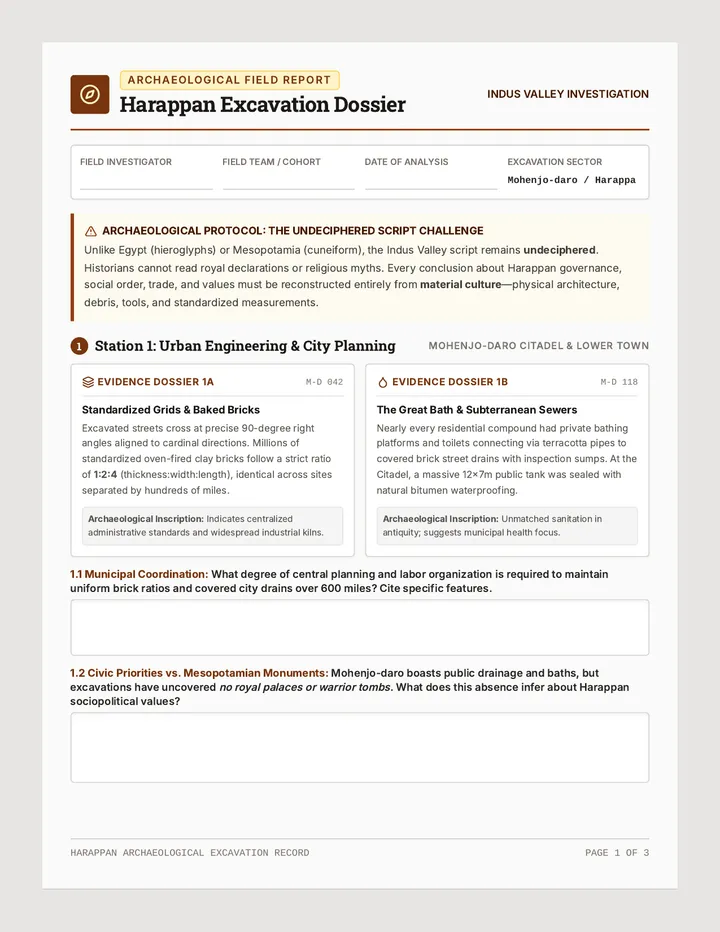
A rigorous three-page archaeological field investigation activity for ninth-grade world history. Students analyze primary archaeological evidence from the Indus Valley Civilization—including urban grid planning and drainage, iconic material artifacts, and maritime trade networks—to construct evidence-based historical claims about an undeciphered ancient society.

E

ebakke

Indus Planned Cities Slides

Indus Planned Cities Slides

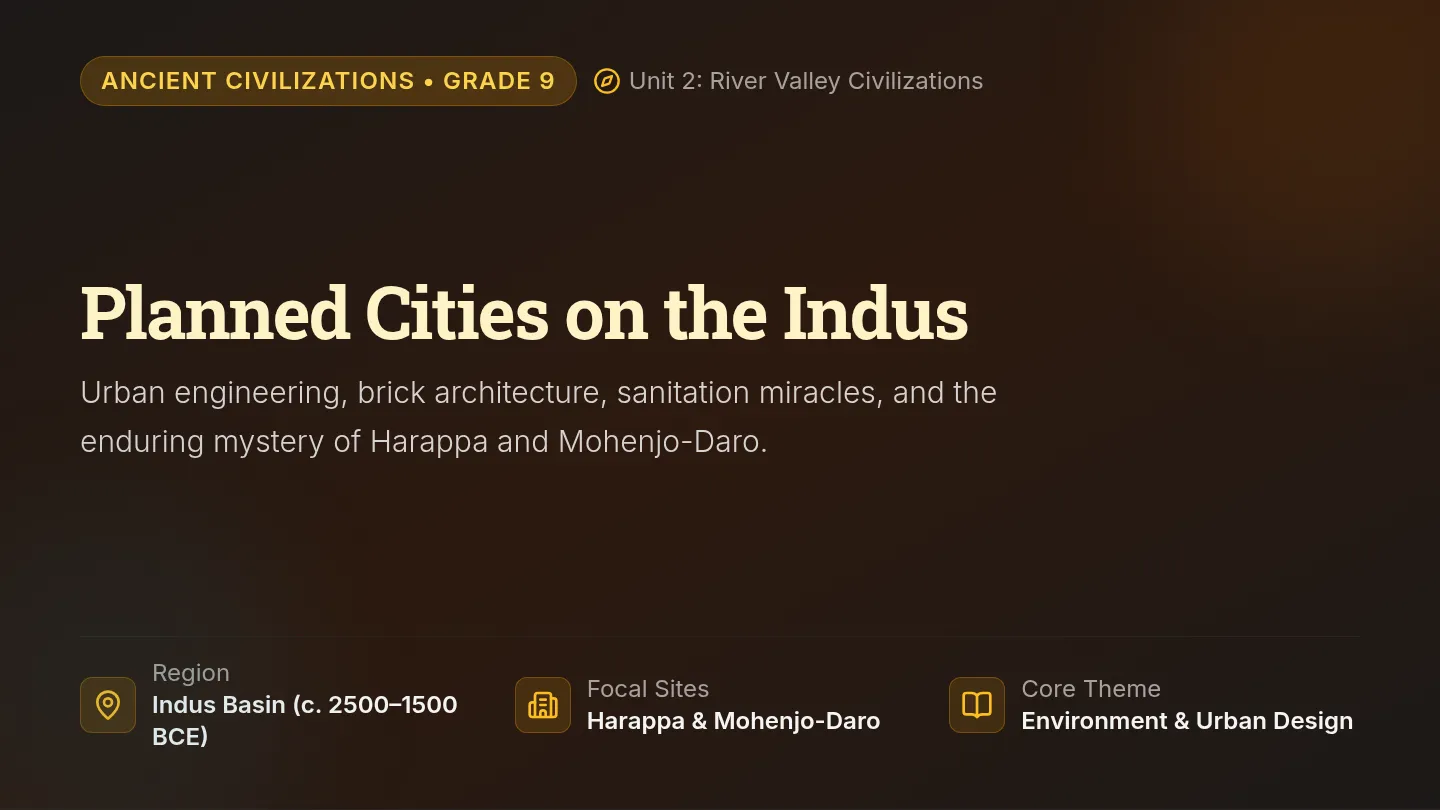
A comprehensive 12-slide instructional deck for 9th grade Ancient Civilizations covering the geography, urban planning, sanitation, culture, undeciphered language, trade, and collapse of the Indus Valley civilization.

E

ebakke

Pathways of Buddhism Student Packet

Pathways of Buddhism Student Packet

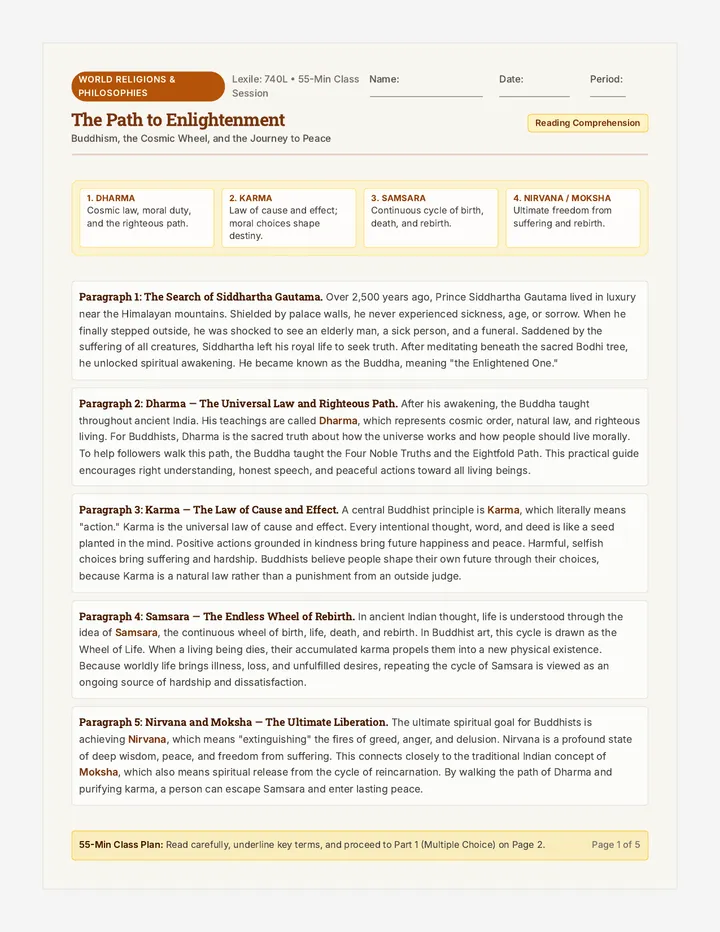
A comprehensive 5-page Buddhism reading comprehension packet designed for a 55-minute middle school social studies lesson. Features a 5-paragraph Lexile 700-800 reading passage, 10 multiple choice questions, 10 true/false items, 5 fill-in-the-blank prompts, a vocabulary word search, a verified crossword puzzle, and 2 open response questions exploring Dharma, Karma, Samsara, and Nirvana.

WM

Wilberto Mejias

Hindu Traditions Reading Packet

Hindu Traditions Reading Packet

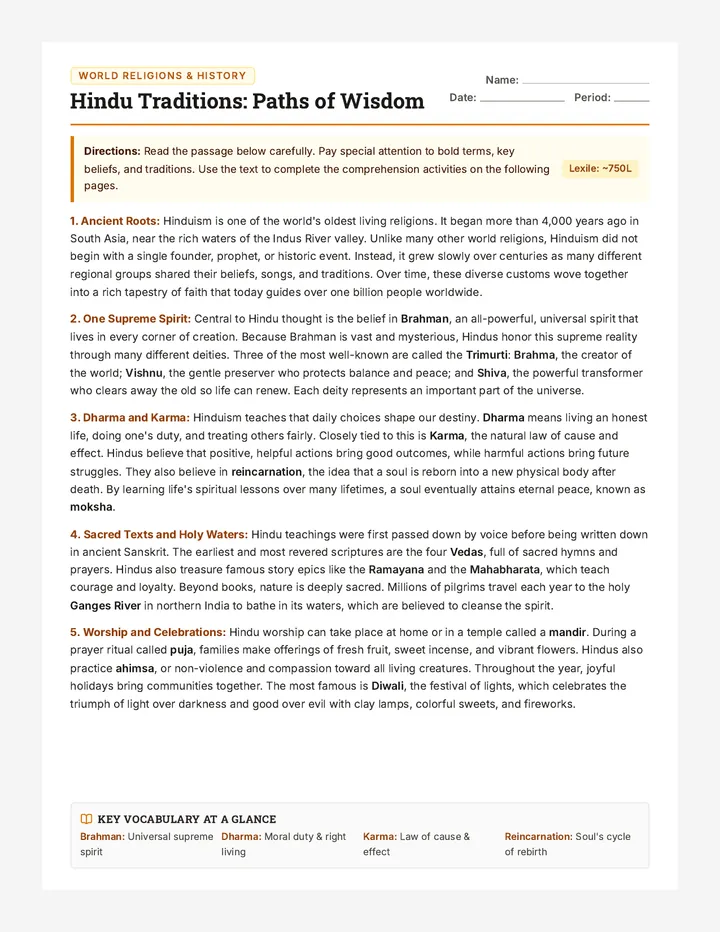
A comprehensive 4-page reading comprehension packet on Hinduism featuring an accessible 700-800 Lexile passage, 10 multiple choice questions, 10 true/false items, 5 fill-in-the-blanks, a crossword puzzle, a word search, and 2 open response questions.

WM

Wilberto Mejias

Silent Citadels Quiz

Silent Citadels Quiz

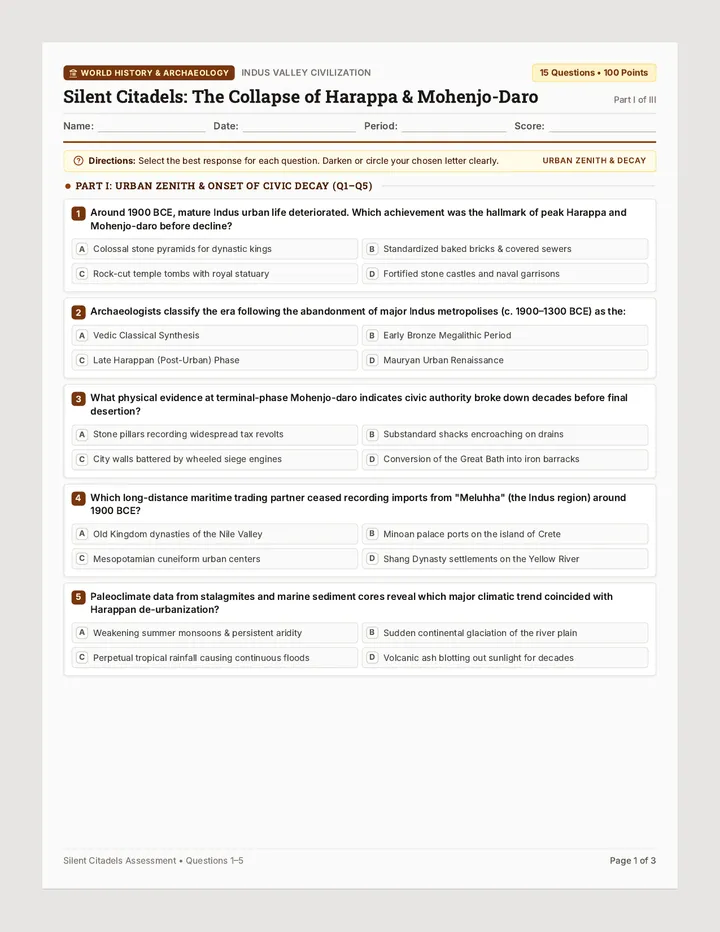
A comprehensive 15-question multiple-choice assessment examining the decline and de-urbanization of the Indus Valley Civilization cities of Mohenjo-daro and Harappa. Covers archaeological evidence, climate change, hydrological shifts, trade disruption, and the debunking of outdated invasion theories.

SW

Sophia Watson

Asian Civilizations Review Worksheet

Asian Civilizations Review Worksheet

A two-page structured review worksheet designed to help students write complete-sentence answers for a test on early Indian and Chinese civilizations. Includes categorized word banks, question-specific sentence starters, handwriting-ready ruled response areas, and a self-assessment sentence quality checklist.

FT

Faith Timberman

Sequences

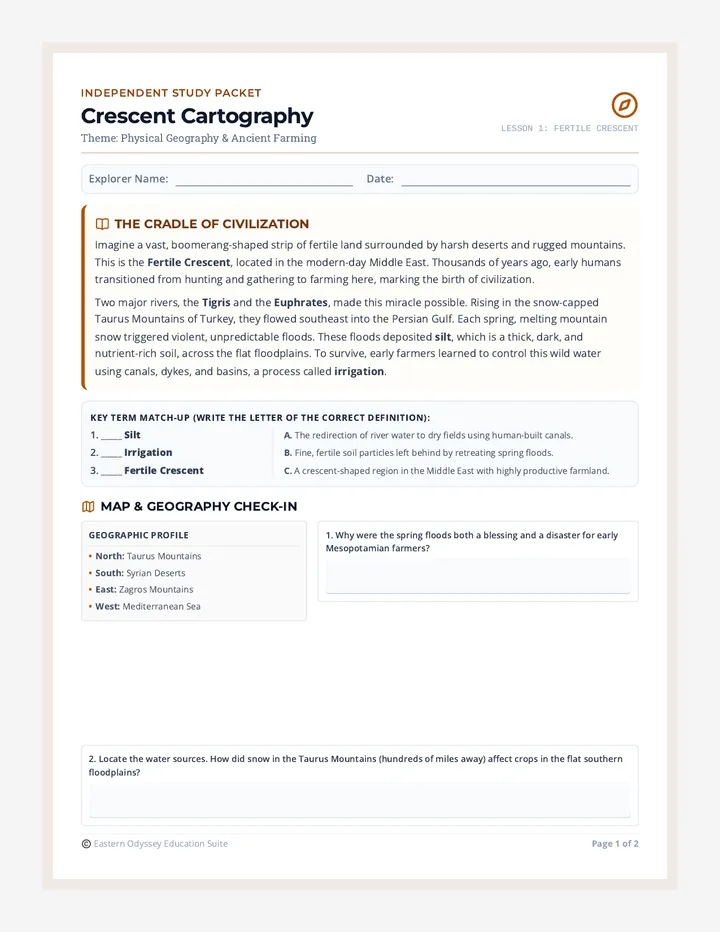
Crescent Cartography Student Packet

Eastern Odyssey Sub Packets

A sequence of 5 highly engaging, self-guided emergency sub plans for 6th-grade Eastern Hemisphere Social Studies, focusing on Ancient Egypt, Mesopotamia, the Fertile Crescent, Monsoon Asia, and Japan's island geography. Each sub plan includes a student packet and a teacher guide.

T

tpayne

10
Mapping the Sand Slides

Desert Discoveries

A differentiated social studies unit covering the geography, cultures, and empires of the Middle East and North Africa, adapted for 3rd-grade readability based on the DESE Investigating History Grade 6 curriculum.

JS

Janette Sullivan

43
Grid Quest Worksheet

Atlas Adventurers

A five-day series of independent, paper-based social studies lessons covering the Eastern Hemisphere for 6th-grade classrooms. Each day is fully prepared with self-contained readings, map activities, and analytical questions, complete with comprehensive answer keys for substitute teachers.

T

tpayne

10
Mesopotamia Explorer Slides

River Valley Chronicles

A comprehensive two-week unit exploring the four major river valley civilizations: Mesopotamia, Egypt, the Indus Valley, and Ancient China. Students will analyze how geography shaped human characteristics and evaluate the social, political, and cultural development of these early societies.

J

joseph.vida

9
Philip II Teacher Guide

Hellenistic Diffusion Sequence

This project-based sequence explores the Hellenistic period, focusing on the conquests of Alexander the Great and the resulting cultural diffusion across Greece, Persia, Egypt, and India. Students investigate military innovations, artistic shifts toward realism, and scientific breakthroughs, culminating in a curated museum exhibit on Hellenistic syncretism.

15
Hinduism Roots Slides

Sacred Cycles

This sequence explores the historical and spiritual foundations of Hinduism and Buddhism in ancient India. Students analyze the origins of the Vedas, the core tenets of Karma and Dharma, the life and teachings of Siddhartha Gautama, and the expansion of these traditions under Emperor Ashoka.

15

Lessons

Freedom Struggles Unit Assessment

Freedom Struggles

A comprehensive lesson exploring the divergent paths to independence in India and Vietnam, examining non-violent resistance, armed struggle, and the influence of Cold War ideologies.

AH

Ashley Hopf

8
Explorer Epochs Wall Chart

Early World Explorers

A comprehensive lesson on early world exploration from 300 BCE to 1500 CE, focusing on the geographical, cultural, and religious impacts of key explorers across different continents.

J

jcasey

14
Time Cartographers Slides

Time Cartographers

An 80-minute sixth-grade lesson on understanding, building, and interpreting historical timelines, teaching BCE/CE, BC/AD, Circa, and Chronological Order, focusing on Mesopotamia, Egypt, the Indus Valley, and global history.

AA

Adam Amster

4
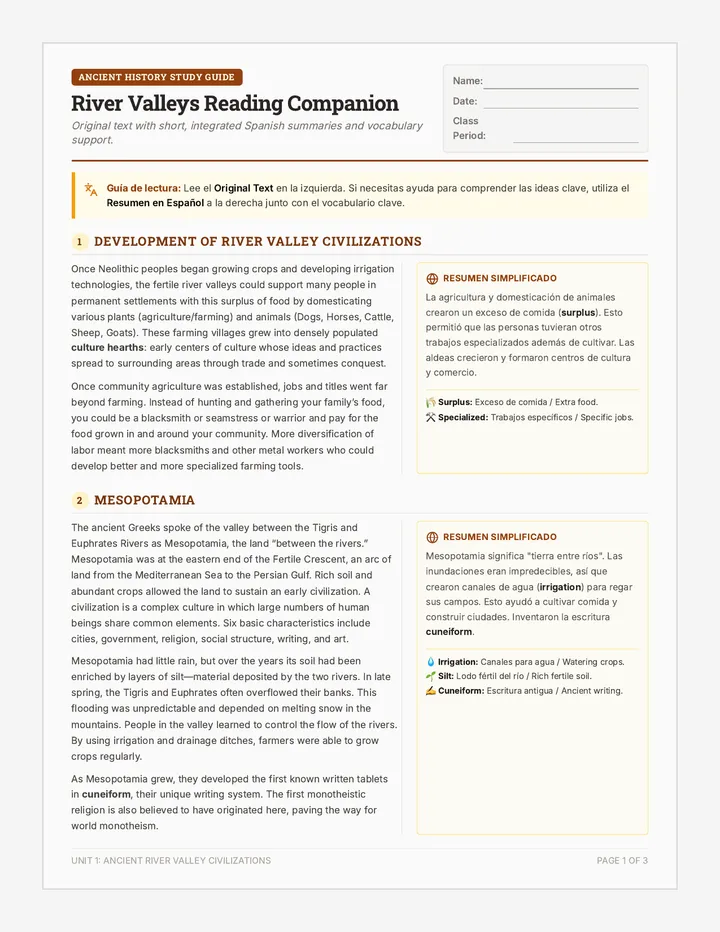
Civilizations Reading Companion

River Valley Civilizations

A comprehensive history lesson focusing on the development of the four major ancient river valley civilizations, featuring differentiated text and scaffolded reading supports for ESL students.

JO

Jacob Obannon

1
River Valley Pioneers Slides

River Valley Pioneers

A high school world history lesson focusing on the geographic factors of the Neolithic Revolution. Students participate in a station rotation activity, analyzing maps, data, and geographical details of four major river valleys (Nile, Tigris-Euphrates, Indus, and Yellow Rivers) to determine why agriculture began in these specific regions.

AH

Ashley Hopf

4
Monument Memories Lesson Plan

Monument Memories

Students will explore and research different historical monuments to understand their cultural and historical significance. The lesson culminates in group presentations that highlight why these structures are vital for collective remembrance.

CM

Ciara McNearly

5