Mesopotamia Explorer Slides Mesopotamia Mud
The Cradle of Civilization
The Land Between
Located in the Fertile Crescent, Mesopotamia lay between the Tigris and Euphrates rivers.
Flooding was unpredictable and violent.
No natural barriers (mountains/deserts) for protection.
Limited stone and timber; mud bricks were everything.
Location Check
Modern-day Iraq, Syria, and Kuwait. Think of the river as a giant "V" shape leading to the Persian Gulf.
The First City-States
Independence
Each city (Ur, Uruk, Kish) had its own government and gods. They often fought for river access.
Theocracy
Early rulers were priest-kings. They managed the gods' property and irrigation systems.
Ziggurats
Massive mud-brick temples in the center of every city. A "stairway to heaven."
Hammurabi's Code
"To bring about the rule of righteousness in the land, that the strong might not oppress the weak."
The Power of Law
Uniformity: Laws applied to all, but punishments differed by social class.
Retaliation: Lex Talionis—"An eye for an eye, a tooth for a tooth."
Accountability: Government took responsibility for order and justice.
Sumerian Genius
Gifts to the Modern World
Cuneiform
The world's first writing system. Pressed into wet clay using a stylus.
The Wheel
Revolutionized transportation and pottery making around 3500 BCE.
Base-60 Math
Why do we have 60 seconds in a minute? Thank the Sumerians.
The Sail
Utilized the wind to move goods up and down the rivers.
Mesopotamia Check
1. Why did the Sumerians build Ziggurats in the center of their cities?
2. How did unpredictable flooding change the way people viewed their gods?
3. How is Hammurabi's Code different from modern laws?
River Valley Unit Plan Teacher Guide River Valley Chronicles
A 10-Day World History Unit Plan
Key Standards
SS.1: Analyze the human characteristics of places and regions (irrigation, urban planning, agriculture).
SS.2: Evaluate the role of groups/individuals in social, political, cultural, and economic development.
Essential Questions
How does geography influence the way a society develops?
What common characteristics are shared by early civilizations?
How did power and social structures evolve along river banks?
10-Day Pacing Guide
Day Topic Focus Activity & Standard Alignment 1 Birth of Cities Intro to 4 rivers; Map skills. Analyze physical characteristics (SS.1). 2 Mesopotamia Sumerian city-states. Impact of unpredictable flooding on culture (SS.1). 3 Hammurabi's Code Primary source law analysis. Role of the state in social order (SS.2). 4 Ancient Egypt The Nile "Gift". Divine Kingship and political unity (SS.2). 5 Egyptian Legacy Hieroglyphics & Afterlife. Cultural development & record keeping (SS.2). 6 Indus Valley Grid cities & Sanitation. Human modification of the environment (SS.1). 7 Indus Trade Seals & Trade routes. Economic development & mystery of collapse (SS.2). 8 Ancient China Yellow River loess. Geography as both blessing and sorrow (SS.1). 9 Mandate of Heaven Dynastic Cycle & Ancestors. Political/Religious justification of power (SS.2). 10 Synthesis Unit Final Assessment. Cross-civilization comparison.
Teacher Background Knowledge
Interaction with Environment:
Emphasis should be placed on the *unpredictable* vs *predictable* nature of the rivers. This directly shaped the religious outlook of the people—Mesopotamian gods were seen as harsh/unstable, while Egyptian gods were seen as benevolent.
Social/Political Development:
Writing was not just "cultural"—it was a survival tool for the state to manage grain storage and labor. Hierarchy was necessary to organize thousands of laborers for irrigation canal construction.
Check for Understanding Questions
1
"How did the geography of China isolate it from other civilizations, and how did this isolation impact its view of itself?"
2
"Compare the grid system of the Indus Valley with the winding streets of Sumer. What does this tell us about their central governments?"
3
"Why was the Rosetta Stone such a vital discovery for understanding Ancient Egyptian history?"
4
"How did Hammurabi's Code address the role of social groups (rich vs poor) in Sumerian society?"
Vocabulary Reference Sheet The Big Four Reference
Background Knowledge & Essential Vocabulary
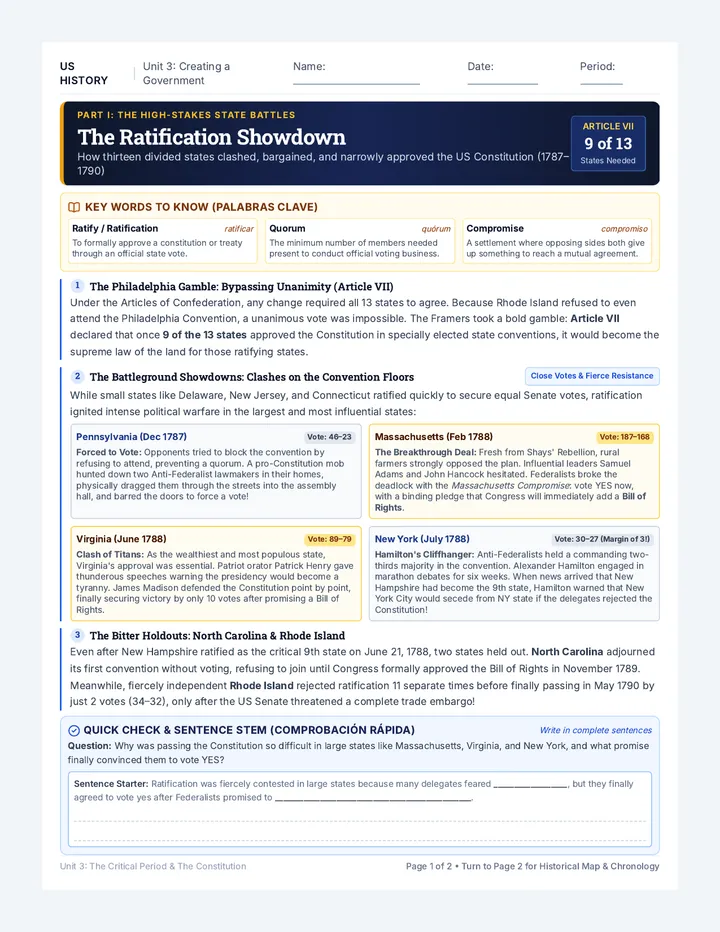
Name:
Date:
The Rise of Civilization
Around 5,000 years ago, the first great civilizations arose in fertile river valleys. Rivers provided three essential resources: water for drinking and irrigation, silt (rich soil) for farming, and transportation for trade. To survive the unpredictable flooding of these rivers, people had to work together to build complex irrigation systems. This cooperation led to the creation of organized governments, social classes, and specialized jobs.
Mesopotamia
Tigris & Euphrates
Ancient Egypt
The Nile
Indus Valley
The Indus
Ancient China
The Huang He
Key Vocabulary
Irrigation
A system of canals or pipes used to bring water from a river to dry farmland.
Social Hierarchy
The organization of people into different ranks or classes based on power and wealth.
Cuneiform
The world's first system of writing, developed by the Sumerians using wedge-shaped marks.
Theocracy
A government where the ruler is seen as a god or is ruled by religious leaders.
Polytheism
The belief in or worship of many gods or deities.
Dynastic Cycle
The pattern of the rise, decline, and replacement of ruling families in Ancient China.
Silt
Fine, fertile soil deposited by river floods, perfect for growing crops.
Urban Planning
The organized design of city layouts, including grid systems and drainage (Indus Valley).
Reflection Question
Why do you think nearly all early civilizations started near a river instead of in a forest or on a mountain?
Civilization Comparison Organizer The Big Four Organizer
Name:
Date:
Use this chart to record the human and physical characteristics of each civilization. Focus on how the river influenced their development.
Civilization River System(s) Geography & Interaction Social & Political Structure Cultural Legacy Mesopotamia
| | | | |
|
Ancient Egypt
| | | | |
|
Indus Valley
| | | | |
|
Ancient China
| | | | |
Synthesis Analysis
1. Identify ONE common challenge that all four civilizations faced due to their physical geography.
2. How did the unpredictable nature of river flooding lead to the creation of organized governments?
Egyptian Legacies Slides Egyptian Eternity
The Gift of the Nile
The Perfect River
Unlike Mesopotamia, the Nile flooded with predictable precision.
Protected by desert "Red Lands" on both sides.
Silt (Black Land) was deposited annually.
Easy travel: Current flows North, Winds blow South.
The Lifeline
"Egypt is the gift of the Nile."
Living Gods: The Pharaohs
1
Absolute Power
The Pharaoh owned all the land, controlled the army, and made all laws.
2
Religious Duty
Responsible for maintaining Ma'at (harmony and balance).
The Social Pyramid
Pharaoh
Nobles & Priests
Scribes & Merchants
Peasants & Farmers
The Journey to Osiris
For Egyptians, death was not the end but a transition to a new life. Success in the afterlife depended on:
Mummification (preserving the body).
The Weighing of the Heart against the Feather of Truth.
Pyramids as eternal homes for kings.
Hieroglyphics
Sacred carvings used for religious and official texts. Deciphered by the Rosetta Stone.
Picture-Based Writing System
Egypt Review
1. Why did the Egyptians have such a positive view of their gods compared to the Mesopotamians?
2. How did the Pharaoh's role as a god impact the stability of the government?
3. What was the religious purpose behind the complex process of Mummification?
Indus Secrets Slides Hidden Harappa
The Indus Valley Civilization
The Indian Subcontinent
A land of Monsoons and high mountain barriers.
The Himalayas and Hindu Kush isolated the region.
Seasonal winds (Monsoons) brought rain for farming.
The Indus River provided silt and a trade route to the sea.
Environmental Challenges
Unpredictable Floods
Like Mesopotamia, the Indus changed its course frequently.
Unreliable Rain
Too much rain = floods. Too little rain = famine.
The World's First Grid Cities
Grid System
Streets were laid out in a precise grid pattern, unlike the messy winding streets of Sumer.
Sanitation
Advanced plumbing! Nearly every house had a private bathroom and sewer drainage.
Standardized Bricks
Every brick in every city was the exact same size ratio. This shows a very strong central government!
(Mohenjo-Daro and Harappa are the two most famous sites)
The Undeciphered Script
Archaeologists have found hundreds of small stone seals with animal drawings and writing, but no one can read it yet.
A Peaceful Society?
Excavations have found few weapons and no massive temples or palaces for kings. Was it a more equal society?
The Mysterious End
Around 1750 BCE, the cities were abandoned. Why?
Environmental changes (Earthquakes)
Rivers changed course or dried up
Overuse of soil and deforestation
Chinese Dynasties Slides River of Sorrows
The Birth of Ancient China
The Middle Kingdom
Early China was isolated by deserts, mountains, and the Pacific Ocean.
Himalayas to the Southwest.
Gobi Desert to the North.
Huang He river provided fertile loess soil.
Why "River of Sorrows"?
The Yellow River flooded unpredictably and violently, destroying whole villages. Its fertile loess was vital, but dangerous.
Power & Divinity
Mandate of Heaven
The belief that a ruler had divine approval to lead. If they governed poorly, they lost the mandate, and a new dynasty would take over.
The Dynastic Cycle
New Dynasty claims Mandate
Peace and prosperity follows
Corruption & disaster strike
Rebellion; New Cycle begins
Oracle Bones
The earliest form of Chinese writing was found on animal bones. Priests used them to ask the gods questions about the future.
Family & Ancestors
The family was central. Ancestors were worshipped as spirits that could influence luck.
Unified Script
One written system for many spoken dialects helped unify the empire!
China Check-in
1. Why did the Chinese call their land the "Middle Kingdom"?
2. How did the Mandate of Heaven explain the rise and fall of dynasties?
3. What role did Oracle Bones play in early Chinese culture?
River Valley Final Assessment River Valley Assessment
Unit 1: The Foundations of Civilization
Name: __________________________
Date: ___________________________
Part I: Concept Check
1. Which geographical feature was MOST important for the development of early civilizations?
A) High mountain ranges for protection
B) Vast deserts to isolate cities
C) River valleys with fertile soil
D) Tropical rainforests for resources
2. In Ancient Egypt, the Pharaoh was considered a living god. This type of government is called a:
A) Democracy
B) Theocracy
C) Oligarchy
D) Republic
3. What was a unique characteristic of the Indus Valley cities (Mohenjo-Daro & Harappa)?
A) Large stone pyramids for kings
B) Planned grid systems and plumbing
C) Walls made of cedar wood
D) Oracle bones used for writing
4. The "Mandate of Heaven" was a concept used to justify the rule of leaders in:
A) Mesopotamia
B) Egypt
C) Ancient China
D) The Indus Valley
Part II: Analysis & Synthesis
5. Explain how the geography of Mesopotamia (lack of natural barriers) influenced its political structure compared to Ancient Egypt.
6. Why was the development of a writing system (Cuneiform, Hieroglyphics, etc.) essential for the growth of large, organized governments?
Part III: Mental Map
Briefly describe the physical location of the four civilizations in relation to one another or sketch a simple map here.
River Valley Answer Key Teacher Notes Answer Key & Teacher Notes
River Valley Chronicles Assessment Guide
Unit Essential Questions
Use these questions to guide your evaluation of student synthesis and short-answer responses.
• How does physical geography influence the political and human characteristics of a region?
• What common social, political, and cultural traits are shared by the four major river valley civilizations?
• How did the development of technology (irrigation, writing) allow for the rise of complex city-states?
Part I: Concept Check
1. Answer: C
Rivers provided water, silt, and transportation.
2. Answer: B
Theocracy = Rule by religious authority or divine rulers.
3. Answer: B
Highly organized urban planning with grid systems.
4. Answer: C
Used by the Zhou dynasty to justify overthrowing the Shang.
Part II: Analysis Exemplars
Q5: Geography & Political Structure
Ideal Answer: Mesopotamia lacked natural barriers, leading to frequent invasions and the development of independent, warring city-states. In contrast, Egypt was protected by deserts, allowing for a more unified, stable kingdom under a single Pharaoh for long periods.
Q6: Importance of Writing
Ideal Answer: Writing was essential for record-keeping, collecting taxes, recording laws (like Hammurabi's Code), and coordinating large-scale projects like irrigation and grain storage. It allowed the government to communicate across distances.
Grading & Discussion Tips
For the graphic organizer, check for the connection between the river's flood pattern (predictable vs. unpredictable) and the culture's view of their gods.
When discussing Hammurabi, emphasize that while the laws were "harsh," they were a step toward justice because they were public and fixed.
The Indus Valley is often the hardest for students because of the "mystery" element—use this to talk about how history is reconstructed from physical evidence.
For China, ensure students understand that the Mandate of Heaven is a cycle, not a permanent grant of power.