Backcountry Fury Slides NC Standard 8.H.1.2 Colonial Resistance Series • Day 1
Inquiry Dossier 01
Backcountry Fury:
The War of the Regulation
How did corrupt local sheriffs, heavy taxes, and court extortion ignite armed rebellion in colonial North Carolina?
Focus: Literal Meaning & The 5Ws + H
Orange & Alamance Counties, NC (1764–1771)
Historical Context
Why Did Backcountry Farmers Revolt?
Extortionate Fees
Corrupt sheriffs and clerks like Edmund Fanning charged illegal, inflated fees for recording deeds and legal papers.
Tryon's Palace Tax
Subsistence farmers in the Piedmont were forced to fund Royal Governor William Tryon's luxurious palace in coastal New Bern.
Unequal Representation
The coastal planter elite controlled the colonial Assembly, leaving the western backcountry without a meaningful political voice.
Key Concept: The Regulators were not demanding independence from Britain yet—they demanded honest local government under British law!
Primary Source Investigation
Regulator Advertisement No. 9 (1768)
Original Excerpt
"We the poor Inhabitants in North Carolina are daily suffering under the oppressive hands of officers... We resolve to pay no more taxes or fees until we know what they are for, and see that they are agreeable to law."
Signed: Backcountry Planters Orange County, NC
Literal Core
The farmers refuse to pay fees until officials show the specific laws authorizing those costs.
Historical Consequence
Governor Tryon brought the colonial militia to crush the Regulators at the Battle of Alamance in May 1771.
Standard 8.H.1.2: Reading for Literal Meaning Ready for Source Worksheet 01
Historical Method Protocol
The Historian's 5Ws + H Protocol
WHO
Who authored the document? Who was their intended target audience?
WHAT
What exact actions or demands are literally stated in the text?
WHEN
When was it written, and what simultaneous crises were occurring?
WHERE
Where in colonial North Carolina (Piedmont vs. Coastal Plain) did this occur?
WHY
Why did the creators feel compelled to produce this document?
HOW
How did colonial leaders and Royal authorities respond to the document?
Open your "Regulator Rebellion Worksheet" to dissect Petition Excerpt No. 9 and test your detective skills!
Regulator Petitions Worksheet NC Standard 8.H.1.2 • Primary Source Lab
Grievances in the Backcountry
Deconstructing Regulator Advertisement No. 9 & Court Petitions (1768–1769)
Name:
Date:
Period:
Primary Source Excerpt: Orange County Regulator Petition (1769)
Colonial Records of NC
"That we the Inhabitants of Orange County have for years groaned under the heavy Burden of exorbitant, illegal fees and taxes... We humbly petition your Excellency to look upon our distressed State, and command the Clerks, Registers, and Sheriffs to publish exact tables of their lawful fees, that we may no longer be plundered by their arbitrary exactions."
Exorbitant: Unreasonably high / excessive. Arbitrary exactions: Unlawful, forced demands of money. Registers: County land recorders.
1 Part 1: The Historian's 5Ws + H Protocol (Standard 8.H.1.2)
Extract the literal facts stated in the petition above to complete each forensic inquiry.
1. WHO wrote and who received this?
2. WHAT specific action is requested?
3. WHEN was this petition created?
4. WHERE was this grievance occurring?
5. WHY were the farmers outraged?
6. HOW did officials abuse their authority?
NC Grade 8 Social Studies • Inquiry Sequence: Tar Heel Voices Page 1 of 2 • Continue to Page 2
Document Deconstruction: Evidence & Meaning
Translating literal colonial text into historical claims
Page 2
2 Part 2: Textual Literal Meaning Check
1. Based directly on the literal text of the petition, what concrete solution did the Regulators demand to ensure transparency?
A. The immediate removal of the Royal Governor
B. Published tables listing exact lawful fees
C. Free western land grants for all poor farmers
D. An armed boycott of all British imports
2. Which group of colonial officials is explicitly accused in the excerpt of taking "arbitrary exactions"?
A. Clerks, registers, and county sheriffs
B. King George III and Parliament ministers
C. British customs agents and naval captains
D. Native American fur traders and guides
3 Part 3: 18th-Century to Modern Translation
Translate the primary source phrase below into a modern 8th-grade explanation.
"groaned under the heavy Burden of exorbitant, illegal fees and taxes..."
In your own words, what is the literal meaning of this complaint?
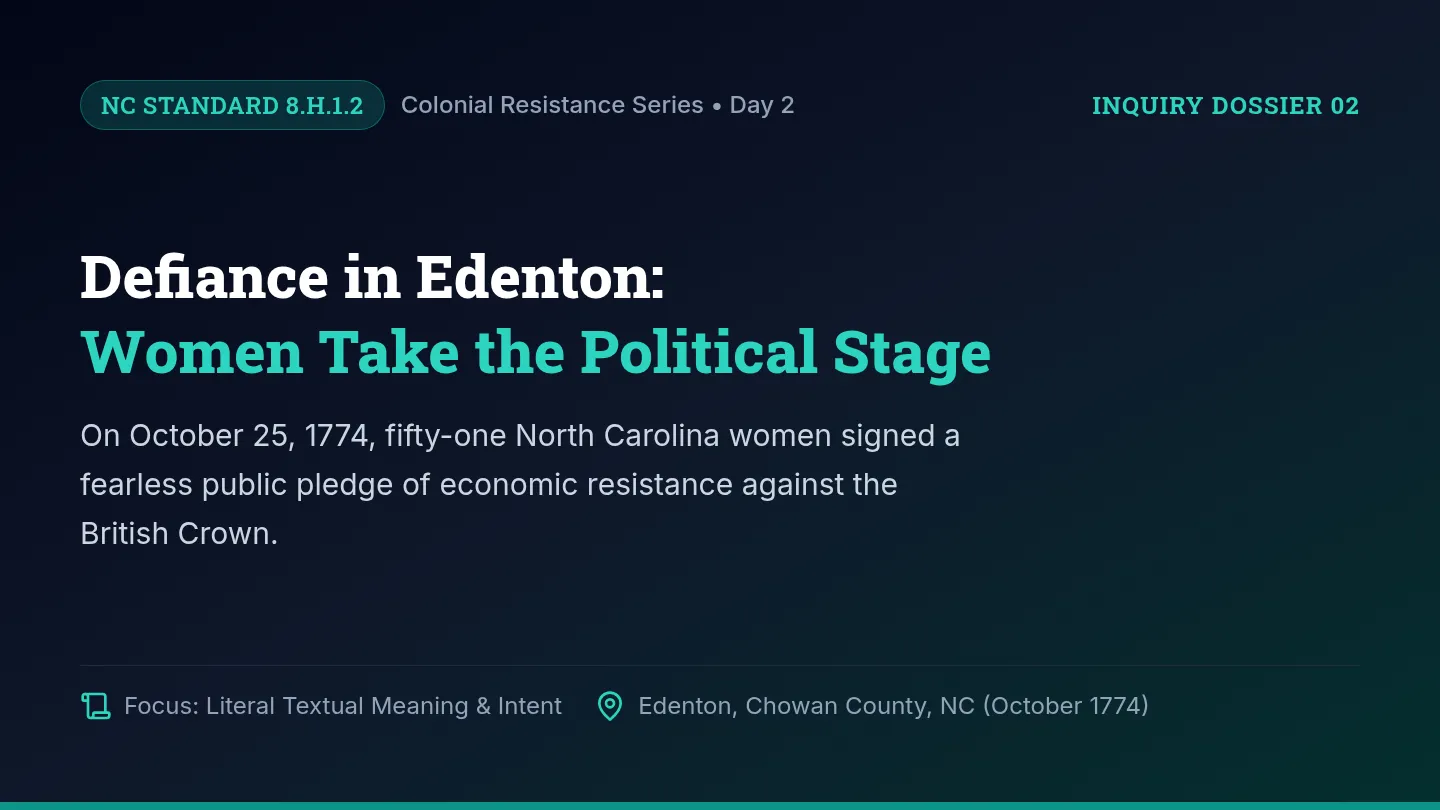
Edenton Defiance Slides NC Standard 8.H.1.2 Colonial Resistance Series • Day 2
Inquiry Dossier 02
Defiance in Edenton:
Women Take the Political Stage
On October 25, 1774, fifty-one North Carolina women signed a fearless public pledge of economic resistance against the British Crown.
Focus: Literal Textual Meaning & Intent
Edenton, Chowan County, NC (October 1774)
Historical Context
Why Was the Edenton Protest Unprecedented?
First Women's Action
In 18th-century British law, women had no formal political role. Penelope Barker and 50 others boldly broke societal conventions.
Economic Boycott
Women managed household buying power. Refusing English tea and cloth directly struck British merchant profits.
Public Declaration
Unlike Boston's disguised midnight tea dumping, the Edenton women published their real legal names in colonial and London newspapers.
Penelope Barker declared: "Maybe we men have acted with patience, but we women must act now for our country!"
Primary Source Investigation
The Edenton Resolutions (October 25, 1774)
Literal Document Excerpt
"As we cannot be indifferent on any occasion that appears nearly to affect the peace and happiness of our country... it is a duty which we owe, not only to our near and dear relations who have already concurred, but to ourselves, to do everything as far as lies in our power to testify our sincere adherence to the same."
Signed: 51 Women of Edenton Printed across Britain & America
Literal Commitment
The signers explicitly pledge not to consume British tea or purchase British manufactured goods.
London's Reaction
British cartoonists mocked them, terrified that colonial women were organizing politically.
Standard 8.H.1.2: Analyzing Who, What, Where, & Why Proceed to Worksheet 02
Historical Method Protocol
Investigating the 1774 Resolutions
1
Literal Meaning Steps
Pinpoint exact words: What does "sincere adherence" mean in the text? What goods were targeted? Identify the literal terms of the boycott.
2
Context & Significance
Why was it controversial for women to sign their names? How did this document signal unity across coastal North Carolina?
Transition to "Edenton Resolutions Worksheet" to decode the document and analyze the London satire cartoon!
Edenton Resolutions Worksheet NC Standard 8.H.1.2 • Primary Source Lab
Defiance at the Tea Table
Deconstructing the Edenton Resolves of October 25, 1774
Name:
Date:
Period:
Primary Source: Association Signed by the Ladies of Edenton, NC (1774)
Morning Chronicle & London Advertiser
"As we cannot be indifferent on any occasion that appears nearly to affect the peace and happiness of our country, and as it has been thought necessary, for the public good, to enter into several particular resolves... we do hereby solemnly engage not to conform to that pernicious practice of drinking tea, or that we would wear any manufacture from England, until such time that all acts which tend to enslave this our native country shall be repealed."
Pernicious: Having a harmful effect in a gradual, sneaky way. Manufacture: Goods made in English factories. Repealed: Officially canceled or revoked.
1 Part 1: The Historian's 5Ws + H Protocol (Standard 8.H.1.2)
Read the literal document text to complete the investigative grid below.
1. WHO authored and signed this document?
2. WHAT two specific items did they refuse to use?
3. WHEN was this document signed?
4. WHERE in North Carolina did this take place?
5. WHY did the signers believe they had a duty to act?
6. HOW long did they promise their boycott would last?
NC Grade 8 Social Studies • Inquiry Sequence: Tar Heel Voices Page 1 of 2 • Continue to Page 2
Document Analysis: Impact & International Reactions
Connecting literal text to colonial and British responses
Page 2
2 Part 2: Textual Literal Meaning Check
1. According to the literal wording of the resolution, until what event did the signers vow to uphold their boycott?
A. Until the British Parliament dissolved permanently
B. Until all oppressive British tax acts were repealed
C. Until George Washington was elected President
D. Until French military troops landed in Wilmington
2. How did the Edenton Tea Party differ fundamentally from the famous Boston Tea Party of 1773?
A. Edenton women publicly signed their real names rather than disguising themselves
B. Edenton colonists destroyed royal merchant ships in the Albemarle Sound
C. Edenton leaders demanded immediate reunion with the King of England
D. Edenton protesters used weapons to capture the Royal Governor's mansion
3 Part 3: International Perspective (The London Press Reaction)
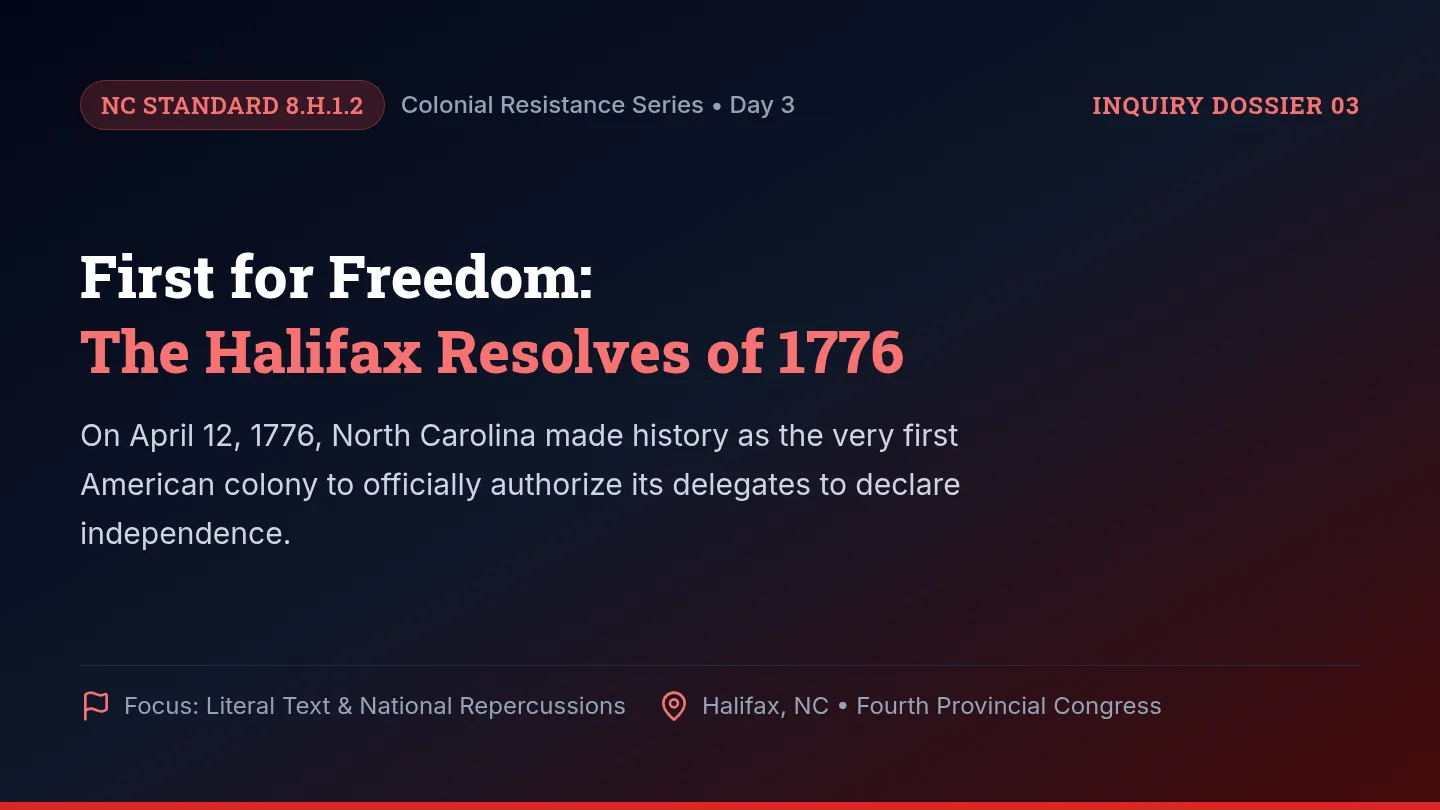
Halifax Resolves Slides NC Standard 8.H.1.2 Colonial Resistance Series • Day 3
Inquiry Dossier 03
First for Freedom:
The Halifax Resolves of 1776
On April 12, 1776, North Carolina made history as the very first American colony to officially authorize its delegates to declare independence.
Focus: Literal Text & National Repercussions
Halifax, NC • Fourth Provincial Congress
Historical Context
The Spark: Moore's Creek Bridge
Patriot Victory
In February 1776, NC Patriots crushed Loyalist forces at the Battle of Moore's Creek Bridge near Wilmington, halting a British invasion.
Royal Governor Flees
Governor Josiah Martin escaped to a British warship off Cape Fear, leaving North Carolina without any British executive authority.
Congress in Halifax
Elected delegates gathered in Halifax to form a provisional government and unanimously voted to push the entire continent toward liberty.
Did You Know? The date "April 12, 1776" is emblazoned in gold across the top ribbon of the official North Carolina state flag!
Primary Source Investigation
The Halifax Resolves (April 12, 1776)
Literal Document Excerpt
"Resolved, that the delegates for this Colony in the Continental Congress be impowered to concur with the delegates of the other Colonies in declaring Independency, and forming foreign Alliances, reserving to this Colony the sole, and exclusive right of forming a Constitution and Laws for this Colony."
Unanimously Adopted: 83 Delegates Halifax, North Carolina
Literal Directive
Empowers NC delegates in Philadelphia (Hooper, Hewes, Penn) to vote for complete American independence.
Self-Governance Condition
Reserves the exclusive power of North Carolinians to draft their own future state constitution.
Standard 8.H.1.2: Reading for Literal Meaning & Significance Proceed to Worksheet 03
Historical Method Protocol
From Halifax to Philadelphia
1
Domino Effect
When the Halifax Resolves arrived in Philadelphia in May 1776, John Adams and Thomas Jefferson praised North Carolina for leading the other colonies out of hesitation.
2
Literal Interpretation
Notice what the document actually states: it does not declare NC an isolated republic; it instructs delegates to declare independence jointly with all colonies.
Open "Halifax Resolves Worksheet" to conduct the final textual synthesis across North Carolina's revolutionary journey!
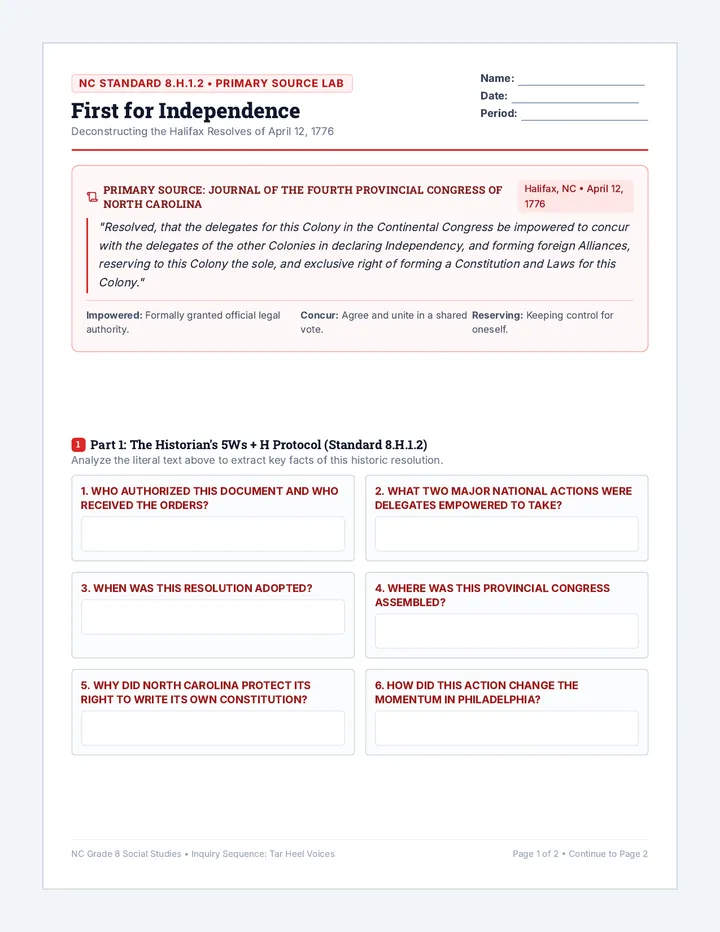
Halifax Resolves Worksheet NC Standard 8.H.1.2 • Primary Source Lab
First for Independence
Deconstructing the Halifax Resolves of April 12, 1776
Name:
Date:
Period:
Primary Source: Journal of the Fourth Provincial Congress of North Carolina
Halifax, NC • April 12, 1776
"Resolved, that the delegates for this Colony in the Continental Congress be impowered to concur with the delegates of the other Colonies in declaring Independency, and forming foreign Alliances, reserving to this Colony the sole, and exclusive right of forming a Constitution and Laws for this Colony."
Impowered: Formally granted official legal authority. Concur: Agree and unite in a shared vote. Reserving: Keeping control for oneself.
1 Part 1: The Historian's 5Ws + H Protocol (Standard 8.H.1.2)
Analyze the literal text above to extract key facts of this historic resolution.
1. WHO authorized this document and who received the orders?
2. WHAT two major national actions were delegates empowered to take?
3. WHEN was this resolution adopted?
4. WHERE was this Provincial Congress assembled?
5. WHY did North Carolina protect its right to write its own Constitution?
6. HOW did this action change the momentum in Philadelphia?
NC Grade 8 Social Studies • Inquiry Sequence: Tar Heel Voices Page 1 of 2 • Continue to Page 2
Historical Synthesis: From Resistance to Independence
Connecting North Carolina's revolutionary sequence (1768–1776)
Page 2
2 Part 2: Textual Literal Meaning Check
1. Based on the literal text, what critical power did North Carolina specifically reserve for itself rather than surrendering to the Continental Congress?
A. The power to establish a royal monarchy in North Carolina
B. The sole and exclusive right of forming a Constitution and Laws for NC
C. The authority to negotiate separate peace treaties with King George III
D. The sole right to print gold coinage across all thirteen colonies
2. Why does the date "April 12, 1776" hold a place of supreme honor on the official North Carolina state flag today?
A. It marks the day NC officially surrendered to the British fleet at Cape Fear
B. It commemorates NC being the first colony to officially call for American independence
C. It represents the day George Washington first visited Tryon Palace in New Bern
D. It signifies the end of the American Revolutionary War at Yorktown