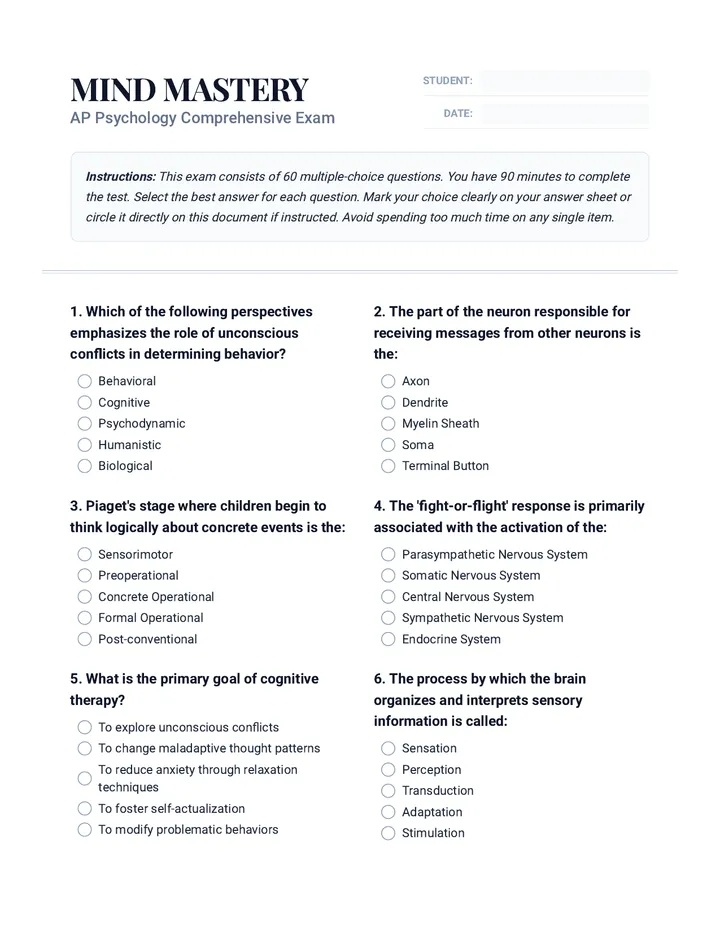
Biological rhythms, sleep cycles, and the psychological impact of dreaming. Analyzes altered states of consciousness including hypnosis, meditation, and the effects of psychoactive substances.
Analyser les effets de la surexposition aux écrans sur la santé et comprendre l'impact écologique de nos activités numériques.
Identifier les dangers des réseaux sociaux (cyber-harcèlement, fake news) et apprendre les réflexes de protection et de signalement.
Comprendre la notion d'identité numérique et savoir distinguer ce qui relève de la sphère privée ou publique sur Internet.
Une leçon interactive pour maîtriser huit concepts fondamentaux de la philosophie à travers des révisions visuelles et un quiz d'évaluation.
A culminating project where students apply their knowledge to analyze real-world case studies, acting as 'neuro-consultants' to evaluate adolescent decision-making under pressure.
Focusing on circadian rhythms and the impact of cortisol, this lesson connects sleep hygiene and stress management to cognitive performance and emotional regulation.
Students examine the role of dopamine and the reward system in the adolescent brain, exploring why teenagers are biologically primed for risk-taking and social validation.
This lesson introduces neuroplasticity, synaptic pruning, and myelination, focusing on how teenage experiences physically reshape neural pathways through a 'use it or lose it' process.
Students explore the structural differences between child, adolescent, and adult brains, focusing on the development gap between the limbic system (emotion) and the prefrontal cortex (logic).
Synthesize unit knowledge by exploring the biological reward pathway and environmental factors influencing addiction and tolerance.
Students apply their understanding of altered states to create a public health resource targeting peers.
Learners investigate the cycle of addiction, defining key terms like tolerance, withdrawal, and the biopsychosocial model.
Une séquence de sensibilisation aux enjeux du numérique pour les classes de CM1-CM2, couvrant l'identité numérique, la sécurité, la santé et l'impact environnemental. Cette séquence vise à former des citoyens numériques responsables et éclairés.
A comprehensive psychology sequence for 9th-grade students exploring the neurobiological development of the adolescent brain. Students investigate the structural changes, chemical drives, and environmental factors that shape decision-making and behavior during their teenage years.
This 10th-grade psychology sequence explores altered states of consciousness, from hypnosis and meditation to the neurochemistry of psychoactive drugs and addiction. Students evaluate scientific theories, analyze physiological changes, and investigate the biological mechanisms that drive perception and dependence.
A comprehensive 11th-grade psychology unit exploring consciousness, attention, and the major theories of dreaming, from Freudian psychoanalysis to modern neurobiological and cognitive models. Students move from defining conscious awareness to critiquing scientific evidence in a culminating seminar on the function of dreams.
A comprehensive 11th-grade psychology unit exploring altered states of consciousness through hypnosis, meditation, and psychoactive drugs, focusing on neurobiology and public health.
A high school psychology unit exploring the subjective experience of dreams and the biological malfunctions of sleep. Students move from psychoanalytic interpretations to neurobiological theories, ending with the diagnosis of sleep disorders and the creation of evidence-based sleep hygiene plans.
A comprehensive 5-lesson unit for 10th-grade Psychology exploring the biological mechanisms of circadian rhythms, the architecture of sleep stages, and the societal implications of adolescent sleep needs.
A comprehensive 12th-grade psychology unit exploring the science of altered states, including hypnosis, meditation, psychoactive substances, and the neurobiology of addiction, culminating in a bioethical debate.
This sequence explores the biological and psychological foundations of sleep, covering circadian rhythms, sleep stages, dream theories, disorders, and the effects of deprivation. Students will analyze physiological data and apply diagnostic criteria to understand how sleep dictates human behavior.
This sequence interrogates the anthropological shift from dance as a communal, sacred, or functional activity to dance as a presentational art form. Students utilize ritual theory to analyze the loss and gain inherent in this transition from ancient trance rituals to modern commodification.
This undergraduate-level sequence explores the intersection of technology and cognition during the Paleolithic era. Students analyze stone tool industries (Oldowan, Acheulean, Mousterian, and Upper Paleolithic) and symbolic expressions (cave art and portable figurines) to understand the development of complex human behavior and social structures.
An undergraduate-level exploration of human memory, covering information processing models, working memory, encoding specificity, reconstructive processes, and the neurobiological basis of consolidation and amnesia.
Évaluation finale sous forme de QCM pour valider les acquis de la séquence et délivrer symboliquement le "Permis Internet". (Version corrigée et optimisée pour une seule page)
Slides pour la séance 3 présentant les impacts sur la santé et l'environnement, avec des conseils pratiques.
Fiche de préparation pour la séance 3 portant sur la santé et l'écologie numérique. (Version compacte corrigée)
Fiche d'activité de réflexion en groupe sur des situations concrètes de dangers numériques. (Version corrigée avec plus d'espace)
Slides pour la séance 2 couvrant le cyber-harcèlement, les fausses informations et les solutions de protection. (Version corrigée)
Fiche de préparation pour la séance 2 axée sur la sécurité, le cyber-harcèlement et les bons réflexes de citoyenneté numérique. (Version corrigée)
Fiche d'exercice pour les élèves permettant de s'exercer à distinguer les informations sensibles de celles que l'on peut partager. (Version corrigée avec lignes d'écriture)
Support visuel pour la première séance, expliquant les concepts d'identité numérique et de vie privée à travers des analogies claires.
Fiche de préparation détaillée pour la première séance de la séquence sur l'identité numérique et la sphère privée, destinée aux enseignants de CM1-CM2. (Version corrigée)
Corrigé détaillé de la fiche de réflexion écrite Sagesse Flash pour l'enseignant, incluant des pistes de notation et les points clés.
Une fiche d'exercices écrits demandant aux élèves d'expliquer les distinctions et les nuances des huit concepts philosophiques étudiés.
Corrigé détaillé du quiz QCM Sagesse Flash avec justifications basées sur les textes sources pour l'enseignant.