Cognitive structures for information processing, memory, and problem-solving alongside the mechanics of language acquisition. Examines how linguistic frameworks shape human thought and mental representations.
A comprehensive review of the course concepts applied to complex logic problems. Includes the course Posttest.
Analyzing statistics for reliability, sample size, and representative quality, while identifying the misuse of averages and partial claims.
Identifying fallacies that bypass logic to target emotions: scare tactics, flattery, peer pressure, and appeals to pity.
Developing the skills to assess the validity and reasonableness of evidence, and ensuring explanations are relevant and testable.
Recognizing errors in inductive logic: hasty generalizations, biased generalizations, and non sequiturs.
A deep dive into common logical errors: Slippery Slope, Circular Reasoning, Ad Hominem, Red Herring, and the Straw Man.
Evaluating source reliability by recognizing bias, determining levels of expertise, and understanding the specific challenges of eyewitness testimony.
Analyzing how language is used to influence: euphemisms, dysphemisms, and the subtle power of biased questioning.
Building logical conclusions from evidence and identifying causal relationships, including 'post hoc' and 'chicken or the egg' errors.
The mechanics of deductive reasoning: identifying premises and conclusions, and assessing the overall structure of a formal argument.
Focuses on identifying the core issues of complex problems, breaking them into manageable parts, and prioritizing components for effective resolution.
Establishes the foundation of critical thinking by distinguishing between reason and emotion, and fact versus opinion (thinking vs. knowing). Includes the course Pretest.
Complete answer key for the updated Lesson 7 worksheet, providing correct fallacy identifications and sample logic translations for emotional appeals in interpersonal contexts.
Student worksheet for Lesson 7 focusing on emotional fallacies within family, friendship, and work relationships. Includes logic translation exercises and personal reflection.
Complete answer key for the Lesson 3 worksheet, covering bias identification, expertise ranking, and analysis of eyewitness reliability factors in relationship and work contexts.
Complete answer key for the updated Lesson 4 worksheet, providing neutral translations and neutral inquiry rewrites for interpersonal scenarios.
Student worksheet for Lesson 4 focusing on euphemisms and biased questioning within workplace, marriage, and friendship contexts.
Complete answer key for the updated Lesson 2 worksheet, featuring problem decomposition and root cause analysis for workplace and parenting scenarios.
Student worksheet for Lesson 2 focusing on reframing problem statements and performing a '5 Whys' root cause analysis within workplace and parenting contexts.
Complete answer key for the updated Lesson 1 worksheet, featuring classifications for relationship-based reason/emotion and fact/opinion scenarios.
Facilitation guide for Lesson 10 on persuasion and rhetoric. Covers Aristotle's pillars, Cialdini's shortcuts, and the "Free Cookie" hook.
Complete answer key for the Lesson 7 worksheet, providing correct fallacy identifications and sample logic translations for emotional appeals.
Student worksheet for Lesson 10. Features identification of Ethos/Pathos/Logos, a deconstruction lab for analyzing real-world advertisements, and a reflection on personal psychological vulnerabilities to influence.
Slide deck for Lesson 10 on persuasion and rhetoric. Covers Aristotle's pillars (Ethos, Pathos, Logos), emotional appeals, propaganda techniques, and Cialdini's principles of influence.
A 12-lesson intensive course on reasoning and critical thinking, aligned with the 'Reasoning Skills Success' framework. This sequence covers everything from the distinction between reason and emotion to complex logical fallacies, statistical analysis, and deductive/inductive logic.
Une série de modules de formation destinés aux conseillers pédagogiques pour renforcer leur expertise en ingénierie de formation continue, spécifiquement appliquée à l'enseignement du français à l'école primaire.
An interdisciplinary graduate sequence exploring the intersection of cognitive psychology and rhetorical questioning. Students analyze biases like anchoring and priming to master the art of persuasive cross-examination.
A graduate-level exploration of the intersection between cognitive science and literary theory, focusing on how readers construct fictional worlds and the ethical dimensions of narrative engagement.
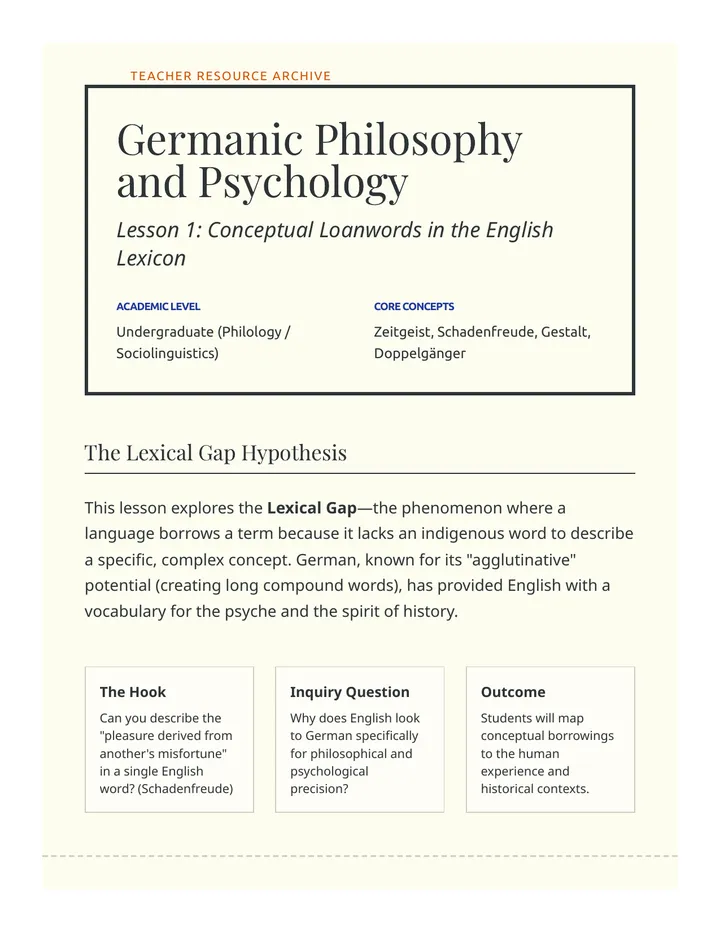
An undergraduate-level exploration of loanwords in English, focusing on the sociolinguistic history and philological origins of terms from German, Spanish, Italian, Arabic, Hindi, and Yiddish. Students investigate how culture, philosophy, and trade shape the lexicon.
This sequence explores advanced verbal and non-verbal reasoning through the lens of analogies. Students move from basic word associations to analyzing degrees of intensity, causal relationships, and precise word choice.
A specialized sequence for undergraduate linguistics or SLP students examining the articulatory and acoustic constraints on phoneme manipulation. Students move from theoretical phonetics to professional diagnostic reasoning.
This sequence explores the rapid physical and cognitive expansion during the first two years of life. Students will move from understanding innate biological reflexes to complex voluntary motor skills, Piaget's sensorimotor stage, and the emergence of language through observational labs and experimental analysis.
This sequence explores the rapid cognitive, physical, and social-emotional changes during an infant's first year, covering motor milestones, Piaget's sensorimotor stage, language acquisition, and attachment theory. Students analyze the interplay between biological maturation and environmental interaction to understand early human development.
A comprehensive 11th-grade psychology unit exploring consciousness, attention, and the major theories of dreaming, from Freudian psychoanalysis to modern neurobiological and cognitive models. Students move from defining conscious awareness to critiquing scientific evidence in a culminating seminar on the function of dreams.
A comprehensive 9th Grade Psychology unit exploring the physical, cognitive, and social development of infants during their first year of life. Students investigate developmental milestones, Piaget's theories, attachment styles, and language acquisition, culminating in a project where they design developmentally appropriate tools for infants.
A 12th-grade Social Communication sequence focused on deconstructing metaphors, analogies, and idioms in media, politics, and news to enhance media literacy and communication skills.