Civilizations Reading Companion
Ancient History Study Guide
River Valleys Reading Companion
Original text with short, integrated Spanish summaries and vocabulary support.
Name:
Date:
Class Period:
Guía de lectura: Lee el Original Text en la izquierda. Si necesitas ayuda para comprender las ideas clave, utiliza el Resumen en Español a la derecha junto con el vocabulario clave.
1 Development of River Valley Civilizations
Once Neolithic peoples began growing crops and developing irrigation technologies, the fertile river valleys could support many people in permanent settlements with this surplus of food by domesticating various plants (agriculture/farming) and animals (Dogs, Horses, Cattle, Sheep, Goats). These farming villages grew into densely populated culture hearths: early centers of culture whose ideas and practices spread to surrounding areas through trade and sometimes conquest.
Once community agriculture was established, jobs and titles went far beyond farming. Instead of hunting and gathering your family’s food, you could be a blacksmith or seamstress or warrior and pay for the food grown in and around your community. More diversification of labor meant more blacksmiths and other metal workers who could develop better and more specialized farming tools.
Resumen Simplificado
La agricultura y domesticación de animales crearon un exceso de comida (surplus). Esto permitió que las personas tuvieran otros trabajos especializados además de cultivar. Las aldeas crecieron y formaron centros de cultura y comercio.
🌾 Surplus: Exceso de comida / Extra food.
⚒️ Specialized: Trabajos específicos / Specific jobs.
2 Mesopotamia
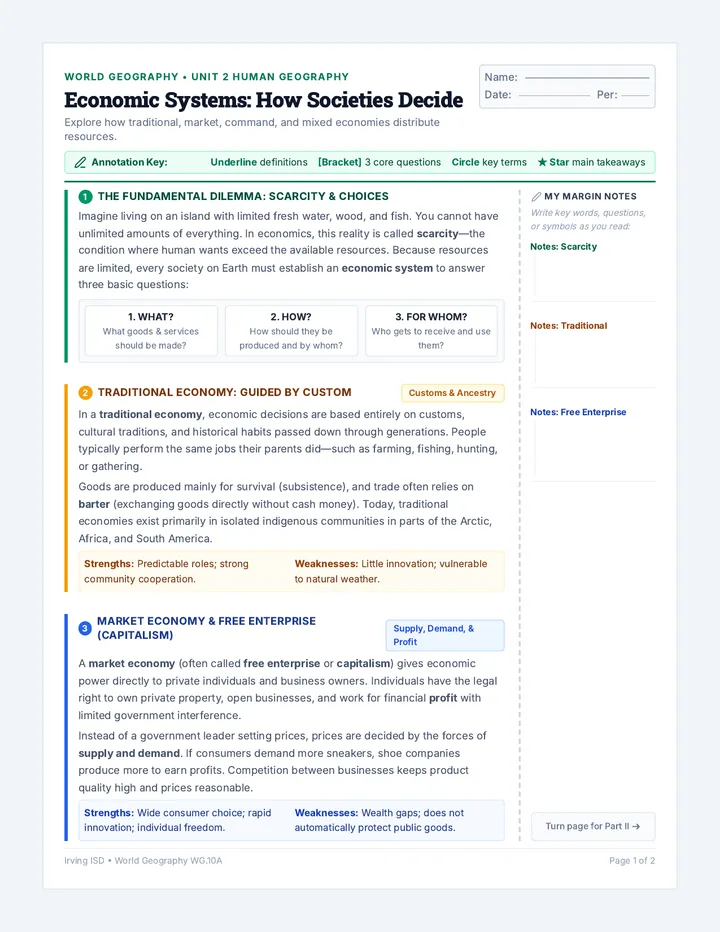
The ancient Greeks spoke of the valley between the Tigris and Euphrates Rivers as Mesopotamia, the land “between the rivers.” Mesopotamia was at the eastern end of the Fertile Crescent, an arc of land from the Mediterranean Sea to the Persian Gulf. Rich soil and abundant crops allowed the land to sustain an early civilization. A civilization is a complex culture in which large numbers of human beings share common elements. Six basic characteristics include cities, government, religion, social structure, writing, and art.
Mesopotamia had little rain, but over the years its soil had been enriched by layers of silt—material deposited by the two rivers. In late spring, the Tigris and Euphrates often overflowed their banks. This flooding was unpredictable and depended on melting snow in the mountains. People in the valley learned to control the flow of the rivers. By using irrigation and drainage ditches, farmers were able to grow crops regularly.
As Mesopotamia grew, they developed the first known written tablets in cuneiform, their unique writing system. The first monotheistic religion is also believed to have originated here, paving the way for world monotheism.
Resumen Simplificado
Mesopotamia significa "tierra entre ríos". Las inundaciones eran impredecibles, así que crearon canales de agua (irrigation) para regar sus campos. Esto ayudó a cultivar comida y construir ciudades. Inventaron la escritura cuneiform.
💧 Irrigation: Canales para agua / Watering crops.
🌱 Silt: Lodo fértil del río / Rich fertile soil.
✍️ Cuneiform: Escritura antigua / Ancient writing.
UNIT 1: ANCIENT RIVER VALLEY CIVILIZATIONS PAGE 1 OF 3
CIVILIZATIONS READING GUIDE Page 2
3 Indus River Valley
Indus civilization, also called Indus valley civilization or Harappan civilization, was the earliest known urban culture of the Indian subcontinent. The nuclear dates of the civilization appear to be about 2500–1700 bce, though the southern sites may have lasted later into the 2nd millennium bce. Among the world’s three earliest civilizations—the other two being Mesopotamia and Egypt—the Indus civilization was the most extensive, stretching across vast modern regions.
Resumen Simplificado
La civilización del Valle del Indo estaba en la antigua India. Fue la más grande de las primeras civilizaciones y destacó por sus ciudades limpias, avanzadas y planificadas (urban).
🏙️ Urban: Zonas urbanas / Planned cities.
🗺️ Extensive: Territorio muy grande / Covering a large area.
4 Ancient Egypt
Ancient Egypt can be thought of as an oasis in the desert of northeastern Africa, dependent on the annual inundation of the Nile River to support its agricultural population. The country’s chief wealth came from the fertile floodplain of the Nile valley, where the river flows between bands of limestone hills, and the Nile delta, in which it flows north into the Mediterranean.
The Nile was Egypt’s sole transportation artery. The Egyptians began grand architectural projects, such as the well known pyramids, developed a complex picture-based writing style known as hieroglyphics, and began to follow a polytheistic religion that led to mummification and deep reverence for various animals.
Resumen Simplificado
Egipto está rodeado de desierto, pero el río Nilo creó un oasis fértil gracias a sus inundaciones. Los egipcios usaron barcos para viajar, construyeron pirámides y escribieron con dibujos llamados hieroglyphics.
🌴 Oasis: Zona verde en el desierto / Fertile area.
🎨 Hieroglyphics: Dibujos como letras / Picture writing.
📦 Mummification: Preservar cuerpos / Preserving bodies.
5 Yellow River / Huang He
Dating back more than 6,000 years, China has one of the world’s oldest cultures. The Huang He (Yellow River) stretches across China for more than 2,900 miles, carrying its rich yellow silt from Mongolia to the Pacific Ocean.
The cultivated valleys of these rivers emerged as one of the great food-producing areas of antiquity. The early Chinese created a dynastic system heavily influenced by their cultural and religious beliefs that lasted for hundreds of years, developing trade and technologies that would heavily influence the globe.
Resumen Simplificado
La civilización china creció junto al río Huang He (Río Amarillo). El río transporta lodo amarillo fértil (silt) perfecto para la agricultura. China fue gobernada durante siglos por familias poderosas llamadas dynasties.
🌾 Cultivated: Tierra preparada para cultivar / Farmed land.
👑 Dynasty: Familia gobernante / Ruling family.
UNIT 1: ANCIENT RIVER VALLEY CIVILIZATIONS PAGE 2 OF 3
CIVILIZATIONS READING GUIDE Page 3
6 Religion in the Ancient World
The River Valley peoples practiced early forms of polytheism, or the worship of multiple gods or deities. Often, religion was a way to explain natural or biological phenomena that were unexplainable without complex scientific tools developed far later in history. For example, if a volcano erupted, there might be an assumption that the civilization had made the god of the underworld angry, and he was exacting punishment.
Many of these religious traditions also spread along trade routes. In Mesopotamia, however, the first roots of monotheism, or worship of only one god or deity, came in the form of early Judaism.
Resumen Simplificado
Los pueblos antiguos adoraban a muchos dioses (polytheism) para explicar eventos naturales como las tormentas. Más tarde, en Mesopotamia, el judaísmo temprano comenzó la creencia en un solo Dios (monotheism).
⚡ Polytheism: Muchos dioses / Many gods.
🌟 Monotheism: Un solo Dios / One single God.
Ancient Civilizations Quick Organizer
Complete the chart below. Use the words from the Scaffold Word Bank to fill in the blanks!
| Civilization | River System | Writing System | Famous Feature |
|---|
| Mesopotamia | Tigris & Euphrates | ✏️ __________________ | First Law Codes |
| Ancient Egypt | 🌴 __________________ | Hieroglyphics | Pyramids & Mummies |
| Indus Valley | Indus River | Pictographs | 🏙️ __________________ |
| Huang He / Yellow | Yellow River | Early Characters | 👑 __________________ |
Scaffold Word Bank
Nile River
Cuneiform
Planned Brick Cities
Dynastic Systems
UNIT 1: ANCIENT RIVER VALLEY CIVILIZATIONS PAGE 3 OF 3