A fast-paced 30-minute 7th grade world history lesson exploring the achievements, commerce, and intellectual legacies of the Ghana, Mali, and Songhai empires aligned with California HSS 7.4.
Why did traders use silent barter? What goods were taxed twice by the king of Ghana?
MALI
How did Mansa Musa put Mali on the European maps? Why were manuscripts valued above gold in Timbuktu?
SONGHAI
How did Askia Muhammad run a centralized empire? What subjects did students study at Sankore University?
Listen for the 60-second transition bell Write clearly on your chart
Whole-Class Debrief Synthesis
Connecting the Three Golden Kingdoms
Commerce
Ghana: The Tollbooth
Proved that controlling trade routes and taxing transactions creates vast imperial wealth without needing to own every mine.
Culture
Mali: Global Spotlight
Turned trade wealth into architectural marvels and international learning centers, making Timbuktu a world intellectual magnet.
Governance
Songhai: Master State
Unified laws, standardized weights and measures, and expanded higher education to over 25,000 university scholars.
Big Takeaway: Medieval West Africa was an international crossroads of wealth, law, and higher learning!
Final 5 Minutes Independent Work
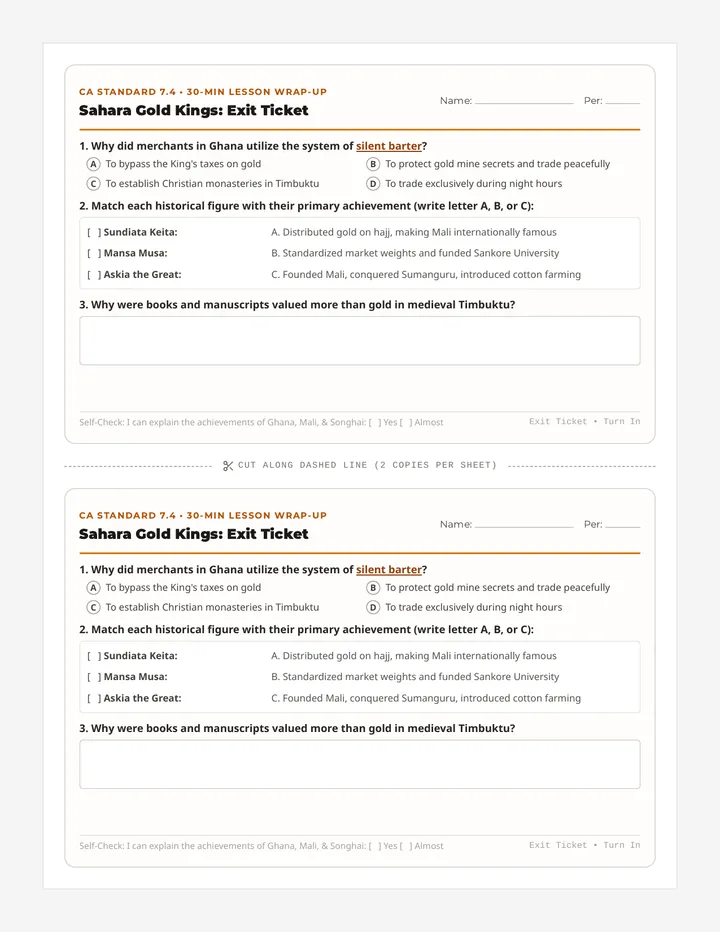
Wrap-Up: Exit Ticket
Demonstrate your understanding on your half-sheet exit ticket:
Identify the primary system Ghana used to trade without speaking or fighting.
Explain how Mansa Musa's pilgrimage transformed Timbuktu's global reputation.
Name the famous university in Songhai where scholars studied medicine, astronomy, and law.
Turn in your slip before leaving! Great work today, Historians!
Bure
Mansa Musa’s 1324 Hajj
In 1324, Mali’s emperor Mansa Musa made a 4,000-mile pilgrimage to Mecca. His caravan was legendary:
60,000 men clad in Persian silk and brocade.
80 camels, each carrying 300 pounds of pure gold dust.
Musa handed out so much gold in Cairo that he caused massive inflation, depressing the market price of gold for 12 years!
Timbuktu: Global Capital of Books & Architecture
Mansa Musa recruited Andalusian poet-architect Abu Ishaq al-Sahili to return to Mali. Using baked sun-dried mud brick and timber beams, al-Sahili constructed the magnificent Djinguereber Mosque in Timbuktu. Scholars, doctors, jurists, and mathematicians flocked to Timbuktu. Handwritten manuscripts—ranging from astronomy to cataract surgery—became more valuable than gold or salt.
Historical Eyewitness Account
“This man Mansa Musa spread upon Cairo the flood of his kindness. There was no person of the court who did not receive from him a sum of gold. They exchanged gold until they depressed its value in Egypt and caused its price to fall... Gold was at a high price until they came that year!”
— Al-Umari, Syrian Chronicler and Historian (1342 CE)
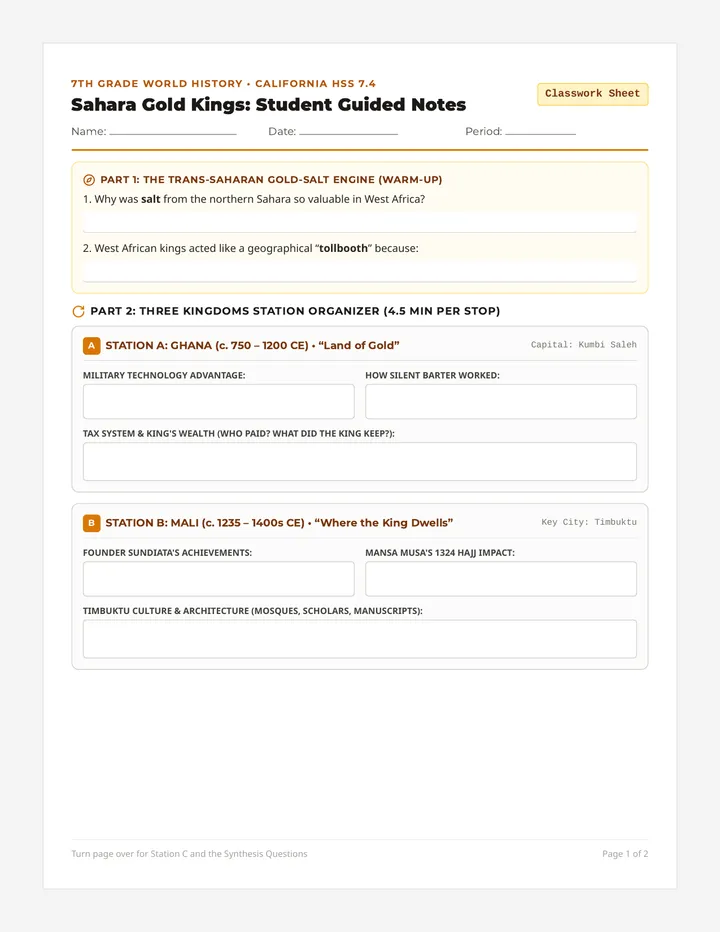
Station Task: Fill in Mali's section on your Guided Notes sheet now!
Station B • Mali
Station C The Songhai Empire • c. 1464 – 1591 CE
Askia the Great & Sankore University
Sunni Ali: River Navy Master
As Mali weakened from succession disputes, the Songhai people around the trading city of Gao rose to dominance. Leader Sunni Ali (ruled 1464–1492) organized a fleet of war canoes along the Niger River.
With his combined river navy and mounted cavalry, Sunni Ali captured the major trading capitals of Timbuktu and Djenné, creating the largest empire in African history.
Askia Muhammad: Master Lawgiver
General Askia Muhammad (Askia the Great) seized power in 1493 and transformed Songhai from a military conqueror into a well-run empire:
Divided the vast empire into five provinces, each run by a governor.
Appointed specialized ministers for finance, agriculture, and the navy.
Standardized weights and measures for all markets to eliminate fraud.
The University of Sankore: 25,000 Scholars
Askia Muhammad was a devoted patron of education. Under his sponsorship, the University of Sankore in Timbuktu housed over 25,000 students from across Africa and the Mediterranean. Students studied a rigorous curriculum: theology, Islamic law (Sharia), advanced mathematics, geography, astronomy, logic, and pharmacology. Upon graduation, scholars were presented with white turbans as marks of divine wisdom.
Historical Eyewitness Account
“Here in Timbuktu there is a great store of doctors, judges, priests, and other learned men, that are bountifully maintained at the king's cost and charges. And hither are brought diverse manuscripts or written books out of Barbarie [North Africa], which are sold for more money than any other merchandise.”
— Leo Africanus, Traveler and Diplomat, The Description of Africa (1526 CE)
Station Task: Fill in Songhai's section on your Guided Notes sheet now!