Frontier Clash Scaffolded Worksheet
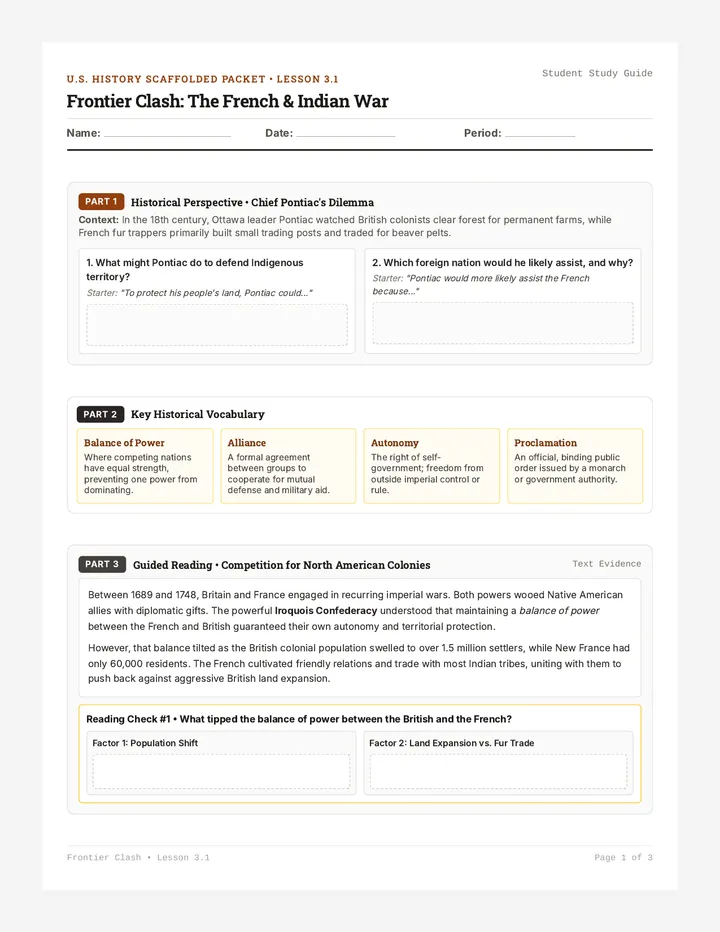
U.S. History Scaffolded Packet • Lesson 3.1
Frontier Clash: The French & Indian War
Student Study Guide
Name:
Date:
Period:
Part 1
Historical Perspective • Chief Pontiac's Dilemma
Context: In the 18th century, Ottawa leader Pontiac watched British colonists clear forest for permanent farms, while French fur trappers primarily built small trading posts and traded for beaver pelts.
1. What might Pontiac do to defend Indigenous territory?
Starter: "To protect his people's land, Pontiac could..."
2. Which foreign nation would he likely assist, and why?
Starter: "Pontiac would more likely assist the French because..."
Part 2
Key Historical Vocabulary
Balance of Power Where competing nations have equal strength, preventing one power from dominating.
Alliance A formal agreement between groups to cooperate for mutual defense and military aid.
Autonomy The right of self-government; freedom from outside imperial control or rule.
Proclamation An official, binding public order issued by a monarch or government authority.
Part 3
Guided Reading • Competition for North American Colonies
Text Evidence
Between 1689 and 1748, Britain and France engaged in recurring imperial wars. Both powers wooed Native American allies with diplomatic gifts. The powerful Iroquois Confederacy understood that maintaining a balance of power between the French and British guaranteed their own autonomy and territorial protection.
However, that balance tilted as the British colonial population swelled to over 1.5 million settlers, while New France had only 60,000 residents. The French cultivated friendly relations and trade with most Indian tribes, uniting with them to push back against aggressive British land expansion.
Reading Check #1 • What tipped the balance of power between the British and the French?
Factor 1: Population Shift
Factor 2: Land Expansion vs. Fur Trade
Frontier Clash • Lesson 3.1 Page 1 of 3
U.S. History Scaffolded Packet • Lesson 3.1
The War for North America (1754–1763)
Name:
Part 4
The Spark • Fort Duquesne & George Washington's Mission (1754)
To prevent British colonists from settling the fertile Ohio River valley, France erected Fort Duquesne at the forks of the Ohio. Virginia's royal governor sent 21-year-old militia officer George Washington to evict the French garrisons, igniting armed clashes.
The Goal
Control the vital waterways and rich farm soils of the Ohio River valley.
The Outcome
Washington was surrounded at Fort Necessity and forced to surrender.
The Impact
Triggered the French & Indian War (and global Seven Years' War).
Part 5
Timeline of the French & Indian War
Chronological Progression
1755 • Braddock's Ambush French Advantage
Gen. Braddock's British army ambushed near Fort Duquesne; Braddock killed, heavy casualties.
1756–1757 • Frontier Raids Frontier Crisis
French destroy British forts on Lake Ontario & Lake George; Indian allies raid settlements in PA and VA.
1758–1759 • The British Turn Naval Superiority
Royal Navy cuts French supply lines; British convince Indian tribes to abandon French alliance.
1760 • Surrender of Canada Decisive Victory
British forces capture Montreal, forcing the French command to surrender all of Canada.
Part 6
The 1763 Treaty of Paris & Imperial Realignment
Signed in 1763, the Treaty of Paris officially concluded the conflict, ending over a century of French colonial presence on mainland North America and dramatically expanding the British Empire.
Reading Check #2 • What did the British gain under the Treaty of Paris?
List the three primary geographic territories transferred to Great Britain, then answer the analysis question:
1. Canada
2. Ohio Valley & Great Lakes
3. Florida (from Spain)
Why was the complete defeat of France devastating news to Native American nations in the interior?
Frontier Clash • Lesson 3.1 Page 2 of 3
U.S. History Scaffolded Packet • Lesson 3.1
Resistance & The Seeds of Revolution
Name:
Part 7
Pontiac's Rebellion (1763) • Indigenous Resistance
Ohio Valley & Great Lakes
The conquest of Canada was terrible news to Indians of the interior. During the spring of 1763, members of several Indian groups captured most of the British forts in the Ohio River valley and along the Great Lakes. They wanted to weaken the British and lure the French back into North America. Pontiac's Rebellion ended when Indian nations made peace in return for British promises to restrain the settlers.
The Threat
British settlers were pouring in to clear farm lands, and British officers stopped giving customary diplomatic gifts.
The Attacks
Allied tribes captured most British frontier forts in the Ohio Valley and Great Lakes region.
Why They Fought
To stop British encroachment and encourage French fur traders to return and help restore balance.
Reading Check #3 • Why Did Indians Capture the British Forts?
Based on the reading summary, complete the two reasons why Indigenous groups attacked and captured the forts:
Reason 1:
Frame: "They wanted to weaken the British so that..."
Reason 2:
Frame: "They hoped to lure the French back because..."
Part 8
The Proclamation of 1763 • The Appalachian Barrier
King George III's Royal Order:
Ordered all colonial settlers to remain east of the Appalachian Mountains to avoid costly frontier wars and keep the peace with Indian nations.
Colonial Reaction & Defiance:
Colonists were furious. Having fought the war to gain western lands, many felt betrayed by the King and crossed the mountains anyway in open defiance.
Part 9
The Albany Plan of Union (1754) • Why Unity Failed
Written by Benjamin Franklin, this plan urged the colonies to unite and cooperate under British rule for shared defense. Both colonial assemblies and the British Crown rejected it.
Why the Colonies Rejected It:
Colonies feared losing their local autonomy (the freedom to govern and tax themselves).
Why the British Crown Rejected It:
British leaders feared that united colonies would become too powerful and harder to manage.
Synthesis
Lesson Check • The Shift in Colonial-Imperial Relations
Culminating Question: Which groups fought each other in the French and Indian War, and how did the British victory unintentionally cause tension between Britain and its American colonies?
Sentence starter: "The war pitted Britain and its allies against France and its allies. After 1763, colonial tension ignited because..."
Frontier Clash • Lesson 3.1 Page 3 of 3
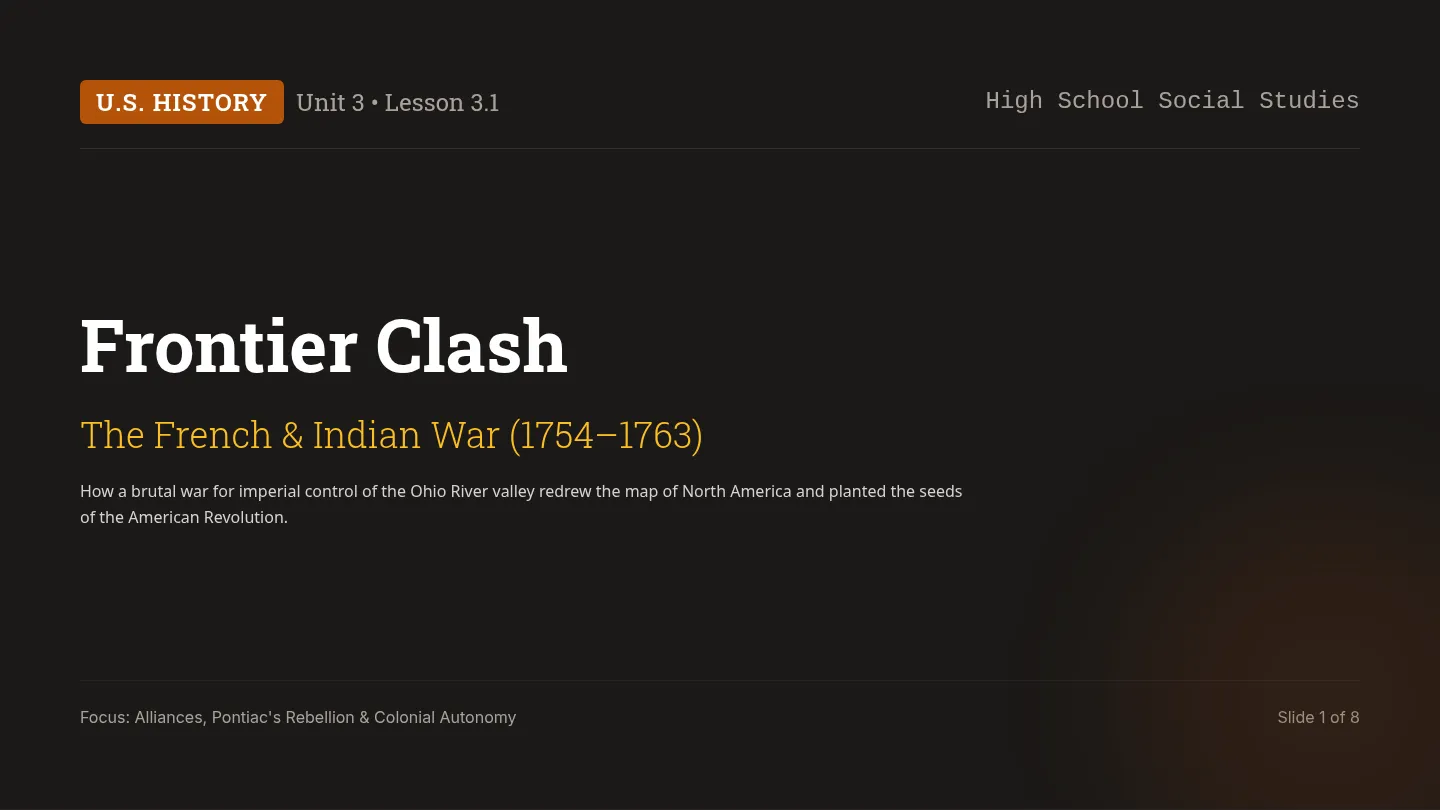
Frontier Clash Teaching Slides
U.S. History Unit 3 • Lesson 3.1
High School Social Studies
Frontier Clash
The French & Indian War (1754–1763)
How a brutal war for imperial control of the Ohio River valley redrew the map of North America and planted the seeds of the American Revolution.
Focus: Alliances, Pontiac's Rebellion & Colonial Autonomy Slide 1 of 8
Warm-Up
Chief Pontiac's Dilemma
Historical Perspective
The Scenario (1750s)
Imagine you are Pontiac, leader of the Ottawa nation.
- British colonists are clearing forests and building permanent farms across your tribal territory.
- French trappers trade for furs, marry into tribes, and leave the wilderness intact.
"These lakes, these woods, and mountains were left to us by our ancestors..."
Turn & Discuss
Question 1:
What could Pontiac do to protect his people's land from settlers?
Question 2:
Which foreign power would he rather deal with, and why?
Record your response in Part 1 of your scaffolded worksheet.
Lesson 3.1 • The French & Indian War Slide 2 of 8
Context
The Balance of Power Tilts
1689 – 1754 Rivalry
British Colonies
Expansion
- Population: ~1,500,000 colonists hungry for cheap farmland.
- Economy: Agriculture, permanent settlements, town building.
- Relationship: Cleared forests, displaced Native villages.
Seen as an existential threat to Indigenous sovereignty.
New France
Trade
- Population: Only ~60,000 trappers, priests, and soldiers.
- Economy: Lucrative beaver fur trade network.
- Relationship: Diplomatic gifts, intermarriage, military alliances.
Built fortified trading posts, not sprawling farming towns.
Iroquois Strategy
Diplomacy
- Balance of Power: Played British and French against each other.
- Gifts & Trade: Received manufactured goods and weapons from both.
- The Crisis: As British numbers exploded, neutrality became impossible.