Avoidance Loop Slides The Cycle of Avoidance
Breaking the feedback loop of anxiety and negative reinforcement.
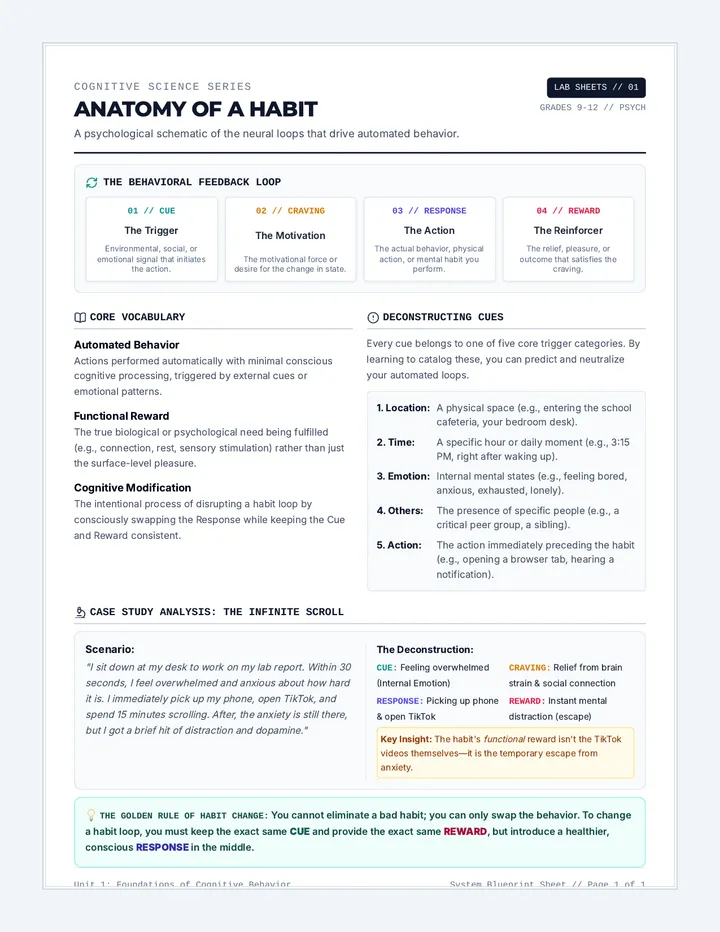
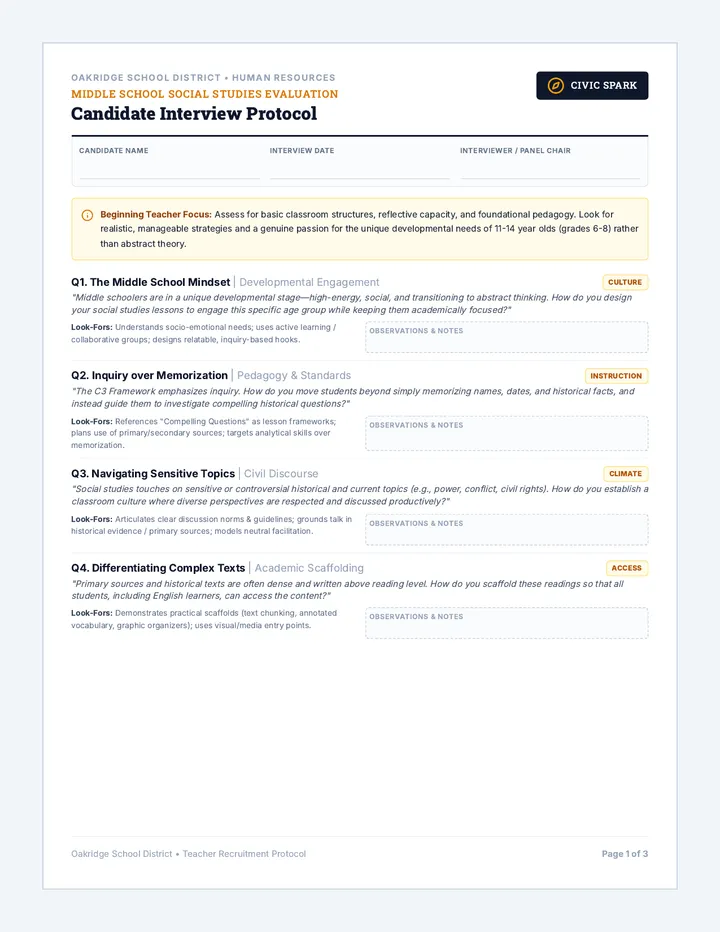
Instant Relief, Long-Term Cost
"Why does avoiding a scary situation make you feel better instantly, but more anxious the next time you face it?"
Short-Term Strategy
Avoidance removes the distress immediately. The brain logs this as a "win."
Long-Term Consequence
The brain never learns the "threat" wasn't dangerous. The fear grows more powerful.
Negative Reinforcement
Reinforcement
Any consequence that increases the likelihood of a behavior happening again.
Negative
The removal or avoidance of an unpleasant stimulus (anxiety, fear, discomfort).
The Logic of Anxiety
"I felt bad. I ran away. Now I feel good. Running away works. I should run away next time too."
The Cycle of Maintenance
Trigger
Fearing a social situation or object.
Distress
Physical and emotional anxiety spikes.
Avoidance
Safety behavior or leaving the situation.
Relief
Anxiety drops quickly. Behavior reinforced.
Breaking the Loop
Exposure Therapy works by preventing avoidance .
Stay in the situation until anxiety naturally decreases.
Learn that the feared outcome is unlikely or survivable.
Break the link between avoidance and relief.
HABITUATION
The brain's natural ability to get "bored" of a stimulus when it is no longer perceived as a threat.
Anxiety Loop Tracker Worksheet Anxiety Loop Tracker
Topic: Behavioral Analysis & Negative Reinforcement
Student Name:
Date:
Part 1: Case Study Mapping
Scenario: Marcus has a fear of public speaking. He is assigned a presentation in his History class. On the day of the presentation, he wakes up feeling nauseous and his heart is racing. He decides to email his teacher and say he is sick, staying home for the day. Within 10 minutes of hitting "send," his nausea disappears and he feels much calmer.
Map the components of Marcus's cycle below:
1. THE TRIGGER (The specific situation or thought)
2. THE DISTRESS (Physical & emotional symptoms)
3. THE AVOIDANCE (The action taken to escape)
4. THE RELIEF (The immediate result/consequence)
Part 2: The Reinforcement Mechanism
How does Marcus's decision to stay home act as "Negative Reinforcement"?
(Hint: Think about what was "removed" and how that makes him more likely to avoid in the future.)
The Long-Term Cost:
What will happen to Marcus's anxiety level the next time he has a presentation? Why?
Part 3: Real-World Loops
Identify a common "avoidance loop" that a teenager might experience. Briefly describe each step.
Trigger:
Distress:
Avoidance:
Relief:
Behavioral Analysis Guide Behavioral Analysis Teacher Guide
Lesson 1: The Cycle of Avoidance
Teacher Resource
Concept 1
Define Negative Reinforcement in the context of anxiety.
Concept 2
Diagram the four stages of the maintenance cycle.
Concept 3
Explain how avoidance prevents habituation.
Key Discussion Points
The "Negative" in Negative Reinforcement
Students often confuse "negative" with "bad" or "punishment." Clarify that in behavioral psychology:
Negative = Subtraction (taking something away).
Reinforcement = Increasing a behavior.
Result = Avoiding (subtracting) anxiety increases the habit of running away.
Habituation vs. Avoidance
Use the "Cold Pool" analogy. If you jump in a cold pool and stay for 10 minutes, your body adjusts (habituation). If you jump in, feel the cold, and immediately climb out, you never adjust. The next time you jump in, it will feel just as cold, if not worse because you now fear the "shock" of the cold.
Common Misconceptions
Misconception
"Avoidance is just common sense."
Students may think avoiding a fear is the logical way to stay safe. Emphasize that in anxiety disorders, the brain is misidentifying safety as danger . Avoidance keeps the brain's "false alarm" system active.
Misconception
"Exposure is just throwing someone into the deep end."
Clarify the difference between flooding (extreme exposure) and systematic desensitization (the topic of this unit). We are building a ladder, not a cliff.
Classroom Activity: Loop Mapping
Step 1: 5 Min
Introduce the 'Hook' question about avoidance and relief.
Step 2: 15 Min
Slide lecture on Negative Reinforcement and the Cycle.
Step 3: 20 Min
Students complete 'Anxiety Loop Tracker' worksheet.
Step 4: 10 Min
Group debrief: Brainstorm 3 common classroom avoidance loops.
Sizing Stress Slides Clinical Tools
Sizing Up Stress
The Subjective Units of Distress Scale (SUDS)
The Calibration Challenge
"If 0 is total relaxation and 100 is a full panic attack, where does Losing Your Phone fall on the scale?"
10?
Mild annoyance
50?
Distressed
75?
High Anxiety
95?
Life Crisis
Why would two people give this situation different scores?
Defining SUDS
Subjective
Based on your feelings, not an objective standard. What's a 50 for you might be a 20 for me.
Units of Distress
A way to measure "how much" fear, anxiety, or discomfort you are experiencing in the moment.
0 - 100 Scale
A precise "emotional thermometer" used in cognitive behavioral therapy (CBT).
75
The Scale Anchors
0-10
Peace
Total relaxation. Sleeping or resting without a care.
25-35
Mild
Slightly uneasy. Like a minor worry you can easily ignore.
50-60
Moderate
Distinctly uncomfortable. Harder to focus. Physical symptoms start.
75-85
High
Severe distress. Urgent desire to leave or avoid. Heart racing.
90-100
Extreme
Highest possible distress. Panic attack. Cannot function.
The Power of Numbers
In the hierarchy...
We use SUDS to build the "ladder." We don't want a step that's a 10 and the next one to be a 90. We need to find the 20, 30, 40, and 50 to bridge the gap.
In the session...
It's a communication shortcut. Instead of "I feel bad," saying "I'm at a 65" tells the clinician exactly what is happening in real-time.
Calibration is Key
Stress Thermometer Activity Stress Thermometer
SUDS Calibration Workshop
Name:
Date:
Distress Scale
100
Panic
80
Severe
60
Mod
40
Mild
20
Uneasy
0
Calm
Exercise 1: Ranking Stressors
Assign a SUDS number (0-100) to each of the following hypothetical scenarios. There are no "right" answers, but try to be consistent based on how you personally react.
Entering a room where you don't know anyone.
A sudden fire alarm goes off in a movie theater.
Forgetting to turn in a major homework assignment.
Walking down a dark, quiet street alone at night.
Accidentally breaking a glass in a quiet restaurant.
Exercise 2: Justifying the Scores
Select the scenario from Exercise 1 that you gave the HIGHEST score and the LOWEST score. Explain why.
Highest (Score: ___)
Lowest (Score: ___)
Exercise 3: The Clinician's Dilemma
If a client says they are at a "5" but they are crying and unable to speak, what does that tell you about their calibration of the scale?
Safety Crutch Slides The Safety Crutch
Identifying Behaviors that Block Habituation
Safety Behaviors
Adaptive Coping
Coping or Crutch?
"Is bringing a water bottle to a speech a healthy habit or a safety crutch that prevents you from learning you can survive without it?"
The answer depends on why you're doing it.
What are Safety Behaviors?
Subtle strategies used to prevent the feared outcome or reduce distress in the short term.
The Problem:
Safety behaviors are "hidden avoidance." If you survive the situation, your brain thinks: "I only survived because I had my phone/water/lucky charm."
Common Examples
Avoiding eye contact
Staring at a phone in social settings
Sitting near exits at all times
Having a "safe person" with you
Carrying anti-anxiety meds "just in case"
Adaptive Coping
The Definition
Techniques that help you tolerate the anxiety while fully engaging in the situation.
"I am feeling anxious, and that's okay."
"I can handle this discomfort."
Deep Breathing
Calms the nervous system without escaping the trigger.
Mindfulness
Observing feelings without trying to "push them away."
Positive Self-Talk
Encouraging the self to stay in the discomfort.
The Function Test
To tell the difference, ask this question about the behavior:
"Am I doing this to help me STAY, or to help me HIDE?"
HELP TO STAY
Adaptive Coping
HELP TO HIDE
Safety Behavior
Spot the Crutch Activity CASE FILE
Spot the Crutch
Identifying Hidden Avoidance in Clinical Narratives
THERAPEUTIC APPROACHES UNIT
LESSON 03 | ACTIVITY
Instructions
Read each of the case narratives below. For each scenario, identify the safety behavior being used and explain how it acts as a "crutch" that might prevent the person from fully overcoming their fear.
01
The Elevator Strategy
"Lila is afraid of being trapped in small spaces. When she has to take the elevator at work, she always makes sure she is holding her phone with a pre-dialed number for emergency services ready on the screen. She keeps her finger hovering over the 'call' button until the doors open on her floor."
Identified Safety Behavior
Why it blocks progress
02
The Social Script
"Sam has social anxiety. Before going to a party, he spends two hours writing out a list of 'safe' conversation topics and jokes in a notebook. During the party, he keeps the notebook in his back pocket and frequently goes to the bathroom to re-read his notes to ensure he doesn't 'run out of things to say'."
Identified Safety Behavior
Why it blocks progress
03
The Dog Park Lookout
"Jamie had a bad experience with a dog as a child and now feels intense fear around them. To 'face their fear,' Jamie goes to the local dog park but stays inside their car with the windows rolled up and the doors locked. Jamie believes they are doing exposure therapy by watching the dogs from the safety of the vehicle."
Identified Safety Behavior
Why it blocks progress
Refining the Treatment Plan
Which of the characters above is using a "hidden" avoidance that they likely believe is helpful? How would you explain to them that their behavior is actually keeping their anxiety alive?
Step by Step Slides Step by Step
Designing the Exposure Hierarchy
The Cliff vs. The Ladder
"How do we get someone from looking at a picture of a spider to holding one without causing a total panic attack?"
Step 1: Picture The Gap Step 10: Holding
Design Principles
01
Specificity
Steps must be concrete. Not "be near a dog," but "stand 5 feet away from a leashed golden retriever for 5 minutes."
02
The "Goldilocks" Step
Gaps between steps shouldn't jump more than 10-15 SUDS points. Too small is boring; too big is terrifying.
03
Progression
Always start at a "Medium" challenge (around 30-40 SUDS). Don't start at a 90, and don't waste time on a 5.
Dialing Up the Difficulty
How do we change SUDS scores?
Adjust these variables:
Distance
Close vs. Far
Duration
5 mins vs. 1 hour
Realism
Photo vs. Real Life
Support
Therapist vs. Alone
Example: Heights
20
Watching a VR video of a skyscraper.
45
Looking out a 2nd story window.
70
Standing on a balcony (4th floor).
95
Leaning over the edge of a rooftop.
Your Turn
Become the Architect
You will be assigned a client with a specific phobia. Your goal is to design a 10-step ladder that bridges the gap from mild discomfort to their ultimate fear goal.
Rules:
• At least 10 steps
• No jumps > 15 SUDS
• Concrete descriptions
Outcome:
• Habituation
• Empowerment
• Breaking the Cycle
Hierarchy Architect Project Hierarchy Architect
Systematic Desensitization Protocol Design
Clinical Project
Client Profile #4412
Name:
Alex R.
Diagnosis:
Arachnophobia
The Fear Context:
Alex is unable to go into their basement or garden due to an intense fear of spiders. The ultimate goal is for Alex to be able to catch a spider in their house using a cup and paper and release it outside without experiencing a panic attack.
Exposure Ladder Design
Goal: Ultimate Fear Target (100 SUDS)
Step Activity Description (Be Specific!) Target SUDS 10 Ultimate Goal: Catch a spider in a cup and release it. 100 09 08 07 06 05 04 03 02 01
Clinical Rationale
Why did you choose your Step 1 starting point?
Explain the "Goldilocks Rule" in your Step 5-6 jump.
Prevention of Safety Behaviors:
What is one common safety behavior Alex might try to use during this hierarchy? How will you instruct them to avoid it?
Habituation Curve Slides Data Analysis
The Habituation Curve
Measuring Progress and Clinical Readiness
Data Detective
"Look at these two graphs of anxiety levels over a 20-minute exposure session... which person actually learned to overcome their fear?"
Client A: SUDS stay at 80 for the whole session.
Client B: SUDS start at 80 and drop to 20.
What is Habituation?
The diminishing of a physiological or emotional response to a frequently repeated stimulus.
The "New Shoe" Analogy
When you first put on a new pair of shoes, you can feel them on your feet every second. After an hour, your brain habituates—the signal is still there, but you no longer "feel" it as a priority.
SUDS (Distress)
Time (Duration of Exposure)
The Goal: Wait for the Drop
When to Move Up?
MOVE UP IF...
The initial SUDS for the step has dropped by 50% across sessions.
The client reports a sense of boredom or "This is easy now."
Habituation happens quickly (within 5-10 minutes).
STAY/REPEAT IF...
SUDS remain high (>50) even at the end of the session.
The client used a safety behavior during the exposure.
The client "escaped" (avoided) before habituation occurred.
Across Sessions
"Progress isn't just about what happens in one hour, but what happens when you return the next day."
80
Start Session 1
40
Start Session 2
10
Start Session 3
This is the rewiring of the brain.
Data Detective Activity Data Detective Activity
PROTOCOL EVALUATION
LESSON 05 | WORKSHEET
Analyze the clinical data charts below for Client: Maria (Fear of Heights). For each chart, identify whether habituation occurred and make a clinical recommendation for the next session.
Session #1: Standing on 2nd Floor Balcony
DATA SET A
0 MIN 5 MIN 15 MIN 30 MIN
Did Habituation occur? Why or why not?
Clinical Recommendation (Next Steps)
Session #2: Standing on 4th Floor Balcony
DATA SET B
0 MIN 5 MIN 15 MIN 30 MIN
Did Habituation occur? Why or why not?
Clinical Recommendation (Next Steps)
The Clinician's Decision
Imagine that in Session #2 (Data Set B), Maria admitted that she was holding onto the railing with both hands and repeating "I am not high up" to herself the entire time. How does this information change your interpretation of the graph?
Protocol Mastery Check Exit Ticket Protocol Mastery Check
Exit Ticket | Exposure & Systematic Desensitization
Student Name:
Date:
01
Explain why "relief" from avoidance is actually a bad thing in the long term for someone with anxiety.
02
A student is building a hierarchy for a fear of crowds. Step 1 is "standing in a busy hallway" (30 SUDS). Step 2 is "attending a sold-out concert" (95 SUDS). Why is this a poor hierarchy design?
03
Define "habituation" in your own words. How do we know when it has happened during a therapy session?
Self-Calibration
Rate your confidence in designing an exposure protocol for a client from 0 to 100 (using the SUDS scale logic!).
0 (No clue) 50 (Could do with help) 100 (Expert Architect)