Stone Age Survival Slides
Global History • Unit 2.2
Life During the Paleolithic Era
Archaeological & Video Investigation
Stone Age Survival:
Life in the Paleolithic Era
Investigating early human diet, nomadic mobility, artifact technology, and environmental interactions.
Instructor: __________________
Date: __________________
Period / Hour: _______
Lesson Focus & Objectives
Inquiry Stage
I Can Statement
“I can describe what living was like for humans during the Paleolithic Era.”
Success criteria: Identify food sources, nomadic movement, social group size, tool materials, and environmental adaptations.
Timeline: ~2,500,000 BCE to ~10,000 BCE
Supporting Question
What was daily life like for early humans before the invention of agriculture?
Key Vocabulary Concepts
Paleolithic
Hunter-Gatherer
Nomadic Lifestyle
Artifacts & Foraging
Turn & Talk: What would be the hardest part of surviving without permanent homes or stores?
Video Evidence • Part 1
Stories from the Stone Age (1 of 15)
Watch: 1:00 – 5:30
Embedded media
Embedded Clip 1 Excerpt Starts at 1:01
Video Focus Questions (Unit 2.2: 1–3)
-
Food: What food did people eat in the Paleolithic Era?
-
Acquisition: How did people get food in the Paleolithic Era?
-
Community: Approximately how many people lived together in Paleolithic communities?
Teacher Notes • Discussion Cues
Pause at 3:15: Discuss meat vs. wild gathered flora, and why 25–50 members was the ideal survival band size.
Key Finding: Paleolithic humans spent the majority of their energy securing daily calories.
Video Evidence • Part 2
Stories from the Stone Age (2 of 15)
Watch: 0:00–3:28 & 8:15–8:42
Embedded media
Embedded Clip 2 Excerpts: 0:00–3:28 & 8:15–8:42
Video Focus Questions (Unit 2.2: 4–5)
-
Human Impact: What effects did the hunter-gatherers have on their environment?
-
Environmental Impact: What effects did their natural environment have on them?
Teacher Notes • Ecological Cues
Highlight fire use, animal migratory changes, and ice age climate shifts as the dual environmental dynamic.
Two-Way Dynamic: Humans altered local flora/fauna while nature dictated migratory routes.
Survival Dynamics
Hunting, Foraging & Band Communities
Band Size: 25–50 People
Nomadic Migration
Humans moved continuously following animal herds and ripening seasonal vegetation.
Food Gathering Roles
Hunting game animals, gathering nuts/berries, and spearing fish provided daily nutrition.
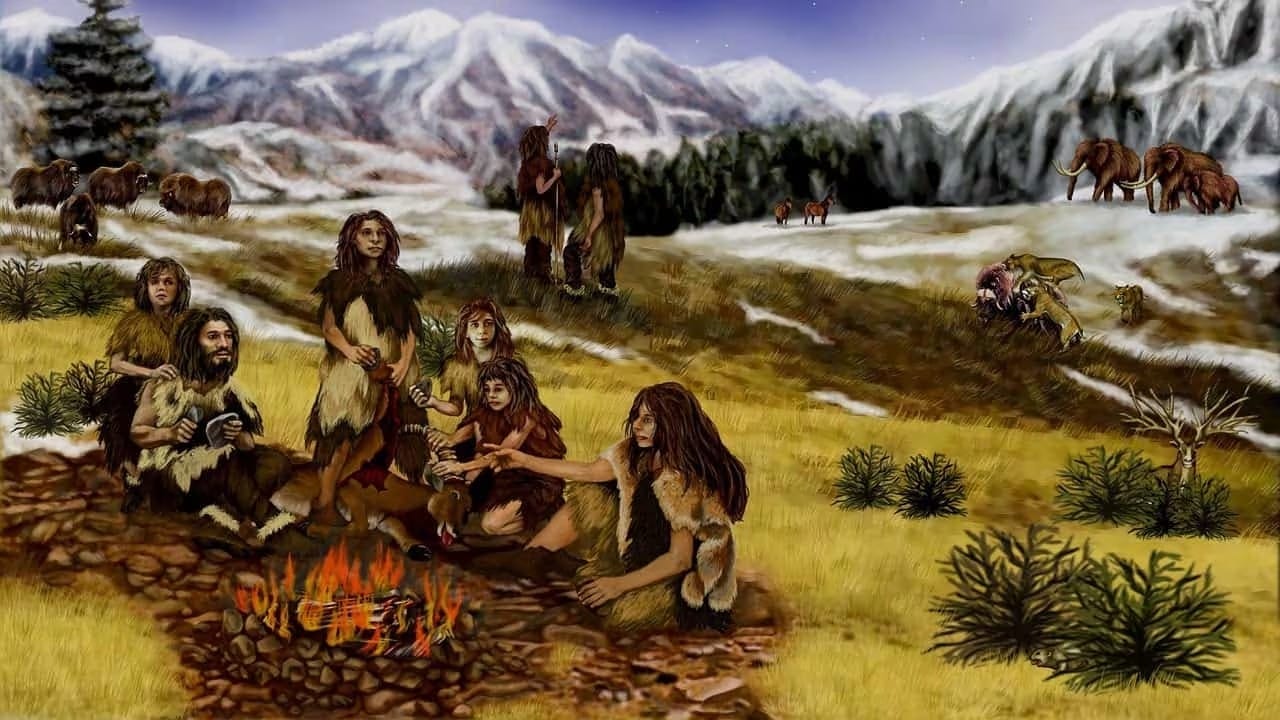
Paleolithic Band Encampment & Landscape
Teacher Notes
• Emphasize: Bands stayed 25–50 to avoid depleting local resources.
• Point out fire pit, hides, and distant mammoths in painting.
Write class notes here:
Constant mobility meant no food surplus; survival was tied directly to local ecosystems.
Technological Innovation
Stone, Bone & Antler Toolkits
Material Culture
Flint & Jasper Blades
Chipped stone blades and scrapers butchered animals, cut wood, and prepared pelts.
Bone Needles & Harpoons
Bone awls and needles enabled stitched hide clothing; harpoons captured fish.
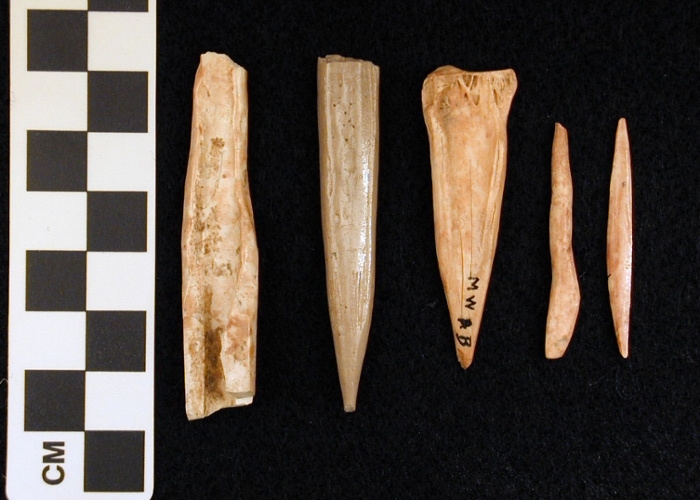
Excavated Bone Awls & Points (Mt. Carmel)
Teacher Notes
• Point out: Carved bone awls pierced hides for warm clothing.
• Notice centimeter scale: precision and handheld portability.
Write class notes here:
Archaeology Rule: Tools reveal the exact climate, food sources, and craftsmanship of their makers.
Living Spaces
Caves, Hides & Mammoth Bone Huts
Temporary Shelters
Rock Overhangs & Caves
Natural rock entrances provided fire warmth, wind shields, and safety from beasts.
Mammoth Bone Dwellings
On treeless plains, frames were built of mammoth tusks and draped with hides.
Photo Placeholder
Paleolithic Shelter Model
Insert diagram or reconstruction of mammoth bone structure or cave shelter.
Teacher Notes
• Shelters had to be quick to build or naturally available.
• Fire was the heart of every camp for warmth and safety.
Write class notes here:
Early humans did not build permanent stone houses until farming began in the Neolithic Era.
Symbolic Expression
Cave Art, Rituals & Deep Meaning
Lascaux & Beyond
Natural Pigments
Ground charcoal, yellow ochre, and hematite were blown or painted with animal fur brushes.
Ritual & Spirit
Images depicted massive prey animals, likely serving hunting rituals and community beliefs.
Photo Placeholder
Lascaux Cave Painting
Insert photo of Lascaux, Chauvet, or Altamira animal murals or hand stencils.
Teacher Notes
• Paintings were deep in pitch-black caves using animal-fat lamps.
• Ask: Why paint bulls and horses instead of humans?
Write class notes here:
Art demonstrates complex symbolic communication and abstract thinking tens of thousands of years ago.
Video Prompt 6 • Trade-Offs Analysis
Nomadic Hunter-Gatherer Life: (+) & (−)
Worksheet Activity
Advantages (+)
- Diverse nutrition from varied wild game & seasonal flora
- Mobility allowed moving away from harsh local weather
- Cooperative, egalitarian social band relationships
- Deep ecological mastery and harmony with nature
Disadvantages (−)
- Extreme vulnerability to severe weather & food scarcity
- Lack of food surplus; cannot store reserves for long
- High danger during big-game hunts without metal gear
- Strict band population limits; vulnerable to injury
Independent & Partner Practice
Complete the artifact analysis & response questions on your Paleolithic Life Worksheet.
Begin Practice
Paleolithic Life Worksheet
Global History 9 Unit 2.2 • Prehistory
Stone Age Survival: Life in the Paleolithic Era
Student Investigation Packet
Name:
Date:
Period/Hour:
Learning Objective
I can describe what living was like for humans during the Paleolithic Era by analyzing video evidence, evaluating artifact technology, and explaining hunter-gatherer adaptations.
1 Introduction: Vocabulary Matching
Match each word to its definition letter (A–E)
1. Paleolithic Era
2. Hunter-Gatherer
3. Nomadic
4. Foraging
A. Moving from place to place following seasonal food resources.
B. Old Stone Age (~2.5M to ~10,000 BCE) characterized by stone tools.
C. A person who survives by hunting animals and gathering wild plants.
D. The act of searching for and collecting wild fruits, seeds, and roots.
2 Video Investigation: Stories from the Stone Age
Excerpts 1 & 2 Questions
1. What food did people eat in the Paleolithic Era? Clip 1 (1:00–5:30)
2. How did people get food in the Paleolithic Era? Methods & strategies
3. Approximately how many people lived together in Paleolithic communities? Band size
4. What effects did hunter-gatherers have on their environment?
5. What effects did the environment have on them?
6. In the chart below, identify two advantages (+) and two disadvantages (−) of being a nomad and hunting/gathering:
Advantages (+)
Disadvantages (−)
Unit 2.2 • Life During the Paleolithic Era Page 1 of 3 • Turn Over →
Document & Archaeological Artifact Investigation
Unit 2.2 Inquiry
Photo Placeholder Document 1: Lascaux Cave Art (Bulls & Horses)
Document 1: Paleolithic Cave Art
Lascaux, France
Paleolithic cave paintings depict bulls, horses, and wild game that were vital to the nomadic hunters who crafted them using charcoal and ochre pigments.
Prompt: Based on the cave painting and description, identify one characteristic of Paleolithic life or culture.
Photo Placeholder Document 2: Flint Blades & Jasper Scrapers
Document 2: Tools from Hunter-Gatherers
North Africa & Sahara
Flint blades (5000–4500 BCE) and green jasper scrapers (5200–2500 BCE) show how early humans flaked stones to create sharp edges for butchering game and shaping wood.
Prompt: Based on the artifacts and description, describe the technology used during the Paleolithic Era and what it was used for.
Paleolithic Lesson Plan
Evergreen Charter School
Daily Instructional Lesson Plan
Teacher: 9th Grade Social Studies Team
Subject: Global History & Geography I
Day(s): 9/24 (September 24)
Unit: Unit 2: The First Civilizations • Topic 2.2: Life During the Paleolithic Era
Topic: Nomadic Hunter-Gatherer Survival, Early Stone & Bone Tool Technologies, and Environmental Adaptation
Learning Objective:
SWBAT describe what living was like for humans during the Paleolithic Era by analyzing primary archaeological artifacts, extracting historical evidence from video excerpts, and evaluating nomadic lifestyle adaptations.
Standards Addressed:
- NYS Social Studies Framework 9.1a: Paleolithic Era characterized by non-sedentary hunting and gathering lifestyles prior to the turn to agriculture.
- CCSS.ELA-LITERACY.RH.9-10.1 & RH.9-10.2: Cite specific textual/artifact evidence; determine central ideas of primary and secondary sources.
- CCSS.ELA-LITERACY.WHST.9-10.1: Write informative arguments with evidence and disciplinary reasoning.
Academic Vocabulary:
Paleolithic Era Hunter-Gatherer Nomadic Foraging Artifact Flintknapping
Materials / Resources:
- Stone Age Survival Slides (with embedded clips)
- YouTube: Stories from the Stone Age (Clips 1 & 2)
- Paleolithic Life Worksheet Packet (3 Pages)
- Interactive smartboard / document camera & pens
Instructional Execution • Lesson Delivery Date: 9/24
Do Now (3–5 minutes): Silent Independent Work on Worksheet Page 1
Task: Students enter, pick up the Paleolithic Life Worksheet packet, and complete Part 1 (Vocabulary Matching: Paleolithic, Hunter-Gatherer, Nomadic, Foraging).
Quick-Write Hook: “Imagine you wake up tomorrow and there are no grocery stores, electricity, or permanent homes. What is the very first thing your group must do to survive until nightfall?” (Record 1 sentence).
Evergreen Charter School • Lesson Plan 9/24 Page 1 of 3 • Pacing & Delivery →
Pacing Guide & Lesson Steps (9/24)
Total Time: 50–55 Minutes
1 I Do • Direct Instruction & Mini-Lesson (5–12 minutes) Slides 1–4 • Video Excerpts
- Frame the Inquiry (2 min): Unpack the learning objective on Slide 2. Establish that the Paleolithic spans 99% of human existence before agriculture.
- Screen (Part 1). Guide students to observe food types (wild grains, meat, roots) and community band size (25–50 members). Highlight why bands remained small.