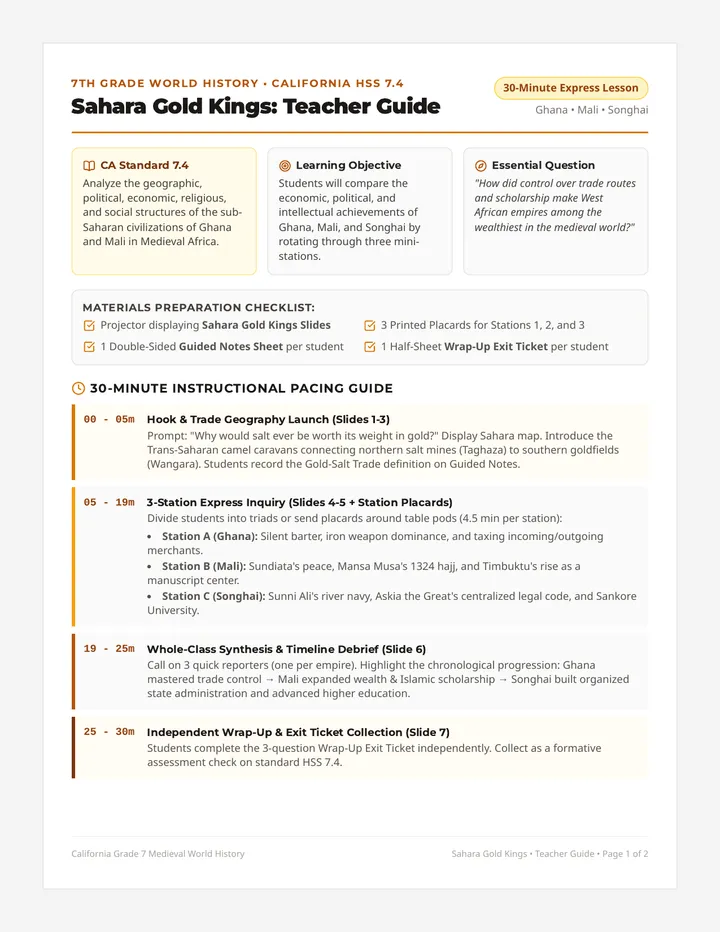
Brain Blueprint Teacher Guide Brain Blueprint
Foundations of Biological Psychology
Teacher Guide
Instructional Objectives
Identify and describe the structural components of a neuron and their functions.
Explain the electrochemical process of neural transmission (action potential).
Map the major divisions of the nervous system and their primary roles.
Differentiate between the structural and functional regions of the cerebral cortex.
Pacing Guide
Introduction 10 min
Neural Structure 20 min
Transmission 25 min
Brain Anatomy 30 min
Q&A / Synthesis 15 min
Critical Inquiry Questions
The Mind-Body Problem
"If every thought and emotion is a result of biological chemical reactions, does 'free will' truly exist, or are we biological machines?"
Teaching Note: Use this to bridge the gap between hard science and philosophical psychology.
Neuroplasticity vs. Localization
"If specific areas of the brain are responsible for specific tasks (localization), how do we explain the brain's ability to rewire itself after trauma?"
Core Lexicon
Action Potential
The brief electrical charge that travels down an axon, caused by the movement of positively charged atoms in and out of channels in the axon's membrane.
Neurotransmitters
Chemical messengers that cross the synaptic gaps between neurons, binding to receptor sites on the receiving neuron.
Autonomic Nervous System
The part of the peripheral nervous system that controls the glands and the muscles of the internal organs.
Amygdala
Two lima-bean-sized neural clusters in the limbic system linked to emotion, particularly fear and aggression.
Frontal Lobes
Involved in speaking and muscle movements and in making plans and judgments.
Plasticity
The brain's ability to change, especially during childhood, by reorganizing after damage or by building new pathways based on experience.
In-Class Case Study: Phineas Gage
Guide students through the historical case of Phineas Gage. Focus on the shift from personality to physical change. Ask students to predict which specific brain regions were damaged based on his behavioral changes (prefrontal cortex).
"Gage was no longer Gage." — Discuss what this means for our modern understanding of the "self."
Brain Blueprint Slides Psychology 101: Mind Explorers
Brain
Blueprint
Exploring the Biological Foundations of Behavior and Experience
Session Objectives
1 Identify the structural components of neurons and their functions.
2 Analyze the electrochemical process of neural communication.
3 Map the major divisions of the nervous system.
4 Relate cortical structures to cognitive functions.
"The mind is what the brain does."
— Steven Pinker
Building Blocks: The Neuron
Dendrites
Branching fibers that receive chemical messages from other neurons.
Cell Body (Soma)
The metabolic center of the neuron; integrates incoming signals.
Axon
Long tail-like structure that carries electrical impulses away from the cell body.
Information Flow
DENDRITES SOMA AXON
The Action Potential
Neural communication is an electrochemical process.
Stage 1
Resting Potential: Neuron is polarized at -70mV.
Stage 2
Depolarization: Na+ ions rush in when threshold is met.
Stage 3
Repolarization: K+ ions exit, resetting the charge.
"All-or-None Principle"
A neuron either fires completely or not at all; there are no partial shots.
Bridging the Gap: Synaptic Transmission
Neurons do not touch. They communicate across a fluid-filled gap called the Synaptic Cleft.
Release of neurotransmitters into the cleft.
Binding to specific receptor sites (Key-and-Lock).
Reuptake: The "recycling" of neurotransmitters.
Dopamine
Reward, motivation, motor control.
Serotonin
Mood regulation, sleep, hunger.
GABA
The brain's primary brake (inhibitory).
Glutamate
The brain's gas pedal (excitatory).
The Body's Communication Network
Nervous System
Central (CNS)
Brain
Spinal Cord
Peripheral (PNS)
Somatic
Autonomic
The Cortex: Specialized Lobes
Frontal Lobe
Decision making, motor control, personality.
Parietal Lobe
Sensory processing (touch, spatial navigation).
Temporal Lobe
Auditory processing, language, memory.
Occipital Lobe
Brain Blueprint Worksheet Lab Report: Brain Blueprint
Module 01
Scholar:
Date:
1 Functional Anatomy: The Neuron
Identify the structural components of the neuron based on the functional descriptions provided below. Write the correct term next to each description.
The receiving fibers that pick up chemical signals from neighboring neurons.
The fatty insulation that speeds up electrical transmission across the axon.
The metabolic center containing the nucleus and genetic material.
Small knobs at the end of the axon that release neurotransmitters into the synapse.
2 Electrochemical Transmission
A. Describe the "All-or-None Principle" and its significance in neural firing.
B. Sequence the process of the action potential (resting state, depolarization, repolarization).
3 Cortical Function Analysis
For each lobe of the cerebral cortex, identify its primary functional responsibility and predict a likely behavioral symptom if that area were localized damaged.
Lobe
Primary Function
Impact of Lesion/Damage
Frontal Lobe
Parietal Lobe
Temporal Lobe
Occipital Lobe
4 Clinical Case Application
The Case of "P.G."
Patient P.G. was a 25-year-old railway foreman who suffered a massive traumatic brain injury. Before the accident, he was described as efficient, smart, and well-balanced. After the accident, he became fitful, irreverent, and grossly profane, showing little deference for his fellows. He was unable to stick to any future plans.
Question: Based on the behavioral shifts described, which specific brain region was likely damaged? Justify your answer using evidence from the text and your knowledge of brain anatomy.
Perception Portals Slides Mind Explorers: Module 02
Perception
Portals
Decoding the Brain's Construction of Reality
Sensation vs. Perception
Sensation
The process by which our sensory receptors and nervous system receive stimulus energies from our environment.
"Bottom-Up Processing"
Perception
The process of organizing and interpreting sensory information, enabling us to recognize meaningful objects and events.
"Top-Down Processing"
Reality is a Hallucination?
"We don't see things as they are, we see them as we are."
— Anaïs Nin
Limits of Awareness
Absolute Threshold
The minimum stimulus energy needed to detect a particular stimulus 50% of the time.
Example: A candle flame seen at 30 miles on a dark, clear night.
Difference Threshold (JND)
The minimum difference between two stimuli required for detection 50% of the time.
Weber’s Law: To be perceived as different, two stimuli must differ by a constant minimum percentage.
Signal Detection
Hit Miss False Alarm
Gestalt: The Whole > Sum of Parts
Proximity
Grouping nearby figures together.
Similarity
Grouping similar figures together.
Continuity
Perceiving smooth, continuous patterns.
Closure
Filling in gaps to create whole objects.
The Power of Context
Perceptual Set
A mental predisposition to perceive one thing and not another, shaped by Expectation, Culture, and Emotion.
"You see the monster in the woods because you were told the woods were haunted."
"Wine tastes better if the taster believes it is more expensive."
Conditioning Lab Slides Mind Explorers: Module 03
Conditioning
Lab
Learning as a Product of Environment and Experience
Classical Conditioning
"Associating two stimuli; anticipating events."
Unconditioned Stimulus (US)
Food
Unconditioned Response (UR)
Salivation
Conditioned Stimulus (CS)
The Bell
Ivan Pavlov
The shift from natural reflex to learned response through repeated association.
Operant Conditioning
B.F. Skinner
Behavior is strengthened if followed by a reinforcer or diminished if followed by a punisher.
Positive Reinforcement
Adding something good to increase behavior (e.g., Reward).
Negative Reinforcement
Removing something bad to increase behavior (e.g., Stop beeping).
Positive Punishment
Adding something bad to decrease behavior (e.g., Scolding).
Negative Punishment
Removing something good to decrease behavior (e.g., Time-out).
Timing Matters: Schedules
Fixed Ratio
Reinforcement after a set number of responses (e.g., Buy 10, get 1 free).
Variable Ratio
Slot Machines.
The most resistant to extinction.
Fixed Interval
Reinforcement after a set amount of time (e.g., Weekly paycheck).
Variable Interval
Reinforcement after unpredictable time (e.g., Pop quiz).
Conditioning Lab Worksheet Lab Report: Conditioning Lab
Module 03
Scholar:
Date:
1. Associative Learning Mechanics
Scenario:
"Every time you come home, you use your squeaky key in the lock. Your dog, who initially didn't react to the sound, now starts wagging his tail and jumping as soon as he hears the squeak, even before you open the door."
Unconditioned Stimulus (US)
Unconditioned Response (UR)
Conditioned Stimulus (CS)
Conditioned Response (CR)
2. Consequences and Contingencies
Define and provide a novel, real-world example for each operant contingency below.
Positive Reinforcement
Negative Reinforcement
Positive Punishment
Negative Punishment
3. Schedules of Reinforcement
Identify the schedule of reinforcement for the following scenarios:
A coffee shop gives you a free latte after you buy 10 cups.
Checking your phone for a text message that could arrive at any time.
A slot machine at a casino paying out a jackpot.
Critical Analysis: Why is the Variable Ratio schedule the most resistant to extinction? Support your answer with behavioral theory.
Memory Matrix Slides Mind Explorers: Module 04
Memory
Matrix
Information Processing, Storage, and Retrieval
Information Processing Model
Sensory Memory
Immediate, brief recording of sensory information.
Attention
Working Memory
Activated memory that holds few items briefly (7 ± 2).
Encoding
Long-Term Memory
Relatively permanent and limitless storehouse.
The Taxonomy of Memory
Explicit (Declarative)
Memories of facts and experiences that one can consciously know and "declare."
Semantic (Facts)
Episodic (Life events)
Implicit (Nondeclarative)
Retention independent of conscious recollection.
Procedural (Skills)
Conditioning effects
Why do we forget?
Encoding Failure
The info never entered long-term memory.
Storage Decay
Memory trace fades over time (Ebbinghaus).
Interference
New/Old info blocks retrieval.
"Memory is not a recording; it is a reconstruction."
Memory Matrix Worksheet Lab Report: Memory Matrix
Module 04
Scholar:
Date:
1. The Atkinson-Shiffrin Model
Differentiate between the three stages of memory based on capacity and duration.
Sensory Memory
Working Memory
Long-Term Memory
2. Memory Systems Analysis
Classify the following memories as either Explicit (Semantic/Episodic) or Implicit (Procedural/Conditioning).
Remembering the name of the first President of the United States.
The physical ability to ride a bicycle without thinking about balance.
Recalling the specific details of your high school graduation ceremony.
3. Failures of the Matrix
The Misinformation Effect
Explain how the way a question is phrased (e.g., "Smashed" vs. "Hit") can alter a person's recollection of a witnessed event. Relate this to the concept of memory as a reconstruction.
Proactive vs. Retroactive Interference
Provide one example for each to demonstrate how old and new information compete for retrieval.
Social Synergy Slides Mind Explorers: Module 05
Social
Synergy
Social Influence, Group Dynamics, and Obedience
The Power of the Situation
Fundamental Attribution Error
The tendency to overestimate the impact of disposition (personality) and underestimate the impact of the situation.
Cognitive Dissonance
The mental tension we feel when our actions don't match our beliefs. We change our attitudes to reduce the discomfort.
"Social psychology is the study of how people's thoughts, feelings, and behaviors are influenced by the actual, imagined, or implied presence of others."
— Gordon Allport
Conformity & Obedience
Asch Effect
Adjusting our behavior or thinking to coincide with a group standard.
Visual Judgement Test
Milgram's Study
65% of participants delivered "lethal" shocks because an authority figure told them to.
Key Factor:
Obedience is highest when the person giving orders was close at hand and perceived to be a legitimate authority figure.
Group Dynamics
Social Loafing
Exerting less effort when in a group than when individually accountable.
Deindividuation
The loss of self-awareness and self-restraint occurring in group situations that foster arousal and anonymity.
Groupthink
"The mode of thinking that occurs when the desire for harmony in a decision-making group overrides a realistic appraisal of alternatives."
Social Synergy Worksheet Lab Report: Social Synergy
Module 05
Scholar:
Date:
1. Attribution and Cognition
Scenario Analysis
"A driver cuts you off in traffic. You immediately think, 'What an aggressive jerk!' and assume they are a bad person."
Identify the attributional bias being displayed. Why is this error so common in social perception?
Cognitive Dissonance in Action
Describe a situation where you (or a hypothetical person) experienced dissonance and explained how the attitude was adjusted to match the behavior.
2. Conformity and Obedience
The Asch Study
What were the key factors that increased the likelihood of a participant conforming to a clearly wrong group answer?
The Milgram Study
What do the results suggest about the average person's capacity for obedience under the direction of an authority figure?
3. Dynamics of the Collective
Social Loafing
Deindividuation
Groupthink
Synthesis Question
Given what you've learned about social influence, how can a group prevent Groupthink during a high-stakes decision-making process?