Throne Wars Anchor Chart Arizona Civics Standard 6.C4.1
THRONE WARS
Who Rules? Comparing Forms of Government in the Ancient World
Daily Learning Targets
I CAN define the five main forms of government in the ancient world: monarchy, oligarchy, tyranny, democracy, and republic.
I CAN explain how power is acquired and held in each ancient system of government.
I CAN compare the roles of citizens in each form of government and evaluate their strengths and weaknesses.
Monarchy
Rule by One
Power is inherited through a family line (kings, queens).
Ancient Example: Mycenaean kings.
Oligarchy
Rule by Few
Power is held by a small group of wealthy aristocrats.
Ancient Example: Spartan elite rulers.
Tyranny
Rule by Force
Power is seized and kept by an absolute individual leader.
Ancient Example: Peisistratos of Athens.
Democracy
Rule by Many
Power is held directly by the citizens who vote on all laws.
Ancient Example: Golden Age Athens.
Republic
Representatives
Power is held by elected leaders who represent the citizens.
Ancient Example: The Roman Republic.
Power Dynamics: Who Decides?
Government Form Who Holds Power? Key Strength Key Weakness Monarchy Inherited Monarch (One) Quick, stable transitions Ruler might be unfit/cruel Oligarchy Wealthy Elite (Few) Shared expertise/resources Ignores needs of the poor Tyranny Strong Military Leader (One) Immediate action, cancels debts Ruler has unchecked power Democracy Every Citizen (All) Equal voice for all citizens Slow decisions, mob rule Republic Elected Representatives Balanced, works for large states Representatives can break promises
⚔️ Throne Wars Challenge: If you were a merchant, farmer, or soldier in 500 BCE, which "throne" would you fight for? Why?
Throne Wars Slides ARIZONA CIVICS 6.C4.1
GRADE 6 CIVICS
Ancient Government Arena
THRONE WARS
Who Rules? Comparing Forms of Government in the Ancient World
Lesson Presentation Ready for Battle ⚔️
The Ultimate Question
What is Government?
In the ancient world, people lived in city-states, empires, and tribes. Just like today, communities needed rules, safety, and leadership.
But who got to make those decisions? How was power grabbed, held, or shared?
"Anarchy is when no one rules. Tyranny is when one rules by absolute force. Democracy is when we rule together."
The Power Scale
1
Rule by One: Monarchy & Tyranny
2
Rule by Few: Oligarchy
3
Rule by Many: Democracy & Republic
Throne Wars: Slide 2 Let the Games Begin
Inherited vs. Bought Power
Monarchy & Oligarchy
Monarchy
Rule by One (Inherited)
Power is passed down within a single royal family. The King or Queen has final say, believed to be chosen by the gods.
👑 Ancient Example: Mycenae (early Greece)
Oligarchy
Rule by Few (Aristocrats)
Power is held by a tiny group of wealthy land-owning families. They make laws that protect their own massive fortunes.
🛡️ Ancient Example: Sparta's Gerousia (Council)
Throne Wars: Slide 3 Next: Rule by Force
Seizing the Throne
Tyranny
What is a Tyrant?
A Tyrant is a leader who seizes supreme power by force, often with backing from the military and the common people.
In ancient Greece, some tyrants were actually highly popular at first! They canceled citizen debts, built grand temples, and protected ordinary farmers from rich oligarchs.
However, their absolute, unchecked power often led them to become cruel, paranoid, and oppressive over time.
Tyrant Playbook
Take power illegally (No inheritance)
Rely on military mercenaries
Build public works to buy support
Ruthlessly silence political critics
Throne Wars: Slide 4 Power is fragile!
The Great Power Shift
Democracy & Republic
Direct Democracy
ATHENS
Every citizen has a seat! Citizens voted directly on every law and policy. No representatives. Everyone sat on massive juries and assemblies.
❗ Citizen Role: Active, high-effort, personal voting.
Representative Republic
ROME
Throne Wars Exit Ticket Assessment Check-in
THRONE WARS EXIT TICKET
Standard 6.C4.1
Comparing Ancient Governments
Student Name:
Date & Period:
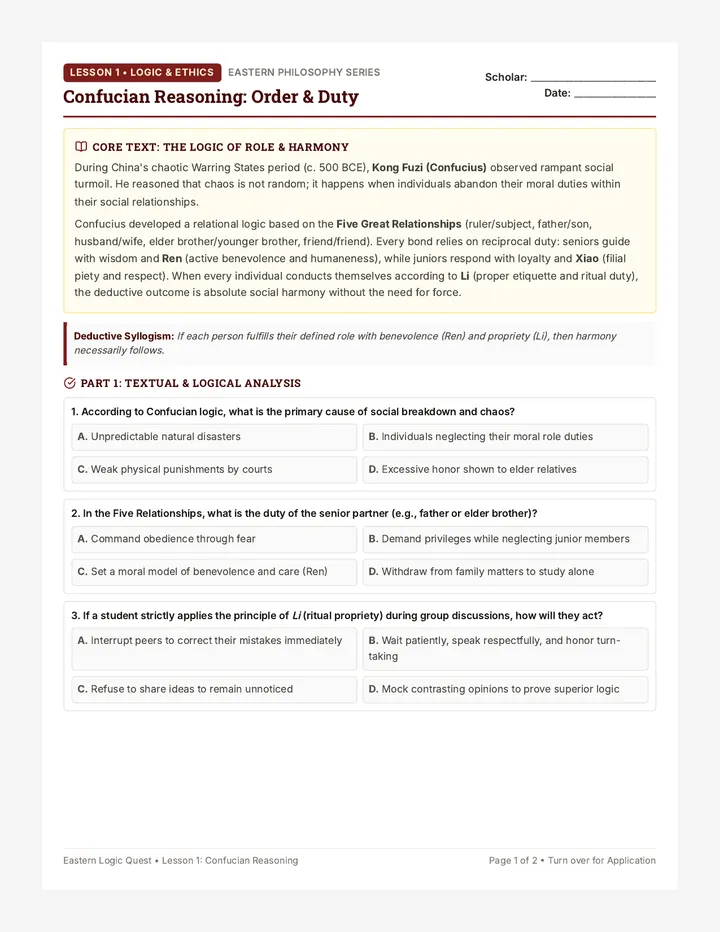
1 Part 1: Scenario Arena (Identify the Form of Government)
Read each scenario and write the correct ancient form of government in the blank box (Monarchy, Oligarchy, Tyranny, Democracy, or Republic).
Scenario A: In the city-state of Corinth, a tiny group of five ultra-wealthy, elite merchant families write all the laws and control the army. Regular citizens have no say.
Scenario B: A popular and wealthy military leader named Peisistratos seizes total power of Athens by force. He cancels citizen debts and builds new temples to keep the crowd happy.
Scenario C: Rome is run by a Senate of lawmakers. Regular Roman citizens do not vote on laws directly, but they elect representatives to make decisions for them.
2 Part 2: Citizen Voice Comparison
Explain one major difference in how a citizen participates in a Direct Democracy (like Athens) versus a Representative Republic (like Rome).
3 Part 3: The Shield of Stability
In your opinion, which of the five ancient forms of government was the most stable over a long period? Support your choice with one clear reason.
Throne Wars Assessment Suite — Grade 6 Civics
Total Score / 30 pts
Throne Wars Answer Key Teacher Resource Suite
THRONE WARS ANSWER KEY & RUBRIC
Standard 6.C4.1
Grading & Exemplars
1 Part 1: Scenario Arena Solutions (4 Points Each — 12 Points Total)
Scenario A (Corinth Wealthy Elites): OLIGARCHY
Grading Note: Award full credit for Oligarchy. Do not accept Monarchy or Tyranny.
Scenario B (Peisistratos Seizure): TYRANNY
Grading Note: Award full credit for Tyranny (accept Tyrant). Do not accept Monarchy as power was taken by force, not inherited.
Scenario C (Roman Senate / Reps): REPUBLIC
Grading Note: Award full credit for Republic or Representative Democracy. Do not accept Direct Democracy.
2 Part 2: Citizen Voice Exemplars (10 Points Total)
Exemplar Response:
"In a direct democracy like Athens, every citizen votes directly on every single law themselves on a hill. In a representative republic like Rome, citizens do not vote on every law; instead, they vote to elect leaders (representatives) who write and vote on the laws for them."
10 Points (Excellent): Clearly explains direct voting vs electing representatives.
5-7 Points (Partial): Mentions voting but fails to contrast direct vs representative action.
3 Part 3: Shield of Stability Rubric (8 Points Total)
Acceptable Arguments (Student may choose any form if supported):
• Monarchy: Stable because power transitions are clear (eldest child) with no chaotic elections.
• Republic: Stable because power is divided among many elected leaders and can survive in huge territories.
• Oligarchy: Stable because the super-rich keep control of resources and make highly aligned rules.
Scoring: 4 points for declaring a specific form; 4 points for a logical, historically grounded reason.
Class Performance Quick Tracker
24 - 30 Points Mastery Achieved (Exceeds)
18 - 23 Points Developing (Approaching)
Below 18 Points Intervention Needed
Throne Wars Grading Companion — Arizona Civics Standard 6.C4.1 Page 1 (Complete)
Sapiens Sparks Slides HUMAN ORIGINS UNIT
LESSON 1 OF 3
Cognitive Revolution
SAPIENS SPARKS
What sparked the ultimate evolution from simple foragers to rulers of the planet?
Early Human Evolution Ignite Your Curiosity 🔥
The Human Recipe
Physical vs. Social
Biological Traits
What physical traits separate us from other primates?
Bipedalism: Walking upright on two legs
Opposable Thumbs: Complex tool manipulation
Massive Brains: High processing capacity
Cognitive Traits
What mental traits make us truly unique?
Symbolic Language: Talking about things we cannot see
Cooperation: Teamwork in huge, non-family groups
Shared Imagination: Creating myths, art, and rules
Sapiens Sparks: Slide 2 The Power of the Mind
The Great Brain Ignition
The Cognitive Revolution
70,000 Years Ago...
Humans experienced a sudden leap in brain capability called the Cognitive Revolution.
Before this, humans made simple stone hand-axes for millions of years without changing. Afterward, humans exploded with art, specialized tools, rituals, and trade networks.
For the first time, early humans could talk about things that weren't physically there—like telling a story, or warning each other: "Watch out, a spirit protects that river!"
Why Storytelling Won
While Neanderthals could communicate simple facts ("Lion near river"), Sapiens could weave complex plans and beliefs ("The lion is our tribe's guardian").
Belief in a shared story allowed thousands of strangers to work together as one.
Sapiens Sparks: Slide 3 Next: The Hunter's Trail
The Nomad's Path
Nomadic Hunter-Gatherers
On the Move
Nomads do not have permanent homes. They move when seasons change, following wild herds and the lifecycles of plants.
🎒 Lightweight belongings only
Daily Foraging
Men typically tracked large animals (elk, mammoths) while women gathered up to 80% of the calorie intake (berries, roots, nuts, eggs).
🍓 Highly diverse, healthy diet
The Forager Band
Lived in close family groups of 20 to 50 people. Highly egalitarian—there were no kings, and wealth was shared because no one could carry extra weight.
🤝 Equal cooperation was vital
Sapiens Sparks: Slide 4 No borders, no crowns!
Hunter Gatherer Survival Guide Nomadic Field Journal
NOMADIC SURVIVAL JOURNAL
Lesson 1: Human Origins
Artifact Ledgers
Nomad Name:
Date & Sun-Phase:
The Sapiens Code: Over 70,000 years ago, a silent ignition occurred in our species. While other humans remained unchanged for millennia, Sapiens developed symbolic language, storytelling, and tools. Because we left no books, we must decode our story through the fragments left behind in the earth.
Part 1: Decoding the Unwritten Past
Examine the archaeological findings below. For each find, write what the artifact tells us about early human cognitive abilities, technology, or community cooperation.
1. Bone Needles
Polished needles made from bird bones with tiny, drilled holes, dated to 40,000 BCE.
Your Hypothesis (Cognitive / Survival Advantage)
2. Sea Shells Inland
Perforated sea shells found in a cave located 300 miles away from the coast.
Your Hypothesis (Cognitive / Survival Advantage)
3. Healed Femur
A human thigh bone showing complete healing from a major fracture years before death.
Your Hypothesis (Cognitive / Survival Advantage)
Unit: Rise of Civilization — Lesson 1 Journal Turn Page Over ➡️
Part 2: The Cave of Shadows (Art Challenge)
Imagine you are an artist in 30,000 BCE. Using charcoal, animal fat, and ochre, you must paint a message on the damp cave wall. In the box below, sketch a hunting scene, a threat your clan faced, or trace a negative hand stencil.
Draw inside this stone canvas. What story does your cave wall tell future generations?
Part 3: Deep Cognitive Reflection
1. Why was the "Cognitive Revolution" (storytelling, beliefs, and symbolic art) a far greater survival weapon than having larger muscles or sharper teeth?
2. Sapiens lived in bands of 20 to 50 people and owned very few personal belongings. Explain how this nomadic lifestyle prevented inequality and forced everyone to work together.
Unit: Rise of Civilization — Lesson 1 Journal Page 2 (Complete)
Green Revolution Slides RISE OF CIVILIZATION
LESSON 2 OF 3
The Neolithic Transition
GREEN REVOLUTION
How the simple act of planting a single seed completely remade the human world.
The Birth of Agriculture Sow the Seeds of Knowledge 🌱
The Great Shift
Foragers vs. Farmers
Paleolithic Foragers
Nomadic: Move constantly to find food.Hunter-Gatherer: Collect wild plants and hunt wild game.Small Bands: 20-50 people, equal roles.
Neolithic Farmers
Sedentary: Stay in permanent mud-brick homes.Agricultural: Cultivate crops and breed livestock.Massive Towns: Hundreds of neighbors, hierarchies.
Green Revolution: Slide 2 The Birth of the Village
Domestication
Taming Wild Nature
What is Domestication?
To domesticate means to train, selectively breed, and adapt wild plants and animals to meet human needs.
Humans select seeds from the biggest ears of wild wheat and breed only the gentlest wild goats. Over generations, the wild traits fade, and these species become entirely dependent on humans to survive.
The Golden Species
🌾
Wheat, Barley, Rice, Maize
🐐
Goats, Sheep (Meat, Wool, Milk)
🐕
Dogs (Guard, Herd, Partner)
Green Revolution: Slide 3 Next: The Food Surplus
The Surplus Engine
Specialization of Labor
1. Food Surplus
In a farming village, a single farmer can grow much more food than their own family needs. This extra food is a Food Surplus, stored in communal granaries.
🌾 Result: We finally have a safety net for winter!
2. Specialization of Labor
Because we have surplus food, not everyone needs to farm! Some villagers can stop farming and devote 100% of their time to other vital skills.
🛠️ New Careers: Potters, Builders, Priests, Soldiers.
Green Revolution: Slide 4 Who makes the rules now?
The Social Pyramid
The Rise of Hierarchy
Inequality is Born
In hunter-gatherer bands, everyone was equal because no one could carry extra wealth.
But in farming towns, people can own land, brick houses, and grain piles. This leads to the Social Pyramid:
Farming Footprint Map Civilization Footprint Series — Page 1
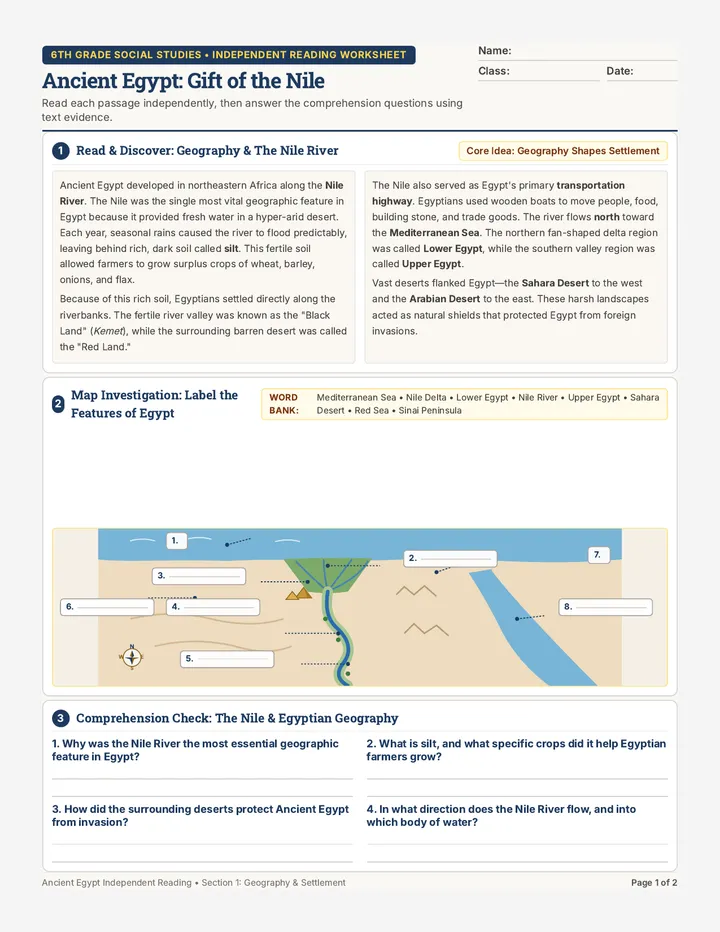
MAPPING THE FERTILE CRESCENT
Standard 6.G1.1 & 6.G3.1
Cradles of Civilization
Explorer Name:
Class Period:
Figure 1.1: The Fertile Crescent and early migration corridors (Nile, Tigris, & Euphrates Valleys).
MEDITERRANEAN SEA RED SEA PERSIAN GULF FERTILE CRESCENT Nile River Euphrates River Tigris River Jericho (9000 BCE) Çatalhöyük (7500 BCE) Ur (3800 BCE)
Environmental Opportunities
The Fertile Crescent offered a rich biological cocktail. Melting glaciers from the Taurus Mountains swollen the Tigris and Euphrates rivers, depositing thick, nutrient-rich silt across the valleys, making the soil incredibly soft and easy to farm.
Environmental Challenges
But stability was fragile. River flooding was violent and unpredictable. Scorching summer heat frequently dried up crops, and the absence of natural barriers like forests or mountains left early towns highly vulnerable to nomadic raids.
Part 1: Map Analysis & Environmental Strategy (10 Points)
Looking at Figure 1.1, explain how the physical geography of the river valleys acted as both a "magnet" for early human settlement and a major challenge that required collective engineering.
Unit: Rise of Civilization — Lesson 2 Workbook Turn Page Over ➡️
Civilization Footprint Series — Page 2
CLIMATE, CULTURE, & CROSSINGS
Standard 6.G3.2 & 6.H1.2
Factors of Migration
Environmental & Cultural Forces of Migration
🌤️ Environmental Pulls & Pushes
Around 10,000 BCE, the last Ice Age ended. Earth warmed, glaciers melted, and rainfall patterns shifted. Large game animals (mammoths) went extinct, pushing foragers to look for other foods. Meanwhile, the warming weather sparked the wild growth of wild grains, pulling humans to stay longer in lush valleys.
🗣️ Cultural Storytelling & Trade
Migration was not just about stomping toward food. Human culture and social connections bound us. Shared tribal stories allowed separate bands to meet peacefully at trade points, exchanging valuable volcanic obsidian, ocean shells, and technical advice on crop planting across vast distances.
Part 2: Analyzing Migration Factors (20 Points)
1. Push & Pull Factors: Describe one environmental "push" factor that forced Paleolithic humans to leave their traditional hunting territories, and one environmental "pull" factor that attracted them to settle in permanent river valleys.
2. Cultural Connections: Archaeologists have found sea shell ornaments hundreds of miles inland in early farming villages. How does this prove that ancient human movement was driven by cultural relationships and trading networks, rather than just wandering aimlessly?
Vocabulary Vault Word Search Vocabulary Mastery Suite
CIVILIZATION VOCABULARY VAULT
Can you locate the 14 core terms hidden in the ancient grid?
Student Name:
Date & Period:
<table class="border-collapse text-center"><tbody><tr class="h-6"><td class="w-6 text-[11px] font-bold text-slate-700 tracking-wider">A</td><td class="w-6 text-[11px] font-bold text-slate-700 tracking-wider">G</td><td class="w-6 text-[11px] font-bold text-slate-700 tracking-wider">R</td><td class="w-6 text-[11px] font-bold text-slate-700 tracking-wider">I</td><td class="w-6 text-[11px] font-bold text-slate-700 tracking-wider">C</td><td class="w-6 text-[11px] font-bold text-slate-700 tracking-wider">U</td><td class="w-6 text-[11px] font-bold text-slate-700 tracking-wider">L</td><td class="w-6 text-[11px] font-bold text-slate-700 tracking-wider">T</td><td class="w-6 text-[11px] font-bold text-slate-700 tracking-wider">U</td><td class="w-6 text-[11px] font-bold text-slate-700 tracking-wider">R</td><td class="w-6 text-[11px] font-bold text-slate-700 tracking-wider">E</td><td class="w-6 text-[11px] font-bold text-amber-800 tracking-wider">P</td><td class="w-6 text-[11px] font-bold text-slate-700 tracking-wider">F</td><td class="w-6 text-[11px] font-bold text-slate-700 tracking-wider">X</td><td class="w-6 text-[11px] font-bold text-[#8C6D31] tracking-wider">H</td><td class="w-6 text-[11px] font-bold text-slate-700 tracking-wider">S</td></tr><tr class="h-6"><td class="w-6 text-[11px] font-bold text-slate-700 tracking-wider">R</td><td class="w-6 text-[11px] font-bold text-slate-700 tracking-wider">E</td><td class="w-6 text-[11px] font-bold text-slate-700 tracking-wider">V</td><td class="w-6 text-[11px] font-bold text-slate-700 tracking-wider">O</td><td class="w-6 text-[11px] font-bold text-slate-700 tracking-wider">L</td><td class="w-6 text-[11px] font-bold text-slate-700 tracking-wider">U</td><td class="w-6 text-[11px] font-bold text-slate-700 tracking-wider">T</td><td class="w-6 text-[11px] font-bold text-slate-700 tracking-wider">I</td><td class="w-6 text-[11px] font-bold text-slate-700 tracking-wider">O</td><td class="w-6 text-[11px] font-bold text-slate-700 tracking-wider">N</td><td class="w-6 text-[11px] font-bold text-slate-700 tracking-wider">B</td><td class="w-6 text-[11px] font-bold text-[#8C6D31] tracking-wider">F</td><td class="w-6 text-[11px] font-bold text-slate-700 tracking-wider">P</td><td class="w-6 text-[11px] font-bold text-slate-700 tracking-wider">A</td><td class="w-6 text-[11px] font-bold text-[#8C6D31] tracking-wider">A</td><td class="w-6 text-[11px] font-bold text-[#8C6D31] tracking-wider">G</td></tr><tr class="h-6"><td class="w-6 text-[11px] font-bold text-slate-700 tracking-wider">A</td><td class="w-6 text-[11px] font-bold text-slate-700 tracking-wider">R</td><td class="w-6 text-[11px] font-bold text-slate-700 tracking-wider">C</td><td class="w-6 text-[11px] font-bold text-slate-700 tracking-wider">H</td><td class="w-6 text-[11px] font-bold text-slate-700 tracking-wider">I</td><td class="w-6 text-[11px] font-bold text-slate-700 tracking-wider">T</td><td class="w-6 text-[11px] font-bold text-slate-700 tracking-wider">E</td><td class="w-6 text-[11px] font-bold text-slate-700 tracking-wider">C</td><td class="w-6 text-[11px] font-bold text-slate-700 tracking-wider">T</td><td class="w-6 text-[11px] font-bold text-slate-700 tracking-wider">U</td><td class="w-6 text-[11px] font-bold text-slate-700 tracking-wider">R</td><td class="w-6 text-[11px] font-bold text-[#8C6D31] tracking-wider">E</td><td class="w-6 text-[11px] font-bold text-slate-700 tracking-wider">K</td><td class="w-6 text-[11px] font-bold text-slate-700 tracking-wider">R</td><td class="w-6 text-[11px] font-bold text-[#8C6D31] tracking-wider">R</td><td class="w-6 text-[11px] font-bold text-[#8C6D31] tracking-wider">E</td></tr><tr class="h-6"><td class="w-6 text-[11px] font-bold text-slate-700 tracking-wider">P</td><td class="w-6 text-[11px] font-bold text-slate-700 tracking-wider">O</td><td class="w-6 text-[11px] font-bold text-slate-700 tracking-wider">L</td><td class="w-6 text-[11px] font-bold text-slate-700 tracking-wider">I</td><td class="w-6 text-[11px] font-bold text-slate-700 tracking-wider">C</td><td class="w-6 text-[11px] font-bold text-slate-700 tracking-wider">Y</td><td class="w-6 text-[11px] font-bold text-slate-700 tracking-wider">R</td><td class="w-6 text-[11px] font-bold text-slate-700 tracking-wider">U</td><td class="w-6 text-[11px] font-bold text-slate-700 tracking-wider">L</td><td class="w-6 text-[11px] font-bold text-slate-700 tracking-wider">E</td><td class="w-6 text-[11px] font-bold text-slate-700 tracking-wider">S</td><td class="w-6 text-[11px] font-bold text-[#8C6D31] tracking-wider">R</td><td class="w-6 text-[11px] font-bold text-slate-700 tracking-wider">Q</td><td class="w-6 text-[11px] font-bold text-slate-700 tracking-wider">P</td><td class="w-6 text-[11px] font-bold text-[#8C6D31] tracking-wider">B</td><td class="w-6 text-[11px] font-bold text-[#8C6D31] tracking-wider">N</td></tr><tr class="h-6"><td class="w-6 text-[11px] font-bold text-slate-700 tracking-wider">S</td><td class="w-6 text-[11px] font-bold text-slate-700 tracking-wider">C</td><td class="w-6 text-[11px] font-bold text-slate-700 tracking-wider">I</td><td class="w-6 text-[11px] font-bold text-slate-700 tracking-wider">E</td><td class="w-6 text-[11px] font-bold text-slate-700 tracking-wider">N</td><td class="w-6 text-[11px] font-bold text-slate-700 tracking-wider">T</td><td class="w-6 text-[11px] font-bold text-slate-700 tracking-wider">I</td><td class="w-6 text-[11px] font-bold text-slate-700 tracking-wider">F</td><td class="w-6 text-[11px] font-bold text-slate-700 tracking-wider">I</td><td class="w-6 text-[11px] font-bold text-slate-700 tracking-wider">C</td><td class="w-6 text-[11px] font-bold text-slate-700 tracking-wider">A</td><td class="w-6 text-[11px] font-bold text-[#8C6D31] tracking-wider">T</td><td class="w-6 text-[11px] font-bold text-slate-700 tracking-wider">B</td><td class="w-6 text-[11px] font-bold text-slate-700 tracking-wider">C</td><td class="w-6 text-[11px] font-bold text-[#8C6D31] tracking-wider">O</td><td class="w-6 text-[11px] font-bold text-[#8C6D31] tracking-wider">U</td></tr><tr class="h-6"><td class="w-6 text-[11px] font-bold text-slate-700 tracking-wider">M</td><td class="w-6 text-[11px] font-bold text-slate-700 tracking-wider">A</td><td class="w-6 text-[11px] font-bold text-slate-700 tracking-wider">N</td><td class="w-6 text-[11px] font-bold text-slate-700 tracking-wider">Y</td><td class="w-6 text-[11px] font-bold text-slate-700 tracking-wider">P</td><td class="w-6 text-[11px] font-bold text-slate-700 tracking-wider">O</td><td class="w-6 text-[11px] font-bold text-slate-700 tracking-wider">W</td><td class="w-6 text-[11px] font-bold text-slate-700 tracking-wider">E</td><td class="w-6 text-[11px] font-bold text-slate-700 tracking-wider">R</td><td class="w-6 text-[11px] font-bold text-slate-700 tracking-wider">Z</td><td class="w-6 text-[11px] font-bold text-slate-700 tracking-wider">X</td><td class="w-6 text-[11px] font-bold text-[#8C6D31] tracking-wider">I</td><td class="w-6 text-[11px] font-bold text-slate-700 tracking-wider">B</td><td class="w-6 text-[11px] font-bold text-slate-700 tracking-wider">N</td><td class="w-6 text-[11px] font-bold text-[#8C6D31] tracking-wider">R</td><td class="w-6 text-[11px] font-bold text-[#8C6D31] tracking-wider">S</td></tr><tr class="h-6"><td class="w-6 text-[11px] font-bold text-slate-700 tracking-wider">V</td><td class="w-6 text-[11px] font-bold text-slate-700 tracking-wider">E</td><td class="w-6 text-[11px] font-bold text-slate-700 tracking-wider">R</td><td class="w-6 text-[11px] font-bold text-slate-700 tracking-wider">R</td><td class="w-6 text-[11px] font-bold text-slate-700 tracking-wider">A</td><td class="w-6 text-[11px] font-bold text-slate-700 tracking-wider">Z</td><td class="w-6 text-[11px] font-bold text-slate-700 tracking-wider">Z</td><td class="w-6 text-[11px] font-bold text-slate-700 tracking-wider">A</td><td class="w-6 text-[11px] font-bold text-slate-700 tracking-wider">N</td><td class="w-6 text-[11px] font-bold text-slate-700 tracking-wider">O</td><td class="w-6 text-[11px] font-bold text-slate-700 tracking-wider">Y</td><td class="w-6 text-[11px] font-bold text-[#8C6D31] tracking-wider">L</td><td class="w-6 text-[11px] font-bold text-slate-700 tracking-wider">Z</td><td class="w-6 text-[11px] font-bold text-slate-700 tracking-wider">B</td><td class="w-6 text-[11px] font-bold text-slate-700 tracking-wider">C</td><td class="w-6 text-[11px] font-bold text-slate-700 tracking-wider">D</td></tr><tr class="h-6"><td class="w-6 text-[11px] font-bold text-slate-700 tracking-wider">P</td><td class="w-6 text-[11px] font-bold text-slate-700 tracking-wider">O</td><td class="w-6 text-[11px] font-bold text-slate-700 tracking-wider">P</td><td class="w-6 text-[11px] font-bold text-slate-700 tracking-wider">U</td><td class="w-6 text-[11px] font-bold text-slate-700 tracking-wider">L</td><td class="w-6 text-[11px] font-bold text-slate-700 tracking-wider">A</td><td class="w-6 text-[11px] font-bold text-slate-700 tracking-wider">T</td><td class="w-6 text-[11px] font-bold text-slate-700 tracking-wider">I</td><td class="w-6 text-[11px] font-bold text-slate-700 tracking-wider">O</td><td class="w-6 text-[11px] font-bold text-slate-700 tracking-wider">N</td><td class="w-6 text-[11px] font-bold text-slate-700 tracking-wider">S</td><td class="w-6 text-[11px] font-bold text-[#8C6D31] tracking-wider">E</td><td class="w-6 text-[11px] font-bold text-slate-700 tracking-wider">X</td><td class="w-6 text-[11px] font-bold text-slate-700 tracking-wider">K</td><td class="w-6 text-[11px] font-bold text-slate-700 tracking-wider">L</td><td class="w-6 text-[11px] font-bold text-slate-700 tracking-wider">M</td></tr><tr class="h-6"><td class="w-6 text-[11px] font-bold text-slate-700 tracking-wider">R</td><td class="w-6 text-[11px] font-bold text-slate-700 tracking-wider">E</td><td class="w-6 text-[11px] font-bold text-slate-700 tracking-wider">S</td><td class="w-6 text-[11px] font-bold text-slate-700 tracking-wider">O</td><td class="w-6 text-[11px] font-bold text-slate-700 tracking-wider">U</td><td class="w-6 text-[11px] font-bold text-slate-700 tracking-wider">R</td><td class="w-6 text-[11px] font-bold text-slate-700 tracking-wider">C</td><td class="w-6 text-[11px] font-bold text-slate-700 tracking-wider">E</td><td class="w-6 text-[11px] font-bold text-slate-700 tracking-wider">S</td><td class="w-6 text-[11px] font-bold text-slate-700 tracking-wider">W</td><td class="w-6 text-[11px] font-bold text-slate-700 tracking-wider">X</td><td class="w-6 text-[11px] font-bold text-[#8C6D31] tracking-wider">C</td><td class="w-6 text-[11px] font-bold text-slate-700 tracking-wider">Y</td><td class="w-6 text-[11px] font-bold text-slate-700 tracking-wider">Z</td><td class="w-6 text-[11px] font-bold text-slate-700 tracking-wider">A</td><td class="w-6 text-[11px] font-bold text-slate-700 tracking-wider">B</td></tr><tr class="h-6"><td class="w-6 text-[11px] font-bold text-slate-700 tracking-wider">X</td><td class="w-6 text-[11px] font-bold text-slate-700 tracking-wider">Y</td><td class="w-6 text-[11px] font-bold text-slate-700 tracking-wider">Z</td><td class="w-6 text-[11px] font-bold text-slate-700 tracking-wider">A</td><td class="w-6 text-[11px] font-bold text-slate-700 tracking-wider">B</td><td class="w-6 text-[11px] font-bold text-slate-700 tracking-wider">C</td><td class="w-6 text-[11px] font-bold text-slate-700 tracking-wider">D</td><td class="w-6 text-[11px] font-bold text-slate-700 tracking-wider">E</td><td class="w-6 text-[11px] font-bold text-slate-700 tracking-wider">F</td><td class="w-6 text-[11px] font-bold text-slate-700 tracking-wider">G</td><td class="w-6 text-[11px] font-bold text-slate-700 tracking-wider">H</td><td class="w-6 text-[11px] font-bold text-[#8C6D31] tracking-wider">R</td><td class="w-6 text-[11px] font-bold text-slate-700 tracking-wider">I</td><td class="w-6 text-[11px] font-bold text-slate-700 tracking-wider">J</td><td class="w-6 text-[11px] font-bold text-slate-700 tracking-wider">K</td><td class="w-6 text-[11px] font-bold text-slate-700 tracking-wider">L</td></tr><tr class="h-6"><td class="w-6 text-[11px] font-bold text-slate-700 tracking-wider">R</td><td class="w-6 text-[11px] font-bold text-slate-700 tracking-wider">E</td><td class="w-6 text-[11px] font-bold text-slate-700 tracking-wider">D</td><td class="w-6 text-[11px] font-bold text-slate-700 tracking-wider">S</td><td class="w-6 text-[11px] font-bold text-slate-700 tracking-wider">E</td><td class="w-6 text-[11px] font-bold text-slate-700 tracking-wider">A</td><td class="w-6 text-[11px] font-bold text-slate-700 tracking-wider">B</td><td class="w-6 text-[11px] font-bold text-slate-700 tracking-wider">C</td><td class="w-6 text-[11px] font-bold text-slate-700 tracking-wider">D</td><td class="w-6 text-[11px] font-bold text-slate-700 tracking-wider">E</td><td class="w-6 text-[11px] font-bold text-slate-700 tracking-wider">F</td><td class="w-6 text-[11px] font-bold text-[#8C6D31] tracking-wider">E</td><td class="w-6 text-[11px] font-bold text-slate-700 tracking-wider">H</td><td class="w-6 text-[11px] font-bold text-slate-700 tracking-wider">I</td><td class="w-6 text-[11px] font-bold text-slate-700 tracking-wider">J</td><td class="w-6 text-[11px] font-bold text-slate-700 tracking-wider">K</td></tr><tr class="h-6"><td class="w-6 text-[11px] font-bold text-slate-700 tracking-wider">M</td><td class="w-6 text-[11px] font-bold text-slate-700 tracking-wider">I</td><td class="w-6 text-[11px] font-bold text-slate-700 tracking-wider">G</td><td class="w-6 text-[11px] font-bold text-slate-700 tracking-wider">R</td><td class="w-6 text-[11px] font-bold text-slate-700 tracking-wider">A</td><td class="w-6 text-[11px] font-bold text-slate-700 tracking-wider">T</td><td class="w-6 text-[11px] font-bold text-slate-700 tracking-wider">I</td><td class="w-6 text-[11px] font-bold text-slate-700 tracking-wider">O</td><td class="w-6 text-[11px] font-bold text-slate-700 tracking-wider">N</td><td class="w-6 text-[11px] font-bold text-slate-700 tracking-wider">T</td><td class="w-6 text-[11px] font-bold text-slate-700 tracking-wider">A</td><td class="w-6 text-[11px] font-bold text-[#8C6D31] tracking-wider">S</td><td class="w-6 text-[11px] font-bold text-slate-700 tracking-wider">X</td><td class="w-6 text-[11px] font-bold text-slate-700 tracking-wider">Y</td><td class="w-6 text-[11px] font-bold text-slate-700 tracking-wider">Z</td><td class="w-6 text-[11px] font-bold text-slate-700 tracking-wider">A</td></tr><tr class="h-6"><td class="w-6 text-[11px] font-bold text-slate-700 tracking-wider">F</td><td class="w-6 text-[11px] font-bold text-slate-700 tracking-wider">O</td><td class="w-6 text-[11px] font-bold text-slate-700 tracking-wider">S</td><td class="w-6 text-[11px] font-bold text-slate-700 tracking-wider">S</td><td class="w-6 text-[11px] font-bold text-slate-700 tracking-wider">I</td><td class="w-6 text-[11px] font-bold text-slate-700 tracking-wider">L</td><td class="w-6 text-[11px] font-bold text-slate-700 tracking-wider">X</td><td class="w-6 text-[11px] font-bold text-slate-700 tracking-wider">Y</td><td class="w-6 text-[11px] font-bold text-slate-700 tracking-wider">Z</td><td class="w-6 text-[11px] font-bold text-slate-700 tracking-wider">A</td><td class="w-6 text-[11px] font-bold text-slate-700 tracking-wider">B</td><td class="w-6 text-[11px] font-bold text-[#8C6D31] tracking-wider">C</td><td class="w-6 text-[11px] font-bold text-slate-700 tracking-wider">C</td><td class="w-6 text-[11px] font-bold text-slate-700 tracking-wider">D</td><td class="w-6 text-[11px] font-bold text-slate-700 tracking-wider">E</td><td class="w-6 text-[11px] font-bold text-slate-700 tracking-wider">F</td></tr><tr class="h-6"><td class="w-6 text-[11px] font-bold text-slate-700 tracking-wider">S</td><td class="w-6 text-[11px] font-bold text-slate-700 tracking-wider">A</td><td class="w-6 text-[11px] font-bold text-slate-700 tracking-wider">V</td><td class="w-6 text-[11px] font-bold text-slate-700 tracking-wider">A</td><td class="w-6 text-[11px] font-bold text-slate-700 tracking-wider">N</td><td class="w-6 text-[11px] font-bold text-slate-700 tracking-wider">N</td><td class="w-6 text-[11px] font-bold text-slate-700 tracking-wider">A</td><td class="w-6 text-[11px] font-bold text-slate-700 tracking-wider">H</td><td class="w-6 text-[11px] font-bold text-slate-700 tracking-wider">I</td><td class="w-6 text-[11px] font-bold text-slate-700 tracking-wider">J</td><td class="w-6 text-[11px] font-bold text-slate-700 tracking-wider">K</td><td class="w-6 text-[11px] font-bold text-[#8C6D31] tracking-wider">E</td><td class="w-6 text-[11px] font-bold text-slate-700 tracking-wider">M</td><td class="w-6 text-[11px] font-bold text-slate-700 tracking-wider">N</td><td class="w-6 text-[11px] font-bold text-slate-700 tracking-wider">O</td><td class="w-6 text-[11px] font-bold text-slate-700 tracking-wider">P</td></tr><tr class="h-6"><td class="w-6 text-[11px] font-bold text-slate-700 tracking-wider">S</td><td class="w-6 text-[11px] font-bold text-slate-700 tracking-wider">C</td><td class="w-6 text-[11px] font-bold text-slate-700 tracking-wider">A</td><td class="w-6 text-[11px] font-bold text-slate-700 tracking-wider">R</td><td class="w-6 text-[11px] font-bold text-slate-700 tracking-wider">C</td><td class="w-6 text-[11px] font-bold text-slate-700 tracking-wider">I</td><td class="w-6 text-[11px] font-bold text-slate-700 tracking-wider">T</td><td class="w-6 text-[11px] font-bold text-slate-700 tracking-wider">Y</td><td class="w-6 text-[11px] font-bold text-slate-700 tracking-wider">A</td><td class="w-6 text-[11px] font-bold text-slate-700 tracking-wider">B</td><td class="w-6 text-[11px] font-bold text-slate-700 tracking-wider">C</td><td class="w-6 text-[11px] font-bold text-[#8C6D31] tracking-wider">N</td><td class="w-6 text-[11px] font-bold text-slate-700 tracking-wider">E</td><td class="w-6 text-[11px] font-bold text-slate-700 tracking-wider">F</td><td class="w-6 text-[11px] font-bold text-slate-700 tracking-wider">G</td><td class="w-6 text-[11px] font-bold text-slate-700 tracking-wider">H</td></tr><tr class="h-6"><td class="w-6 text-[11px] font-bold text-slate-700 tracking-wider">R</td><td class="w-6 text-[11px] font-bold text-slate-700 tracking-wider">E</td><td class="w-6 text-[11px] font-bold text-slate-700 tracking-wider">G</td><td class="w-6 text-[11px] font-bold text-slate-700 tracking-wider">I</td><td class="w-6 text-[11px] font-bold text-slate-700 tracking-wider">O</td><td class="w-6 text-[11px] font-bold text-slate-700 tracking-wider">N</td><td class="w-6 text-[11px] font-bold text-slate-700 tracking-wider">A</td><td class="w-6 text-[11px] font-bold text-slate-700 tracking-wider">B</td><td class="w-6 text-[11px] font-bold text-slate-700 tracking-wider">C</td><td class="w-6 text-[11px] font-bold text-slate-700 tracking-wider">D</td><td class="w-6 text-[11px] font-bold text-slate-700 tracking-wider">E</td><td class="w-6 text-[11px] font-bold text-[#8C6D31] tracking-wider">T</td><td class="w-6 text-[11px] font-bold text-slate-700 tracking-wider">G</td><td class="w-6 text-[11px] font-bold text-slate-700 tracking-wider">H</td><td class="w-6 text-[11px] font-bold text-slate-700 tracking-wider">I</td><td class="w-6 text-[11px] font-bold text-slate-700 tracking-wider">J</td></tr></tbody></table>
Vocabulary Vault Worksheet Vocabulary Mastery Suite — Page 1
CIVILIZATION VOCABULARY LEDGER
Terms 1 to 7
Foundational concepts
Student Name:
Date & Period:
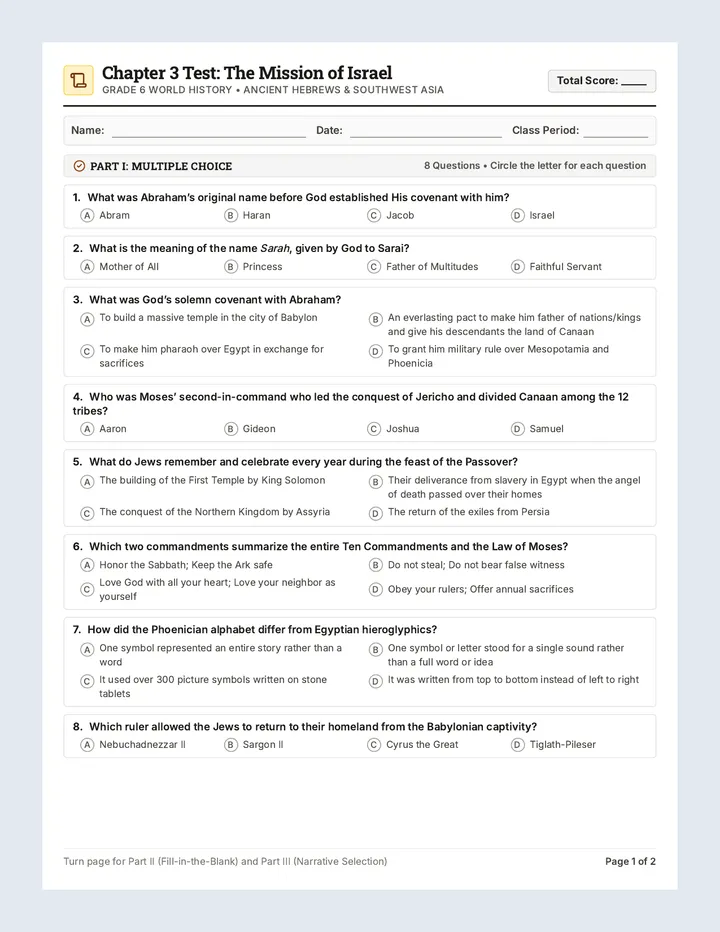
A Part A: Term matching (Match letter to definition)
Write the letter of the correct matching definition in the blank box next to each term.
1. Agriculture
2. Agricultural Revolution
3. Architecture
4. Fertile Crescent
5. Fossil
6. Genus
7. Giovanni da Verrazzano
A. An Italian explorer commissioned by France who mapped the Atlantic coast of North America in 1524.
B. The art or practice of designing and constructing buildings and large monuments.
C. The scientific practice of farming, cultivating soil for crops, and domesticating livestock.
D. A biological classification grouping closely related species (e.g., Homo).
E. The prehistoric transition of human groups from nomadic foraging to settled farming.
F. The crescent-shaped, fertile river valley region of early farming in the ancient Middle East.
G. Preserved remains, impressions, or traces of an ancient organism embedded and turned to stone.
B Part B: Context Case Studies
Select the most appropriate term from Terms 1–7 above to complete each archaeological/historical report scenario below.
Case Study 1: An archaeologist in Turkey unearths a 30,000-year-old skull. Through careful scientific examination, they classify it as belonging to the Homo group, which represents the biological
of early humans.
Case Study 2: In 1524, sailing on the ship Dauphine, navigator
became the first European to enter New York Bay, mapping the harbors for the French Crown.
Case Study 3: Once hunter-gatherers mastered
, they could grow barley surpluses in the Tigris Valley. This trigger is known historically as the
.
Vocabulary Vault Worksheet — Page 1 Turn Page Over ➡️
Vocabulary Mastery Suite — Page 2
VOCABULARY SENTENCE BUILDERS
Terms 8 to 14
Synthesis & Application
C Part C: Definition & Application Sentences
For each term, write a clear definition in your own words, then compose an original, historically accurate sentence using the term.